In my last post, I asked what constitutes justice when a denomination and departing congregations find themselves fighting over church property. Who defines justice? And does protecting an institution’s interests necessarily mean justice has been served?
But the question doesn’t end at the church’s property line. It follows people through the sanctuary doors. What constitutes justice when a retired pastor’s choice of where to worship becomes a question of denominational loyalty?
I raise the question because the present situation in South Carolina called back to mind an action taken by my former annual conference, the Louisiana Conference of The United Methodist Church, three years ago.
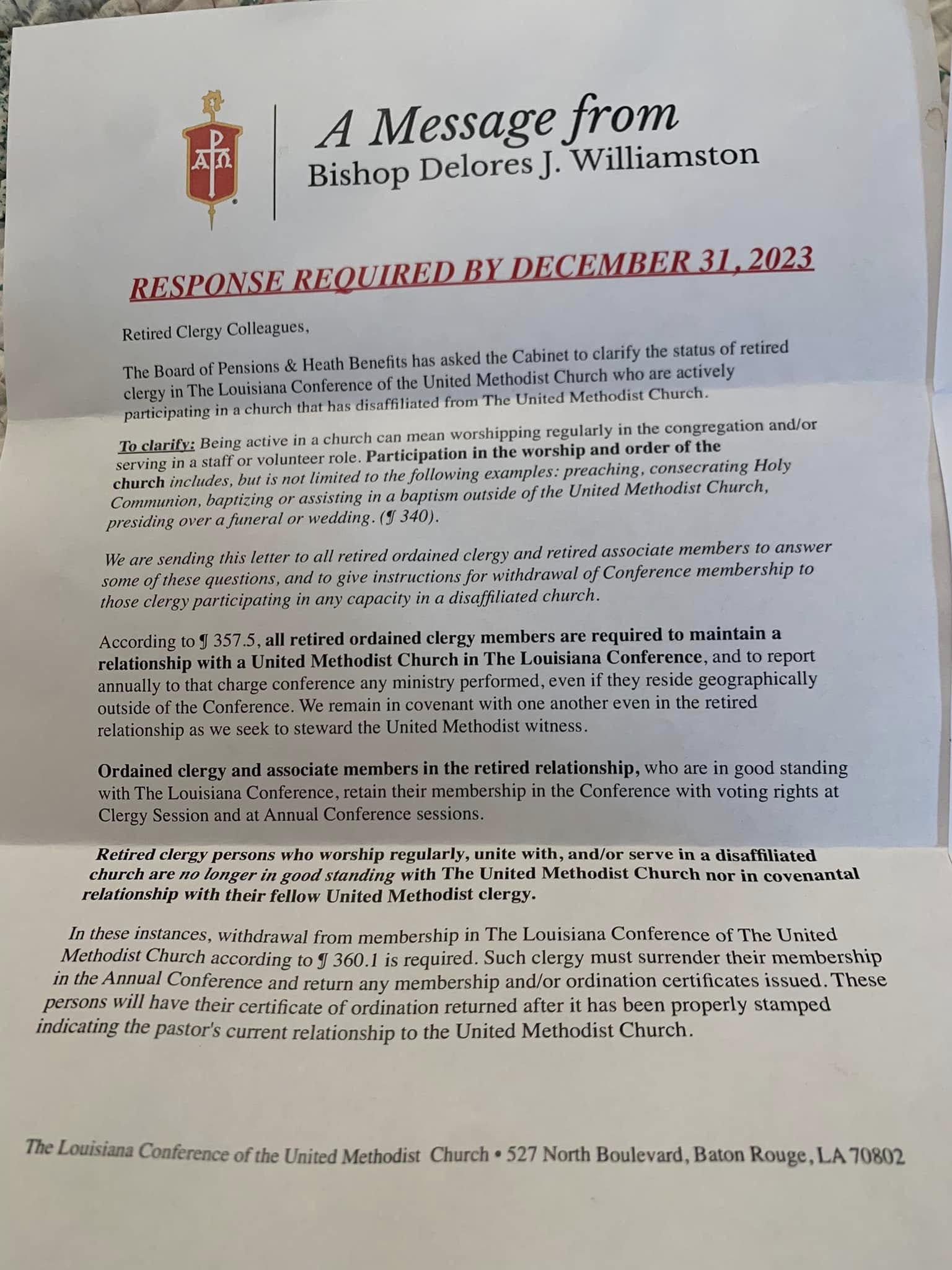
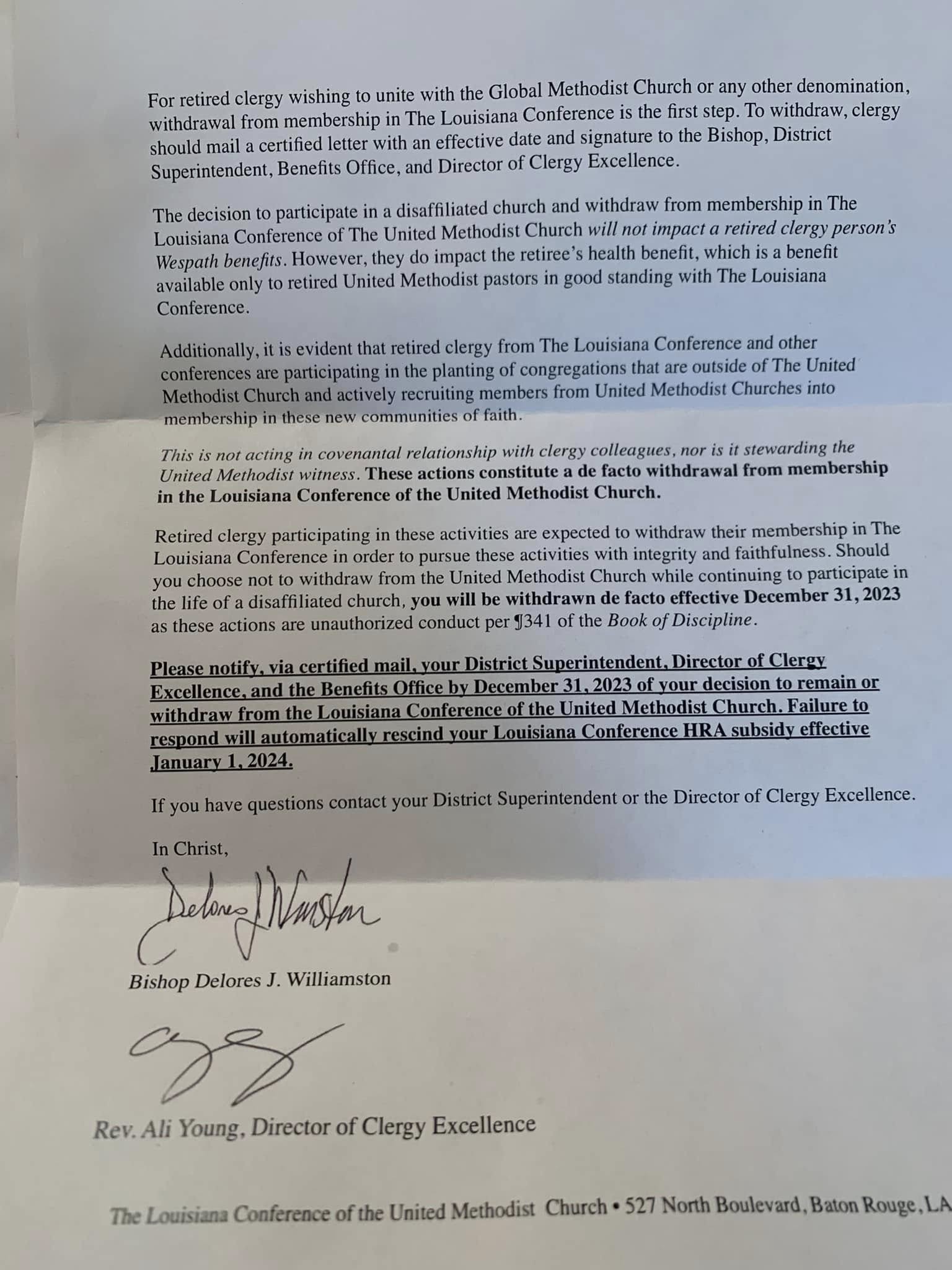
I hear you saying, “Malone, you’re a little late to the party.” I know, but I still wrestle with whether the position outlined in Bishop Delores J. Williamston’s letter to retired clergy was just. The letter addresses their participation in congregations that disaffiliated from the denomination.
I’m including both pages here because the wording matters. Readers deserve to see the bishop’s explanation, including the concerns about clergy covenant and accountability, before considering my questions.
When worship becomes the issue
One sentence in the letter deserves particular attention:
“Being active in a church can mean worshipping regularly in the congregation and/or serving in a staff or volunteer role.”
The letter goes on to identify preaching, presiding at sacraments, and officiating at weddings and funerals as examples of participation. It states that retired clergy who worship regularly, unite with, or serve in a disaffiliated congregation are no longer in good standing or in covenantal relationship with their fellow United Methodist clergy. Withdrawal from conference membership is required.
That is a broad boundary. It encompasses the pastor standing behind the pulpit. It also encompasses the retired pastor sitting in the pew. Should those activities be treated the same way?
There is another question of consistency. If a retired United Methodist pastor may lead a funeral in a Presbyterian, Episcopal, or Baptist church, why should leading one in a disaffiliated congregation carry different consequences? In each instance, the pastor is ministering outside the denomination. What makes one acceptable and the other a violation of covenant?
Is the distinction theological? Does the restriction imply that a disaffiliated congregation is no longer a Christian church, or that it has become apostate? The letter does not make that argument. If the distinction rests instead on the congregation’s decision to leave, then why should that history determine whether a retired pastor may minister to grieving people there?
I recognize that holding a funeral in another church’s building is not necessarily the same as joining its denomination or accepting an ongoing pastoral role. That is precisely why these distinctions matter. Occasional pastoral care, regular worship attendance, and formal ministerial affiliation deserve to be considered on their own terms.
If the concern is ministry outside United Methodism, why single out disaffiliated congregations? If the concern is specifically their departure, what makes this restriction a just response? A different history may explain the different treatment. It does not, by itself, establish that the treatment is just.
Covenant deserves a serious conversation
I spent more than twenty-eight years as a United Methodist pastor. I understand that clergy covenant involves responsibilities. Retirement does not erase those commitments.
The letter explains the continuing relationship retired clergy are expected to maintain with a United Methodist congregation and the reporting required of them. I received many of those reports in my time as a District Superintendent. I know it matters.
The letter also raises concerns about retired clergy planting congregations outside the denomination and recruiting members from United Methodist churches. Yup! I agree that doing so while retaining United Methodist credentials raises legitimate questions about covenant. But putting those activities in the same category as occasionally helping with a funeral, assisting in a baptism, or participating in a worship service seems, well, a bit unjust.
A denomination has a legitimate interest in how people holding its credentials represent it and exercise ministry. Clergy colleagues have legitimate reasons to expect honesty and care in their relationships with one another. But acknowledging those responsibilities does not settle every question about how they should be enforced.
Regularly attending worship, joining another denomination, and recruiting people away from a congregation are different actions. What justifies placing them within the same boundary? What harm does each cause? And should each carry the same consequence? Those are questions about justice.
A policy can be clear and still deserve examination. An institution can have authority and still need to explain why a particular exercise of that authority is proportionate and faithful to its mission.
There are people behind the policy
I know former colleagues who have responded in different ways. Some willingly surrendered their credentials so they could participate with integrity in the congregations where they wanted to worship and serve. Others continued openly, essentially daring the conference to take their credentials. Still others continued quietly, careful about drawing attention to where they worshiped or how they participated.
I will not identify them or describe circumstances that might identify them. Their lives are not illustrations for me to use without regard for the consequences. Nor do I assume that every response resolves the question of covenant equally well. But these different responses reveal the strain this boundary places on people.
Surrendering credentials after a lifetime of ministry is no small thing. Neither is feeling that worshiping with a Christian congregation must be done discreetly.
What kind of pastoral conversation might help people navigate those choices? Is there room to listen to the relationships, convictions, and spiritual needs involved before concluding that participation constitutes a broken covenant?
The consequences matter
The letter also addresses benefits. It explicitly states that withdrawal will not affect a retired clergy person’s Wespath benefits. It distinguishes those benefits from the conference’s retiree health benefit, which it describes as available only to retired United Methodist pastors in good standing with the Louisiana Conference.
That distinction matters. The letter isn’t a threat to take away a pastor’s pension. Still, attaching consequences for retiree health benefits to a determination of good standing makes the definition of good standing especially consequential. I am addressing the letter and the reasoning it presents, rather than making a claim about how every case was handled or what policy is in effect today.
Perhaps the policy has changed. Perhaps it was never enforced. Those possibilities would matter in assessing its present impact, but they would not erase the questions raised by the letter itself. What does it mean for the church to tell retired pastors that where they worship could affect their standing—and, with it, their eligibility for a retiree health benefit?
Is regular worship attendance sufficient grounds for consequences of this magnitude? What pastoral purpose does that serve? And could a more carefully drawn boundary protect legitimate denominational interests while respecting a retired pastor’s conscience?
Justice must reach beyond our own interests
These questions should not depend on which denomination’s name appears over the church house door. If my own denomination established a comparable boundary, it would deserve the same scrutiny. Otherwise, “justice” becomes a word we use when we dislike someone else’s decisions and put away when the decisions benefit us.
I am not asking the church to abandon accountability. I am asking what faithful accountability should look like when conscience, Christian fellowship, and institutional commitments come into tension.
We should be able to distinguish worship attendance from the exercise of denominational authority. We should be able to address concerns about recruitment without assuming that every act of participation poses the same problem. And we should be able to ask whether a consequence is proportionate without being accused of dismissing covenant altogether.
In the previous post, the question concerned property. Here, it concerns people—their worship, their relationships, their years of service, and their consciences. The institution’s interests deserve consideration. So do those of the retired clergy.
Just because we can justify something doesn’t make it just. Justice by whose definition? Surely our answer must make room for the person sitting in the pew.
Until next time, keep looking up…
If any of my reflections encouraged or challenged you, follow Not the Perfect Pastor on Facebook for more conversations about faith, ministry, and becoming faithful disciples of Jesus.
Discover more from Not the Perfect Pastor
Subscribe to get the latest posts sent to your email.

