When All You’ve Got is “Oh, God…”

Romans 8:18–28

There are seasons in life when the words just don’t come.

You’ve prayed.
You’ve asked.
You’ve tried to hold it together.

And nothing has changed.

If you’re honest, you’re not even sure what to pray anymore. All you’ve got left is, “Oh, God…”

According to the Apostle Paul—that’s enough. 


When Life Feels Heavy

Romans 8 is one of the most comforting and practical passages in all of Scripture because it speaks directly to real life—real pressure, real pain, real uncertainty.

Paul doesn’t pretend suffering isn’t real. He just refuses to let suffering have the final word.

Instead, he points us to the work of the Holy Spirit—God’s presence with us in the middle of it all.

And here’s the promise:
The Holy Spirit helps us in our weakness—especially when we don’t know how to pray.


The Spirit Comes Alongside You

One of the names Jesus gave the Holy Spirit is Comforter. The Greek word is parakletos—it means “to come alongside.”

God didn’t leave us alone.

Even now, the Holy Spirit is present with you—walking with you, strengthening you, comforting you.

If you’ve ever felt peace in the middle of chaos…
If you’ve ever looked back and seen God working when you couldn’t see it at the time…

That was Him.


The Spirit Prays With You

Let’s be honest—sometimes prayer feels impossible.

We live in a world of shortcuts and abbreviations. But when life hits hard, even those fall apart. Sometimes all we can say is, “Oh my God…”

There are two kinds of those prayers:

  • The praise-filled kind
  • The desperate kind

And sometimes, all you have is the desperate kind.

“God… do something.”

That’s not a weak prayer. That’s a real one.

Paul says that in those moments, “the Spirit intercedes for us with groanings too deep for words.”

In other words:
God hears what you meant to pray—not just what you managed to say.

The Holy Spirit takes the ache in your heart and brings it before the Father perfectly.


The Spirit Prays For You

It gets even better.

Not only does the Spirit pray with you—He also prays for you.

Romans 8:27 says the Spirit “pleads for us… in harmony with God’s will.”

Think about that.

You may not always know what to pray.
But the Holy Spirit does.

And He is praying for you—right now—perfectly aligned with the will of God.

And He’s not alone.

Jesus Himself is interceding for you.

The entire Trinity is actively involved in your life and your prayers.

That means this:
Your prayers are never unsupported, unheard, or off track when you belong to Christ.


When You Don’t Know What to Pray

So what do you do when you’re stuck?

When you don’t have clarity…
When you don’t have strength…
When all you’ve got is “Oh, God…”

Start here:

“Your will be done.”
“Your good be done.”

Those two prayers will never miss.

Jesus gave us the first one in the Lord’s Prayer.
Paul anchors the second one in Romans 8:28.

And don’t misunderstand that verse.

It doesn’t say everything is good.
It says God is working in everything for good.

He is not wasting your pain.
He is not ignoring your struggle.
He is weaving it all together for His glory and your ultimate good.


A Simple Way to Respond

Let me make this practical.

Here’s the question we’re wrestling with right now:

What is one thing Jesus is asking you to obey that you’ve been avoiding?

You probably already know the answer.

The reason you’ve been avoiding it?
You don’t feel ready. Strong enough. Clear enough.

That’s exactly where the Holy Spirit meets you.

So here’s a simple prayer rhythm to walk this out:

A.L.A.S.

  • Ask
  • Listen (sit quietly before God)
  • Act (take one step of obedience)
  • Share (tell 1–3 people)

That’s it.

No complicated system. No new program.

Just a simple, daily dependence on the Holy Spirit.


When All You’ve Got is “Oh, God…”

That’s still enough.

Because you’re not praying alone.

The Spirit is with you.
The Spirit is praying with you.
The Spirit is praying for you.

And God hears you—fully, clearly, and perfectly.


A Prayer

Come, Holy Spirit…
For those who are weak—be strength.
For those who are weary—be comfort.
For those who have no words left—pray for them.

Amen.

If you found these words encouraging or helpful, would you mind giving it a like, or consider sharing it with someone who needs to hear it today?

Until next time, keep looking up…

Because of the resurrection, our hope is secure—and that hope reshapes how we live today. Peter shows us what it means to live expectantly, patiently, and righteously as we move from Easter to glory.

From Easter to Glory

1 Peter 1:3–9

God Is Good… Even When Life Isn’t

God is good.

We say it easily. We say it often. And it’s true.

But what happens to that belief when life isn’t?

Because God’s goodness doesn’t always show up the way we expect it to.

And that’s exactly where Peter writes—from the middle of real pressure, real hardship, real trials—reminding believers that God is still good… even there.

Peter is writing to believers scattered across Asia Minor. And he’s writing from Rome—the very center of the empire that is beginning to press in on them.

These Christians aren’t being applauded for their faith.

They’re being questioned. Misunderstood. Talked about.

The pressure is building.

Christianity hasn’t been outlawed yet, but you can feel it coming. The tone is shifting. The hostility is rising. And Peter has a word for them as they stare down what he calls “fiery trials.”

So what do you do when following Jesus starts to cost you something?

Peter doesn’t start with strategy.

He doesn’t start with survival tips.

He starts with Easter.

Because Easter changed everything.

God is good—not because life is easy, but because the tomb is empty.

Hope Anchored in the Resurrection

Peter grounds everything in the resurrection.

Because of Easter, we have been born again—not improved, not adjusted, but made new.

Because of Easter, we have an inheritance that cannot be taken, cannot be touched, and cannot fade.

And as we walk this road—uncertain and sometimes difficult—we are not alone.

God Himself is guarding us through faith.

Then Peter lifts our eyes even higher—from an empty tomb all the way to future glory.

From resurrection… to the day we stand before Christ and hear, “Well done.”

That’s the Gospel.

From Easter to glory.

And because of that, hope is no longer wishful thinking.

It’s how we live.

Living Expectantly

If we really believe that, then we don’t just get through life—we live expectantly.

We’re not just surviving.

We’re looking forward to something.

Our future shapes our present—whatever that present looks like.

It shapes how we respond to the good days.

It shapes how we respond to the hard days.

We don’t just believe in a better day.

We live like it’s coming.

There’s an old story about a woman who was terminally ill. As she planned her funeral, she told her pastor she wanted to be buried with a fork in her hand.

The pastor was puzzled.

She explained that at church potlucks and family dinners, when the main course was finished, someone would always say, “Keep your fork.”

And she knew what that meant.

Something better was coming.

Dessert was on the way.

So she said, “When people see me in that casket holding a fork, I want them to wonder why—and I want you to tell them… keep your fork. The best is yet to come.”

Don’t put your fork down yet.

Because what you’re experiencing right now—no matter how good or how hard—is not the end of the story.

There is more coming.

We don’t just endure life—we live expectantly.

Living Patiently

If we live with that kind of hope, we also learn to live patiently.

We don’t live in a patient world.

We want everything now.

Quick answers. Quick change. Quick results.

An easy life produces a soft faith.

God is not just getting you through the fire—He is working in you through the fire.

Not every fire in life is sent by God.

But God will use every fire.

So here’s the question:

What is one thing Jesus is asking you to obey right now that you’ve been avoiding?

We don’t just endure life—we live patiently.

Living Righteously

We don’t live righteously to become something.

We live righteously because, in Christ, we already are something.

We live righteously because, in Christ, we already are something.

We already have His approval. So we live like it.

Growth doesn’t happen in a moment.

It happens over time as we surrender more and more of our lives to Jesus Christ.

The Work of Grace

God’s grace calls us (prevenient grace).

God’s grace forgives us (justifying grace).

God’s grace changes us (sanctifying grace).

God’s grace will complete the work (glorifying grace).

From Easter to Glory

If we believe it… we live like it.

We live expectantly.

We live patiently.

We live righteously.

And one day, we will stand before the King of glory.

“Well done.”

Reflection

What is one thing Jesus is asking you to obey right now that you’ve been avoiding?

Until next time, keep looking up…

The Day the Earth Shifted…

Did you feel it?

Not long ago, here in Minden, the ground moved. For a moment, what felt stable… wasn’t. And there’s something deeply unsettling about that—when what you thought you could stand on suddenly shifts beneath your feet.

Matthew tells us that something like that happened at the cross—and again at the resurrection.

When Jesus died, the earth shook. And three days later, it shook again.

Because when God was at work through the death and resurrection of Jesus, He wasn’t just changing a few lives—He was shifting the ground beneath the entire world.

When What We Expect Collapses

Holy Week begins with confidence.

A crowd gathers to welcome Jesus. They celebrate Him. They even try to define Him. They want a king—but a king on their terms. A crown without a cross. Power without sacrifice.

They didn’t reject Jesus. They tried to reshape Him.

And for a moment, everything felt stable—like they understood exactly what God was doing.

But they were standing on shaky ground.

When Everything Falls Apart

By Friday, everything collapses.

The same voices that shouted “Hosanna” now demand a cross. And shortly after 3:00 p.m., as Jesus breathes His last breath, the earth shakes.

In that moment:

  • – The disciples watched their hope collapse
  • – The religious leaders watched their certainty collapse
  • – The Romans soldiers watched their control collapse

Everything they thought was solid… gave way.

But here’s what they didn’t understand:

Good Friday wasn’t the world coming apart.

It was the beginning of God’s great realignment.

When God Finishes What He Started

Early Sunday morning, the earth shakes again. Not as something new—but as the completion of what God had already begun.

What Friday broke… Sunday restored.

  • – On Friday, hope faded — on Sunday, hope rose
  • – On Friday, despair settled — on Sunday, joy broke through
  • – On Friday, death spoke — on Sunday, life spoke louder

The resurrection wasn’t just an event.

It was a shift.

What the Resurrection Changes

When the earth shifted, everything shifted with it:

  • – Death shifted to Life
  • – Despair shifted to Joy
  • – Sin shifted to Forgiveness
  • – Condemnation shifted to Grace
  • – Defeat shifted to Victory

And if that’s true, then we don’t get to live the same way anymore. We don’t live in fear—we live in hope. We don’t chase worldly success—we pursue faithfulness. We don’t grasp for crowns—we take up crosses.

If the resurrection is true, then nothing in our lives can stay where it is.

The Shift We Don’t Want to Make

Here’s where it gets uncomfortable.

One of the biggest shifts needed today isn’t out there—it’s in us… and in the Church.

We’ve started calling sin by another name.

We call it brokenness.

Now, there’s truth there. We are wounded. We are shaped by things beyond our control. But if we’re not careful, that language becomes an escape.

Broken things don’t bear responsibility.

Sin does.

And if we are only broken, then what we need is therapy.

But if we are sinners… then what we need is a Savior.

And that’s exactly why Easter matters.

Jesus didn’t die and rise again just to help us cope.

He didn’t come to make us slightly better.

He came so sinners could be forgiven, restored, and made new.

The Real Question

The earth has shifted.

The tomb is empty.

Jesus is alive.

The question isn’t what happened then.

The question is—what is going to happen in us now?

What needs to shift in your life?

  • – From death to life?
  • – From despair to joy?
  • – From sin to forgiveness?
  • – From control to surrender?

Because if the resurrection is true, something in you cannot stay where it is.

An Invitation

The invitation isn’t to try harder.

It’s not to clean yourself up.

It’s to repent and believe the Good News.

To stop pretending.

To stop resisting.

To come to Jesus.

The same power that shook the earth can change your life.

The same Jesus who walked out of that tomb can bring you out of whatever tomb is holding you.

So get off the shaky ground.

And stand on the solid rock—Jesus Christ.

The earth has already shifted.

The only question left is this:

Will you?

Until next time, keep looking up…

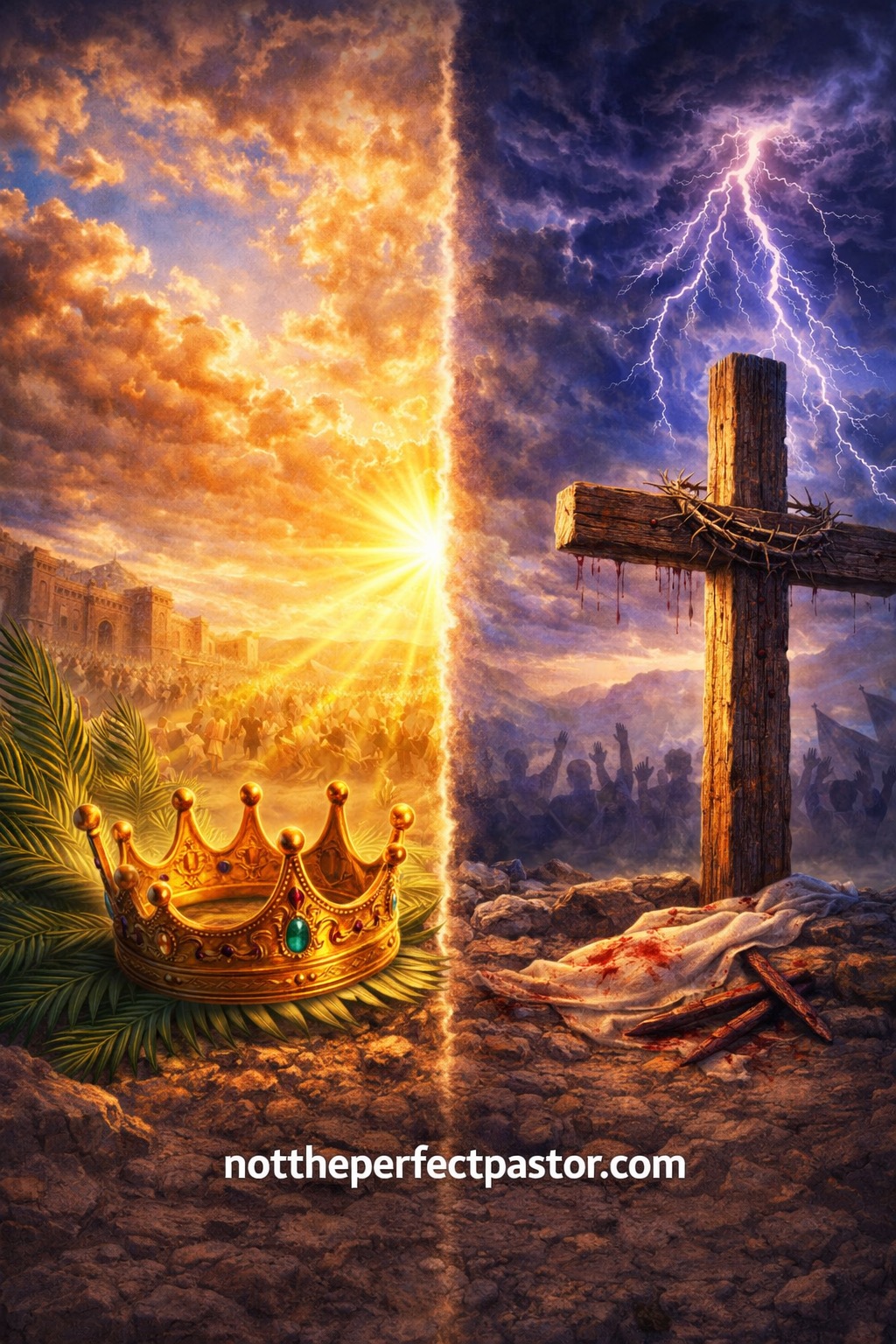
A Crown or a Cross?

What Palm Sunday Teaches Us About Shattered Expectations and True Faith

This Sunday is Palm Sunday—the day we remember the crowds waving palm branches and shouting “Hosanna!” as Jesus rode into Jerusalem. But here’s what haunts me every year: Less than a week later, many of those same voices were shouting “Crucify Him!”

How does a crowd go from crowning a King to demanding His death in just a few days? And what does that say about us when God doesn’t meet our expectations?

On Palm Sunday, we often focus only on the triumphal entry. This year, let’s do something different. We’ll look at Mark’s account of Jesus entering Jerusalem—and then jump straight to the trial before Pilate on Good Friday. In less than a week, the same city saw the crowd shift from “Hosanna!” to “Crucify Him!” They began the week expecting a crown. They ended it demanding a cross.

The Triumphal Entry (Mark 11:1-11)

As Jesus approached Jerusalem, riding on a young colt, the crowd erupted in praise straight from Scripture:

Hosanna! Blessed is he who comes in the name of the Lord! Blessed is the coming kingdom of our father David! Hosanna in the highest!” (Mark 11:9-10, quoting Psalm 118)

They spread their cloaks and leafy branches on the road, anointing Him as King in a festal procession. These weren’t outsiders. They were good, religious people who knew and loved the Word of God.

From “Hosanna” to “Crucify Him” (Mark 15:1-15)

Fast-forward to the trial before Pilate. The chief priests, elders, scribes, and the crowd—still religious people—now cried out, “Crucify Him!” They chose Barabbas, a rebel and murderer, over Jesus.

In just days, their cheers turned to condemnation. Why?

They knew the Scripture… but they did not understand the Word made flesh standing before them. They wanted a crown on their terms—a political deliverer who would overthrow Rome and restore Israel’s glory immediately. When Jesus refused to fit their expectations, their hearts turned.

The heartbreaking truth is that both crowds were driven by the same root issue: Jesus shattered their expectations.

The Same Struggle Today

If we’re honest, the same thing can happen to us. Many of us are “good, religious folks” who love the Bible and love Jesus. We pray for healing, deliverance from addiction, or for our children to come home—expecting the crown of quick answers and comfortable outcomes.

When God says “no,” or “not yet,” or when the cross of suffering comes instead of the comfort we wanted, our hearts can waver just like that first-century crowd.

Yet here is the wonder of the gospel: God’s “no” to our agenda is often His greater “yes” to a better, eternal life—resurrection life. He does not abandon us to our sin or our pain. He uses even the hardest things to redeem us.

The very thing we think will destroy us, the Lord uses to shape us.

Jesus Knows the Pain of “No”

Remember Jesus in the Garden of Gethsemane, praying, “Let this cup pass from me.” Even the Son of God asked for a different way, and heaven was silent. Not because the Father didn’t love Him, but because the cross was the only way to save us.

That temporary “no” from the Father became our eternal “yes.” Because Jesus went to the cross, the crown comes through the cross—one of the beautiful paradoxes of God’s Kingdom.

Our God is a big-picture God. As He declares in Isaiah 46:10, “I make known the end from the beginning, from ancient times what is still to come.” He sees the whole story. We see only the painful circumstances right in front of us. But He is already turning our “no” into resurrection victory.

What This Means on Monday Morning

When the medical scan comes back worse, when the phone call brings bad news, or when the prodigal still hasn’t come home—what then?

We have a daily choice: Will I demand the crown on my terms right now, or will I trust the King who leads through the cross?

Here are four practical steps when your expectations are shattered:

  1. Name the disappointment honestly to God. Jesus did this in Gethsemane—pour out your heart without pretense.
  2. Remember you are not abandoned. The same God who said “no” to His own Son is working something far greater than we can see.
  3. Choose to worship anyway. Sing “Hosanna” even when you don’t feel it. Sunday is coming.
  4. Cling to your baptism. Those waters marked you as belonging to the King whose crown came through the cross.

When you feel your heart beginning to waver like that ancient crowd, run back to the cross and whisper, “Lord, I don’t understand, but I trust You. You are still King of kings.”

We Are Barabbas

Nowhere is this clearer than at the trial before Pilate. The crowd was given a choice: Jesus or Barabbas. Barabbas was exactly what they wanted—a man of action promising quick deliverance. Jesus was what they (and we) needed—the innocent Son of God who would take their place.

They chose Barabbas. And Jesus took Barabbas’s place on the cross.

We are Barabbas. We are the guilty ones who deserve judgment, yet because of Jesus we go free. He took our place so that our temporary “no’s” could become God’s eternal “yes.”

We want a quick, revolutionary fix. Jesus offers sacrificial love. We want a crown on our terms right now. Jesus gives us the cross that leads to the crown of life.

The Crown That Comes Through the Cross

One day, the same Jesus will return riding a white horse. On His robe and on His thigh will be written: “King of kings and Lord of lords” (Revelation 19:16). The crown of thorns becomes the crown of glory. The cross was never the end—it was the path to His eternal reign.

The crowd had a choice: a crown or a cross. Which choice will we make?

Until next time, keep looking up…