Justice by Whose Definition? There’s Only One Winner

The United Methodist Church is the gift that just keeps giving. Especially if you’re a Methodist pastor who writes a blog. I would much prefer the subject were something other than another church dispute, but here we are.
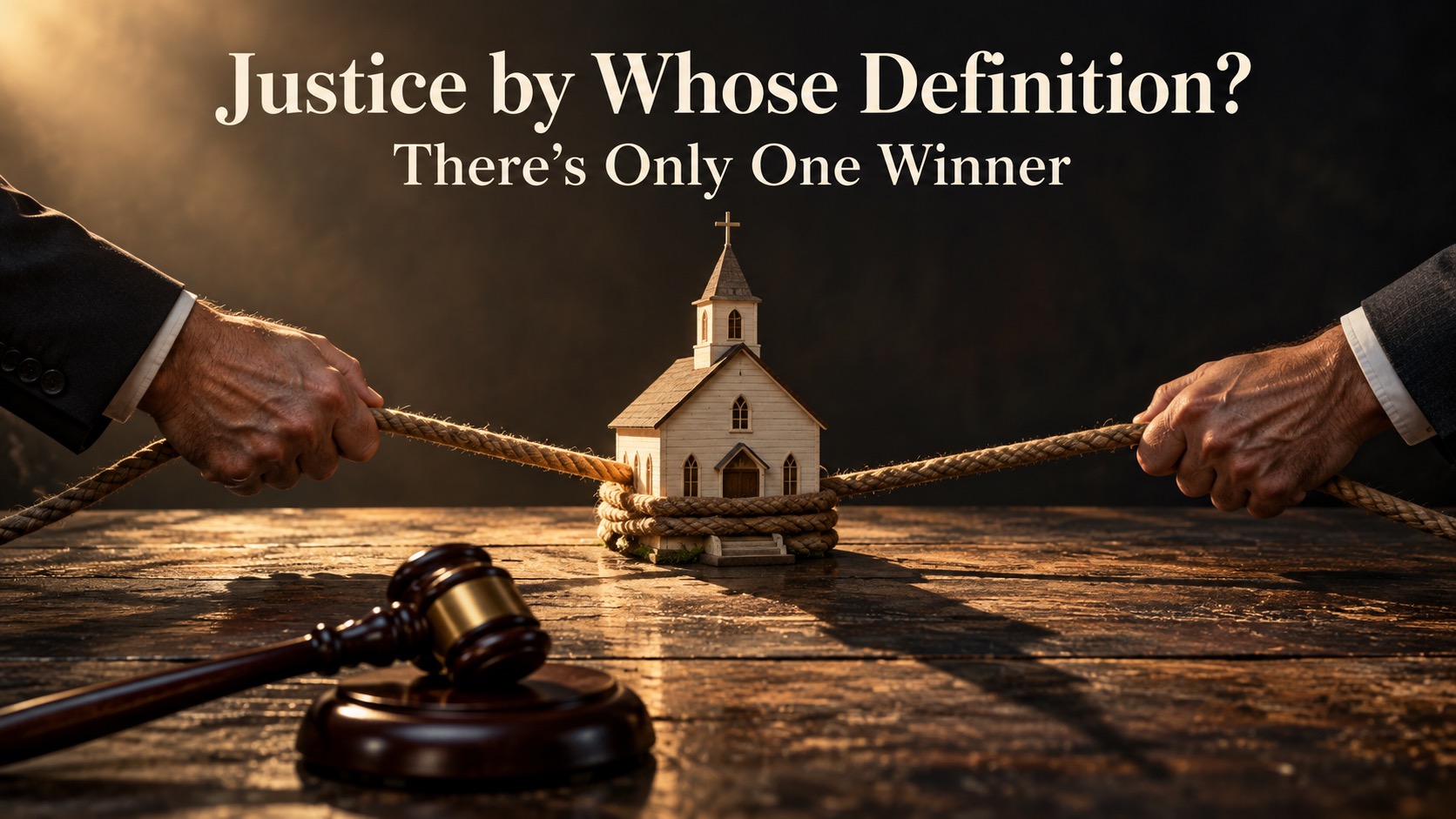
In recent posts, I’ve asked, “Justice by whose definition?” I’ve asked it about church property and about the treatment of pastors. Now, the conflict between Highland Park United Methodist Church and the Horizon Texas Conference brings me back to the question again.

Highland Park United Methodist Church in Dallas and the Horizon Texas Conference are embroiled in a dispute over church governance, denominational authority, and property. The conference sued after Highland Park changed governing documents in ways the conference says improperly removed denominational oversight; church leaders dispute those allegations.

In a recent called congregational vote, an overwhelming majority of those voting supported leaving the denomination, but the conference maintains that a congregational vote alone cannot end that relationship. The conflict now involves both a pending lawsuit and competing claims about who has authority to lead the church.

Hearing Both Sides

Let me begin by granting both sides something: I believe they think they are acting justly. Conference leaders understand themselves to be protecting a trust they have a responsibility to preserve. Highland Park’s leaders understand themselves to be acting faithfully on behalf of their congregation and its future. We can give both sides the benefit of the doubt about their intentions without concluding that either side has gotten everything right.

That is part of what makes this so difficult. People can sincerely believe they are doing the right thing and still need to examine what they are doing—and what it is costing everyone around them.

I bring my own history to this discussion. As many reading this know, I spent more than twenty-eight years as a United Methodist elder, including time as a district superintendent. I understand something of the responsibilities conference leaders carry. I also understand something of the frustration that leads people to conclude they can no longer remain in the denomination they once expected to serve for the rest of their lives.

So, I’m interested in the arguments about trust clauses, church authority, and property. But I keep coming back to a question that won’t be settled simply by determining whose legal argument is stronger. The question I’m wrestling with is this: What does justice require of people who claim to follow Jesus?

My Dog in the Hunt

Some may ask, “Do you even have a dog in this hunt?” It’s a fair question. I left the United Methodist Church in August 2019. I don’t have a claim on Highland Park’s property or a vote in the Horizon Texas Conference. Whatever happens in court, nobody will be sending me a check. I do, however, still have friends who serve it faithfully, and leaving did not erase my affection for the people or the institution that helped shape my ministry.

More than that, I’m still a Christian pastor. When Christians fight publicly, the damage to our witness doesn’t stop at the denominational boundary. People watching from the outside may not understand the difference between a United Methodist and an Evangelical Methodist, and most would not care to know. All they hear is Methodist. They hear us Methodists talk about Jesus, and then they watch how we treat one another.

That gives me a reason to care. It also gives all of us a question to consider: What are they learning about Jesus from watching us?

Already Defeated?

As I contemplate this situation, I can’t help but return to 1 Corinthians 6. Paul addresses a church in which believers are taking one another to court, and he has some uncomfortable things to say about it.

What troubles me most is that Paul doesn’t wait for a verdict before declaring that something has already gone terribly wrong. In verse 7, he tells them that having lawsuits against one another is already a defeat. Then he asks whether they would be willing to suffer wrong rather than continue the fight.

That is a difficult word to hear when we’re convinced we’re right. It is even more difficult when we believe we have a responsibility to protect something entrusted to us.

I can almost hear the objections because I’ve raised some of them myself. There are obligations to honor. There are gifts from generations of faithful people to protect. There are ministries to sustain and people whose future must be considered. Those responsibilities are real, and they deserve more than a dismissive wave of the hand. But Paul’s words deserve more than that, too.

If we can explain all the reasons we have to fight without seriously considering Paul’s challenge, have we allowed Scripture to examine our actions? Or have we simply decided that our circumstances are too complicated for it to apply?

I don’t read this passage as a blanket prohibition against every use of the courts. It should never become a way to silence victims or shield wrongdoing from accountability. Paul himself goes on to confront those who wrong and cheat their fellow believers. His concern includes both the injury being done and the way Christians are handling it.

Still, I can’t read this passage and come away comfortable with the prospect of Christians spending years and substantial ministry resources fighting one another over who gets to control the church.

At the very least, Paul calls us to examine what we are willing to surrender for the sake of faithfulness. That question belongs to everyone involved. It belongs to conference leaders charged with protecting the connection, and it belongs to congregational leaders seeking a different future.

Are we willing to accept an outcome that gives us less than everything we believe we deserve? Can we make room for the needs of the people across the table, including those who want to remain United Methodist? Can we pursue a settlement that allows ministry to continue without requiring one side to humiliate the other?

I don’t know everything that has been said behind closed doors or every effort that has been made toward an agreement. I do know that Paul gives us reason to keep pursuing one.

More Important Than Winning

Surely our responsibility to protect the church includes a responsibility to consider what our fighting is doing to it. That is why I keep wondering what a different outcome might look like. Whatever efforts have already been made, could both sides find a way to stay at the table long enough to reach an agreement without prolonging the litigation? And could both sides leave the negotiating table with something less than everything they want, yet preserve something more important than a victory?

A “just” agreement would have to take seriously the congregation’s future, the conference’s responsibilities, and the people who wish to remain United Methodist. Those people cannot become an afterthought. Neither can the ministry that might continue if the parties find a way forward.

I am not suggesting that any of this would be easy. I am asking whether the difficulty of reaching an agreement is greater than the damage of continuing the fight.

I bring that question out of my own experience. I was a delegate at the February 2019 special General Conference that adopted Paragraph 2553. When that conference ended, I knew my time in the UMC was coming to an end. I left that August, not for lack of conviction, but because I saw the fight that was on the horizon and I simply didn’t want to be a part of that fight.

Sometimes having the right to fight does not make fighting right.

And that brings me back to the question: Justice by whose definition? If our definition accounts for property, authority, and obligations but leaves no room for sacrifice, reconciliation, or love for the people across the table, we need to examine it again. We may be able to explain our position perfectly and still have trouble explaining how our conduct reflects Jesus.

Someone may eventually win in court. A judge-or judges-may settle questions of ownership and authority. But a favorable ruling won’t restore every broken relationship, recover every ministry dollar spent, or persuade our watching neighbors that we meant what we said about loving one another.

What do we lose while we wait to find out who wins? If we secure the property but damage our witness, if we defend the institution but deepen the division, what exactly have we protected?

The only winner in all this is the Devil. The Devil has been quite successful in sowing division among the people called Methodist.

Surely we don’t have to keep helping him.

Until next time, keep looking up…

If any of my reflections encouraged or challenged you, follow Not the Perfect Pastor on Facebook for more conversations about faith, ministry, and becoming faithful disciples of Jesus.

Justice by Whose Definition?

And so the fight for “justice” continues.

In an October 13 statement, the South Carolina Conference of The United Methodist Church announced that a circuit court judge intends to dismiss cases brought by the Conference and local United Methodist churches involving 70 churches seeking to separate from the denomination. According to the statement, the written orders have not yet been entered. The Conference nevertheless announced its intention to appeal.

For years, congregations seeking to leave The United Methodist Church over theological differences could do so with their property under a temporary provision in the Book of Discipline (Paragraph 2553). That window closed at the end of 2023. In the years since, some churches have continued to separate—often outside the processes allowed by church law—while annual conferences have sought to retain the properties under the denomination’s longstanding trust clause. The South Carolina cases are one result of that unresolved conflict.

Near the conclusion, Bishop Leonard Fairley said, “So, we will continue to seek justice faithfully, pursue the appropriate legal avenues available to us, and trust God with what lies ahead.”

It was the word justice that caught my attention. Just what constitutes justice in a situation like this? And who gets to define it?

Let me acknowledge my own perspective. I spent more than 28 years as a United Methodist pastor, including two years as a district superintendent. I now pastor Haughton Methodist Church, a congregation that chose to walk away from its former church property. I have a history here. I have convictions. I won’t pretend otherwise. 

But those experiences are precisely why I think the question deserves more than an assumption that justice means our side wins. Read alongside the announced intention to appeal, that language raises a question for me: Does seeking justice necessarily mean overturning the dismissal?

Who Has a Just Claim?

An Annual Conference can argue that church property belongs to a connection larger than any single congregation. Local churches have benefited from appointed pastors, denominational relationships and the contributions of those who came before the present membership. Some have also received financial assistance. Those things matter.

But generations of local people putting money in offering plates, paying mortgages, repairing roofs, mowing grass and keeping the lights on matter just as much. So do the sacrifices of people who believed they were providing a place where their children and grandchildren could worship and come to know Jesus. How does one weigh those contributions?

Where a Conference’s financial investment has been limited or nonexistent, what makes retaining the property morally just? Is the legal claim sufficient to settle the Christian question? And from the other direction, does the present congregation’s desire to leave erase every obligation to the connection or every intention of previous generations?

Those questions require actual answers. Calling our preferred outcome “justice” does not provide them. A court can determine legal rights. Christians still have to ask how we ought to exercise those rights.

What Does the Fight Cost?

The bishop’s statement also speaks of people hungry for the Gospel, communities needing healing and children needing to discover the love of Jesus. Amen. I couldn’t agree more. There is much ministry before us. That is part of what makes this so troubling.

What does it cost to continue these disputes? And I don’t mean only the attorney fees. What does it cost in pastoral attention? In congregational energy? In relationships? In the credibility of our witness to people watching from outside the church? What could the money accomplish if it were used to feed the hungry, clothe the naked or support ministries of care for the sick?

I get it: property has value, and protecting it can preserve resources for future ministry. Stewardship sometimes requires difficult decisions. But stewardship also requires asking whether the expense of securing an asset is consuming the very ministry that asset was supposed to serve.

That question applies to departing congregations, too. A congregation can become so determined to keep a building that keeping it becomes the organizing purpose of its life. At some point, both sides ought to ask: How much are we willing to spend to avoid losing? And what might we lose while insisting on winning?

The Scripture We Have to Face

Then there is Paul. 1 Corinthians 6 makes uncomfortable reading when Christians are taking one another to court. Paul confronts believers over their lawsuits and asks why they would not rather suffer wrong or accept being cheated.

I don’t believe a blog paragraph can settle every question about how that passage applies to every legal circumstance. But surely it requires more from us than a quick explanation of why our particular dispute deserves an exception.

Paul asks us to consider the possibility that accepting a loss might be more faithful than securing a victory. What are we supposed to do with that? Does it have any practical authority over our decisions? Can it change our course of action? Or do we affirm the authority of Scripture until Scripture threatens something we are determined to keep?

I ask that as someone who has preached plenty of difficult passages and then discovered how difficult they are to live. What sounds right when we read it in worship on Sunday can be harder to accept when we meet with an attorney on Monday.

Sometimes You Walk Away

At Haughton, our congregation walked away. I cannot mention that as though leaving church property behind were a small thing. A church building holds memories. People remember weddings, funerals, baptisms and the places where they sat beside someone they loved. You can’t pack any of that into a moving van.

We now worship in a storefront. There are limitations and inconveniences. The decision to walk away had consequences beyond the day we left. But there is still a congregation. There is still worship. There is still a Gospel to proclaim and a community to serve.

Our experience does not give me the right to prescribe the same decision for every other church. It does give me a reason to take Paul’s question seriously. Accepting loss is an actual possibility, with actual costs.

It also raises a question for the institution receiving what a congregation relinquishes. A congregation’s willingness to walk away does not automatically establish the justice of the Conference keeping the property, or the justice of the Conference continuing to fight for it. Accepting an outcome and declaring that outcome just are different things.

If we appeal to Scripture when asking a congregation to accept loss, we must also ask what Scripture might require the Conference to surrender. Otherwise, accepting loss becomes something we recommend exclusively to the other side.

Justice, Mercy and Humility

Micah 6:8 holds together doing justice, loving mercy and walking humbly with God. I need all three. So does the church.

Humility requires admitting that my interests can influence my definition of justice. Mercy requires taking seriously what my insistence on those interests will cost someone else. Neither makes justice unimportant, but both should shape how we pursue it.

I don’t know how the South Carolina appeals will unfold. The statement itself says the trial court’s written orders are still pending. I am not claiming to know how the legal questions should be resolved. I am asking whether we have given the Christian questions the attention they deserve.

What do we owe one another? What does our witness require? What are we willing to surrender for the sake of the Gospel? And, perhaps most importantly, can we recognize justice when it requires something of us?

The fight for “justice” continues. Meanwhile, the hungry still need food, the sick still need care, the poor still need help, and the orphan and widow still need someone to stand beside them. A world still needs Jesus. Those needs don’t settle the property question. But they ought to weigh heavily in how long we fight, how much we spend and what we are willing to surrender.

Justice. We all want justice. The problem is in knowing whose definition to use.

Until next time, keep looking up…

If any of my reflections encouraged or challenged you, follow Not the Perfect Pastor on Facebook for more conversations about faith, ministry, and becoming faithful disciples of Jesus.

The Coming Storm…

I heard some bad news this week that makes me think it really is only the first winds of the storm that is blowing on the horizon for the institutional church, especially as it presents itself in the local congregation.

What was the news? I heard that this past Sunday was a pastor’s last Sunday at one local congregation because the congregation could no longer pay the pastor’s salary. I hated to hear the news, especially for the pastor who was faithful to lead the congregation through the disaffiliation process of the United Methodist Church.

I don’t know all the details of the transition. I know it was, by all United Methodist standards, a successful church plant a decade ago. The departing pastor was not the founding pastor (that might have a little to do with it), but the fact that the local congregation could no longer pay the salary points to a financial reality that many congregations will be facing in the future.

The news got me to thinking about some of the challenges that the institutional church will face in the future…there really is a storm on the horizon.

Challenges on the Horizon

Inflation

Thanks to Covid and bad national economic policy, everything costs more these days. That means people have less money to give to the church, but it also means that utilities, sound equipment, cleaning supplies, office supplies…literally everything costs more.

When people are unable to give to the church because their personal expenses have gone up, the local congregation can’t keep up with its own expenses. Programs have to be cut, personnel costs have to be cut. The model for the local congregation is unsustainable.

Real Estate

What inflation has done to everything else, it’s also done to real estate. I suppose this challenge could have been included in inflation above, but I think it stands on its own. Real estate prices have risen disproportionately to almost everything else, which is good for homeowners, but not really good for anyone else.

Real estate becomes a problem for the institutional church when it comes to the prospect of church planting. How can a “traditional church model” of church plant afford real estate in today’s market? Or, how can a “growing” congregation afford to either build or relocate in today’s real estate environment?

Not to mention building restrictions that many municipalities are placing on property use. Municipalities lose millions of dollars of revenue when property is used for a church. Those municipalities aren’t liking that much anymore and planning and zoning commissions are limiting the number of churches in some areas…because the municipalities need more revenue, too.

Salaries

Salaries will definitely be a challenge for local congregations in the future. Well, the future is now! Thus, the example given above. The local congregation could no longer afford the pastor’s salary. So it will continue to be as inflation takes its toll on the economy.

Even large congregations will find themselves scaling back on personnel in order to sustain the cost of keeping the doors open. Let’s face it, there are a lot of pastors and church staff who weren’t making a living wage anyway. It’s only going to get worse.

Congregations will begin (have begun) the transition to bi-vocational ministers, and pastors will have to transition to bi-vocational because, I know for a fact, that pastors like to eat and live indoors. I’m not saying there is anything wrong with that transition. It might even be for the best—it puts the pastor out into the community with an opportunity to meet un-churched, de-churched and un-saved people instead of spending all of their time “tending the sheep” inside the church walls, or sitting eight hours a day in the office because the Church Council demands their “availability” to the congregation.

Honestly, though, when you start cutting church staff, programs suffer and today’s institutional church model is built around attractional programming.

Clergy Shortage

Okay, so even if a congregation can afford to pay a full-time pastor, where are they going to find said pastor? (For more on the clergy shortage, click here and here).

There is no longer a functional ministry pipeline from which to choose trained professional clergy.  Number one, people aren’t going to seminary in the numbers they were in the past. Seriously, they finally figured out that spending all that money for a seminary education wasn’t paying off.

Many people who feel called to ministry have figured out they can fulfill their calling in the non-profit world and get paid more for it. I know it’s not all about the money in ministry, but pastor’s still have to provide for their families.

Additionally, traditional denominations have provided a pipeline and pastors would “rise up through the ranks” to fill pastoral roles. Well, there are no ranks anymore in many denominations. Many denominations find themselves in “warm body syndrome” where they just need someone/anyone to fill a pastoral position. Yeah, the Holy Spirit is really in that process.

Another issue affecting the clergy shortage is the fact that the majority of clergy are near or past retirement age. I know! Retirement is not a biblical concept, but most retired clergy don’t have the energy and don’t really want to invest the time it takes to “grow” a church. Yeah, I’m probably just speaking for myself, but I’ve also heard it from other retired clergy who have been asked about serving full-time or even planting a church.

The clergy shortage makes the traditional institutional church model unsustainable.

Shrinking Attendance

Rev. Max Edwards, General Superintendent of the Evangelical Methodist Church, posted a link to an article in his weekly newsletter that is really eye-opening. Church attendance has been falling for generations and according to the article, shrinking attendance has costs far beyond the ability of a congregation to stay open.

Also, the article states that since the 1990’s, 40 million people have stopped going to church—that’s one in eight Americans, and in 2021, membership in houses of worship fell below the majority for the first time.

Yeah, I know! Covid, right? Covid only accelerated the decline. Most churches haven’t recovered their pre-Covid attendance. Most churches never will. Shrinking attendance makes the traditional model of the institutional unsustainable.

Disciple-Making Process

Okay, as one who served as a full-time pastor, I assume my share of responsibility for this one, but the local congregation has not been very good at making disciples. Most congregations don’t have an intentional disciple-making process.

For generations, it has been about programming for the local church and for the passing on of information as if we can just get enough information we can experience transformation.

Yeah, well it doesn’t work that way. Information does not equal transformation. Only the Holy Spirit can transform a person and I suspect we were so busy planning programming and designing ways to keep people’s attention that we forgot to leave room for the Holy Spirit.

Heck, we didn’t even disciple our children and that’s the very place we should excel most. Young people have left the traditional church in droves and they’re not coming back!

Unless and until a local congregation implements an intentional disciple-making process—a process whereby a person grows up in faith and holiness to engage their own gifts for ministry in service to the Kingdom—the local church/traditional brick-and-mortar model is going to be unsustainable.

The House Church

I think there is a legitimate answer for the challenges facing the local church and the institutional church. I don’t want to talk about a bunch of problems without offering some solutions.

I am evermore convinced that the answer to the “church” problem is to go back to the future—The House Church.

I don’t intend to lay out the Biblical justification for house churches in this blog (for that you can click here, here, here, here and here). But, let me offer some reasons that I believe the house church is the harbor in the storm facing the institutional church.

Here are some reasons I believe this:

No Professionals Needed

You don’t need a “professional” pastor in a house church. All that is required is for a person to exercise his/her gifts for ministry.

There is no need for a salary because it is not a “job” or means of support for anyone who is part of a house church. The ministry pipeline already exists in every house church. The members of the house church are the ministers—each one engaging in the use of their own giftedness supporting the body of Christ.

No need for M.Div’s or theological schools and no student loans to have to pay back. The primary expense of any local congregation is cut in half when no “professional” pastor is needed.

Real Estate

In a house church, real estate is not an issue. You already own it (unless you rent, of course). What’s more, the government can’t shut you down in the next pandemic. The cost of maintaining a place of worship no longer exists because you’re going to live in your house anyway.

It’s More Evangelistic

Trust me, it’s easier to invite someone to your house for a Bible study than it is to invite them to a church building for worship.

With a house church, you can meet in the local coffee shop (a house church doesn’t necessarily limit one to a literal house) for prayer. Someone will see you praying and it will open the door for a conversation with someone present who desires/needs prayer.

Honestly, many existing local congregations, including many who disaffiliated from the UMC, are really Sunday school classes that own property. What if all those “Sunday school classes” transitioned to house churches and sold their property and gave all the money to missions—of course, that would have to mean the local congregation had a focus and passion for missions, but that’s for another blog.

The church becomes infinitely more accessible under a house church model in today’s culture—more accessible than a traditional church ever will be again.

Financially Sustainable

A house church doesn’t need gazillions of dollars to sustain itself. There are no salaries, no church staff, no buildings to maintain, no church vans or buses to pay for. The only need for money comes in the resourcing, and there are abundant resources for house churches whose costs can easily be shared by those attending.

Quickly Scalable

Because house churches are not dependent on large investments of money, and because they are only limited by the real estate that its members already own, it becomes simple to multiply and replicate.

So, your house can only accommodate 20 people? Cool! Start another house church!

Intergenerational

The church was/is meant to be intergenerational. The house church is specifically meant to be so. Yes, everyone stays together. Everyone prays together. Everyone sings together. Everyone studies together.

This is the absolute best example of disciple making for your children. We pray with our children and for our children…and they pray for and with us. That’s the way it is supposed to be.

We were never supposed to send our children to children’s church or our youth to youth services. Worship is meant to be intergenerational.

Tell me, really? Why does the “traditional” church model have “youth ministry” at 5 p.m. on Sunday, yet they don’t have any ministries at the same time for adults…or children…or anyone else?

And, really? We want the church to do for our children and youth what the Bible says parents are supposed to do? The home is now, and has always been, the greatest incubator of faith.

Like Hurricane Beryl in the Gulf of Mexico this past week, all the signs pointed to the storm that was coming. The signs are on the horizon for the local church. How will local congregations (and the institutional church) prepare for the storm ahead?

An Invitation

May I invite you to pray with me? Pray for the many local congregations that are struggling with their future. They have looked toward the horizon and see the storm brewing but are unsure how to prepare. Pray for the Holy Spirit to lead them into His future for them…and pray that the congregation will be open to the Holy Spirit.

Also, pray with me about The House Church Movement. The House Church Movement was a vision the Lord gave me back in 2020, but it has been on the back burner (I rather called it “paused”) for a couple of years. I am praying to discern if now is the time to re-launch the Movement.

I would love to hear your thoughts. Please comment below, and if you live in the northwest Louisiana area and would be interested in being a part of a re-launch, I’d love to hear that, too. All it takes is two:

20 “For where two or three gather in my name, there am I with them.” (Matthew 18: 20 NIV)

Until next time, keep looking up…