I don’t know why (I’ve never used a betting app in my life), but an advertisement popped up on my phone recently offering me the opportunity to bet on whether the price of silver would go up or down over the next twenty-four hours. Silver. Over the next twenty-four hours. Who knew?
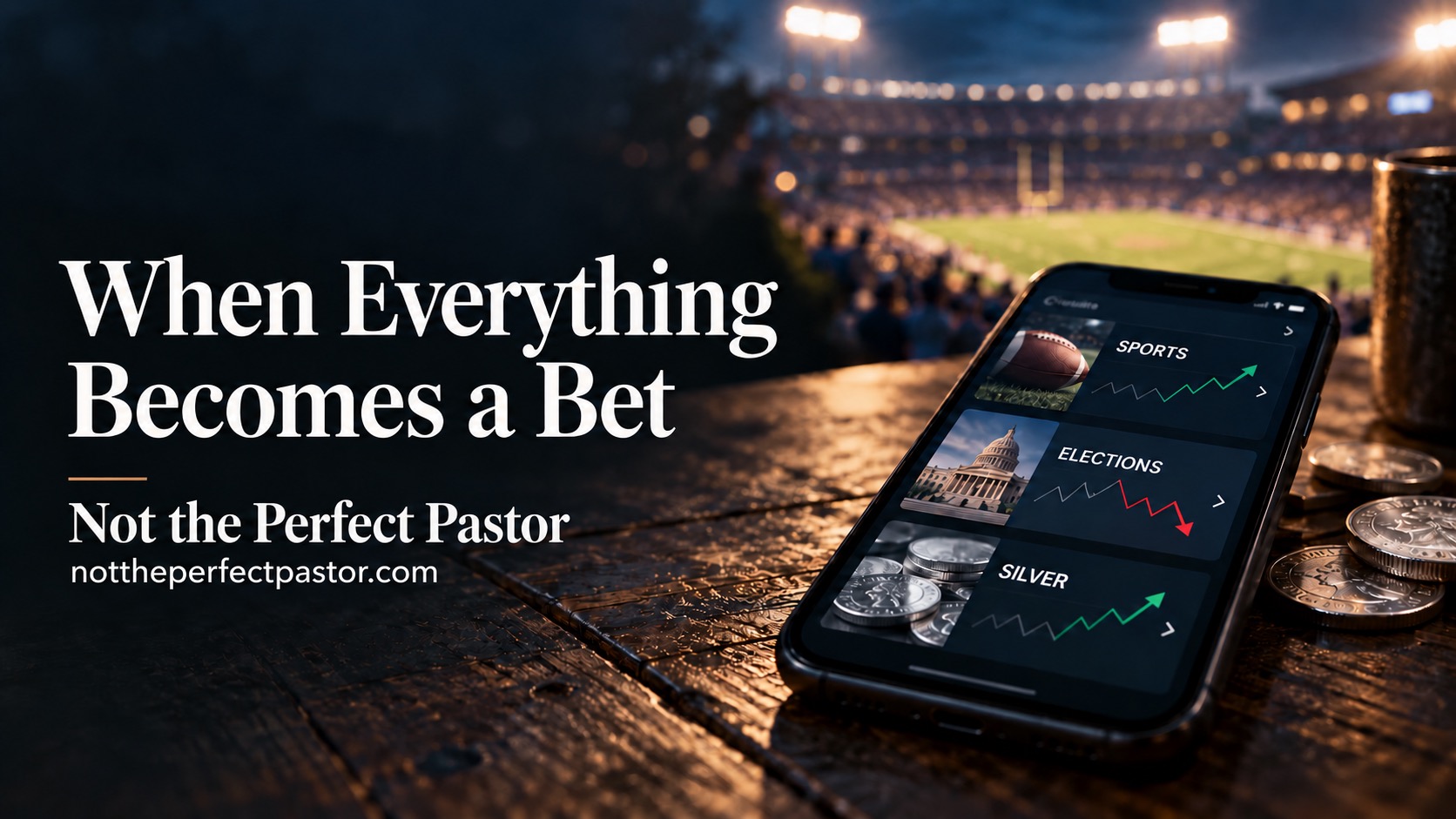
The ad was for Kalshi, a prediction-market platform. Its products are called event contracts, and its exchange model differs from a traditional sportsbook—or so I’m told. I’m not versed enough in online betting to know the difference. What I do know is online wagering has proliferated recently, and I can’t think that’s a good thing. Apparently, we can now bet on anything in life. Increasingly, the opportunity comes looking for us.
WHEN TRUST BECOMES A SALES PITCH
That bothers me—more than a little. One of the reasons it bothers me is that a few of my favorite podcasts are now being sponsored by these “betting” markets. Though not specifically faith-based, they are led by folks who claim a deep faith. That gives me a little heartburn. When we come to trust someone’s voice, that trust can extend to what they’re selling. I wonder whether these hosts have thought enough about what they’re inviting their listeners to do.
I’m also concerned that these betting markets are being used as a gauge for future elections. What are the chances so-and-so will win? What are the odds the Republicans hold onto the House? I wonder how those “predictions” might shape our judgment. A candidate’s chances of winning tell us very little about whether that person ought to win. Are we allowing the way people bet to influence the way we think about whom to vote for?
A SAINTS FAN’S CONFESSION
Sports betting raises another concern: the integrity of the games themselves.
Now, I need to confess something. I love the New Orleans Saints. And I have occasionally been accused of wearing a tin-foil hat when discussing the way officials treat my team. I rather prefer to think of it as protective headgear for a long-suffering fan.
After watching Jared Goff’s apparent fumble become an incomplete pass, then watching a similar-looking play involving Tyler Shough remain a fumble against the Raiders, I suspect my tin-foil hat club has picked up a few members. Welcome. Bring your own aluminum foil. We’re a modest operation.
Yes, I’ve heard the rules explanations. No, I have no evidence that either call had anything to do with gambling. Being a Saints fan does not qualify me to conduct a federal investigation, though it has given me considerable experience demanding one.
Beneath my humor, though, is a serious concern. Players, coaches, and officials make decisions that affect what happens on the field. Those decisions can also affect the outcome of wagers. That creates opportunities for conflicts of interest, misuse of inside information, and deliberate manipulation.
A disputed call does not establish any of those things. But it can illustrate how fragile trust becomes when fans know money is riding on the decision. A bad call has always been part of sports. Betting can add another question to the familiar argument about whether the official got it right: did somebody have a reason to get it wrong?
I need to be careful about asking that question of any particular person without evidence, but I’ll also remind us that betting-related misconduct has occurred. The NBA banned Jontay Porter after finding he shared confidential information, limited participation for betting purposes, and wagered on NBA games.
That example matters because an entire team does not have to agree to lose for a wager to be compromised. A market tied to one individual’s performance can create an opportunity for that individual to influence the result. The temptation deserves attention before another scandal gives us a reason to pay it.
THE NEXT BET IS ALWAYS WITHIN REACH
There was a time when going somewhere to gamble required at least the decision to go. That offered no guarantee of restraint, but it created a boundary. A phone puts the opportunity in our pocket. The same device we use to talk to our children, check the weather, and read the news can invite us to put money on the next uncertain outcome—the next election, the next game, even the next solitary play.
Convenience is usually presented as a good thing. I don’t think we can say the same thing when it comes to gambling. What happens when the next wager is always within reach? What happens when a loss can immediately be followed by another opportunity to win it back? And what responsibility belongs to businesses that earn money by encouraging us to keep participating?
WHOSE MONEY?
As disciples of Jesus, we ought to ask what this constant invitation to wager is doing to our families, our communities, and our understanding of a good life.
I find those questions inseparable from stewardship and contentment. The money entrusted to us carries responsibilities—to our households, to our neighbors, and to the work God calls us to do. The promise of a quick gain can make the ordinary work of earning, saving, giving, and waiting seem painfully inadequate.
Are we stewards? If so, then just whose money are we gambling with? I could rattle off a list of biblical passages that leave little doubt whose money it is. The one I’ll mention here is Matthew 25:14–30, the Parable of the Talents. The servants are entrusted with their master’s property, and they are accountable for what they do with it. That ought to make us ask whether the way we use what God has entrusted to us reflects His purposes.
What does faithful stewardship look like when I open my wallet—or an app on my phone? Am I considering what God would have me do with what He has given me? His generous grace ought to move me to gratitude and faithfulness. That deserves more thought than the odds on my next wager.
ARE WE CONTENT?
It’s not just a matter of faithful stewardship, either. It’s also an issue of contentment. I’m reminded of Hebrews 13:5 here: “Keep your lives free from the love of money and be content with what you have, because God has said, ‘Never will I leave you; never will I forsake you.’”
Are we trusting God for His provision, or are we trusting in blind luck?
We also need to consider how gambling can feed greed and envy. Do we gamble because we want something we don’t have? Do we gamble because we want something that belongs to someone else? Even if we start out simply wanting a little entertainment, we ought to pay attention to what keeps us coming back.
In Philippians 4, Paul describes contentment as something he learned. That suggests practice. It suggests that our desires need formation. A steady invitation to imagine how much better life could be after the next winning wager offers a competing lesson.
MORE THAN PERSONAL CHOICE
Certainly, some people place an occasional bet and stop. But a biblical assessment cannot end with the person who can afford a loss and walk away. It must also consider the person who keeps going, the spouse who discovers the missing money, and the child whose needs go unmet. When money needed at home is lost, the consequences reach people who never agreed to the wager.
Personal freedom matters. So do the responsibilities that come with it. Calling an activity a personal choice does not make all its consequences personal.
Friends, we can be biblical about this subject without humiliating people who are struggling–that’s what grace is for. Someone whose betting has become destructive needs the church. They need a place to tell the truth, find practical help, and discover people who are willing to walk with them. Their family needs care as well.
Even when gambling is legal, legality is an insufficient measure of whether an industry serves the common good. We can recognize personal freedom while questioning businesses that continually encourage people to risk money. We can enjoy sports while insisting that their integrity matters more than the number of markets someone can build around them.
That little advertisement about silver left me with a question much larger than tomorrow’s price. Just because we can make a bet out of something, should we?
I would like us to recover the freedom to enjoy a game, follow the news, or pick up our phones without being invited to put money on what happens next.
Until next time, keep looking up…