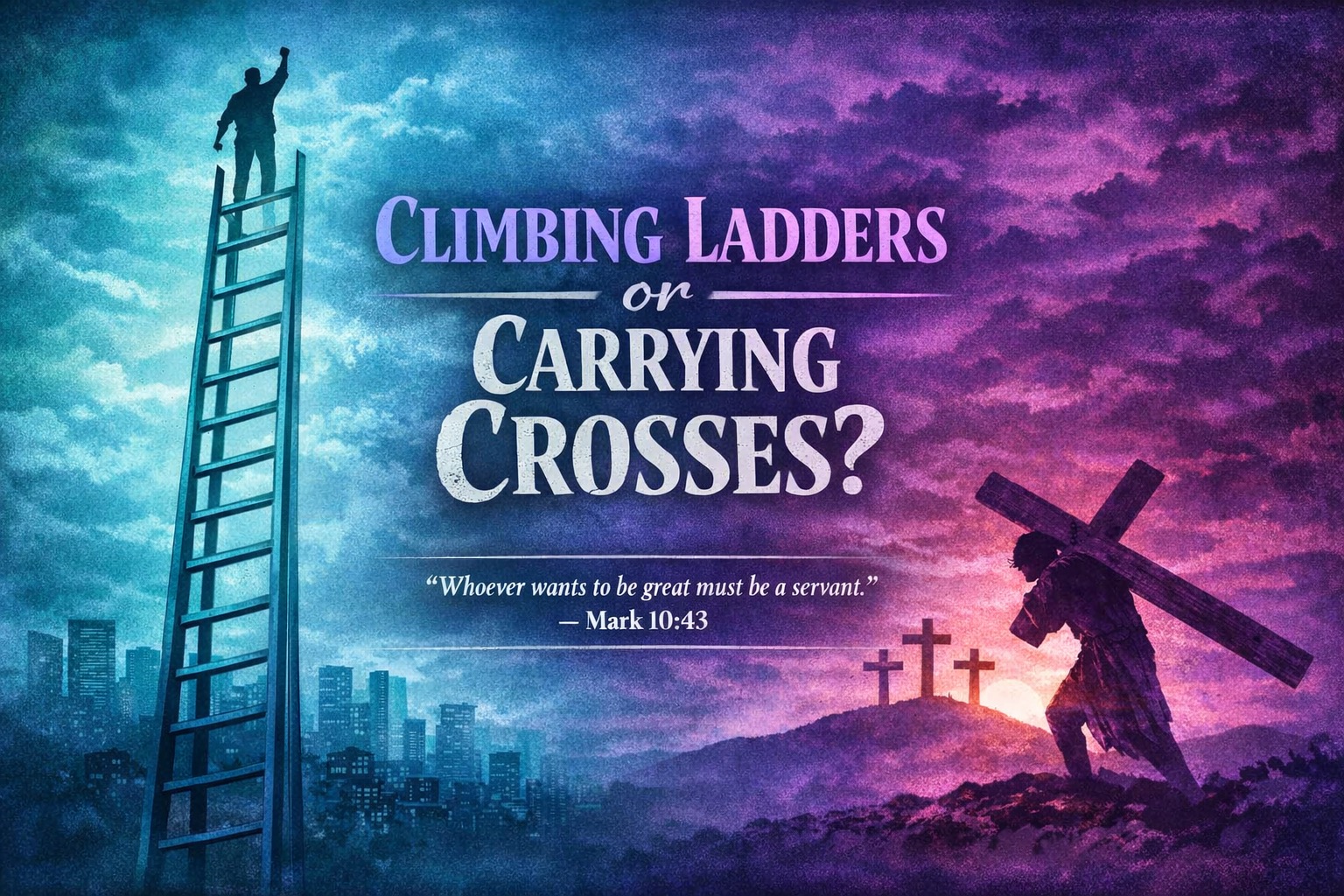
Age is a humbling thing. It brings aches in new places, but it also brings old decisions into sharper focus. One uncomfortable truth I have come to see is this: Not every decision made for questionable reasons ends badly.

That may be one reason some of them are so difficult to recognize. Sometimes the opportunity works out. Sometimes the new position goes well. Sometimes everyone involved flourishes. The outcome becomes evidence we use to reassure ourselves that we made the right decision. But good outcomes do not always justify the reasons behind our decisions. Sometimes we succeed for the wrong reason.
You’re wondering about that questionable decision, aren’t you? One in particular has returned to my thoughts recently. It happened in 2011. At the time, I was serving as pastor of Benton United Methodist Church. A few years earlier, in 2008, I had taken a clergy renewal leave. When I returned that December, I stood before the congregation and made a commitment: I would stay as their pastor as long as they would have me.
And I meant it when I said it.
At least, I thought I did.
Then, in February 2011, the bishop called. He invited me to serve on the Cabinet as a district superintendent. It was an honor—a significant opportunity and the kind of invitation a pastor does not receive every day.
Vanessa and I talked about it. I said I would pray about it. Looking back, however, I’m not sure I really did. If I prayed at all, my prayer was probably more “Thank you” than “What do you want me to do?”
The truth is, I had already made up my mind.
The invitation felt like the next rung on the ecclesiastical ladder I had been climbing for a long time. It carried recognition, greater responsibility and the possibility of broader influence. I could easily describe it as an opportunity to serve the Church in a new way—and it was.
But it was also something I wanted.
There is nothing necessarily wrong with accepting a new responsibility or pursuing an opportunity. There is also nothing necessarily wrong with ambition. The danger comes when ambition becomes so entangled with our sense of calling that we can no longer tell them apart.
That is what happened to me.
I accepted the position without fully wrestling with the commitment I had made to the congregation. A promise that had sounded firm in 2008 suddenly became negotiable when a sufficiently attractive opportunity appeared in 2011.
Perhaps it was a promise I should never have made. In the United Methodist system, pastors do not ultimately control how long they remain in an appointment. But I had made it. The people had heard it. They had every reason to believe I meant it.
And then I set it aside. At the time, I had plenty of ways to justify my decision. It was a good opportunity. It was a larger role. It offered the possibility of broader impact. I could tell myself that the bishop had called, the Church needed me, and God had opened the door. All those things may have been true.
But they were not the whole truth. The rest of the truth was that my ambition spoke louder than my commitment.
I wish I could point to a particular moment when that realization struck me, but I can’t. It emerged gradually. As I have grown older and looked back across the years of my ministry, I have begun to see things I could not—or would not—see when I was living them.
Faithfulness has certainly been part of my story. I have loved the Church. I have wanted to serve Christ. I have tried to follow where I believed God was leading. But faithfulness was not the only thing driving me. Ambition was there too.
That is difficult for me to admit because ambition rarely announces itself honestly, especially in the Church. It does not usually say, “I want a more important position,” or “I want people to recognize me.” It learns to speak the language of calling, opportunity, influence and impact.
We tell ourselves we are expanding our ministry. We are accepting a new challenge. We will be able to influence more people. We may even interpret the opportunity itself as proof that God wants us to take it.
I did not have to choose between faithfulness and ambition because I had learned how to call my ambition faithfulness. Only with the passage of time have I become more capable of separating the two.
Leading a small congregation has been part of that process. Small-church ministry has brought a level of humility into my life that I did not know I needed. It has forced me to reconsider some of the assumptions I once carried about success, influence and significance.
There are fewer people in the room. There is little institutional prestige. Most of what happens will never be noticed beyond our congregation. There are no impressive statistics to report and few opportunities to convince myself that the size of my platform is evidence of the importance of my ministry. There are simply people to love, Scripture to teach, burdens to help carry, prayers to pray and a congregation to serve. And perhaps that is closer to faithfulness than much of what I once imagined.
Small-church ministry has not removed every trace of ambition from me. I am not sure anything short of complete sanctification could accomplish that. But it has exposed ambition in ways that success often concealed it. It has reminded me that a larger assignment is not necessarily a more important one, and that faithfulness cannot always be measured by the size of the room, the prominence of the title or the reach of the ministry.
Sometimes faithfulness looks like staying.
That is what makes the promise I made to the Benton congregation difficult to remember. I told them I would remain as long as they would have me. A little more than two years later, when an attractive opportunity appeared, that commitment became negotiable.
I never went back and acknowledged that to the congregation. There was no moment when I stood before them and admitted how much ambition had influenced my decision. I cannot go back and change what I did, but I can look back honestly and name what I now see.
Some things can be corrected. Other things can only be confessed.
I do believe God was at work in ways I could not see at the time. The Benton congregation has flourished, and so have Vanessa and I. God brought good from the years that followed, and I remain grateful for them.
But good outcomes do not make every motive good.
God’s ability to redeem a decision does not relieve me of the responsibility to examine why I made it. Grace does not require me to rewrite the past so that I was right all along. Grace gives me the freedom to admit that I was not fully honest about what was driving me—with the congregation, with God or perhaps even with myself.
That may be one of the most difficult forms of repentance. Failure forces us to examine ourselves. Success often allows us to avoid it.
Sometimes the hardest thing to face is not realizing that we failed.
It is realizing that we succeeded—and still need to repent.
Until next time, keep looking up…
If any of my reflections encouraged or challenged you, follow Not the Perfect Pastor on Facebook for more conversations about faith, ministry, and becoming faithful disciples of Jesus.