Things, They are a Changin’…

Unless you’ve been living under a rock, you’ve heard of Cracker Barrel Restaurants rebranding initiative. I must say, we’ve finally found something that everyone can agree on: no one likes the new branding that Cracker Barrel came up with!

Conservatives and Progressives/Liberals alike have lamented the corporate change. There are several reasons I’ve seen over the past week. Those reasons include a loss of nostalgia and identity, The redesigned logo removes the iconic image of a man leaning on a barrel—an emblem of Southern charm and the chain’s heritage—leaving just the words “Cracker Barrel” on a gold background. Critics say this erases the brand’s sentimental value.  

There is also the sense of perceived sterility and blandness. Many called the new logo and updated decor “cold,” “sterile,” or “soulless”—in stark contrast to the warm, cozy atmosphere long associated with Cracker Barrel.  

As with everything else these days, there are those who note the political undertones of the move and the backlash that followed. Conservative figures widely criticized the change as an example of “wokeness,” while others accused the company of abandoning tradition to appeal to diversity, equity, and inclusion agendas. Even California Governor Gavin Newsom mockingly added fuel to the fire, reflecting deep political polarization surrounding what many consider a benign design change.  

And let’s not forget the financial consequences of the rebrand. Cracker Barrel’s stock plunged nearly 15% in one day, erasing an estimated $100 million to $195 million in market value. 

I’d say someone didn’t really think that decision all the way through.

Let me say that my family used to love Cracker Barrel. We came to love it when we moved to Kentucky for seminary. Cracker Barrel was a welcome stop on the 12-hour drive between seminary and our home in Louisiana that we would make several times each year.

The biscuits and the cornbread muffins were always warm. The hospitality was always cordial. The atmosphere was inviting and the food quality was consistent. We always knew what we were going to get when we stopped at a Cracker Barrel.

We don’t go to Cracker Barrel anymore, though. We stopped going before the rebrand. We stopped going because the last three times we went to Cracker Barrel, the food simply wasn’t very good. And, they started serving alcohol, too! Not that the alcohol really matters. We go to restaurants all the time that sell alcohol, but there was something that stung me when they made that move. It’s probably more my issue than Cracker Barrel’s, but still…

So? Why such the pushback on Cracker Barrel? I think it’s because Cracker Barrel represents a memory. It was Grandma’s kitchen with biscuits and gravy, and rocking chairs on the front porch. The rebrand stripped away everything the company represented to its customers, all in the name of “relevance” and “modernization.”

I’m not so sure it’s not the same struggle the Church/church faces, too. We want to reach the next generation. We want to be relevant. But sometimes, in the process, we risk losing the very soul of who we are.

Some churches throw out every hymn, every tradition, every symbol of the faith, hoping that a sleek, modern design will attract people. But what happens? People walk in and say: ‘This doesn’t feel like church anymore. It feels soulless.’

Now, don’t get me wrong—change is necessary. We must preach the Gospel in the language of our day, but the Gospel is still the Gospel. The method of the message may change, but the message must never change. Or, just like Cracker Barrel discovered, we can’t throw away our heritage and expect people to follow. People are hungry for warmth, for story, for authenticity. People are hungry for Jesus!

Are we giving them Jesus, or are we giving them some warmed over, feel-good-get-your-God-moment and sending them back out into the world? The Church/church just needs to give the people Jesus every time they come.

Paul tells us in 2 Thessalonians 2:15‘So then, brothers and sisters, stand firm and hold fast to the teachings we passed on to you.’

Notice, Paul isn’t saying never change. He traveled culture to culture, adapting his methods to reach people, but he never threw away the core. He held fast to the Gospel, even as he adjusted his approach.

So here’s the lesson for us as a Church/church:

  • Change is fine—but it must not be an erasure.
  • We can add new songs, new ministries, new outreach—but not at the cost of losing the warmth of fellowship, the truth of Scripture, and the centrality of Jesus Christ.
  • People don’t come to church for flash and logos. They come because they’re looking for a family, for hope, for soul, for salvation.

So the next time you drive past a Cracker Barrel (or hear someone complaining about the new logo) remember this: What the world is truly longing for is not sleeker branding, but something real, something rooted, something alive. And friends, that’s exactly what the church can offer, if we hold fast to Jesus Christ while speaking His love in a way this generation can understand.

I sure do wish we could all agree on that!

Until next time, keep looking up…

Nine Things For a Church in Transition…

So, I’m pastoring a small congregation these days. As I reflect on my past leadership as a vocational minister, and I think about where God is calling me to lead as a bi-vocational pastor, I’ve sought to define the necessary actions that will help our congregation be faithful to God’s calling for this stage in our life.

What stage is that? I can’t actually answer that question, but if I attempted to provide an answer, it would be the transitional stage. We are a congregation that is in transition. We’re meeting in a storefront. I would define that as transitional. The storefront can’t be our permanent home unless we are content to be who we are where we are, and I don’t believe the Lord ever wants us to be content with who we are where we are, so we’ll see how that plays out.

We’re also transitional in our mission. As a congregation that was displaced from its property, there is a time of defining who God is calling us to reach with the Gospel. Our “target” now is not who the “target” was a year ago, because our storefront is located in a different part of the community. We’re in transition in figuring this out.

We’re also transitional in our worship style. The Lord has provided us with some amazing musicians to lead us in worship, and working to their strengths has made us adapt from a more traditional worship style to a more “contemporary” worship style. It is definitely a transitional time for the congregation.

One other transition the congregation is facing is in leadership. No, not in finding new leadership, but in understanding what it means to have a truly bi-vocational pastor. How does the congregation provide leadership in tandem with a bi-vocational pastor? Certainly a transitional aspect of life for the congregation.

These transitional aspect of congregational life have forced me to consider this question: What are nine things we MUST do to be faithful as a congregation in this time of transition? In no particular order, here are the nine things I’ve defined as necessary to navigate the transitions:

1. Biblical Teaching/Preaching

This almost goes without saying, but I’ll say it anyway. Let me clarify what I mean: I mean keeping the message simple without all the smoke and mirrors, sounds and light shows and video driven illustrations. It’s not about flash, it’s about truth and the Gospel message is a simple message for everyone. Keep it simple. Preach the Bible. Preach truth. The fluff is a distraction from the truth.

Technology is great, and it can really bring a “Wow” factor to worship, but in this transitional time, we need to let God wow us, not the technology.

2. Participatory Worship

Traditional worship (and by traditional I mean pretty much every church worship service these days) has become more of an observation exercise than anything else. Folks show up, sit in rows, listen to singers perform and preachers preach. Worship has become more performance than anything else.

Nope! Worship is meant to be a participatory experience. From music, to prayers, to preaching and teaching, to communion. All of the body of Christ is meant to participate in worship. Participatory worship will be another way that we encounter God, and we need to encounter Him over and over again during this period of transition.

3. Holy Spirit Led

One of my old mentors used to pray before he entered worship, “Lord, let something happen today that is not in the bulletin!” During this time of transition, we have to leave room for the Holy Spirit to move. We’re looking for flexibility not rigidity, allowing room for the Holy Spirit to move, even in our corporate worship.

That scares a lot of people, and it kind of scares me, too. It’s also a little bit counter to the argument that the Spirit works in our preparation for worship. Well, yes He does, but He can also lead in the present and we have to attune ourselves to His presence and moving.

4. More Fellowship Time

One of the reasons we have divisions is because we don’t spend enough time sharing meals together and doing activities outside the worship setting. No, I’m not talking about Sunday school or small group time. I’m talking about playing together. I’m talking about having fun together.

What does that look like? That’s yet to be determined, but it is necessary to navigating transitions in a healthy way. It will also help us define who God is calling us to be as a congregation.

5. Hear the Bible Again

I have to confess that I’ve been guilty of listening more to what other people say about what the Bible says than simply reading the Bible and letting the Bible say what it says.

Do you know what I mean? I mean I want to listen to what Billy Abraham says the Bible says than what the Bible says it says. Don’t get me wrong. Biblical scholars are great, and we shouldn’t be anti-scholarship, but often we hear 90% of what someone thinks what the Bible says and 10 of what the Bible actually says.

How about we start with hearing the Word and start with the Word we just heard?

6. Less Clock, More Connection

How did we ever come to believe that church/worship needed to be limited to one hour? Yes, I know the adage “The mind can absorb only what the seat can endure.” And, yes, I know there is the one guy always sitting in the back of the congregation checking his watch.

Seriously, we have to move past that mentality if we’re going to encounter the living God. Just when the Holy Spirit starts to move the preacher says, “Well, we’re out of time, so I’ll close.” I’ve said it many times. I wonder how often I quenched the Holy Spirit by making that statement?

Yup, I get hungry, too, but we can’t let our need to finish in an hour cause us to miss the Spirit.

7. Talk About Sin

I’m not talking about making every worship encounter fire and brimstone. I’m talking about acknowledging the reality of sin and acknowledging the destructive nature of sin. Sin has become unpopular topic in many churches these days. That’s unfortunate because unless we realize the destructive nature of sin, how can we know the saving grace of the Lord Jesus Christ?

Who needs salvation when there is no sin?

8. Engage the Community Spiritually

We love giving backpacks and school supplies to kids. We love feeding the hungry and clothing the naked. We love, love, love meeting physical needs and we love to pat ourselves on the back when we do so. There’s absolutely nothing wrong with that. We are supposed to minister to the needs of others (read Matthew 25), but people’s greatest needs are more often spiritual.

What are we doing to engage our community on a spiritual level? What are we doing to address their spiritual needs? Those are questions we must ask during this transitional period of our congregational life.

9. Develop a Kingdom Vision

For too many congregations in transition, the vision is to simply stay afloat–to keep the doors open, to keep the bills paid, to hang on to the status quo. Transitional congregations must be intentional in developing a Kingdom vision–a vision for the future and for growth. It is about a vision for expanding the Kingdom of God, not about keeping people inside the walls of the church.

Developing a Kingdom vision takes time and intentionality. It takes patience and it takes relying on the Holy Spirit to move among us. Don’t rush it.

Conclusion

One would think I could come up with one more thing for the congregation to do in this transition. We like top ten lists, right? Honestly, though, anything I might add to the list above would really just dovetail off one of these nine, so I’ll leave the list at nine.

We could also spend more time unpacking each of the nine, but I offer them hear as conversation starters. I’d love to hear your feedback, and I’d also love to hear if you have any you would add to the list. Add them in the comments and let’s keep the conversation going.

Until next time, keep looking up…
Am I Doing it All Wrong?

I haven’t written for a couple of weeks. I’ve either been busy or lazy (or a bit of both), so the words getting on the page have been slow to come. The respite from writing has given me time to think, though, and that can be a dangerous thing.

What have I been thinking about? I’ve been thinking about my role as a “pastor.” Actually, not my particular role as pastor, but the “pastor” model of the church of church leadership.

I was a “pastor” vocationally for 28 years. I’ve been a “pastor” bi-vocationally off and on since 2019. That gives me a total of 34 years experience, so maybe I have some insight into the role. Then again, maybe not.

Let me preface this blog with the statement that I think most pastors do a fantastic job and fill their role with integrity, character, diligence and faithfulness. The question I’m about to posit isn’t a reflection on anyone’s service in ministry, nor is it a reflection on God’s calling on anyone’s life. After all, ministry has been my calling since the age of 27 (perhaps longer, but I was deaf to the call), so the question has shaken me to my core.

Pastor vs. Pastor-Model

What is it that has shaken me to my core? Drum roll, please! Is the “pastor” model of leadership as we know it even a biblical concept?

What has prompted the question in this season of my life? Well, I “pastor” a small local church. They call me pastor and I call myself their pastor, but what I really am is their Sunday preacher. I don’t mind being their Sunday preacher. They need a Sunday preacher and I like to preach, so it seems to be a good fit. The folks are wonderful, faithful people who love Jesus, and I’m blessed to be their Sunday preacher, but, they need a pastor, too (or someone who fills the role that is traditionally called the “pastor”)

Perhaps they don’t need a “pastor” as traditionally defined. What they need is leadership. And, here might be a good place to clarify that I’m not really talking about the “pastor,” but more the “pastor model” that the Church has developed through the years. Yes, the “pastor” is a biblical calling:

11 Now these are the gifts Christ gave to the church: the apostles, the prophets, the evangelists, and the PASTORS (emphasis mine) and teachers. 12 Their responsibility is to equip God’s people to do his work and build up the church, the body of Christ. (Ephesians 4:11-12 NLT)

As certain as I am that “pastor” is biblical, I’m not equally certain that the “pastor model” of church leadership is biblical. The Apostle Paul, in writing to the Ephesians, certainly seems to indicate that there is some sort of plurality of leadership in the body of Christ (the local church), not one person who is the “pastor,” or the “senior pastor,” or the “founding pastor” who makes all the decisions in the church, or does most of the leadership work in the congregation.

Actually, Paul makes the case that the local church is to be led by “overseers” and “deacons” who would shepherd (pastor?) the church:

Here is a trustworthy saying: Whoever aspires to be an overseer desires a noble task…, and

In the same way, deacons are to be worthy of respect, sincere, not indulging in much wine, and not pursuing dishonest gain

(1 Timothy 3: 1, 8 NIV)

Likewise, in Titus 1, Paul instructed Titus to appoint “elders” who would serve as “overseers” of the local congregation:

The reason I left you in Crete was that you might put in order what was left unfinished and appoint elders in every town, as I directed you. An elder must be blameless, faithful to his wife, a man whose children believe and are not open to the charge of being wild and disobedient. Since an overseer manages God’s household, he must be blameless—not overbearing, not quick-tempered, not given to drunkenness, not violent, not pursuing dishonest gain. (Titus 1:5-7 NIV)

I think the Bible is relatively clear that there is to be a plurality of leadership in the local congregation, with each one fulfilling the gifts given to the Church by Christ Himself. It is Jesus Christ who is the head of the Church/church. The plurality of leaders sit under His headship/Lordship. He is the One to whom we look for guidance. He is the One whom we follow.

Priesthood of All Believers

I also don’t see any biblical evidence for the distinction between clergy and laity in that plurality of leadership. Actually, I don’t see any distinction between clergy and laity at all. Sure, there were priests in the Old Testament, but I distinctly recall the passage in Matthew’s Gospel when Jesus breathed his last breath on the cross and “the curtain of the temple was torn in two from top to bottom” (Matthew 27: 51 NIV). Since the death of Jesus, anyone (I repeat-anyone!) could enter the holiest of places. The separation no longer exists.

Likewise, the Apostle Peter affirms that fact:

As you come to him, the living Stone—rejected by humans but chosen by God and precious to him— you also, like living stones, are being built into a spiritual house to be a holy priesthood, offering spiritual sacrifices acceptable to God through Jesus Christ. (1 Peter 2: 4-5 NIV)

This would be an excellent place to talk about men and women in leadership, and qualifications for elders, overseers and deacons, but I’m not perplexed by those questions, so I won’t chase those rabbits. I’m perplexed by the whole “pastor model” of church leadership, and I just wonder (as one who tries to live biblically) if I’ve been doing it wrong all these years?

I may not have been doing it wrong, but I certainly don’t believe I’ve been doing it biblically. I’ve been doing it the way I’ve been trained to do it, so it’s not necessarily the “wrong” way, it’s just not the biblical way. There’s nothing sinful about the way the pastor model has been/is being done, it’s just got me wondering if the pastor model has run its course and it’s time to get back to doing it the biblical way.

Perhaps all I’m doing is trying to justify my own inability to lead the congregation in a healthy, effective way these days. That, or the Lord is prompting me to dig more deeply into His calling upon my life and how He wants me to live that out. I pray it’s the latter. I fear it’s the former.

I suppose time will tell, but today is Sunday, and the folks need a Sunday preacher. So, until the Lord (or the congregation) tells me different, I’ll go be a Sunday preacher. That’s all I know to do right now. If you’ve got any clarity for me, please leave a comment below. I’d love to hear it.

Until next time, keep looking up…

Reflections, Course-Corrections and Deep Gratitude…

It is early Sunday morning. I love the early morning hours. They are the best time for me to pray, reflect, read and give thanks. Sometimes I write. Sometimes I don’t. Trust me. Coffee is better at 4:00 a.m., than at 8:00 a.m.

This morning is different than most mornings. It is different, first, because I’m breathing different air than usual. Vanessa and I were able to slip away to Hot Springs, AR for a little R & R over the holiday weekend.

I’m drinking coffee in a rented house. I tell you, this Vrbo thing is nice. You can actually rent someone’s home when you’re on vacation! As nice as it is, I’m not sure I could rent my home to perfect strangers. Seriously, someone you don’t know poking around in your personal space? A bit frightening to me, but here I am doing it in someone else’s home. Go figure?

As I reflect this Sunday morning, I am reflecting again on how fleeting life is. Even these moments of reflection seem to be fleeting, too.

It is different, secondly, because I am holding a tension between sorrow and joy this morning. Not that there isn’t always some sorrow and some joy resident in our lives, but this morning the contrast is particularly striking.

The Paradox of Life and Death

The news is filled with reports from the hill country of Texas and the flash flooding from the Guadalupe River. The sudden loss of life. The tragedy of families searching for loved ones. The tales of heroism. The heart-break to hear of little girls missing in the midst of it all. My heart is broken for those little girls and their families, and also for the Camp Mystic staff who was responsible for their safety. These past two mornings have beef filled with prayer for all of them. Those prayers continue this morning.

In the midst of the deep sorrow, I am also experiencing deep joy at having a few hours to connect (re-connect) with our daughters. Kelsey and her husband, Matt, spent a couple of nights with us here in Hot Springs, and Brittney and our grandson, Lincoln spent yesterday and last night with us. They are our little girls, and I am grateful (eternally so) that we’ve not experienced the horror of losing one of them. While my heart sinks at what I sense those families in Texas are experiencing, I give thanks to the good Lord for our children and the blessings He has poured out on our family.

The devil wants to make me feel guilty for being so grateful, but I refuse to succumb to his tactics. We hold life and death in tension constantly, and this morning is no different. As the Book of Common Prayer (and the Methodist funeral liturgy) reminds us:

In the midst of life, we are in death; From whom can we seek our help?

The answer, of course, is that we find our help in the name of the Lord. As challenging as it sometimes is to do, I hold the tension between life and death by grace and with gratitude, trusting that the Lord will give us strength to face whatever life brings our way.

Missing Annual Conference

I’m also reflecting this morning on Annual Conference. Yeah, I know right? But I must be missing Annual Conference. I’ve had two dreams this week that I was Annual Conference. It’s probably because my Facebook newsfeed has been filled with former colleagues who were attending Annual Conference, and who have been sharing their “new appointments” on their Facebook pages. That reality has brought both good and bad memories. Again, with the paradox (irony?) that is life.

I must say that I haven’t missed Annual Conference very much since I surrendered my credentials in the United Methodist Church. I’ll admit that first June in 2020 was different, but it would have been different anyway because of a little thing called Covid. Beginning in 2021, though, I connected with the Evangelical Methodist Church, and have attended their iteration of Annual Conference since then…until this year.

Due to circumstances beyond my control (that whole life and death thing again), I was unable to attend this year’s “Journey” session. I missed Annual Conference, literally. I suppose, through my subconscious, I’m missing it figuratively, too.

What do I miss? I miss the collegiality. I miss the friendships. I miss the fellowship. I miss the laughter over meals shared. I miss the worship. I miss the singing. I miss the work of Annual Conference. I miss the slipping away to the book store (or to the mall, or the coffee shop, or the golf course, or wherever) when there was a boring report session. Yes, there is much I miss about Annual Conference. The quiet mornings of this weekend have been moments of reflection on that loss.

The quiet mornings of this weekend have also brought me joy as I’ve reflected on the goodness of God since I left the United Methodist Church in 2019. It was a pain-staking decision to surrender my credentials that year, but let’s just say there are many actions the denomination has taken since that time that have affirmed our decision.

There were other options open to me in 2019, one of which was the path of “retirement.” Honestly, if I’m asked by someone now about my situation, and I don’t want to get involved in a whole conversation, I will simply say, “I retired.” It’s easier than having to go through a long explanation about “surrendering orders,” and all that.

Choosing to Quit

Yup! I quit! Call me a quitter if you want, but the reality is I didn’t quit ministry. I simply quit the United Methodist Church. (If we’re being honest, the UMC left me long before I left it.) I had no idea if it was the right decision then, but time has proven that it was a course-correction in my faith journey, and for that course-correction, I give thanks.

Had I chosen to “retire” in the UMC, I would now be limited by the same Annual Conference (that I loved so dearly) as to where I could preach the Gospel, or even attend as a worshipper. If a family member passed away, and that person’s funeral was in a congregation that disaffiliated from the UMC, I couldn’t (with integrity) participate in their funeral without fear of punishment (financially held hostage would be a better characterization). I’m not always sure what Jesus would do, but in that case, I’m pretty sure.

Yeah, I know…sour grapes and all that. I shouldn’t be chewing gum that I’ve chewed before, but the reflections of this weekend have been a reminder of the tensions in life. I’ve been both filled with sorrow and filled with joy…filled with grief and filled with anticipation…filled with heartache and filled with gratitude. In the midst of it all, there is grace–God’s grace. It is only by His grace that the tension is bearable.

So, I’m just going to hold on to Him. Won’t you join me?

Until next time, keep looking up…

Failure Doesn’t Have to be Final…

The church where I pastor (Haughton Methodist Church) is reading the Bible through in a year. I made the commitment to the congregation that if they would read the Bible through in a year, then I would preach from one of the passages they read over the previous week. So far, except for one week, I’ve kept that commitment. The weekly readings have become my lectionary for the year.

This week, we read Matthew’s account (Matthew 26: 69-75) of Peter’s denials of Jesus. I love the Apostle Peter. One reason I do is because Peter’s journey through life (and faith) so greatly reflects my own. Peter’s is a life that experienced many transformations, and I believe there is something for all of us to learn, even in Peter’s (seeming) failure. I think Peter’s life reminds us that transformation is an on-going thing. It’s never a one-time event. That’s kind of what the whole “sanctifying” grace idea is about.

Sanctifying Grace

Let me focus on sanctifying grace here just a moment because I believe I see it at work in Peter’s life in these moments. In John Wesley’s understanding, God’s grace is real (primarily) in three distinct ways—prevenient grace, justifying grace and sanctifying grace.

Let me try to illustrate: I went to the heart doctor this week. Whoopee! The price of getting old, I suppose. The doctor informed me that I did, in fact, have a heart problem. Prevenient grace is like going to the heart doctor and finding out there is something wrong with your heart. There is a dawning awareness that something has to change…that transformation is needed.

Justifying grace is that moment when we come to embrace the reality that something is wrong with our heart, and that we’ll embrace the prescription offered by the doctor. A better analogy would be discovering you need a heart transplant (prevenient grace), and actually submitting to the surgery necessary to get a new heart (justifying grace), but hey, I don’t need a heart transplant so…

Sanctifying grace is learning how to live with your new heart condition. The diet has to change. The exercise routine has to change. There may even be a few medications involved (there is!). If we’re going to honor the gift we’ve been given, we have to stop doing the things we did before and start doing new, healthier things.

What does any of that have to do with Peter? I’m glad you asked.

Peter’s Tale

Peter’s life was filled with transformative moments. He walked on water (Matthew 14). That is a transformative moment. Yet, Peter had such small faith that he couldn’t sustain it.

Another transformative moment came when Jesus changed Peter’s name and called him “the Rock” (sorry, Dwayne Johnson), yet almost immediately after, Jesus rebukes him and calls him satan (Matthew 16: 21 – 23). Talk about whiplash!

Still another transformative moment for Peter came on Mount Herman when he witnessed Jesus transfigured, and Peter wanted to build three shrines for Moses, Elijah and Jesus (Matthew 17: 1 – 13).

Perhaps the most transformative experience of Peter’s life was his denial of Jesus. It’s interesting that the most transformative event is also considered Peter’s greatest failure.

Peter, who was ready to die for Christ, had a change of heart (a transformation?) when confronted by a young lady around a campfire.

His world had been turned upside-down when Christ was arrested…and yes, this same Peter who would deny Jesus three times was the same Peter, who at the time of Jesus’ arrest, cut off the ear of one of the Roman guards. Brash, daring, adventuresome…yet, humbled under a colossal failure.

God would, however, use Peter’s colossal failure to transform him into a disciple who would change the world. There is hope for me yet! Failure doesn’t have to define us. Failure doesn’t have to be final!

Let me share three brief lessons I learn as I survey Peter’s failure.

Temptation

First, temptation gets us all sooner or later. Peter, who walked on water, saw Jesus transfigured and even had his mother-in-law healed from her sick bed (wonder what he thought about that?) gave in to the temptation he faced.

Call it fear, call it peer pressure, call it whatever you’d like to call it–he was tempted and he succumbed. What’s worse, Jesus had warned him that it was going to happen. Peter, in his brashness, said, “Never, Lord!”

Never say never. Temptation will get even the best of us. Temptation will get us when we least expect it in the most subtle ways.

What a stark contrast between this Peter, cowering before a servant girl in a courtyard, and the Peter who would grab the sword and cut off a soldier’s ear.

It’s a good reminder that battlefields (spiritual ones) are everywhere, even in the most mundane places. There are battlefields even in the quiet, routine moments of life.

Lying

A second lesson I learn is lying gets easier with time. Peter denies Jesus not once, or twice, but three times, and with each denial he takes one step further away from the Truth.

Lie #1–“I don’t know what you’re talking about.”

Lie #2–“I don’t know the man!”

Lie #3–“Dad-gum it, people (I didn’t want to use the language Peter probably used), I told you I don’t know that man!”

This is a moral failure in the worst sort of way. Seriously, lying to protect your own skin? How low can you go? Wait! Don’t ask. You might get the chance to find out. Friends, the truth matters. It always matters.

From Failure to Faith

One final lesson I learn (perhaps the most important one) is that faith comes after failure. Look it up in Merriam-Webster. Faith comes after failure (cute, huh?).

Peter heard the rooster crow and he was immediately reminded of Jesus’ previous warning. Matthew tells us that Peter wept bitterly. Peter could have chosen to wallow in this shame and his failure would continue to define him for subsequent generations, but we know that is not what happened.

Peter’s journey defines for us our response to our own failures. This moment of bitter weeping is significant. It marks the beginning of Peter’s repentance. Regret is a painful emotion, but it can also be a catalyst for transformation. When we are confronted with our own failures, we have two choices: we can either sink into despair or allow our brokenness to drive us back to God.

In Peter’s tears, we see a heart that is broken but not hardened. Unlike Judas, who also experienced regret but fell into hopelessness (Matthew 27: 1 – 10), Peter’s sorrow leads him toward restoration.

Restoration

Remorse, repentance, restoration. That’s God’s plan for our failures (moral or otherwise). All of it is a gift of God’s sanctifying grace. I’m reminded of the words to the old hymn of the Church “Grace Greater Than Our Sin:”

Grace, grace, God’s grace; grace that will pardon and cleanse within. Grace, grace, God’s grace; grace that is greater than all our sin.

Peter, this Peter, who failed so greatly would go on to become the great leader of the early church, and would eventually give his life for the cause of Christ. His failure did not define him. Neither should ours.

Step Into Your Calling

One final point I would make…and it gets sticky here…our failures do not disqualify us from God’s service. Many would argue that point, depending on the particular failure, but I would say, either we believe in grace, or we don’t. We either believe in forgiveness, or we don’t. We either believe in restoration, or we don’t (ask the Prodigal Son).

Yes, one can be restored to ministry, but remorse and repentance are requisite. Peter wasn’t restored immediately. In Mark’s gospel, Jesus was intentional in alerting Peter of His resurrection. Jesus told the women at the tomb, “Go tell the disciples AND PETER…(Mark 16).

And, in John’s gospel, we find Jesus coming to Peter and the other disciples after His resurrection to fully restore Peter (John 21: 15 – 19) to leadership among the disciples.

This is a hard one to swallow, for sure, and it needs its own blog to unpack, but the reality is that Christian discipleship is hard work. It’s ugly work. It is, however, necessary work. And, there is no greater work that needs to be done.

This is a hurting world full of hurting people, both inside and outside the Church. This hurting world needs the message of grace in Jesus Christ. This hurting world and these hurting people need the message that failure doesn’t have to be final…now…or ever!

Until next time, keep looking up…

Preaching in the Storefront, Part 2: Five Drawbacks to Storefront Church…

I wrote last week concerning the advantages of preaching in a storefront church (read it here). I figured I should also share some of the limitations that come with having a storefront church. These limitations affect both our congregation and the community.

Space Limitations

Our storefront church faces significant constraints due to limited physical space. Unlike traditional church buildings, which are purpose-built to accommodate a large congregation, classrooms, offices, and multipurpose spaces, our space (though originally a church) was fitted for commercial use.

Our space lacks the architectural features needed for worship, such as high ceilings, sanctuaries, and designated areas for fellowship. We’re going to struggle to figure out how to hold events in our space, or to expand to Sunday school or small group ministry. And, potluck…well, we’ll just have to see about that.

Additionally, our storefront has a relatively small seating capacity. Yes, there is a wall we can take out, but even then, limited space can lead to overcrowding, discomfort, and an inability to host special events, such as weddings, funerals, or community outreach programs.

One other thing to note, the lack of auxiliary spaces like nurseries, kitchens, and meeting rooms may hinder the church’s ability to offer vital services, such as childcare, Bible studies, and community meals.

Perception and Identity

The perception of a church operating in a storefront can also pose challenges. Traditional church buildings convey a sense of permanence, sanctity, and history, which can attract members and foster community respect.

In contrast, a storefront church can struggle to establish the same sense of legitimacy and stability. Passersby may view it as a temporary or informal operation rather than a dedicated place of worship.

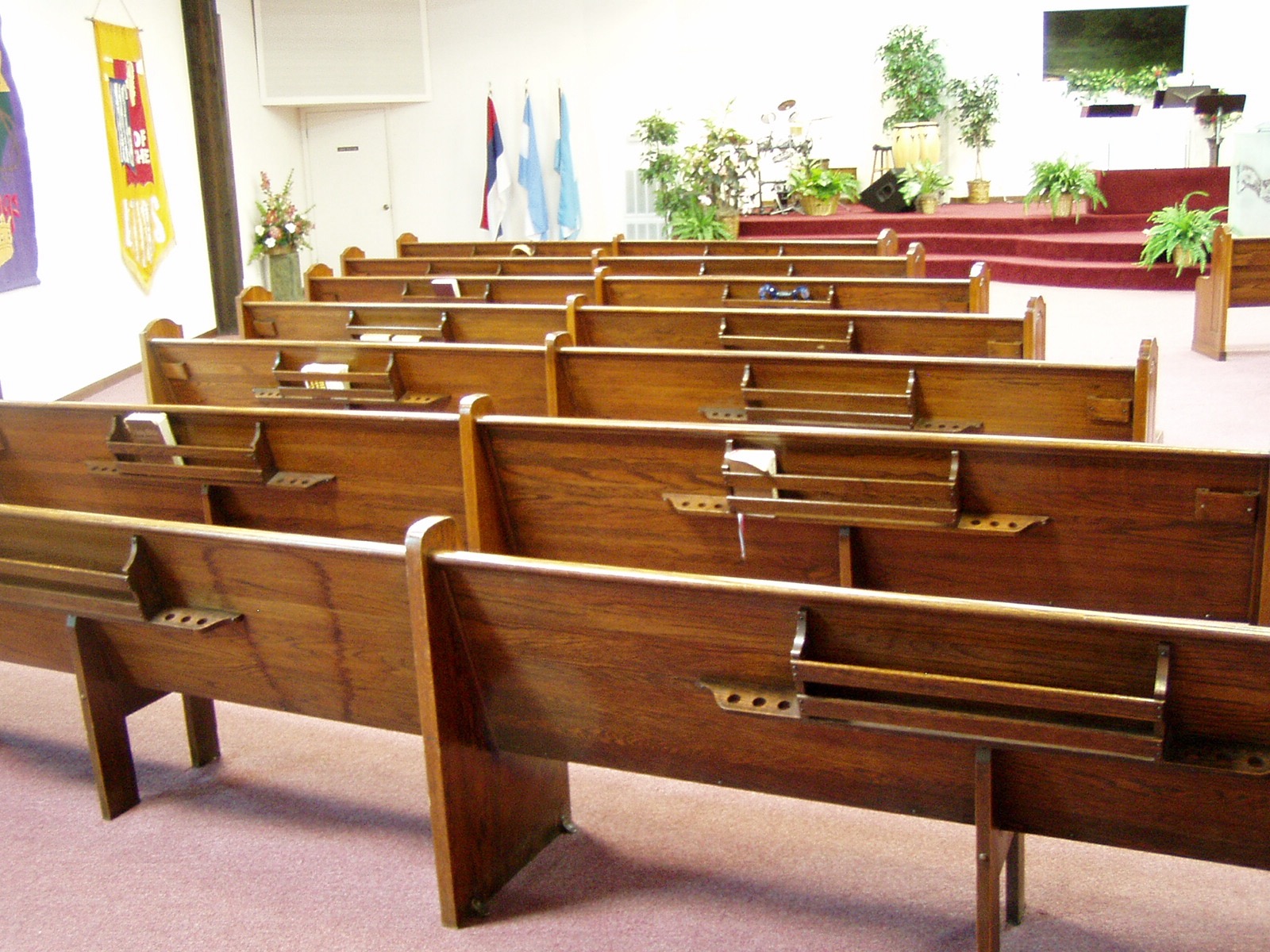
This perception issue can extend to potential members, who might associate the storefront location with financial instability or a lack of resources. For some, the absence of traditional symbols such as steeples, stained glass windows, and pews may detract from the spiritual atmosphere they expect in a church setting. Over time, these perceptions can impact the church’s ability to grow and sustain itself.

Acoustics and Ambiance

Storefronts are not designed with worship services in mind, and this often leads to challenges with acoustics and ambiance. Traditional church buildings are constructed to enhance sound quality, ensuring that sermons, music, and prayers resonate effectively within the space. Storefronts, on the other hand, often have flat ceilings, hard floors, and minimal soundproofing, which can result in poor acoustics and echoing.

Luckily, the acoustics are not very bad in our storefront. I preach without a microphone every Sunday (not a hard thing to do when our average attendance is 30, but if we grow, I’ll probably have to rethink it). More people absorb more sound. Without a microphone, I might become muffled. Heck, they might think I’m muffled now, but they haven’t said so if that’s the case.

The lack of ambiance in a storefront can also hinder the spiritual experience. Traditional church buildings often feature architectural elements like vaulted ceilings, intricate woodwork, and natural lighting, all of which contribute to a sense of reverence and awe. I’ll confess that our team has done a fantastic job of creating a worshipful ambiance in our space, but many storefronts can feel sterile or utilitarian, which can make it difficult for congregants to feel spiritually connected or inspired.

Zoning Issues

Operating a church in a storefront can also lead to zoning and legal challenges. Many municipalities have specific zoning regulations that restrict or limit the use of commercial spaces for religious purposes. I haven’t found that to be the case with Bossier Parish, but if you’re thinking about a storefront church in another community, it’s best to check zoning early in the planning process.

Churches may be required to apply for special permits or variances, which can be time-consuming and costly. Additionally, these regulations often limit the types of activities that can take place within the space, further constraining the church’s ability to serve its congregation and community.

Parking is another common issue associated with storefront churches, and it certainly it with ours. We’ve got four spaces in front of the church and have to utilize a parking lot for a strip center next door. Spots fill up fast when we have a large (40 people) crowd for church. Any growth we experience will ultimately be impacted by limited parking.

Financial Limitations

Storefront churches are a cost-effective alternative to traditional buildings, as I mentioned in my previous blog. That notwithstanding, they can also present significant financial challenges in the long term.

Leasing or purchasing a storefront space is initially more affordable, but the costs associated with retrofitting the space for worship can be substantial. Churches may need to invest in sound systems, seating, lighting, and signage to make the space functional and welcoming.

Additionally, rent will go up at some point, which can strain the church’s budget. Unless your landlord is a member of the congregation and has mercy on it, rent will increase. If rents become unaffordable or the property owner decides not to renew the lease, the congregation may be forced to relocate, disrupting their operations and sense of community.

Deep Roots

Traditional church buildings often serve as landmarks and gathering places, hosting events, providing shelter, and offering a range of social services. Storefronts, by contrast, may not have the space or facilities needed to support such activities. This can restrict the church’s ability to act as a hub for community life and outreach.

Moreover, the transient nature of storefront operations can make it difficult for a church to establish deep roots in the community. If the congregation frequently moves or struggles to maintain a visible presence, it may struggle to build trust and foster long-term relationships with local residents and organizations.

Conclusion

This much I know: For every advantage a storefront may offer a congregation, there is an equal disadvantage. The task of the pastor and the congregation is to weigh the advantages and disadvantages appropriately, pray and then follow the leading of the Holy Spirit.

I’m uncertain how the storefront will impact our congregation yet. We haven’t been in the space long enough to know. I know God has put us here for now, so we’ll seek to be faithful to the call we hear going forward.

But still, if you’re in the Bossier Parish, Caddo Parish or Webster Parish area, please come join us. Perhaps you’ll help us figure it out.

Until next time, keep looking up…

Preaching in the Storefront…

Yup! I preach in a storefront every week. Who would have thought after over 30 years in ministry that I’d end up in a storefront church? Well, apparently the Lord thought it because here I am.

Haughton Methodist Church (the church I began pastoring late last year) meets in a rented storefront. Well, actually the building was originally a church that outgrew the facility. It was converted to an office building and was used as such for the last couple of decades.

I must say the rented storefront is much better than the rented hotel room the congregation used for the better part of nine months. I gotta give props to the faithful in the congregation who were committed enough to set up and tear down that hotel room week in and week out. That’s a lot of work and a lot of commitment.

Of course, Haughton Methodist Church was meeting in the hotel room (and now the rented storefront) due to its disaffiliation from the United Methodist Church. Well, not really disaffiliation. They missed that boat for reasons I won’t go into, but suffice it to say, they walked away from their property…just threw the Louisiana Annual Conference the keys…and began the journey as nomads. I applaud the congregation’s faith and faithfulness. It’s one reason I’m blessed to serve them as pastor.

Preaching in a storefront has really had me thinking and praying about a strategy for the congregation moving forward. That part of being a pastor hasn’t left me. In my contemplation, research and prayer, I’ve discovered there are a few advantages to meeting in a rented storefront. I thought I’d share a few of those with you today.

Financial Flexibility

The first (and perhaps major) benefit of renting a storefront for church meetings is the financial flexibility it provides. Establishing a permanent church building requires significant upfront capital for purchase or construction, not to mention ongoing maintenance, utilities, and other operational costs.

I did a little investigating and discovered the congregation’s old facility is listed for sale by the Annual Conference for $445,000.00 (you can check it out here). That’s a lot of money to a small congregation like ours! If someone wanted to purchase it and gift it back to the congregation, now that’s a conversation we’d be open to!

For a small or growing church, this financial burden can be overwhelming and will divert resources from ministry programs, outreach, or other crucial areas. Renting a storefront, on the other hand, often provides a more affordable alternative. The monthly rental cost is predictable and easier to manage, allowing us to allocate our resources to other vital areas such as outreach efforts or mission work.

Additionally, renting avoids the long-term financial commitment and debt associated with owning property, offering us the flexibility to adjust as our needs evolve. Hey? We’ve got a one-year lease. That gives us time to discern God’s next steps for the congregation.

Visibility and Accessibility

Another benefit that a storefront location can offer is significantly more visibility and accessibility than a traditional church building, particularly if the church is situated in a busy commercial area like ours. There’s not a lot of foot traffic where we’re located, but we get great exposure to passing drivers, and our proximity to local businesses makes our storefront church a visible part of the community.

We’re located right next door to an oil change shop, which I find incredibly ironic, but that’s for another blog.

I’m praying this increased visibility can attract new visitors who might not have otherwise considered attending church, whether due to curiosity or the convenience of being located near their place of work, shopping, or living.

Community Engagement

A third advantage (should we choose to capitalize on it) to renting a storefront can be an intentional decision to engage with the surrounding community. Unlike churches housed in large, traditional buildings that may be tucked away in suburban areas, a storefront church is situated in the heart of the local community.

This proximity offers numerous opportunities for interaction with people who may not otherwise step foot inside a traditional church building. Church members can become familiar faces in the neighborhood, and the church itself can become known for its commitment to the well-being of the community.

I’ve already made several visits to the neighboring oil change facility to carry left over treats from our fellowship time. I hope to build an on-going relationship with those guys.

Additionally, I can see our storefront offering opportunities to host events, activities, and programs that reach a wide array of people. Whether it’s offering after-school programs, hosting community events, or providing social services like food banks or job training, a storefront church can effectively serve as a community hub.

Because of its location in a commercial area, a storefront church is more likely to attract people who are not actively seeking a church but may be drawn to the church’s services or outreach activities. This creates a sense of accessibility and relevance, positioning the church as an integral part of the community rather than as a separate entity.

Adaptability

Renting a storefront gives our congregations the ability to remain adaptable and flexible in our growth and development. As we grow, our needs will change, and our storefront offers us the flexibility to move to a larger or different location when necessary.

Unlike a permanent building, a storefront will allow us to scale up or down based on attendance, financial health, and ministry priorities. This adaptability is especially beneficial for us in what I’m calling “our formative years.” It will allow us to respond quickly to changing circumstances without being tied to a long-term commitment.

Furthermore, our storefront landlord has given us some flexibility in changing our layout as growth and needs dictate. Our storefront can be customized to suit the needs of the congregation and community. Unlike traditional church buildings, which often have fixed architectural features such as pews, stained glass windows, or large sanctuaries, storefront spaces are usually more neutral and open.

This gives us the freedom to design our space according to our unique vision and style. Whether it’s creating an inviting, contemporary worship space or setting up an area for fellowship and community gatherings, a storefront can be easily adapted to accommodate various church activities.

A Final Thought

As I’ve had time to pray and reflect on our situation at Haughton Methodist Church, I’ve discerned that being in a storefront is both practical and strategic. It’s a choice that can support our long-term growth and success (even more than getting our old property back).

Ultimately, the success of our congregation will not be defined by the building we meet in, but by the relationships we foster, the ministries we engage in, and the impact we have on our community.

So, if you’re in Bossier Parish, Caddo Parish or Webster Parish, and you’ve never considered the possibility of worshipping in a storefront, why don’t you join us at Haughton Methodist Church. We’d love to have you on this incredible journey!

Until next time, keep looking up…

Advice to Young Preachers (and maybe some old ones, too)…

I’ve been preaching for 34 years. It was 34 years ago this month that I preached my first sermon in my home church of Chatham, LA. I’ve been reflective this week as I look back on that event. I remember being scarred stiff, nervous as a long-tailed cat in room full of rocking chairs and utterly exhilarated, all at the same time.

What I remember most, though, is that the sermon was short and I read through it at supersonic speed. It probably lasted all of ten minutes, but for the kid who was delivering the sermon, it felt like an eternity.

I think I’ve come a long way in 34 years. As I reflect on 34 years of preaching, I thought I’d share a few things I’ve learned along the way with any young preachers (and old ones, too) who might read this blog. So, here goes…

1) Stay Teachable

I don’t care that we live in the Information Age and that you grew up with a phone in your hand that holds more information than all the books in the Smithsonian Library. You don’t know it all. How do I think you think you know it all? Because as a 27 year-old young man, I thought I knew it all, too. I didn’t!

No matter how many years you’ve been preaching, there’s always more to learn. Stay humble, be open to correction, and continually seek growth. Whether it’s from books (yes, books!), mentors, or life experience, always be a student of the Word and the world around you.

2) Guard Your Heart

Listen to me, you young whipper-snapper: The Devil is coming after you. No matter what you think, he is working to defeat you and God’s Word, and he will use every tool at his disposal. You are not invincible. How do I know you’re not invincible? Because I wasn’t.

I have fallen. Many times. The Devils attacks never cease. That’s why it is necessary to ALWAYS guard our hearts. The demands of ministry will lead to burnout (been there, done that), frustration, and even moral failure (ask this preacher, and this one and this one, too).

This veteran preacher would warn you to protect your heart—stay faithful to your spouse, keep your integrity intact, and be wary of the temptations that come with being in a position of power or influence.

3) It’s Preparation over Performance

It’s easy for preachers (both young and old) to get caught up in the performance aspect of preaching—delivering a good sermon, impressing the congregation, or even gaining popularity.

Preaching isn’t about performing. Yes, there are aspects of “performance” that every preacher brings to the pulpit. But, preaching isn’t about the performer. It is about communicating the Truth of God’s Word. That can only happen after the preacher has spent time in the Word, given his heart to preparation and been obedient to the Holy Spirit.

This old preacher would remind you to keep Christ at the center of everything you do. The goal is to be a humble vessel for the Lord’s message, not the messenger that gets all the attention. Our job is to point people to Jesus, not to make them admire us.

4) Don’t Fear Failure

I always wanted my next sermon to be better than my last sermon. It is a lofty goal, and one worthy of pursuing. After all, we are supposed to offer our best to the Lord. Give him the best fruit, not the last fruit.

Let this old preacher remind you that you will not hit a home run every time you step up to the plate. Home run? Heck, you’re not even going to get a single every time. A fellow by the name of Josh Gibson holds the all-time record for batting average in professional baseball at .3716. That’s getting a hit less than 40% of the time.

Do your best to prepare (see #3 above). Seriously, I used to contemplate theatrics and drama, bells and whistles, etc., to make the sermon better. I’ve shared about the philosophy that drove that mentality before (see it here), so I won’t unpack that again. I no longer seek out those “dramatic” elements, but the desire for the next sermon to be better than the last one hasn’t gone away.

If you fail (and you will), fail in the delivery. Please, please, please, do not fail in the preparation. Failure is part of the journey. Learn from it (see #1 above), and keep moving forward.

5) Stay in Love with the Lord

This should probably be number 1. Oh, well! I’m not reorganizing the list now. Our ministry can only be as deep as our personal relationship with the Lord. We cannot lead our people where we have not been.

Ministry is a calling that requires spiritual depth. This old preacher would stress the importance of prayer, Bible study, and personal devotion. Without these, your ministry risks becoming shallow and empty, and you’ll struggle to minister effectively to others.

Put another way, your next sermon may be better than the last, but it will only be from the performance aspect.

Staying in love with the Lord will also help you guard your heart (see #2 above).

6) Preach the Gospel, Not the Culture

It’s tempting to give people what they want to hear, but this seasoned preacher would encourage you to always stick to the truth of God’s Word, even when it’s difficult. Our role is not to appease the crowd but to communicate the life-changing truth of the Gospel, which may not always be easy to hear.

You will hear from your congregation occassionally these words: “I come to church to feel good, to get a re-charge.” How do I know you’ll hear that? Because I’ve heard it, too…in every congregation I’ve served. Don’t fall for it. Sometimes the Gospel is meant to challenge us. Live into that reality.

Don’t preach only what’s easy to preach. Preach what is True!

7) Love Your Congregation

It’s easy to get caught up in programs, projects, or numbers, but might this old preacher remind you to genuinely care for your people? Ministering to them requires listening, understanding, and showing them love in practical ways, not just delivering a sermon on Sundays. People need to know you genuinely care about their lives, their struggles, and their joys. Besides, you can’t preach Truth to people you don’t really know.

8) Don’t Do it Alone

Never stop seeking the wisdom of those who’ve been in the trenches before you. The value of mentors is immeasurable. I encourage you young preachers to find and lean on those who have walked the path before, seeking counsel, encouragement, and accountability. You don’t have to figure it all out alone.

9) Take Care of Your Family

Your ministry at home is as important as your ministry in the pulpit. Let this old preacher stress the importance of balancing family life with church responsibilities. A healthy marriage and family will not only keep you grounded but will also provide a good model for your congregation. Don’t neglect the people closest to you in the name of serving others.

10) Embrace the Responsibility

Do not take your calling lightly. It is the greatest calling in the world. It is also the most humbling calling in the world when one considers the spiritual destiny of others is in our hands. This old preacher would tell you to be mindful of the heavy burden that comes with leading people in their spiritual journey. Be cautious with your words, actions, and decisions because they can have a profound impact on others’ faith.

Conclusion

So, there are ten things I would say to a young preacher after 34 years in the pulpit. I probably didn’t say them very well. There is probably more I could add, but I figure ten is a solid list to begin with. Maybe we could share a cup of coffee and come up with more.

Maybe you could add more to the list. Please do so in the comments. I’d love to hear them because old preachers need advice, too.

Until next time, keep looking up…

Twenty Minutes a Day: Ten Reasons to Read the Bible in a Year

I am on a journey (again) to read the Bible in a year. It is a spiritual exercise I’ve practiced before, but I decided it was time to take up the practice once more.

I started the journey on January 1st, but I did something a little different this year, I invited the congregation I pastor to take the journey with me.

We are a congregation in transition (click here to go to our website) (click here to go to our Facebook page), so I thought it might be nice as we seek a vision of God’s calling for our congregation if we could “be on the same page” for this year of discernment.

This year I found an incredibly helpful tool that makes the discipline easier (it is a daunting task, I don’t care what anyone says). It’s the Bible in a Year Bible (find it here). No more flipping from the Old Testament to the New, back to the Psalms and to Proverbs. The readings are all in one place on a couple of pages to make the discipline simpler. I’m down for that!

Now that I’m five days into the process, I’ve rediscovered it takes about twenty minutes a day to read the passages. Twenty minutes a day! I thought it might be helpful if I share ten reasons to spend twenty minutes a day with the Bible, so here goes…

1. Spiritual Growth

One of the most significant reasons to read the Bible in a year is the opportunity for spiritual growth and maturity. The Bible is not just a collection of ancient writings; it is the living Word of God.

Hebrews 4:12 describes Scripture as “living and active, sharper than any two-edged sword,” meaning it has the power to change us. Reading the Bible regularly shapes our hearts, minds, and actions, transforming us into the image of Christ.

The more we immerse ourselves in Scripture, the more we grow in wisdom, understanding, and Christlikeness. Over the course of a year, this daily discipline allows for a deep, sustained relationship with God that produces spiritual fruit.

2. Understanding of God’s Word

The Bible is a complex book (book of books, actually) that spans different genres, time periods, and cultures. By committing to read the entire Bible in a year, we gain a better understanding of its structure and message.

Rather than cherry-picking verses that are familiar or comfortable, reading through the Bible helps us understand the broader narrative—God’s creation, His covenant with Israel, the life and teachings of Jesus, and the early church’s development.

An holistic understanding is essential for knowing God more fully and living in light of His truth.

3. A Closer Relationship with God

One of the most intimate ways to develop a relationship with anyone is to spend time with them. In the same way, reading the Bible is an act of seeking God.

The Bible is God’s communication to us—His words of love, instruction, and correction. By setting aside time each day to read Scripture, we invite the Lord to speak directly into our lives.

Whether we’re reading a psalm that comforts, a prophecy that challenges, or a teaching of Jesus that guides us in how to live, each passage is an opportunity for connection. The more we read, the deeper our relationship with the Lord will become. His presence becomes tangible as we learn more about His character, His plans, and His promises.

4. Overcome Challenges

Life is full of challenges, whether they come in the form of personal struggles, health issues, relationship problems, or spiritual doubts. Reading the Bible in a year provides a foundation for facing these difficulties.

The Scriptures are filled with stories of people who encountered hardships—yet through faith, perseverance, and God’s intervention, they overcame. From the Psalms that express raw emotion in times of distress to the letters of Paul that teach endurance through suffering, the Bible offers encouragement, wisdom, and promises for every situation in life.

Regularly reading God’s Word gives us the spiritual armor we need to face life’s trials with hope and confidence.

5. More Knowledge and Wisdom

Knowledge of Scripture is essential for wisdom. The Bible is not only a spiritual guide but also a practical manual for living. Proverbs 2:6 tells us that “the Lord gives wisdom; from His mouth come knowledge and understanding.”

Reading the Bible regularly equips us with knowledge that can guide us in every area of life—from decision-making and relationships to work and finances.

The book of Proverbs, in particular, is full of practical advice for living wisely, but the entire Bible is rich with principles that can be applied to modern life.

Whether through moral guidance or examples of wise leaders, reading the Bible in a year enhances both our intellectual understanding and our ability to apply God’s wisdom in daily life.

6. Transformation and Renewal

Romans 12:2 urges believers to “be transformed by the renewing of your mind.” One of the most powerful ways to renew our mind is through regular exposure to Scripture.

As we read the Bible, the Holy Spirit works to change our thinking and refine our heart. The Bible provides a lens through which we can view the world more clearly, helping us discern truth from error, good from evil, and what is of eternal value from what is fleeting.

As we spend time in God’s Word, our priorities shift, our values realign with His, and our desires are transformed. Over the course of a year, this process of transformation leads to a life that reflects God’s will more clearly.

7. A Deep Appreciation for Jesus Christ

The Bible is ultimately about Jesus Christ—both the Old and New Testaments point to Him as the central figure in God’s redemptive plan.

Reading the Bible in a year gives us a greater appreciation for who Jesus is and what He has done. In the Old Testament, we see foreshadowings of Christ through prophecies, sacrifices, and types. In the New Testament, we witness His life, death, and resurrection.

A year-long journey through the Bible helps us see Jesus as the fulfillment of God’s promises and the hope for all people. This deeper understanding leads to a greater love and devotion for Christ, as we see more clearly the scope of His work and His sacrifice on our behalf.

8. Stronger Faith

Faith gets stronger by hearing the Word of God. Romans 10:17 tells us, “So faith comes from hearing, and hearing through the word of Christ.” Regularly reading Scripture deepens our understanding of God’s promises and His faithfulness.

When we read about God’s faithfulness to Abraham, Moses, David, and the early church, we are reminded that God has always kept His Word. This encourages us to trust Him more fully in our own life.

As we see how God has acted in history, we are emboldened to believe that He will continue to act on our behalf. A year of daily Bible reading cultivates a growing faith, rooted in the truth of God’s Word.

9. Inspiration to Share the Gospel

The Bible is not just for personal growth; it is also the foundation of the Christian message. As we read the Bible in a year, we will be better equipped to share the gospel with others (ain’t this what we’re supposed to do?).

The teachings of Jesus, the apostles, and the prophets give us the words to speak when we encounter someone seeking answers to life’s most important questions.

The Bible is filled with verses that highlight God’s love for us, His desire for salvation, and His offer of grace through faith in Jesus Christ. A more thorough understanding of Scripture helps us to communicate the gospel message clearly and confidently, empowering us to be a witness to others.

10. Accomplishment and Discipline

Finally, reading the Bible in a year gives us a sense of accomplishment and develops the discipline of consistent Bible study (Bible study IS a spiritual discipline, after all).

Committing to read the Bible daily is a challenge, but completing it is a rewarding achievement. The Bible is a large book, and reading it in its entirety requires commitment and perseverance. This experience cultivates self-discipline, which is a virtue that extends beyond Bible reading.

By committing to this goal and following through, we not only enrich our spiritual life but also build character. We can look back at the end of the year and marvel at the depth of insight we’ve gained and the personal growth we’ve experienced.

A Closing Thought

So, it’s January 5th. Want to join the journey? Don’t worry! It’s okay to pick up the process now. Just adjust your days by five. So, you won’t be on the same page as me. You’ll still reap the benefits of the process.

Just a word of encouragement before I close…

Don’t beat yourself up if you miss a day or two. The spiritual disciplines are not meant to be wicked taskmasters trying to whip us into shape. They are gifts of grace from the Lord meant to draw us closer to Him. Simply start where you left off. Reading the Bible in a year doesn’t have to extend from January 1 to December 31, you know?

Hope this was helpful, and I hope you’ll join me on the journey.

Until next time, keep looking up…