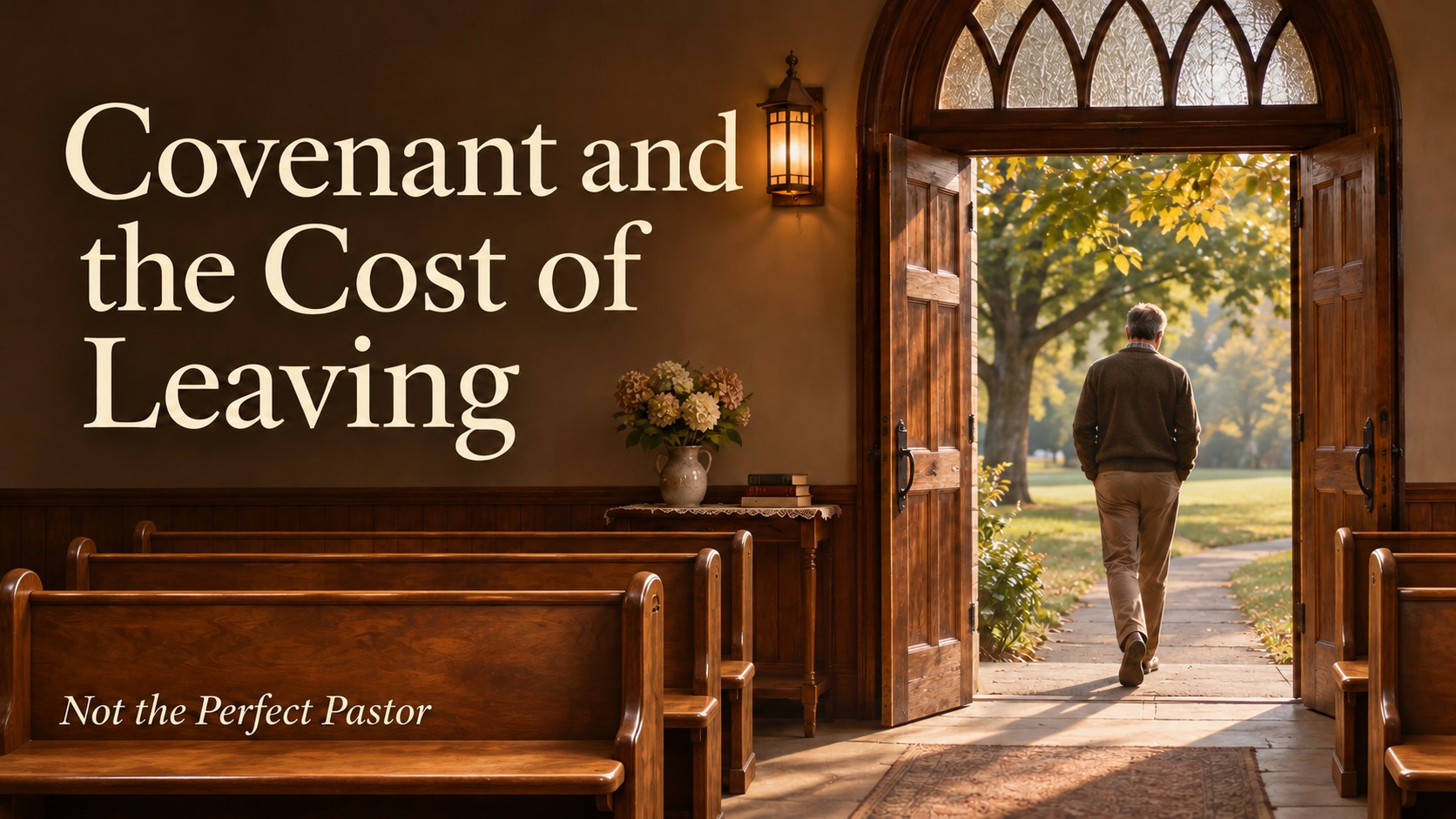
I signed up for the covenant. That is where I need to begin this reflection. In my recent articles, I have asked, “Justice by whose definition?” The question behind this one is closely related: What do we mean when we speak of covenant, and what do we owe one another when we enter it?
Two recent posts from Facebook friends brought that question back to me. Both addressed the conflict involving Highland Park United Methodist Church and the Horizon Texas Conference. One emphasized the obligations clergy and congregations accept within a connectional church. The other questioned the consistency of leaders who invoke those obligations after departures from church law within their own ranks.
I understand the first argument. The second touched something that was central to my decision to leave The United Methodist Church in 2019.
The promises I made
I spent more than twenty-eight years as a United Methodist elder. I served congregations and served as a district superintendent. I understood that I belonged to a connectional church. I knew there were obligations that came with that relationship, and I had accepted them.
I also knew those obligations did not disappear every time I disagreed with a decision. A covenant that requires nothing of us when keeping it becomes difficult would be a pretty thin covenant.
Covenant in this sense is a biblical concept. God initiated numerous covenants throughout the Bible, culminating in the new covenant in the Gospel of Jesus Christ. The idea of covenant involves promises made before God, shared responsibilities and a commitment to seek one another’s good. Grace, truth, accountability and the work of reconciliation all belong to the covenant relationship.
Let me offer a word of clarity: a denominational covenant draws on biblical covenant, but it is not equivalent to God’s new covenant in Christ.
As the division within the denomination deepened, I struggled with my own place in it. I did not believe we could continue living faithfully as a divided people. I was angry with denominational leaders for failing, in my judgment, to lead in a way that reflected the covenant we had all agreed to uphold.
And I was troubled by my own faithfulness. There were aspects of my relationship with the denomination in which I felt I was falling short of the covenant I had accepted. That was on me. I did not want to be a covenant-breaker.
By 2019, I had reached a painful conclusion: I could no longer live faithfully within that covenant. Yet leaving felt like breaking it, too.
I was a delegate to the special General Conference in February of that year. Afterward, I knew I would leave, and I did so in August. That decision did not neatly settle the question of my faithfulness. I left carrying the weight of promises that still mattered to me.
When mutual accountability becomes doubtful
That history explains why one friend’s reflections resonated with me. He raised the question of whether the Book of Discipline functions as the law of the church or as a collection of requirements some people may choose to disregard.
I understand the force of that question. If we agree to live under a common Discipline, its authority cannot depend on whether we happen to agree with the provision before us.
Bishop Melvin Talbert’s actions were one example. He officiated at a same-sex union in 2013 despite the church’s prohibition. A complaint followed, and a “just resolution” was announced in 2015. He did not face a church trial or the possible loss of his credentials. There was a process. My question is whether that outcome demonstrated the accountability the covenant required.
Then came the election and consecration of Bishop Karen Oliveto in 2016. In 2017, the Judicial Council ruled that consecrating a bishop who was a “self-avowed practicing homosexual” violated church law. It also said she remained in good standing pending the appropriate administrative or judicial process. The ruling did not itself remove her from office.
My concern extended to every bishop who laid hands upon Karen Oliveto in that consecration. In my estimation, they, too, broke covenant and should have faced disciplinary scrutiny for participating in an action contrary to the church order they were entrusted to uphold.
What others celebrated as courage, I understood as a breach of our shared commitments. I could recognize the sincerity of their convictions and still ask why those convictions appeared to carry more weight than the promises we had made together. Who gets to have disobedience understood as an act of conscience, and who gets to have it treated as a failure of covenant?
For me, these events weakened confidence that our commitments were genuinely mutual. I was still examining whether I was keeping my promises while wondering whether the same seriousness was expected throughout the connection.
Another person’s unfaithfulness did not excuse my own. It did, however, affect whether I could trust the relationship we were asking one another to preserve.
The weight of questioning faithfulness
Another friend’s post emphasized the covenantal obligations of the Highland Park pastors. He says he does not presume to judge their character or private motivations. He also raises questions about their covenantal fidelity and whether their conduct warrants accountability.
Those are serious questions. Their conduct is not beyond examination, and I can’t resolve their faithfulness from the outside.
But I know what it feels like to wrestle with the possibility that leaving makes you a covenant-breaker. I know that departure can follow a painful examination of promises rather than an easy dismissal of them. When we question someone’s covenantal fidelity, we should leave room for that possibility.
My friend expressly acknowledges that accountability must apply throughout the connection. I agree. What I find missing is a fuller reckoning with the history that has made appeals to covenant difficult to trust.
Saying one has an obligation to a covenant doesn’t repair the trust damaged when people believe that obligation has been applied selectively. Saying that everyone is accountable should be followed by evidence that everyone is.
What covenant requires of us now
None of this automatically justifies Highland Park’s decisions. Nor does it mean that a violation of church law makes every other provision optional. That would leave us with no meaningful common commitments at all.
It means the church needs to examine more than the faithfulness of those who seek to leave. Those who exercise authority must also examine how their leadership has strengthened or weakened the trust on which covenantal life depends.
Too often, what I heard from leadership—whatever the intention—was, “Shut up and follow me!” That is how appeals to covenant sounded to me when questions about accountability went unanswered. What I needed to hear was a willingness to examine their own part in the breakdown of trust. An appeal to covenant would have carried a lot more weight had it been accompanied by an honest wrestling with questions like these:
What have we acknowledged? Where have we accepted responsibility? What have we done to repair relationships damaged by inconsistent accountability? How have we listened to people who believe they can no longer remain without compromising their own faithfulness?
Those questions belong alongside questions about clergy obligations and congregational responsibilities. They belong to all of us who have exercised leadership, myself included.
I can’t claim that I handled every part of my own struggle perfectly. I can say that the covenant mattered to me. That is why remaining became so difficult, and why leaving was painful. It is also why I entered a covenant with another denomination. I still believe in making promises before God and accepting the responsibilities that come with them.
That belief is also why I want the church to take the work of repairing trust as seriously as it takes the work of enforcing obligations. We need the humility to acknowledge where we have failed one another, the willingness to accept responsibility, and the grace to listen when someone says that staying has become a crisis of conscience. None of that makes our promises less important. It gives us a way to honor them even when the relationship is breaking.
I signed up for the covenant. It still means something, and because it means something, I believe we owe one another more than an accounting of who broke it. We owe one another an honest reckoning with what it would take to restore trust. We did not find a way to remain together. But those of us who left and those who remain still owe one another grace, humility, and kindness.
We no longer share a denomination. We still share the same name Methodist, and with it, more importantly, the call of Christ to love one another. May we all covenant to do so.
Until next time, keep looking up…
If any of my reflections encouraged or challenged you, follow Not the Perfect Pastor on Facebook for more conversations about faith, ministry, and becoming faithful disciples of Jesus.

