I’m not the perfect pastor. I’m not the perfect pastor because I’m not a perfect person. Among the many foibles I possess is not know when to keep my mouth shut…well, let me clarify that. I know when I should keep my mouth shut. The foible is in actually keeping my mouth shut.

I should probably clarify that further. My tendency is to keep my mouth shut when I should speak up and to open my mouth when I shouldn’t speak up. I’m uncertain as to which I’m doing this morning, but here goes anyway…well, because I’m not the perfect pastor.
Faith and Politics…again!
Those who know me know (and I’ve confessed) that I am a bit of a political junkie. Naturally, the election season has my interest peaked. Because I’ve also been a pastor (and probably will be again someday), I’m always looking at the intersection of faith and politics. It always raises the question, “How does our faith inform our politics?”
Some people might proffer the question, “Should our faith inform our politics?” I say if our faith doesn’t inform our politics, it’s probably not much of a faith.
So, how is faith informing politics this election cycle? Well, I’m glad you asked!
I came across this interesting survey from Rasmussen Reports last week. Rasmussen is an independent polling organization that polls daily through each election cycle. It is independent in the sense that it is neither left nor right leaning, and it does its best to “weight” its polls so that their polls aren’t skewed one way or the other. It is also independent in that they neither depend upon outside money, nor do they receive outside money to conduct polling. Seems to me that is how it should be.
Here’s what their polling found, and what I find interesting in the intersection of faith and politics: people of faith (all faith backgrounds) are generally voting for Donald Trump. Here’s the breakdown Rasmussen reported:
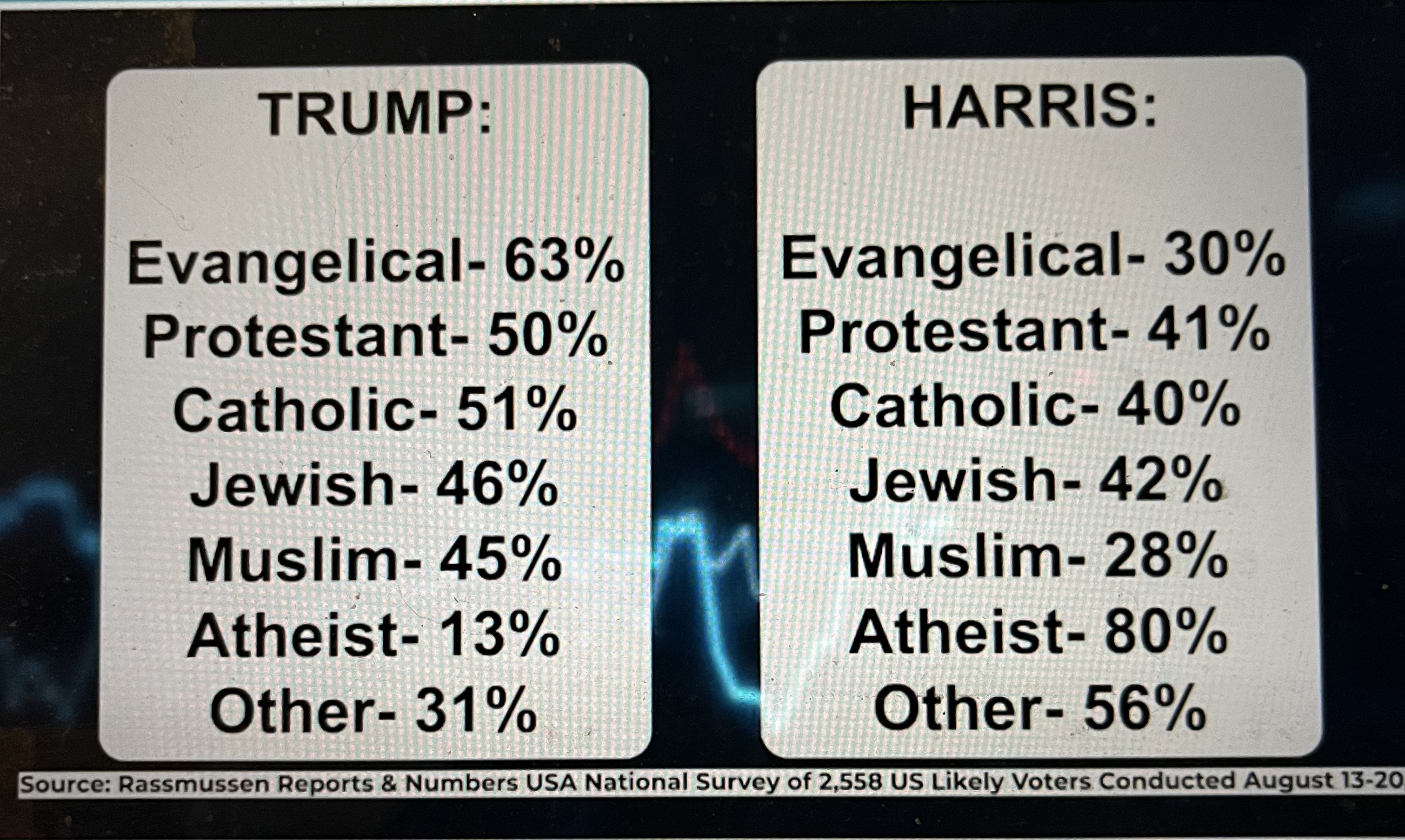
This poll is getting little attention in the media. The only reason I found it is because I was looking for it. Though it is getting little attention, I find it quite revealing in showing there really is a clash of cultures in this election and that clash is between the religious and the non-religious.
Every major faith group (except “other”) is voting in the majority for Donald Trump, and the only group even close to the margin of error is the Jewish faith. “Other” would include Hindu, Buddhist, et. al., and I only assume they were lumped together because the sample size of each was too small to be reliable.
While people of “other” faith backgrounds support Harris, the overwhelming majority of atheists support her. I’m sorry, but that just gives me pause as one who identifies as an evangelical believer in Jesus Christ.
It’s not that I believe Kamala Harris to be a non-religious person. According to Biography.com, she grew up in a black baptist church, has attended Hindu temples (as a result of her Indian heritage) and married a Jewish man. Now, that’s what I call an intersection of faith and politics!
Atheism in the Public Square
When I consider that the “atheists” could be the deciding factor in the most consequential election of our lifetime, I am concerned about the direction of our nation. Every national poll shows this election to be a toss-up (see here and here for two of the most recent). The atheist vote could very well make the difference.
Why do so many atheists support the Democratic Party? From what I’ve been able to discern, it comes down to two things: abortion rights and Christian nationalism. I’d post a few links here on abortion rights and Christian nationalism but you can do a simple Google search and find all the links you need. You’ll be reading for days.
Let me just get this out of the way: I am staunchly pro-life, and that is pro-life in the sense that life begins at conception and that every avenue must be pursued to protect that life. I am also a pragmatist (and not a Christian nationalist) and I believe that the Supreme Court of the United States got it right when they returned the abortion debate to the individual states. That is just one place where my faith informs my politics, and yes, I know it sets up its own clash of cultures. But, I’m just an old white guy, so what do I know?
A “Christian” Nation?
No, I’m not a Christian nationalist (as the term is most commonly defined–it’s a relatively new term, by the way). I do not believe that the United States must be a “Christian” nation, but I do believe that the United States of America was formed (and its underlying foundational documents designed) by people who were Christian, or whose philosophical/ideological perspective were rooted in the Judeo-Christian worldview.

The values and morals that shaped this nation are the values and morals that have their foundation in Scripture. The further we move away from those values as a nation, the more endangered the American experiment becomes…and the more godless the culture becomes. We are far down that road now. I’m wondering if there is a U-turn in our future? I’m wondering if this election cycle will tell us?
Not that Donald Trump is a bastion of Christian morality. His moral failures have been documented copiously, and you can do your own Google search on that, too. Honestly, I believe we are left with the two choices we have for President of the United States BECAUSE we have become unmoored from the Judeo-Christian values upon which this nation was founded.
I also believe the election of Donald Trump won’t provide the U-turn the nation needs to preserve our nation. It might slow it down a little, but it won’t turn it around. The U-turn that matters will happen in the Church through the power of the Holy Spirit. It will take a spiritual revival on the level of the first and second Great Awakenings. It will take prayer and preparation that can only begin in the faith communities of our nation.
The Ripkens
I won’t say who I’ll be voting for in this election. I’ll only say I won’t be voting with the atheists. You can if you want, but don’t come crying to me when we become a completely godless nation. Of course, becoming a completely godless nation might not be such a bad thing. Ask Nik and Ruth Ripken, they can tell you.
The Ripkens were missionaries to Malawi and Somalia, and it was while they were in Somalia that they lost one of their three sons. Their loss forced the Ripken’s to reconsider their calling, and after some reflective time, they were assured they were called to be missionaries, although the focus of their ministry shifted.
They felt called to go into the regions of the world where Christians were persecuted greatest to discover ways they could be in ministry to them. Nik Ripken began by traveling to Russia, China and Central Asia to interview members of the persecuted church.
What he discovered was not that we needed to do anything to help the persecuted church, but that it was his faith that was resurrected by the faithful witness of those Christians. They heard stories of pastors imprisoned and emaciated, yet still clung to their hope in Christ. They heard stories of fathers separated from their families because they smuggled bibles in for others to discover Christ.
In China, he was able to meet with about 150 house church pastors to hear their stories. He said no one really knew what they would find in China. In 1948, when communism came to China, the church was outlawed. At the time, there were between 400,000 and 700,000 Christians.
No one really knew if the church had survived after all these years. Yet, today there are over 10 million Christians in a nation that is openly hostile to their faith. The church flourished in conditions it should not have. The 150 pastors, after telling their stories to Ripken began to ask, “Has Christ made it to the rest of the world?”
What the Ripken’s discovered was that where the church was persecuted the greatest was the very place where faith has thrived the greatest. History has taught the same lesson. The burning question Ripken had for all he interviewed was, “Is Christ worth it?” Is Christ worth the suffering, the imprisonment, the loss of family and even death? As one interviewee said, “Oh, Christ is worth it!”
The lesson for me as I live in this culture that is shifting around me is to ask myself, “Is Jesus worth it?” When all cultural accommodation for the Christian faith ends, will Jesus be worth it? Will Jesus be worth my family? Will Jesus be worth my job? Will Jesus be worth my life?
I pray that I can say, “Oh, Christ is worth it!” My fear is I won’t have the courage.
Until next time, keep looking up…
 Not the Perfect Pastor