Grace and the Government…

I just can’t seem to get politics off my mind (I can’t imagine why!). Perhaps writing about it will help to clear the many cobwebs that appear to be clouding my judgement these days. If I were exercising good judgment, I’d stay as far away from politics as I can, but I’m not exercising good judgment, so…

I am thinking primarily of the Apostle Paul’s instructions to the Roman Church in Romans 13. It gives me no small amount of heartburn to read his words, especially as I contemplate the future of this nation called the United States of America. Our choices for leadership aren’t stellar, but choose we must. Here is Paul’s counsel to the early church:

Let everyone be subject to the governing authorities, for there is no authority except that which God has established. The authorities that exist have been established by God.Consequently, whoever rebels against the authority is rebelling against what God has instituted,and those who do so will bring judgment on themselves. For rulers hold no terror for those who do right, but for those who do wrong. Do you want to be free from fear of the one in authority? Then do what is right and you will be commended. For the one in authority is God’s servant for your good. But if you do wrong, be afraid, for rulers do not bear the sword for no reason. They are God’s servants, agents of wrath to bring punishment on the wrongdoer. Therefore, it is necessary to submit to the authorities, not only because of possible punishment but also as a matter of conscience.

This is also why you pay taxes, for the authorities are God’s servants, who give their full time to governing. Give to everyone what you owe them: If you owe taxes, pay taxes; if revenue, then revenue; if respect, then respect; if honor, then honor.

Romans 13: 1 – 7 (NIV)

I read Paul’s words and I think, “Yeah, right! I’m not submitting to that!” There is so much our government does that I don’t agree with…that seems down-right un-Christian. Why would I submit to that?

Pres. Ronald Reagan

I’m also reminded of President Ronald Reagan (the first President I had the pleasure of voting for, by the way–I also want to see the new movie). President Reagan once quipped, “I think you all know that I’ve always felt the nine most terrifying words in the English language are ‘I’m from the government and I’m here to help’.” His cynicism reflects my own.

The Roman Example

How can I read Paul’s words in light of my cynicism? First, I have to take off my American glasses. I think about government and my mind focuses (quite naturally) upon our federal government, our state government, or our local community governmental structures. The Apostle Paul didn’t have any of these in mind when he penned his counsel to the Roman church. Paul was living in a vastly different culture than our own, yet even then he could council disciples that the government was there to help.

Paul was living in a world dominated by the Roman Empire, and his council was somewhat shocking to the Christians living in Rome. The Roman Empire was one of the most evil and cruel empires to ever rule a larger part of the world.

The emperor at that time was Nero. He took pleasure in killing Christians. In fact, historians say that he burned many Christians as torches to light up his garden parties. Yet, in spite of its cruelty, immorality, and persecution of Christians, Paul said to submit to the government in Rome.

His instruction to submit is front and center in this passage. In his instruction to submit, Paul gives us insight into God’s vision and role of government, and his words still speak to those of us who seek to be faithful disciples of Jesus Christ.

God and the Government

Paul can’t help but remind the Roman Christians that God is the one who establishes governments. Three times Paul states that God has established all government authority. A quick reflection of biblical history confirms the fact.

When God wanted to take his people out of Egypt he broke the will of Pharaoh with ten plagues. In God’s dealings with his people he used the governments of the world to bring blessing or punishment as needed. God used the Assyrians to destroy Israel. God used Nebuchadnezzar to take his people into captivity in Babylon as punishment for their disobedience. There they repented and returned to the Lord. Then God brought in Cyrus, king of the Medes and Persians, to set his people free and place them back in the Promised Land. The Old Testament indicates that the Lord blessed all people through Cyrus.

In the New Testament, God continues pulling the strings of kings and governments. God’s timing is always right! Luke’s gospel (Luke 2) tells us “At that time the Roman emperor Augustus…” God’s Son was to enter the world just as the emperor issued a decree that a census should be taken of the entire Roman world. It was a time when the world had the best roads, an efficient postal service, safe travel, and some semblance of law and order. Paul’s appeal was based on the ultimate idea of the sovereign nature of God, and if we believe nothing else, don’t we believe ultimately, God is in control?

But, I ask myself, what about the evil governments? Is God responsible for the power of the communists who tried to stamp out the gospel? What about Adolf Hitler? Or, how about those immoral, corrupt, and crooked politicians that are found in our own government? Is God responsible for their power?

The Power of Sin

Here I see the power of sin at work in God’s creation. The fact that any leader, as sinful humans, take authority and abuse it is not God’s fault. The problem (it seems to me) with a theocracy is not with God, but with those who represent God when they begin to think they ARE God. This holds, too, for our own government. We must be careful that those in our own government don’t assume that they have taken God’s place.

Government is not God. Government is a tool given that God uses for His purposes. When Jesus was on trial before Pontius Pilate he corrected Pilate’s false understanding of government authority. Remember that Pilate said, “Don’t you realize I have power either to free you or to crucify you?

Jesus responded, “You would have no power over me if it were not given to you from above” (John 19:11).

Sin is a powerful thing, and the same sin that touches the depth of our hearts can touch the depth of even the best human government. One of the biggest hurdles for us to cross in order to have the attitude that Paul described in these verses from Romans chapter 13 is to see the governing authorities as being established by God. When the Holy Spirit works that conviction in us, then we will want to submit to the governing authorities. A glance at history, and a look at God’s Word, will convince us that God establishes all authority.

I think Benjamin Franklin would agree. Franklin said, “I’ve lived, sir, a long time, and the longer I live, the more convincing proofs I see of this truth—that God governs in the affairs of men. If a sparrow cannot fall to the ground without His notice, is it probable that an empire can rise without His aid? We have been assured, sir, in the sacred writings, that ‘except the Lord build the house they labor in vain who build it.’ I firmly believe this, and I also believe that without His concurring aid, we shall succeed in this political building no better than the builders of Babel.”

The Purpose of Government

God’s establishing government is not without purpose, and Paul discloses at least two tasks of government. First, he indicates that government’s responsibility is to order society. Think about what the government does for us. We have state and federal highways. It is the government that provides libraries, schools, and universities.

Those in authority provide law and order through police departments and the justice system. We have fire protection. We have freedom to worship and practice our religion. The government ensures free trade and fair business practices. Those in authority maintain an army to protect our borders from invasion.

William Barclay says it this way: “To the state ordinary people owe a wide range of services which individually they could not enjoy. It would be impossible for every man to have his own water, light, sewage, transport system. These things are obtainable only when men agree to live together. And it would be quite wrong for a man to enjoy everything the state provides and to refuse all responsibility to it. That is one compelling reason why the Christian is bound in honour to be a good citizen and to take his part in all the duties of citizenship.”

Government (or should I say good government?) is nothing more than a body of people who have covenanted together to maintain certain relationships between each other by the observance of certain laws. Without these laws and the mutual agreement to observe them, evil and selfishness would win the day. Each of us owe our security to the government, and are therefore under a responsibility to it. 

As Paul notes, part of that ordering of society is the idea of the government’s responsibility to execute justice. Justice is a delicate issue. It always raises the question of whose justice are we talking about.

Justice is often about perspective, I suppose. The government was greatly used, I believe, by God through the 1960’s and the civil rights movement. There were many injustices that were corrected through government action. Thanks be to God!

And, the 1860’s, too. Again, in the U.S., and prior in England, government was a tool of God used to abolish the institution of slavery. In all those instances, there were those who debated, argued and fought and even died for justice sake. As we reflect back on those times in history, dare any of us say that justice did not prevail? The church’s voice was integral in all of those struggles. No matter the political climate, we must never let the voice of the church be silenced in the fight for justice.

The struggle for justice continues even today, as well it ought. Survey the twenty-four hour news cycle and we can hear the cries of those who plead for justice. The church must hear their cries, and must be ready to respond in the name of justice.

I remind us all, though, that what the people of God seek is righteousness…that is how justice is defined. Just because something can be justified does not make it right. God seeks righteousness, from his people and in his creation. Justice and justification are not necessarily the same thing. 

Some have suggested that Paul was writing these words concerning justice and aiming them at the Jewish people. You might recall the Jewish people were quite the rebellious bunch in the first century near east. Insurrections were not uncommon, especially in Galilee.

The Zealots give us an example (among which one of Jesus’ own disciples is numbered). The Zealots were convinced that there was no king for the Jews but God; and that no tribute must be paid to anyone except to God. They were not content with simple passive resistance. Their aim was to make any civil government impossible. They were known as the dagger-bearers. They were nationalists who employed terrorist methods that were not only directed towards the Roman government, but they also wrecked the houses and burned the crops and assassinated the families of their own fellow-Jews who paid tribute to the Roman government. Paul is saying, “No way! That’s not the action of a disciple.” It was Paul’s way of saying, “You reap what you sow.”

The Need for Grace

What is true for nations is also true for individuals. We think little of violating the speed limit until we are the one stopped for speeding. H. L. Menken said, “Injustice is relatively easy to bear; what stings is justice.”

It is here that I see the power of sin in my life. It is here that I see my need for grace. The source of all grace is our God, who ultimately showed us grace through His Son, Jesus Christ on the cross. Even there, it was the Roman government used as God’s instrument to get us to grace, as atrocious as it was, for, you see, grace is a messy thing. We try to sanitize it, in our lives, in our culture and even in our churches, but no matter, grace is messy (see the Parable of the Prodigal Son). But, the Good News is God’s got a handle on all of it.

So, what are we to do? Paul says submit. Our submission is not really to the government, though. Rather, our submission is to the sovereignty of God.

God has got this thing…at least that’s what I keep reminding myself. The election will come. Someone will win it. I’ll like it or I won’t. Either way, my prayer is that I will be found faithful, and I’ll look for grace…even in the government. Maybe you will, too.

Until next time, keep looking up…

Is Jesus Worth It?

I’m not the perfect pastor. I’m not the perfect pastor because I’m not a perfect person. Among the many foibles I possess is not know when to keep my mouth shut…well, let me clarify that. I know when I should keep my mouth shut. The foible is in actually keeping my mouth shut.

I should probably clarify that further. My tendency is to keep my mouth shut when I should speak up and to open my mouth when I shouldn’t speak up. I’m uncertain as to which I’m doing this morning, but here goes anyway…well, because I’m not the perfect pastor.

Faith and Politics…again!

Those who know me know (and I’ve confessed) that I am a bit of a political junkie. Naturally, the election season has my interest peaked. Because I’ve also been a pastor (and probably will be again someday), I’m always looking at the intersection of faith and politics. It always raises the question, “How does our faith inform our politics?”

Some people might proffer the question, “Should our faith inform our politics?” I say if our faith doesn’t inform our politics, it’s probably not much of a faith.

So, how is faith informing politics this election cycle? Well, I’m glad you asked!

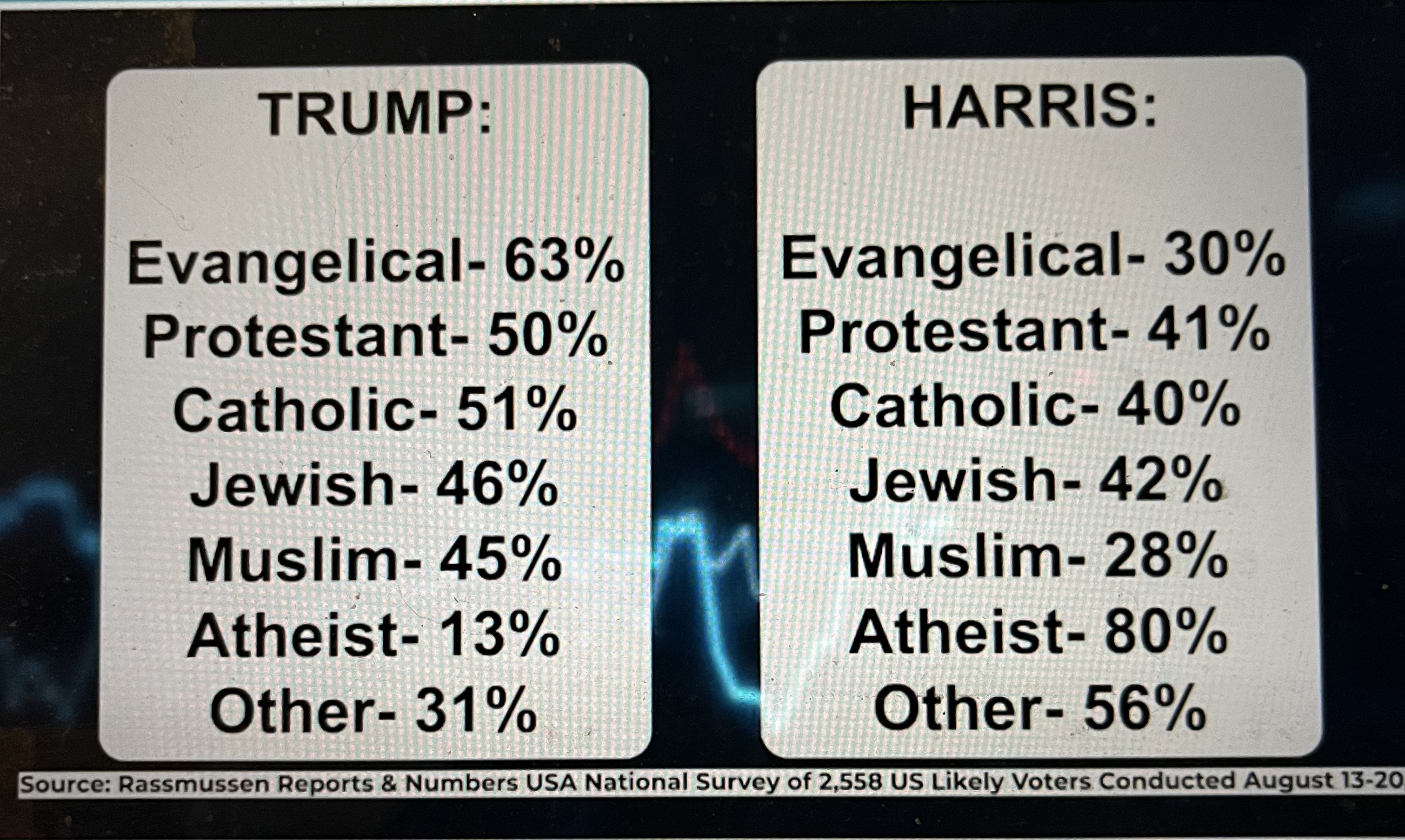
I came across this interesting survey from Rasmussen Reports last week. Rasmussen is an independent polling organization that polls daily through each election cycle. It is independent in the sense that it is neither left nor right leaning, and it does its best to “weight” its polls so that their polls aren’t skewed one way or the other. It is also independent in that they neither depend upon outside money, nor do they receive outside money to conduct polling. Seems to me that is how it should be.

Here’s what their polling found, and what I find interesting in the intersection of faith and politics: people of faith (all faith backgrounds) are generally voting for Donald Trump. Here’s the breakdown Rasmussen reported:

This poll is getting little attention in the media. The only reason I found it is because I was looking for it. Though it is getting little attention, I find it quite revealing in showing there really is a clash of cultures in this election and that clash is between the religious and the non-religious.

Every major faith group (except “other”) is voting in the majority for Donald Trump, and the only group even close to the margin of error is the Jewish faith. “Other” would include Hindu, Buddhist, et. al., and I only assume they were lumped together because the sample size of each was too small to be reliable.

While people of “other” faith backgrounds support Harris, the overwhelming majority of atheists support her. I’m sorry, but that just gives me pause as one who identifies as an evangelical believer in Jesus Christ.

It’s not that I believe Kamala Harris to be a non-religious person. According to Biography.com, she grew up in a black baptist church, has attended Hindu temples (as a result of her Indian heritage) and married a Jewish man. Now, that’s what I call an intersection of faith and politics!

Atheism in the Public Square

When I consider that the “atheists” could be the deciding factor in the most consequential election of our lifetime, I am concerned about the direction of our nation. Every national poll shows this election to be a toss-up (see here and here for two of the most recent). The atheist vote could very well make the difference.

Why do so many atheists support the Democratic Party? From what I’ve been able to discern, it comes down to two things: abortion rights and Christian nationalism. I’d post a few links here on abortion rights and Christian nationalism but you can do a simple Google search and find all the links you need. You’ll be reading for days.

Let me just get this out of the way: I am staunchly pro-life, and that is pro-life in the sense that life begins at conception and that every avenue must be pursued to protect that life. I am also a pragmatist (and not a Christian nationalist) and I believe that the Supreme Court of the United States got it right when they returned the abortion debate to the individual states. That is just one place where my faith informs my politics, and yes, I know it sets up its own clash of cultures. But, I’m just an old white guy, so what do I know?

A “Christian” Nation?

No, I’m not a Christian nationalist (as the term is most commonly defined–it’s a relatively new term, by the way). I do not believe that the United States must be a “Christian” nation, but I do believe that the United States of America was formed (and its underlying foundational documents designed) by people who were Christian, or whose philosophical/ideological perspective were rooted in the Judeo-Christian worldview.

The values and morals that shaped this nation are the values and morals that have their foundation in Scripture. The further we move away from those values as a nation, the more endangered the American experiment becomes…and the more godless the culture becomes. We are far down that road now. I’m wondering if there is a U-turn in our future? I’m wondering if this election cycle will tell us?

Not that Donald Trump is a bastion of Christian morality. His moral failures have been documented copiously, and you can do your own Google search on that, too. Honestly, I believe we are left with the two choices we have for President of the United States BECAUSE we have become unmoored from the Judeo-Christian values upon which this nation was founded.

I also believe the election of Donald Trump won’t provide the U-turn the nation needs to preserve our nation. It might slow it down a little, but it won’t turn it around. The U-turn that matters will happen in the Church through the power of the Holy Spirit. It will take a spiritual revival on the level of the first and second Great Awakenings. It will take prayer and preparation that can only begin in the faith communities of our nation.

The Ripkens

I won’t say who I’ll be voting for in this election. I’ll only say I won’t be voting with the atheists. You can if you want, but don’t come crying to me when we become a completely godless nation. Of course, becoming a completely godless nation might not be such a bad thing. Ask Nik and Ruth Ripken, they can tell you.

The Ripkens were missionaries to Malawi and Somalia, and it was while they were in Somalia that they lost one of their three sons. Their loss forced the Ripken’s to reconsider their calling, and after some reflective time, they were assured they were called to be missionaries, although the focus of their ministry shifted.

They felt called to go into the regions of the world where Christians were persecuted greatest to discover ways they could be in ministry to them. Nik Ripken began by traveling to Russia, China and Central Asia to interview members of the persecuted church.

What he discovered was not that we needed to do anything to help the persecuted church, but that it was his faith that was resurrected by the faithful witness of those Christians. They heard stories of pastors imprisoned and emaciated, yet still clung to their hope in Christ. They heard stories of fathers separated from their families because they smuggled bibles in for others to discover Christ.

In China, he was able to meet with about 150 house church pastors to hear their stories. He said no one really knew what they would find in China. In 1948, when communism came to China, the church was outlawed. At the time, there were between 400,000 and 700,000 Christians.

No one really knew if the church had survived after all these years. Yet, today there are over 10 million Christians in a nation that is openly hostile to their faith. The church flourished in conditions it should not have. The 150 pastors, after telling their stories to Ripken began to ask, “Has Christ made it to the rest of the world?”

What the Ripken’s discovered was that where the church was persecuted the greatest was the very place where faith has thrived the greatest. History has taught the same lesson. The burning question Ripken had for all he interviewed was, “Is Christ worth it?” Is Christ worth the suffering, the imprisonment, the loss of family and even death? As one interviewee said, “Oh, Christ is worth it!”

The lesson for me as I live in this culture that is shifting around me is to ask myself, “Is Jesus worth it?” When all cultural accommodation for the Christian faith ends, will Jesus be worth it? Will Jesus be worth my family? Will Jesus be worth my job? Will Jesus be worth my life?

I pray that I can say, “Oh, Christ is worth it!” My fear is I won’t have the courage.

Until next time, keep looking up…

Perhaps the Problem is Us…

Sometimes, I struggle on these Sunday mornings to find something to write. Other times, I have too much that I want to write and have a hard time knowing what to cull. Today is one of the latter times.

There is an abundance of subjects that I have decided opinions on, but I know I can’t write something on all of them. Based on the stats of these blogs, I can discern that most people want short, quick reads. Sorry. Today probably won’t accommodate you. You are forewarned!

Facebook Jail

I’ll begin by saying that Facebook let my wife out of Facebook jail, so I’ll probably remain on the platform. For those of you who may not know, Facebook put my pretty wife in Facebook jail for a second time.

Seriously, she only posts Bible verses, pics of grandchildren and household projects, but some of the Facebook arbiters found them to be against community standards, so they suspended her. After an appeal, she was reinstated. Guess I’ll stay on a while longer.

That’s probably a good thing. Most folks find the blog through Facebook, although a good number do get email alerts when I publish. I suppose I should try to build my subscriber base by encouraging folks to sign up with email, but I’m not trying to “monetize” the blog so it doesn’t much matter.

However, should you want to receive a notification when I publish, you can like and subscribe below and you’ll be able to find me apart from Facebook.

Now, on to other things on my mind…

Politics is Life

Politics is “top of mind” (as the en vogue saying goes) for almost everyone these days, and so it is for me. This year’s election is seventy-one days away and there is both anticipation and anxiety as that day approaches. We go to the polls seeking to change the direction of the nation, or to stay the course because the circumstances of the nation are such that the majority is pleased with the direction the leadership has set.

This year, we will not “stay the course” necessarily, for we will elect a new president. Some people believe electing one particular candidate will, in essence, be staying the course, though that candidate is doing much to draw distinctions between herself and her predecessor. Others believe electing the other candidate will lead the nation in a new, more prosperous direction.

I’m a bit of a political junkie myself. I don’t try to hide that fact. I don’t (well, not often anyways) make my political views known. You won’t see me (often) posting political articles on social media, promoting particular candidates or particular parties. We’re all in this together and part of our problem is not being able, or willing, to put aside our differences in order to overcome the divisiveness our system finds itself in.

This election cycle is an historic time for our nation. As in the election cycle of 2008 when we elected our nation’s first African-American president, we may this cycle, elect our nation’s first female president. Some say, “It’s been a long time coming,” while others say, “This is not the woman we need to elect.”

The anxiety of the moment is heightened by the cultural circumstances we are experiencing as a nation. Consider these circumstances—a stock market, that while reaching new heights, its volatility is shown by the constant swings from one day to the next, a world economy that still languishes mostly in recession, job market volatility and when we factor in the shifts in cultural values over the past few years, there’s no wonder anxiety is up.

My generation is concerned whether Social Security will be around for our retirement. Healthcare costs, in spite of an overhaul of the system, continue to rise. We have 35 trillion dollars of debt as of this past Friday morning. The Middle East is on fire, there is a war in Ukraine and China is threatening Taiwan. Do we believe a new president will change any of these circumstances?

Perhaps that’s not the appropriate question. Perhaps the appropriate question is “Whom or what do we trust?” Is our trust in a political party? Is our trust in a candidate for president or the government? I am reminded of the words of King David (that’s right KING David) writing in Psalm 20:7—

Some trust in chariots and some in horses,
    but we trust in the name of the Lord our God (Ps. 20:7 NIV)
.

As those who are called to follow Jesus Christ, our hope is in Him and in Him alone. We are citizens of the United States, but we are disciples of Jesus Christ, and if our hope is in the government or a political candidate, it is a misdirected hope.

A Biblical Example

When the nation of Israel left Egyptian bondage and became a nation, Moses and then Joshua was their national leader. They weren’t elected, but rather chosen by God for leadership of the nation. Afterward, God led with a group of judges over the people. There were twelve tribes with different leaders yet they were not united. They had problems working together.

The leadership they did have was corrupt and made poor choices, so the people demanded that God give them a new leader. They wanted a king like all the other nations around them. When things were not going well, the people thought what they needed most was a change in leadership, a new administration, a new structure of government. The people thought: 

“If we just get this new leader everything will be okay. He’ll solve all of our problems. He will protect us from our enemies, he will bring a sense of unity among our divided people (bipartisanship?), he will stabilize our economy, he will provide a new direction, he will provide the change we need.”

Sound familiar? Certainly! Every presidential candidate promises it.

God had a response to the nation in those days. Listen to what God told the prophet Samuel, who was the judge of the nation at the time:

And the Lord told him: “Listen to all that the people are saying to you; it is not you they have rejected, but they have rejected me as their king.As they have done from the day I brought them up out of Egypt until this day, forsaking me and serving other gods, so they are doing to you.Now listen to them; but warn them solemnly and let them know what the king who will reign over them will claim as his rights. (1 Samuel 8: 7 – 9 NLT)

God said the reason people put their hope in new leadership to solve their problems is because they rejected God as their leader. They no longer looked to God as their hope. Sounds a lot like us…

I feel relatively certain Kamala Harris or Donald Trump, believe they will do their best to lead our nation through these challenging times. But, both candidates are human beings and that means they’re flawed…just like the rest of us. God told Samuel to make sure the people knew any leader they chose would have flaws. Did they ever!

The Problem as I See It

The problem wasn’t with the leaders. The problem was with the people. As we survey the landscape of our nation, the problem is not the economy or the culture. The problem is not with terrorism or health care, with crime or poverty. The problem is sin.

We can’t lay the problem at the door of the White House, or the state house. We can’t lay the problem at the door of the courthouse or the school house. We must lay the problem at the door of the church house, and at the door of our house. Simply put, the government can’t fix that problem.

Sin works itself out in many ways. Pride comes to mind. The government can’t fix pride.

Self-centeredness comes to mind. The government can’t fix self-centeredness. Almost no one votes against self-interest. We elect representatives to represent OUR interests. We want representatives who will bring home the bacon to our district, never mind that the interests of our district may stand in direct opposition to the interests of a neighboring district. If they don’t bring home the bacon, we get new representatives. 

The government can’t fix greed. We want more and bigger stuff. We mortgage the future to have stuff we want now. As one cliché states it, “We buy stuff we don’t need with money we don’t have to impress people we don’t like.” The government can’t fix that! Oh, the government can (apparently?) forgive student loan debt, but it can’t change the inner desire for more and bigger and better stuff.

The government can’t fix gluttony. We’re concerned about the escalating costs of health care, yet we continue to overindulge in every guilty pleasure. I’m preaching to myself now. We make poor health choices, fail to exercise and live healthy lives and then want the government to deal with the obesity problem, and heart problems and circulation problems. Don’t shout me down, please! I’m simply pointing out the obvious. 

I love you, but the problem is not with the government. The problem is with us. Our problem is a spiritual problem. Sin comes when we reject God, when we do what is right in our own eyes.

Hope in the Darkness

Perhaps I’ve painted a dark picture with a broad brush, but there is hope. There is a prescription for what ails us. Both political parties talks about the need for change, and promises change, but real change won’t happen with a new leader or new legislation. Real, lasting change will occur when God’s people choose to trust God and turn to Him.

I’m reminded of a most famous Old Testament passage from 2 Chronicles this morning. At the time the passage was written Israel was at its zenith. They had just finished all of King Solomon’s building projects with the high point being the Temple in Jerusalem.

It was a time of great prosperity and peace, and national pride was running high. It was during the dedication of the temple that God gives a warning. God said when the rain doesn’t fall and the locusts eat your crops—in other words—when the nation does into a downturn, this is what needs to happen:

14  “Then if my people who are called by my name will humble themselves and pray and seek my face and turn from their wicked ways, I will hear from heaven and will forgive their sins and restore their land.” (2 Chronicles 7:14 NLT)

The prescription for us and our nation is prayer.

The Temple was to be a reminder of God’s sacred presence among the people.

Were we to read all of King Solomon’s prayer at the dedication of the Temple, we would discover the importance of the practice of prayer in maintaining the nation’s covenant relationship with God. Solomon, and later Isaiah, understood the Temple was “a house of prayer for all nations” (Is. 56:7), and Jesus, himself echoed that sentiment when he drove the moneychangers from the Temple upon his entry into Jerusalem.

Right relationship with God, whether in the Old or New Testament, is rooted in prayer. Understand though, that prayer is not effective because of our righteousness, but because of the power possessed by the One to whom prayer is offered.

What was once true of a building in Jerusalem is now true of a body…the body of Christ, the Church. The Apostle Paul states it this way: 

19 “Or do you not know that your body is the temple of the Holy Spirit who is in you, whom you have from God, and you are not your own? 20 For you were bought at a price; therefore glorify God in your body and in your spirit, which are God’s.” (1 Corinthians 6:19 – 20 NLT)

We bring glory to God when we pray. We cannot pray without humility. Humility is nothing more than acknowledging our dependence upon God.

F.B. Meyer said, “I used to think that God’s gifts were on shelves one above the other, and that the taller we grew in Christian character the easier we could reach them. I now find that God’s gifts are on shelves one beneath the other. It is not a question of growing taller, but of stooping down, to get His best gifts.”

Humility brings us to God, and our coming gives Him glory.

There is no effective prayer without devotion. That’s what it means to “seek” God’s face. Worship, generosity and service are tangible ways we show our devotion. It also means seeking God’s will for every area of our lives, and passing the faith to our families and communities.

There also is no effective prayer without repentance. Both the Old and New Testament words for repentance mean “to turn.” It means a change of direction from sin and toward God—an about-face, if you will.

Repentance is a faith response to God’s offer of forgiveness. We believe God will forgive, therefore we turn to him. When we repent of our sin—our pride, our self-centeredness, our greed, our gluttony and our idolatry—then, we’ll see the power of God revealed in Jesus Christ. We’ll find the help for which we search.

Prayer has the power to fix our problems because prayer brings us into the sacred presence of God Almighty, and it is God’s power in Jesus Christ that heals and forgives and reconciles all that is broken…in this nation…in every nation…     

Here’s our challenge: to humble ourselves before God, seek His face and repent of all that separates us from Him and from each other.

Join me as I pray for our nation, for the election and those leaders who have offered themselves to lead us.

That’s as neutral as I can be these days, though I believe the cultural moment demands that the disciple of Jesus Christ be something other than Switzerland.

This post is already too long and I’ve still got too many things I want to write. I’ll just stop now by reiterating: Pray, pray, pray!

The problem really is with us.

Until next time, keep looking up…
Seventy-eight Days to Choose…

Seventy-eight days. That’s how long it is until we choose the person who will lead our nation for the next four years. As I’ve gotten older, I’ve discovered that seventy-eight days is no time at all. What are we, as Christians, doing to be ready to choose the right leader?

I know! Our choices aren’t great, but then again, we probably get the leaders we deserve. I just have to ask: What have we done to deserve the choices we have? Sorry! Don’t answer that question. It is rhetorical.

Most people reading this have probably already made up their mind about the choice coming in seventy-eight days. Without becoming too political, let me take this opportunity to offer biblical four characteristics to look for in choosing our next leader.

Four Biblical Characteristics

What are the four characteristics? Humility, capability, responsibility and accountability.

Jethro & Moses

Let me start by calling to mind a conversation between Moses and Jethro in Exodus 18: 13 – 27 (click here to read the entire conversation). To set the context of Jethro’s conversation, it’s been just over a month since Moses led the people out of Egyptian bondage and Pharaoh’s oppression. In that time, they’ve seen God deliver them through the Red Sea, provide water from a rock and God is feeding them daily with manna and quail. They’ve also just won a military victory over a people group called the Amalekites.

Jethro gets word of all God has done for Moses and the people, so he takes Moses’ wife and two sons, loads up and prepares to take them back to Moses. At some point before going down to Egypt, Moses had sent them to live with Jethro while he went off to do God’s work.

Jethro arrives, they catch up on all the events since they were last together and had a party and a worship service to celebrate. The next day, Moses goes out to do what he always does…hear the complaints of the people against each other…he sits in judgment, day after day, deciding all the petty (and not-so-petty) complaints of over 600,000 men, not including women and children.

Humility

Jethro immediately notices a problem, so Jethro (verse 14) says, “Why are you trying to do this alone?” Jethro, in asking Moses the question, is trying to give Moses a lesson in humility. Humility is perhaps the greatest quality to look for in a leader. The original Hebrew spoken by Jethro leaves the impression that he sees Moses acting like a King over the people.

Moses considers himself uniquely qualified to judge the people and their issues, almost like he’s God’s partner in this deal. That’s the strength of the language in the text.

Jethro says, “That’s not good!” Basically, he’s saying, “Get over yourself, Moses. You’re killing yourself and you’re killing the people trying to do this alone.” It was a matter of respect. The whole tone of the conversation indicates that Moses’ ego was getting in the way of what is best for the people and for himself.

Egotistical leadership is devastating to any organization. Granted, it takes a pretty big ego for someone to run for President, or any other office, for that matter, but ego that is not tempered with humility is egomaniacal and is ultimately destructive.

There is a fantastic visual image contained in this entire episode, and it has to do with humility, and the power of humility.

The encounter begins with Moses sitting to judge the people, and the narrative indicates he’s sitting because he’s worn out. Jethro offers his advice and says, “If you do this, you’ll be able to “stand up” under the pressure.” It’s Jethro’s way of saying, “If you humble yourself and relinquish some leadership, you’ll really find yourself standing over the people instead of the people standing over you.”

That’s exactly what Jesus said, too.  In Luke 22: 24 – 30, his disciples were discussing who would be greatest among them. When they arrived at the house, Jesus asked what they were discussing, though he already knew. They didn’t answer him, but he sat them down and said “If anyone wants to be first, he must be last of all and servant of all.” Servant leadership is a Kingdom principle. It’s driven by humility.

The cause that must be served is far greater than any one leader or individual. What’s true in business is also true in government, and in churches, and at home. No one leads alone. A leader needs the humility to acknowledge their own limitations.

Capability

A second characteristic I see in choosing leaders wisely is capability. We need leaders who are capable of leading us.

Jethro recognizes the necessity of leadership on different levels. Part of that capability has to do with honesty and integrity. We could make these their own traits, but they are what make a capable leader.

When I talk about honesty and integrity, I cringe when I look at the candidates we have to choose from. Of course, it’s nothing new. The effects of Huey Long’s patronage system are still felt in Louisiana today, and history reminds us of the corruption of Tammany Hall in New York City throughout the nineteenth and early twentieth centuries, and of the long history of alleged corruption in Chicago politics.

Politics and corruption seem to go hand in hand. Jethro reminds Moses that at the heart of capability are honesty and integrity.

Jethro told Moses to identify capable leaders and appoint them judges over thousands, hundreds, fifties and tens. Different leaders must fill different roles. Moses learns there are different levels of leadership, and each leader must fill the role he/she is uniquely gifted to fill.

We’re all leaders, we simply lead at different levels. Let’s face it…there are politicians who are great politicians at the local level but would be terrible at a higher level. One question we should ask of those running for public office, or seeking a leadership capacity is “Are they capable of fulfilling the role?” Not every leader is equipped to fill every role; choices must be made based on the individual’s gifts, skills and talents.

I experienced this as a District Superintendent for the United Methodist Church. The church is led by a great number of gifted pastors, but honestly, not every pastor is suited to be the pastor of a large church, and there are pastors whose giftedness far exceeds the level of church they currently serve.

There are fantastic pastors in small churches, but it would be disastrous for some of them and for the church to be appointed to a large church. There are natural born leaders who simply have the charisma to continually lead up, but there are equally gifted leaders capable and competent to lead on a smaller scale.

There are many leadership skills that are teachable. Parents are leaders, even though they may only lead one other person, and parents can be taught to be better leaders. The same with managers is true. Leadership skills can be taught, nurtured and developed, and a leader’s capability can be increased, but for many there is a ceiling. That doesn’t matter. They’re still leading, and can be great leaders, as long as they’re leading at their level of capability.

We need to be asking the question, “Which of these two candidates is capable of leading our nation right now?” The answer is obvious to me, but you have to answer the question in your own heart and mind.

Responsibility

A third characteristic I see in Jethro’s advice is that of responsibility. When we choose leaders, we must be willing to let them lead. We can’t extend leadership responsibility and then micromanage their efforts. We’ll destroy their spirits and we’ll undo the good that could be done through their efforts.

Jethro makes it clear to Moses that if you’ll follow this advice…identify leaders and let them lead…then Moses will be able to stand up under the pressure and the people will return in peace. Sharing power is what God wants and what God expects. It is truly a holy act.

Accountability

Are we willing to allow the leaders we choose to actually lead us? We must follow their leadership unless and until they prove they’re not capable, and that brings me to the final characteristic I see, and that is accountability.

Responsibility is nothing without accountability. Verse 24 says that Moses listened to his father-in-law’s advice. He submitted himself to the accountability offered. He was willing to be confronted with the cold, hard facts, and he demonstrated the humility to receive Jethro’s “constructive criticism.”

Okay, so there is one candidate who doesn’t often take constructive criticism well. I’m not sure about the other one yet, although a staff turnover rate of 90+% isn’t encouraging. Like I said…our choices aren’t great.

We should choose leaders who are willing to be held accountable. One of the great things about the American experiment is the “checks and balances” of the three branches of government. Part of the problem of governing by executive order is it circumvents the accountability component. But, then again, every four years, or two years, or six years as the case may be, is the election cycle. The accountability of the ballot box is always the accountability of last resort in the civic arena.

We, too, if we desire to be godly leaders, should submit ourselves to accountability. John Wesley was so concerned with building a righteous fellowship that he devised a series of questions for his followers to ask each other every week. Some found this rigorous system of inquiry too demanding and left.

Rev. Chuck Swindoll

Today, the very idea of such a procedure would horrify many disciples, yet some wisely follow just such a practice. Chuck Swindoll for example, has seven questions that he and a group of fellow pastors challenge each other with periodically:

1. Have you been with a woman anywhere this past week that might be seen as compromising? 
2. Have any of your financial dealings lacked integrity? 
3. Have you exposed yourself to any sexually explicit material? 
4. Have you spent adequate time in Bible study and prayer? 
5. Have you given priority time to your family? 
6. Have you fulfilled the mandates of your calling? 
7. Have you just lied to me?

Genuine accountability is transformative. Moses followed Jethro’s advice, and his life and the lives of his nation were transformed.

Everything rises or falls on leadership. If we choose leaders who demonstrate humility and capability, granting them responsibility and expecting accountability, then we’ll have leaders that will serve the greater good and perhaps, even grow the Kingdom of God.

I am thoroughly convinced that neither of the candidates running for President of the United States measure up to these characteristics. We Christians have a lot of praying to do over the next seventy-eight days. May God grant us the grace to do the best we can with the choices before us.

Prayer. Hmmmm? Now there’s an idea. Perhaps I’ll blog about that next week.

Until next time, keep looking up…

Finding the Perfect Church…

It’s been FIVE years since I stepped away from full-time vocational ministry. For parts of those five years my wife and I were church “homeless.” That’s right! We didn’t have a church home. We became church shoppers…looking for the perfect church.

The sad thing? We haven’t found one. The sadder thing? I uttered a lot of the same excuses I heard other people utter in my 28+ years in vocational ministry.

Making Excuses

Perhaps you’ve heard some of these excuses. Perhaps you’ve made some of these excuses if you’ve ever been church “homeless.” Perhaps you’re saying some of these things right now if you’re currently church “homeless.” What are those excuses?

  • “This church is too small…”
  • “This church is too large…”
  • “There aren’t any children here…”
  • “There are too many children here…”
  • “The youth group is too small…”
  • “The youth group is too large…”
  • “The youth pastor is too (well, there are a lot of things we can say about youth pastors!)…”
  • “There’s no youth group…”
  • “I don’t like contemporary music…”
  • “I don’t like traditional music…”
  • “The music is too loud…”
  • “There are too many old people…”
  • “The pastor’s sermons aren’t good…”
  • “The pastor doesn’t know me…”
  • “I don’t like the pastor…”
  • “I’m not being fed…”

That is certainly not an exhaustive list of excuses I’ve heard through the years. You could add your own. The problem with church shopping is that it betrays an appropriate understanding of what the church is, and it feeds into our consumer mentality–the fact that we have become “consumers” of religion.

Going to church should not be like going shopping. I’m going to church to find what I need and I’ll keep shopping until I find it. Looking for a church that “I” like is one of the most selfish endeavors on the planet. Oh, and it is also one of the most un-biblical, too!

Reasons to “Church Shop”

Actually, there are very few reasons we should be church “homeless.”

One reason is because we’ve moved to a new community. A job or career change takes us to a new community and we’re forced to move away from our current church home.

Another reason is a change in our relationship status, i.e., we got married or divorced or remarried. The change in relationship affords a new opportunity to go to church with the other, or to begin again with the other.

Yet another reason to leave a church is because the church has abandoned orthodoxy. This is the primary reason that Vanessa and I were church homeless. I don’t intend to get into a discussion here about orthodoxy or my former church home. That can be for another time, but suffice it to say we believed (and still believe) that our former church home abandoned the “faith once delivered to all the saints.” We could be wrong (I often am!), but apparently a lot of other people agree with me.

I’ve gone a long way out of the way to say, “Stop looking for the perfect church. You’re not going to find it!” What’s the old saying? If you find the perfect church, don’t go! You’ll mess it up! Actually, that’s not true. You can’t mess up what’s already messed up. There is NO perfect church. Looking for one missed the point entirely.

The Uncomfortable Church

When we look for the perfect church, we usually mean the perfect church for us. We mean we want a church that meets my needs. We want to be with people who generally look like us, who generally act like us, who generally make the same amount of money as we do, who are in the current life stage we are in, etc. What we really mean is we want a church where we can feel comfortable.

Guess what? Church is not about our comfort. Guess what? We’re supposed to be uncomfortable in church! We’re supposed to be uncomfortable with our sin because we are in the presence of a holy God.

We’re supposed to be uncomfortable because there are people in church who aren’t like me. We’re supposed to be uncomfortable in church because the teaching challenges me to be transformed.

We’re supposed to be uncomfortable in church because I’m being asked to surrender myself…my wants…my likes…my dislikes…my desires…all of me…to Jesus and to one another.

Dang! All of that makes me uncomfortable. Welcome to the perfect church!

I kind of think that’s what the Apostle Paul had in mind when he wrote the Ephesian church in its infancy:

12 …remember that at that time you were separate from Christ, excluded from citizenship in Israel and foreigners to the covenants of the promise, without hope and without God in the world. 13 But now in Christ Jesus you who once were far away have been brought near by the blood of Christ. 14 For he himself is our peace, who has made the two groups one and has destroyed the barrier, the dividing wall of hostility, 15 by setting aside in his flesh the law with its commands and regulations. His purpose was to create in himself one new humanity out of the two, thus making peace, 16 and in one body to reconcile both of them to God through the cross, by which he put to death their hostility.  (Ephesians 2: 12 – 16 NIV)

Making Us One in Christ

One humanity out of the two. What two? Jews and Gentiles. Let’s face it. In the first century, Jews and Gentiles did not like each other very much (understatement!). Yet, they were called by Christ to be together…to worship together…to serve together…to love God together…and…wait for it…to love one another together. Talk about out of their comfort zone! That’s exactly where Christ is calling us to be and it is exactly what Christ is calling us to do.

Imagine how evangelistic it is for the world to see people who are normally at each other’s throat worshipping and serving together. The world sees it and they wonder, “How can that be?” It is through this imperfect church that the world (and we) see how powerful and amazing His grace is to save a bunch of people who really don’t like each other.

Don’t go looking for a church online. Yeah, I know. We look for the Google reviews when we’re looking for a church home. Why go to a four-star church when you can find a five-star one? Let me remind you that church health can’t be measured by Google reviews.

Yes, I know that when you’re shopping for a new church home that you’ve already watched the sermons online and you’ve perused the church website or Facebook page. It’s what we do.

Do you really want to grow in Christ? Then, how about go to the church that doesn’t have an online presence? Yeah, preacher, you’re really stretching it now!

Do you really want to grow in Christ? Then how about look for the church home that you’ll probably like the least…that is least like you. Perhaps that is where real growth will occur, and maybe…just maybe…that’s because it is as Jesus intended it.

Yeah, I don’t know, either. I’m really just processing my own church homelessness over the past five years. Perhaps my processing it will help others get off the couch and find their new church home and will give them pause while they do. Then again, maybe not.

Finding a new church home is not about “me.” It is about finding Jesus, loving Him and loving one another. THAT is the perfect church.

Until next time, keep looking up…

This Ain’t That…

Okay, so by now you’re aware that there was an assassination attempt on the life of Donald Trump on July 13, 2024. You’ve probably seen the soon-to-be iconic photograph taken that day at the fairgrounds rally in Butler, PA.

I’ll say with a fair degree of certainty that photograph sealed Joe Biden’s fate as far as the Presidential election is concerned. Regardless of what one thinks of Donald Trump, one must admit it is a compelling picture.

I continue to be amazed how some in the Christian community can try to make something out of current events that there is simply no evidence to support. Donald J. Trump may be a character of biblical proportions, and he may, in fact, be God’s man for God’s time (that remains to be seen), but please, let’s stop trying to tie biblical images to the man. We might just be opening a can of worms that we don’t need to open when we do that.

What do I mean?

Not too long after the assassination attempt, Donald Trump was tied to an obscure passage of scripture in Leviticus noting that Trump was somehow being anointed for God’s service (click here for an example).

The photo on the right also started hitting my Facebook feed shortly after the assassination attempt, and one prosperity preacher, Rev. Jentezen Franklin, made the connection while making remarks before the Faith & Freedom Coalition breakfast during the Republican National Convention. I searched the internet for the video, but it has apparently has been taken down.

Let me just say: This ain’t that!

Here’s the passage in question:

 23 Moses slaughtered the ram and took some of its blood and put it on the lobe of Aaron’s right ear, on the thumb of his right hand and on the big toe of his right foot. 24 Moses also brought Aaron’s sons forward and put some of the blood on the lobes of their right ears, on the thumbs of their right hands and on the big toes of their right feet. Then he splashed blood against the sides of the altar.  Leviticus 8:23 – 24 NIV

In its context, Leviticus 8 is clearly Moses’ anointing of Aaron and his sons to the Old Testament Aaronic priesthood. It was a consecration of Aaron and his sons as priests for the nation of Israel. We must read it and understand it as we seek to understand what God was doing with His people in that time. To attempt to make a contemporary application is to open ourselves to several problems.

The Problems

Exegesis

Exegesis simply means the critical explanation or interpretation of a text, especially of scripture. To take out of the text that there is a connection between the Aaronic priesthood of the Old Testament and Donald Trump is blatantly false. To suggest that the assassination attempt on Donald Trump is God’s anointing of him as some sort of priest or prophet for the United States of America is to have a completely wrong understanding of the Old Testament.

Connecting this passage of scripture, even as allegorical or metaphorical, is to make a very crass interpretation of scripture. We must be careful doing this…or tying any American President (or any person for that matter) to events in the Bible. We must be careful because two can play that game.

Here’s what I mean:

One of the heads of the beast seemed to have had a fatal wound, but the fatal wound had been healed. The whole world was filled with wonder and followed the beast.  Revelation 13: 3 NIV

Could Donald Trump be the beast of Revelation? I don’t know! I guess it depends on your interpretation of scripture (or your political party!).

Devil in the Details

Honestly, there are just too many details missing for Leviticus 8 to be in any way associated with Donald Trump. First, the blood applied to Aaron and his sons came from a sacrificial ram. That means something else had to die to provide the blood for the ceremony (think New Testament…think Jesus here). The blood applied to Aaron’s ear (and thumb and toe) was not his own.

Second, the Levitical instructions are specific in what was to be done with the fat and the entrails of the sacrificial animal. As best I recall, there was no fat or entrails (blood and guts) involved in the assassination attempt of former President Trump.

Third, as far as we know, none of the blood made its way to Trump’s big toe. We do know that he lost his shoes when he was tackled by the Secret Service, and he had the presence of mind to want to retrieve his shoes before departing the platform.

I’m going to say, as an aside, that wanting to get your shoes while someone is shooting at you is either the most narcissistic thing in the world, or the bravest thing in the world. There’s probably an element of both involved, but I’ll let you be the judge of it. Maybe they were just expensive shoes!

Lessons Learned

Let me be the first to say that I also think my Christian brothers and sisters who dispute God’s providence in the protection of Donald Trump through that attempt might also be hasty in their response. There is nothing wrong in acknowledging that God could very well have been provident in those circumstances, the fact that someone else was killed notwithstanding. One lesson in all of this is for us not to become extreme either way.

Another lesson to be learned is that the Bible is not a political prop and we shouldn’t seek to use it for political gain. It is the revelation of God the Father designed and given to lead us to repentance in Jesus Christ, the Son through the power of the Holy Spirit. Shame on us for using it any other way.

One final lesson we can learn is that Jesus Christ is our hope and the Savior of the world. We have so much hope and truth in the Gospel of Jesus Christ that we have no need of taking an obscure passage of scripture and misapplying it to our current situation to find hope. Jesus is the Savior who forgives sinners, saves them by His grace, invites them into His Kingdom and will one day come again in glory to reign eternally. That’s enough!

I’m telling you…this thing with Donald Trump…it ain’t that!

Until next time, keep looking up…

To Eat and Live Indoors…

I didn’t get paid. And, really…I’m okay with that fact. There have been a couple of instances recently when I was invited to minister in settings and I was offered no remuneration. Can you believe that? Yeah! Me either! Geesh! What are people thinking?

No Complaints

Please, if any of you are reading this and I’ve been in ministry with you recently, don’t wrack your brain wondering if you “paid” me for the ministry. It’s 100% okay. I’m not complaining. I’m not in ministry for the money…though I do like to eat and live indoors.

Why am I 100% okay with not getting paid for ministry? Because I’ve learned the freedom that comes from not being dependent on the “church” for a living. Oh! There is freedom in that independence.

It’s been five years since I stepped away from vocational ministry. We stepped away from ministry totally trusting the Lord to provide for our needs (and He has). Yes, I had a job lined up, but even that job meant we had to adjust our lifestyle if we were going to make it, and I figured I would pick up some extra dough on the side by “filling the pulpit” to cover some gaps in the budget.

For twenty-eight years the “church” provided a good living (a very good living the last few years, I might add). I’ll be honest. It was hard to walk away from that security. Great salary. Great benefits. Great retirement plan (both in this world and the next!). What’s not to like? And, hey? Didn’t Jesus say that a “worker is worthy of his wage” (Matthew 10:10)?

I’m not indicting the model of vocational ministry that developed through the centuries. It serves its purpose to the Church (the institution) and to the church (the local congregation). Nor, am I indicting those who continue to serve full-time in vocational ministry. That’s your calling. You have to walk in that calling to be obedient. Good for you!

Paul’s Ministry

I am, however, going to espouse the freedom and the virtue of bi-vocational ministry. When someone hears the word bi-vocational, it is generally taken to mean a person who serves a congregation but also maintains secular employment–generally because the congregation can’t afford a full-time pastor.

What I mean when I say bi-vocational is a person who maintains secular employment as a means to support his/her ministry. I believe that’s what the Apostle Paul meant when he wrote:

On the contrary, we speak as those approved by God to be entrusted with the gospel. We are not trying to please people but God, who tests our hearts. You know we never used flattery, nor did we put on a mask to cover up greed—God is our witness. We were not looking for praise from people, not from you or anyone else, even though as apostles of Christ we could have asserted our authority. Instead, we were like young children among you. Just as a nursing mother cares for her children, so we cared for you. Because we loved you so much, we were delighted to share with you not only the gospel of God but our lives as well. Surely you remember, brothers and sisters, our toil and hardship; we worked night and day in order not to be a burden to anyone while we preached the gospel of God to you (1 Thessalonians 2:4-9 NIV).

The Apostle Paul was a tent-maker and he plied his trade wherever he went in order to support the ministry to which he was called. Yes, he could have asserted his right to be compensated by those to whom he ministered, but he chose otherwise. He was a traveling evangelist, but he wasn’t expecting a love offering wherever he went.

Advantages of Bi-Vocational Ministry

As I reflect on Paul’s life and my own experience over the past five years, I want to point out three advantages of bi-vocational ministry.

Don’t Compromise the Gospel

First, there is the freedom of not compromising the message of the Gospel. Paul says that he is “not trying to please people, but God, who tests our hearts.” I’m not saying that pastors in full-time ministry compromise the Gospel. Please don’t hear that. I’m saying in bi-vocational ministry, the temptation to compromise the Gospel is not present because one is not dependent on the congregation to eat and live indoors.

Let me offer an example, if I may. When I served as a District Superintendent, it was a common task to meet with congregational leadership to discuss pastoral leadership. More than once (a lot more than once) I heard church leadership say, “the pastor works for us.”

Too many congregations see the pastor as an employee. As an employee, he/she is supposed to do what the leadership says. As an employee, the pastor is dependent on the congregation for a livelihood. As an employee, the pastor can be fired. With that in mind, there is the temptation to “give the people what they want” so that I can maintain the security of my position.

I’m sorry, but no! The pastor is not an employee. Congregations need to hear that. Pastor, you are called to proclaim the Gospel of Jesus Christ and the Truth of God’s Word. That means we have to tell people what they don’t want to hear sometimes. We need the freedom to do so to be faithful to the call. Bi-vocational ministry provides the means to that end.

Role-Model

Second, bi-vocational ministry provides the opportunity for the minister to be a role-model for others on a daily basis. I love how Paul says that he did not “put on a mask to cover up…” It becomes really easy for a pastor to put on the pastor mask every day to go out into the secular world. It’s like putting on a clergy collar for the world to see (nothing wrong with a clergy collar), but It can too easily become a role we play instead a definition of who we are. Believe me, this one hits very close to home!

Being in the marketplace in secular employment every day challenges the believer (and especially the pastor) to model the faith in ever more faithful ways. You can’t hide behind the clergy collar when you’re around 8 co-workers who know your short-comings and see them five or six days a week. As Paul told the Thessalonians, “we were delighted with you not only the gospel of God but our lives as well.”

Evangelism in Truest Sense

Third, bi-vocational ministry puts the minister in the secular world where secular people live. If we want to reach the world with the Gospel of Jesus Christ, we have to be where the people are. That is evangelism in its truest sense.

As a full-time vocational pastor, I spent more time with church people than I did with secular people. Between worship services, staff meetings, board meetings and bible studies, it left little time for engaging with un-churched and de-churched people. There was no time to share the Gospel with the lost (unless one considers folks in the church lost) because most of one’s time is already spoken for (you’re an employee, remember?).

Additionally, because a bi-vocational minister is in the secular world on a daily basis, living where secular people live, it becomes easier to interpret secular thinking and to stay abreast of shifting cultural values and mores. One gets the opportunity to understand why people think like they do and believe what they believe. It helps the minister make the Gospel relevant when the minister understands the mindset of the society and secular people.

A Final Thought

There are probably more advantages to being bi-vocational as a minister of the Gospel. These are just three I’ve thought about this morning reflecting on Paul and my own experience.

I never really saw myself as a bi-vocational minister in this regard. I’ve considered being bi-vocational in the traditional sense. Lord knows there is ample opportunity. I’ve said in recent years that I don’t have time for that. It’s not fair to the congregation because I couldn’t devote enough time to “grow” a church. After all, there’s no such thing as part-time ministry, only part-time pay.

But, I am bi-vocational in that I can work to support the work of the ministry to which I’m called. Right now, I’m called to be in the oil change business and preach in local congregations when asked. That’s what I’ll do for now. You can pay me, or not. I don’t care. If you do, I’ll be grateful and accept your blessing. If you don’t, I’ll thank God for His provision and that I had the chance to share the Gospel so as not “to be a burden to anyone.” That, and I like to eat and live indoors…

Perhaps the Lord is prompting you, Pastor, to reflect on His calling in your life. Is it time for you to become bi-vocational, too?

Until next time, keep looking up…

Praying for the USA…

Please don’t mistake me for a Christian Nationalist (although some probably will), but I am reminded this morning of the words of the Psalmist:

12 Blessed is the nation whose God is the Lord,
    the people he chose for his inheritance.
13 From heaven the Lord looks down
    and sees all mankind;
14 from his dwelling place he watches
    all who live on earth—
15 he who forms the hearts of all,
    who considers everything they do
.

16 No king is saved by the size of his army;
    no warrior escapes by his great strength.
17 A horse is a vain hope for deliverance;
    despite all its great strength it cannot save.
18 But the eyes of the Lord are on those who fear him,
    on those whose hope is in his unfailing love,
19 to deliver them from death
    and keep them alive in famine.

20 We wait in hope for the Lord;
    he is our help and our shield.
21 In him our hearts rejoice,
    for we trust in his holy name.
22 May your unfailing love be with us, Lord,
    even as we put our hope in you.
(Psalm 33: 12 – 22 NIV)

Now is not the time for followers of Jesus to point fingers and ascribe blame. Now is the time for us to pray.

For my left-leaning friends, President Trump is not Hitler reincarnated and he is not an existential threat to our democracy. Stop saying he is. Please!

For my right-leaning friends, President Trump is not the savior nor the Savior of America. Stop treating him that way. Please!

Rather, as followers of Jesus, let us pray for our nation and our leaders. That’s what we’re instructed to do:

I urge, then, first of all, that petitions, prayers, intercession and thanksgiving be made for all people— for kings and all those in authority, that we may live peaceful and quiet lives in all godliness and holiness. This is good, and pleases God our Savior,… (1 Timothy 2: 1 – 3. NIV)

Here is the question I have for my left-leaning friends: Did you pray for President Trump while he was in office? No? Then, shame on you! Are you praying for him now that someone has attempted to take his life? No? Then, shame on you!

Here is the question for my right-leaning friends: Are you praying for President Biden while he is in office? No? Then, shame on you! Are you praying for him now that the evidence of his cognitive decline is irrefutable? No? Then, shame on you!

Yes, I have my political biases and my political preferences. I will express those (although I’m guilty of occasionally expressing otherwise–yes, I repent) on Election Day at the ballot box. It makes us good citizens when we do.

In the meantime, I’ll recognize that President Trump was God’s man for God’s time (for whatever reason he was) while he was President, and I will treat him with the respect he deserves. I’ll also recognize that President Biden is God’s man for God’s time (for whatever reason he is) while he is President, and I will treat him with the respect he deserves. And, I will pray for them both…and their families…and our nation.

July 13, 2024 was a sad day in American history regardless whether we are right-leaning or left-leaning. Let us not, as those who say we follow Jesus, add to the division in our nation by joining in the expression of hateful political rhetoric (though both President Trump and President Biden make it so easy to do so). It is unbecoming of a disciple of Jesus, and it gives the Church a black eye when we do (guilty again–and again, I repent).

So, my rant is over. Will you join me in repentance? More importantly, will you join me in prayer?

Until next time, keep looking up…

The Coming Storm…

I heard some bad news this week that makes me think it really is only the first winds of the storm that is blowing on the horizon for the institutional church, especially as it presents itself in the local congregation.

What was the news? I heard that this past Sunday was a pastor’s last Sunday at one local congregation because the congregation could no longer pay the pastor’s salary. I hated to hear the news, especially for the pastor who was faithful to lead the congregation through the disaffiliation process of the United Methodist Church.

I don’t know all the details of the transition. I know it was, by all United Methodist standards, a successful church plant a decade ago. The departing pastor was not the founding pastor (that might have a little to do with it), but the fact that the local congregation could no longer pay the salary points to a financial reality that many congregations will be facing in the future.

The news got me to thinking about some of the challenges that the institutional church will face in the future…there really is a storm on the horizon.

Challenges on the Horizon

Inflation

Thanks to Covid and bad national economic policy, everything costs more these days. That means people have less money to give to the church, but it also means that utilities, sound equipment, cleaning supplies, office supplies…literally everything costs more.

When people are unable to give to the church because their personal expenses have gone up, the local congregation can’t keep up with its own expenses. Programs have to be cut, personnel costs have to be cut. The model for the local congregation is unsustainable.

Real Estate

What inflation has done to everything else, it’s also done to real estate. I suppose this challenge could have been included in inflation above, but I think it stands on its own. Real estate prices have risen disproportionately to almost everything else, which is good for homeowners, but not really good for anyone else.

Real estate becomes a problem for the institutional church when it comes to the prospect of church planting. How can a “traditional church model” of church plant afford real estate in today’s market? Or, how can a “growing” congregation afford to either build or relocate in today’s real estate environment?

Not to mention building restrictions that many municipalities are placing on property use. Municipalities lose millions of dollars of revenue when property is used for a church. Those municipalities aren’t liking that much anymore and planning and zoning commissions are limiting the number of churches in some areas…because the municipalities need more revenue, too.

Salaries

Salaries will definitely be a challenge for local congregations in the future. Well, the future is now! Thus, the example given above. The local congregation could no longer afford the pastor’s salary. So it will continue to be as inflation takes its toll on the economy.

Even large congregations will find themselves scaling back on personnel in order to sustain the cost of keeping the doors open. Let’s face it, there are a lot of pastors and church staff who weren’t making a living wage anyway. It’s only going to get worse.

Congregations will begin (have begun) the transition to bi-vocational ministers, and pastors will have to transition to bi-vocational because, I know for a fact, that pastors like to eat and live indoors. I’m not saying there is anything wrong with that transition. It might even be for the best—it puts the pastor out into the community with an opportunity to meet un-churched, de-churched and un-saved people instead of spending all of their time “tending the sheep” inside the church walls, or sitting eight hours a day in the office because the Church Council demands their “availability” to the congregation.

Honestly, though, when you start cutting church staff, programs suffer and today’s institutional church model is built around attractional programming.

Clergy Shortage

Okay, so even if a congregation can afford to pay a full-time pastor, where are they going to find said pastor? (For more on the clergy shortage, click here and here).

There is no longer a functional ministry pipeline from which to choose trained professional clergy.  Number one, people aren’t going to seminary in the numbers they were in the past. Seriously, they finally figured out that spending all that money for a seminary education wasn’t paying off.

Many people who feel called to ministry have figured out they can fulfill their calling in the non-profit world and get paid more for it. I know it’s not all about the money in ministry, but pastor’s still have to provide for their families.

Additionally, traditional denominations have provided a pipeline and pastors would “rise up through the ranks” to fill pastoral roles. Well, there are no ranks anymore in many denominations. Many denominations find themselves in “warm body syndrome” where they just need someone/anyone to fill a pastoral position. Yeah, the Holy Spirit is really in that process.

Another issue affecting the clergy shortage is the fact that the majority of clergy are near or past retirement age. I know! Retirement is not a biblical concept, but most retired clergy don’t have the energy and don’t really want to invest the time it takes to “grow” a church. Yeah, I’m probably just speaking for myself, but I’ve also heard it from other retired clergy who have been asked about serving full-time or even planting a church.

The clergy shortage makes the traditional institutional church model unsustainable.

Shrinking Attendance

Rev. Max Edwards, General Superintendent of the Evangelical Methodist Church, posted a link to an article in his weekly newsletter that is really eye-opening. Church attendance has been falling for generations and according to the article, shrinking attendance has costs far beyond the ability of a congregation to stay open.

Also, the article states that since the 1990’s, 40 million people have stopped going to church—that’s one in eight Americans, and in 2021, membership in houses of worship fell below the majority for the first time.

Yeah, I know! Covid, right? Covid only accelerated the decline. Most churches haven’t recovered their pre-Covid attendance. Most churches never will. Shrinking attendance makes the traditional model of the institutional unsustainable.

Disciple-Making Process

Okay, as one who served as a full-time pastor, I assume my share of responsibility for this one, but the local congregation has not been very good at making disciples. Most congregations don’t have an intentional disciple-making process.

For generations, it has been about programming for the local church and for the passing on of information as if we can just get enough information we can experience transformation.

Yeah, well it doesn’t work that way. Information does not equal transformation. Only the Holy Spirit can transform a person and I suspect we were so busy planning programming and designing ways to keep people’s attention that we forgot to leave room for the Holy Spirit.

Heck, we didn’t even disciple our children and that’s the very place we should excel most. Young people have left the traditional church in droves and they’re not coming back!

Unless and until a local congregation implements an intentional disciple-making process—a process whereby a person grows up in faith and holiness to engage their own gifts for ministry in service to the Kingdom—the local church/traditional brick-and-mortar model is going to be unsustainable.

The House Church

I think there is a legitimate answer for the challenges facing the local church and the institutional church. I don’t want to talk about a bunch of problems without offering some solutions.

I am evermore convinced that the answer to the “church” problem is to go back to the future—The House Church.

I don’t intend to lay out the Biblical justification for house churches in this blog (for that you can click here, here, here, here and here). But, let me offer some reasons that I believe the house church is the harbor in the storm facing the institutional church.

Here are some reasons I believe this:

No Professionals Needed

You don’t need a “professional” pastor in a house church. All that is required is for a person to exercise his/her gifts for ministry.

There is no need for a salary because it is not a “job” or means of support for anyone who is part of a house church. The ministry pipeline already exists in every house church. The members of the house church are the ministers—each one engaging in the use of their own giftedness supporting the body of Christ.

No need for M.Div’s or theological schools and no student loans to have to pay back. The primary expense of any local congregation is cut in half when no “professional” pastor is needed.

Real Estate

In a house church, real estate is not an issue. You already own it (unless you rent, of course). What’s more, the government can’t shut you down in the next pandemic. The cost of maintaining a place of worship no longer exists because you’re going to live in your house anyway.

It’s More Evangelistic

Trust me, it’s easier to invite someone to your house for a Bible study than it is to invite them to a church building for worship.

With a house church, you can meet in the local coffee shop (a house church doesn’t necessarily limit one to a literal house) for prayer. Someone will see you praying and it will open the door for a conversation with someone present who desires/needs prayer.

Honestly, many existing local congregations, including many who disaffiliated from the UMC, are really Sunday school classes that own property. What if all those “Sunday school classes” transitioned to house churches and sold their property and gave all the money to missions—of course, that would have to mean the local congregation had a focus and passion for missions, but that’s for another blog.

The church becomes infinitely more accessible under a house church model in today’s culture—more accessible than a traditional church ever will be again.

Financially Sustainable

A house church doesn’t need gazillions of dollars to sustain itself. There are no salaries, no church staff, no buildings to maintain, no church vans or buses to pay for. The only need for money comes in the resourcing, and there are abundant resources for house churches whose costs can easily be shared by those attending.

Quickly Scalable

Because house churches are not dependent on large investments of money, and because they are only limited by the real estate that its members already own, it becomes simple to multiply and replicate.

So, your house can only accommodate 20 people? Cool! Start another house church!

Intergenerational

The church was/is meant to be intergenerational. The house church is specifically meant to be so. Yes, everyone stays together. Everyone prays together. Everyone sings together. Everyone studies together.

This is the absolute best example of disciple making for your children. We pray with our children and for our children…and they pray for and with us. That’s the way it is supposed to be.

We were never supposed to send our children to children’s church or our youth to youth services. Worship is meant to be intergenerational.

Tell me, really? Why does the “traditional” church model have “youth ministry” at 5 p.m. on Sunday, yet they don’t have any ministries at the same time for adults…or children…or anyone else?

And, really? We want the church to do for our children and youth what the Bible says parents are supposed to do? The home is now, and has always been, the greatest incubator of faith.

Like Hurricane Beryl in the Gulf of Mexico this past week, all the signs pointed to the storm that was coming. The signs are on the horizon for the local church. How will local congregations (and the institutional church) prepare for the storm ahead?

An Invitation

May I invite you to pray with me? Pray for the many local congregations that are struggling with their future. They have looked toward the horizon and see the storm brewing but are unsure how to prepare. Pray for the Holy Spirit to lead them into His future for them…and pray that the congregation will be open to the Holy Spirit.

Also, pray with me about The House Church Movement. The House Church Movement was a vision the Lord gave me back in 2020, but it has been on the back burner (I rather called it “paused”) for a couple of years. I am praying to discern if now is the time to re-launch the Movement.

I would love to hear your thoughts. Please comment below, and if you live in the northwest Louisiana area and would be interested in being a part of a re-launch, I’d love to hear that, too. All it takes is two:

20 “For where two or three gather in my name, there am I with them.” (Matthew 18: 20 NIV)

Until next time, keep looking up…

A Glimpse Inside a Preacher’s Mind…

I went to church last Sunday. I heard a good sermon from a good preacher. These former United Methodists, though, they are in uncharted waters. The preacher who was preaching was doing so “in view of a call” to be the church’s pastor. The congregation was handing out ballots so the people could vote. It just seemed all so Baptist to me, but we are living in a new world as former United Methodists, aren’t we?

A Critical Mind

I did what I usually do when I attend worship where I’m not preaching. I critiqued the sermon. Don’t judge me! I suspect it is what most preachers do when they attend worship. They’ll probably tell you otherwise, but only a few (those really holy few) really mean it.

What is there to critique? Well, there is first the choice of text. Unless the preacher is preaching from the Revised Common Lectionary, I wonder why the preacher chose the text he/she chose. Did the preacher spend time in deep prayer and devotion and was moved by the Spirit to preach this text? Or, did the preacher just pull out an old sermon, dust it off, freshen it up and preach it?

Next, I can usually find a reason to critique the points of the sermon. “Well, I don’t know if I would have included that in the message.” “Interesting direction he/she took with that point.” “That application doesn’t really work with that point.” “I think I could have found a better illustration for that point.” And on it could go…

Then, I can usually find a critique of the preacher’s exegesis. Exegesis is one of those three dollar theological words that simply means “read out of.” It is taking the biblical text and bringing out the meaning, rather than reading meaning into the text.

Let me see if I can say it another way: Reading into the text (called eisogesis) would be like saying, “This is what the text means to me.” Reading out of the text would be saying, “This is what the author meant when he wrote the text.” There is a world of difference between the two.

Finally, I can usually find a critique or two on the preacher’s delivery. The preacher’s dress code, the preacher’s cadence, the preacher’s inflection, the preacher’s diction. And, on it could go…

Not to worry, though. I know that when I preach to a congregation that has other preachers in it, I’m probably getting the same treatment. Nonetheless, we preach on in spite of the critique. And, seriously, the guy is a good preacher and he preached a good sermon. That’s what you do when you’re preaching in view of a call (it still sounds strange saying that as a Methodist).

A Thoughtful Mind

How do I know the sermon was a good sermon? Because it was thought-provoking. The notes I made from the message cover the worship folder from the service.

The scripture for the message was Matthew 14: 22 – 33–

22 Immediately Jesus made the disciples get into the boat and go on ahead of him to the other side, while he dismissed the crowd. 23 After he had dismissed them, he went up on a mountainside by himself to pray. Later that night, he was there alone, 24 and the boat was already a considerable distance from land, buffeted by the waves because the wind was against it.

25 Shortly before dawn Jesus went out to them, walking on the lake. 26 When the disciples saw him walking on the lake, they were terrified. “It’s a ghost,” they said, and cried out in fear.

27 But Jesus immediately said to them: “Take courage! It is I. Don’t be afraid.”

28 “Lord, if it’s you,” Peter replied, “tell me to come to you on the water.”

29 “Come,” he said.

Then Peter got down out of the boat, walked on the water and came toward Jesus. 30 But when he saw the wind, he was afraid and, beginning to sink, cried out, “Lord, save me!”

31 Immediately Jesus reached out his hand and caught him. “You of little faith,” he said, “why did you doubt?”

32 And when they climbed into the boat, the wind died down. 33 Then those who were in the boat worshiped him, saying, “Truly you are the Son of God.”

So, here’s your opportunity to get a glimpse into how my mind works when I’m listening to someone else preach.

Thinking About Peter

The preacher’s message prompted me to look at the event from Peter’s perspective. My first thought was, “I wonder how many steps Peter took on the water?” Did he take one and then began to sink? Did he take ten before he began sinking? Even if he took one step, what a miracle that is because people don’t walk on water!

Also, Peter was actually willing to get out of the boat. What a risk of faith! Those who are willing to take the risk of faith generally reap the greatest rewards. Seems like there is a sermon in there to me. I’ll come back to this note another day. Yeah, I know, John Ortberg wrote an entire book about it. Nonetheless, I can put my own spin on it.

Peter, even in the midst of great faith, exhibited doubt and fear. No one is perfect…not even Peter…even as great as his faith was. Even the greatest among us can be overcome by doubt and fear…even in the midst of a miracle. Maybe it’s in the midst of a miracle that the devil shows up to do his most deceptive work?

Thinking About the other Disciples

I also think about the disciples who remained in the boat. I first got the impression that the disciples who remained in the boat are like most followers of Jesus. We are unwilling to take the risk of faith. The safest place is in the boat in the middle of the storm.

Interestingly, though, even disciples who aren’t willing to take the risk of faith still reap the benefit from those who do. They witnessed the miracle of Peter walking on water and of Jesus calming the storm. See how much difference one person’s faith can make? Yeah, probably a sermon in there, too. I’ll hold on to this note.

Thinking About Jesus

Of course, this is one of the Gospels, so what is most important is what do we learn about Jesus? First, Jesus is in the storm. That doesn’t mean Jesus causes the storm. It just means He’s there. Probably a sermon in there somewhere, too.

Not only is Jesus in the storm, sometimes He calls us into the storm. Yeah, I could do an entire sermon on our uniquely American name-it-and-claim-it prosperity gospel with this as an example of how we don’t need to avoid the “storms of life.” Jesus is there in the storm and He calls us to join Him there. It is where faith is built and miracles happen.

Jesus also gives us a powerful example of the spiritual disciplines of prayer and solitude. He went away alone (as was often His want) to pray. Jesus’s power was rooted in His relationship with His Father. I’m not so sure that this is not the most important point of the encounter. Jesus was sustained by this relationship, and all He accomplished He accomplished because of His connection to His Father. Exegesis (see above) proves this point well. Yeah, there’s a sermon in there.

One final thought I noted was the simple fact that Jesus is our salvation. Whether we are in the storm or in the boat, it is Jesus who saves us. Jesus saved Peter from the doubt and fear he experienced in the storm (while he was walking on water, I might add), and Jesus saved the other disciples when He calmed the storm once He got into the boat. Perhaps this is the most important point of the encounter–Jesus saves!

A Hopeful Mind

See? I told you it was a good sermon. No, the preacher didn’t make all these points in his sermon (it would be insufferably long if he did!). The sermon was good enough to get me to think all those things. So what if I might have gone a different direction? So what if the preacher’s diction wasn’t the greatest? So what if…? So what?

I left challenged to think more deeply about this event and its implications in my life and the life of the Church. I left asking more questions about Jesus and wanting to find the answers. That’s what good sermons do. I can only pray that my sermons are that good, too.

So now, you’ve had a brief glimpse into how the mind of a preacher works…or, at least how this preacher’s mind works. Please don’t judge me. I am, after all, not the perfect pastor.

Until next time, keep looking up…