A Look into Life…

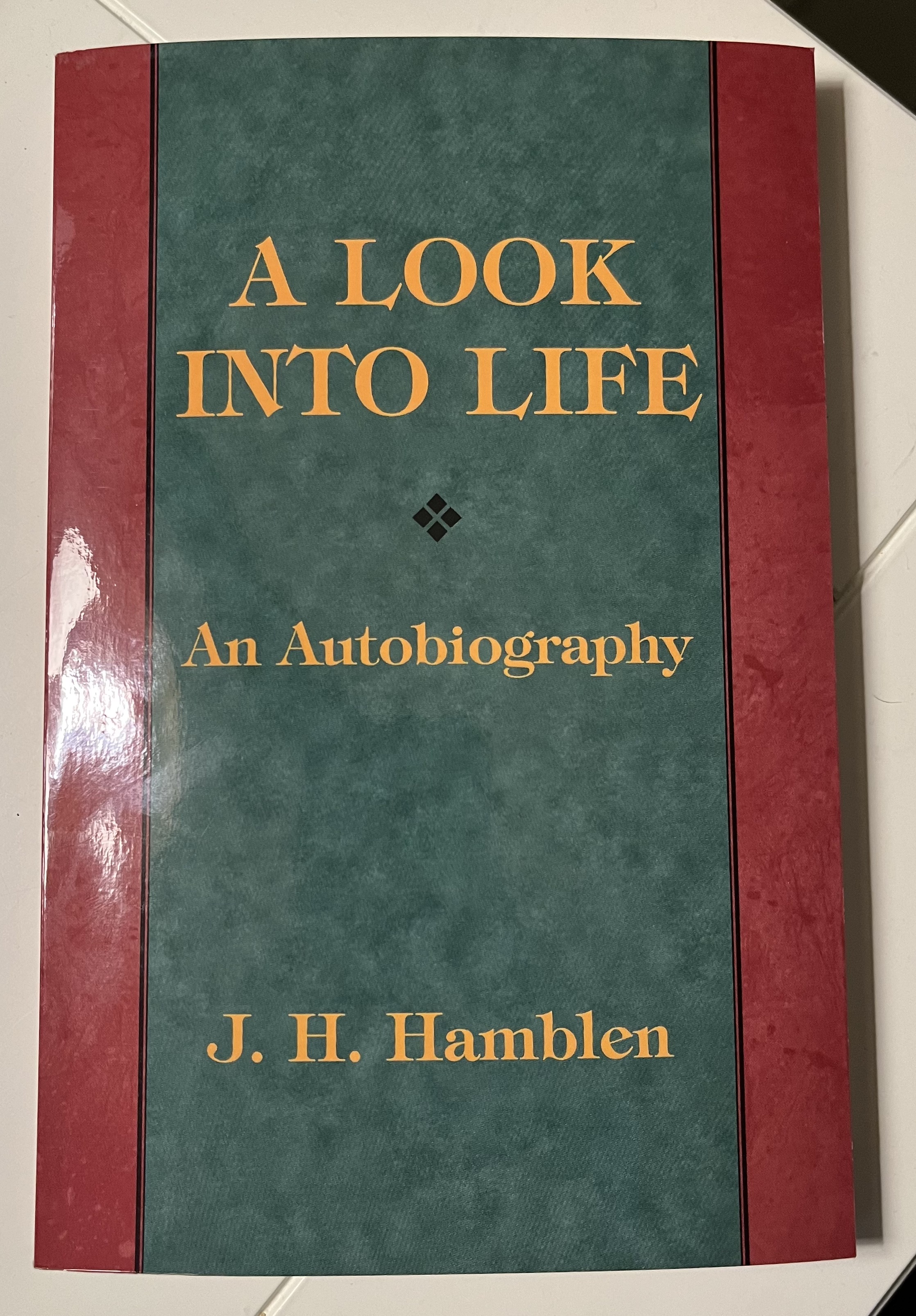
I’m always on the look out for a good book to read, and Rev. Max Edwards, the General Superintendent of the Evangelical Methodist Church recently made the recommendation of A Look into Life, the autobiography of Dr. J. H. Hamblen. For those of you who don’t know, Dr. Hamblen was the driving force behind the founding of the Evangelical Methodist Church. (Order your copy by clicking here).

Dr. Hamblen was a Methodist preacher. He was part of the Methodist Episcopal Church, South and subsequently (after 1939) part of The Methodist Church (which would later become the United Methodist Church). Dr. Hamblen would say he was a Methodist preacher because he grew up with a shoutin’ Methodist mama.

I’m not going to give you an in-depth analysis or review of Dr. Hamblen’s autobiography in this blog. I’m simply going to recommend that you put it on your reading list for 2024, especially if you’re a Methodist or a history buff. You’ll be glad you did.

The book is an easy read (I read it in three sittings), yet it is filled with stories and reminisces of past appointments and experiences in each one. I could almost see him riding that old horse and buggy for the forty miles between appointments as he rode the “circuit.” Reading it is like listening to a wily veteran share stories from the war. If one is interested at all in hearing how the appointive process in The Methodist Church worked in the “old” days, this is a great chronicle.

What I found most interesting was the unfolding of events that eventually led Dr. Hamblen to form the Evangelical Methodist Church. “Modernism” had made its way into The Methodist Church in the early part of the 20th Century and it was his position against the “program” of the Methodists that led him in 1946 to call a prayer meeting in Memphis, Tennessee to address this issue. Out of that prayer meeting the seeds of the Evangelical Methodist Church were sown. Dr. Hamblen eventually paid the price by forfeiting both his pulpit and his pension in The Methodist Church. He never regretted the sacrifice.

I admit that I felt some kinship with Dr. Hamblen as I read. The issues he dealt with and the challenges he faced in the “modernist” controversy were not unlike the challenges and issues that led to many of the disafilliations in the current United Methodist Church. I felt like I was reading a contemporary biography, rather than one whose primary events happened in the 1940’s. I guess the old saying, “The more things change, the more they stay the same,” is true. King Solomon said it best:

What has been will be again,
    what has been done will be done again;
    there is nothing new under the sun.

Eccelesiastes 1:8 (NIV)

Dr. Hamblen included in the book two essays written by a friend, Dr. Robert Shuler (also known as “Fightin’ Bob”) who pastored Trinity Methodist Church in Los Angeles, California. Dr. Shuler is definitely a character you should research. Dr. Hamblen included the essays in the book because they encapsulated for him the essence of the philosophy underlying the EMC. I mention them here because (with the changing of a very few terms) reflect the current divide in the UMC. Here are a few quotes from Dr. Shuler’s essays:

“I am a Methodist. I am a Wesleyan. I am committed heart and soul to the Arminian position, up to the point where that positions veers off toward humanism. Moreover, I deplore the fact that thousand of Methodists, who feel that they can no longer conscientiously remain with the Methodist Church under present Unitarian and Socialistic leadership, find themselves adrift and are joining the Pentecostal movements and other religious groups that are not distinctly Methodist.

“It seems to me that the Evangelical Methodist Church is a God-sent organization, if for no other reason, in that it offers tens of thousands of loyal Methodists, who can not go with present Methodist leadership, a church home, in which the may continue to be loyal, active Methodists. But that is not the only reason for its existence. So far as I can discover, The Evangelical Methodist Church is in every particular what original Methodism purported to be. It is a Bible centered Methodist Church and a soul-saving centered Methodist Church. The distinctive doctrines of primitive Methodism are the doctrines that are accentuated by The Evangelical Methodist Church.”

Dr. Shuler would further write, “Christianity is today in a state of flux in her organic processes. There are two schools of thought that cannot and will not live at peace with each other. Methodism is split wide open at this very point. We have thousands of Methodists…who believe what the Wesleys believed and taught and we have thousands of other Methodists who have accepted Unitarianism, Universalism, Socialism and even Humanism and made them a part of the Methodism which they promote and direct. There is no blending these two varieties of Methodism.”

As I mentioned earlier, exchange a few terms and it is an accurate reflection of the current United Methodist Church.

I’m not writing to get anyone to consider the Evangelical Methodist Church as a landing place, although I do invite you to explore it as a possibility. I have found a home here. You might, too, especially if you are committed to a traditional interpretation of Wesleyan/Arminian theology. We remain a small denomination, but we are strongly committed to Jesus and to being a “soul-saving centered” church.

I am writing more as a means of processing some of my own anxiety over having left the United Methodist Church. Unlike Dr. Hamblen, I didn’t pay the price with my pension, though I did lose the “big” church pulpit. Like Dr. Hamblen, I did lose valued friendships and long-term, meaningful relationships. Also like Dr. Hamblen, I haven’t looked back. The Lord has blessed us through it all. For that, I give Him thanks.

Let me commend A Look into Life to you for reading. Maybe you’ll enjoy it as much as I did.

Until next time, keep looking up…

Still Some Dying to Do…

The past week has had me contemplating death…yes, even my own! What a morbid way to begin a blog, right? Hear me out, though!

Certainly, as I’ve gotten older, I’ve thought about my own demise. My dad died at age 63, so I’m a mere three years younger than he was when he passed away. I’ve thought about that often since October.

Honestly, that’s not really the death I have been contemplating recently. It may have been the ice storm left me with too much time on my hands, or the fact that I preached on Jesus’s baptism last week, but the death I’ve been contemplating is death to self. In that regard, I know I have a little more dying to do.

I am reminded of the words of Dietrich Bonhoeffer, who said in The Cost of Discipleship, “When Christ calls a man, he bids him come and die.” We die to pride, we die to selfishness, we die to our own will, our own desires, and we are raised to be like Christ.

As much as baptism is a symbol of the forgiveness of sins, it is also a symbol of our dying. The Apostle Paul said as much to the Roman church:

Or have you forgotten that when we were joined with Christ Jesus in baptism, we joined him in his death? For we died and were buried with Christ by baptism. And just as Christ was raised from the dead by the glorious power of the Father, now we also may live new lives.Since we have been united with him in his death, we will also be raised to life as he was. We know that our old sinful selves were crucified with Christ so that sin might lose its power in our lives. We are no longer slaves to sin. For when we died with Christ we were set free from the power of sin. And since we died with Christ, we know we will also live with him.

Romans 6: 3 – 8

Baptism is our acknowledgment that we have heard God’s call to come and die. Baptism is our acknowledgment that we are not sent to work “for” God, but are sent to be “used” by God for His purpose. We acknowledge that we are His vessel so that His grace can be poured out through us. For that to happen, I must die.

My pride must die. Pride has no place in God’s presence. Pride cannot be sustained in God’s presence. If I’m still struggling with pride (and I am), I still have some dying to do.

Death is a frightening thing, though. We avoid it like the plague. Yes, even dying to self, especially when we live in a culture that tells us life is about self-realization, self-actualization and self-fulfillment. No, I’m sorry! That is not what the Bible says and that is not God’s call upon our lives. God’s call is to self-surrender. God’s call is to selflessness. God’s call is to self-denial. In that regard, I still have some dying to do.

Paul says we are dead to sin. Oh, really? It sure doesn’t feel that way some days! It’s probably because I still have some dying to do. God’s call is to holiness…to sanctification (that $3 theological word we Wesleyans like to throw around). We Wesleyans believe that baptism is an acknowledgment that God’s sanctifying grace begins its work in us so that God might do His work through us. We believe that a life of holiness is real and attainable, but it will only come through death–death to self. We must die to live. An oxymoron, I know, but according to Paul, it is imperative.

Then why is it that many (most) days, I feel like I actually regressed in the pursuit of holiness? Honestly, some days I get tired of trying! Death is hard! Faithfulness is hard! Pursuing a life of holiness is exhausting! Well, duh!

The last week of reflection has shown me that it is so hard because I’m the one doing all the work. I’m the one doing all the work because I still have some dying to do. The “old self” hasn’t died enough to realize that forgiveness is a gift…salvation is a gift…the Holy Spirit is a gift. I heard the call of God and then “I” went to work instead of receiving the gift and allowing the Holy Spirit to do His work in me.

I work so dad-gum hard to become a better me that I never realized that the Lord wants to make me a different me. He’ll do all the work if I just get out of the way and let him. The only way I can get out of the way is through death–death to self.

How? How can I die to self? I can’t! I’ve figured that one out. This death is not within my ability to accomplish. I have to quit trying. I have to surrender even my desire for self-denial to the power of the Holy Spirit. I cannot overcome the temptations and pride of life in myself. It is only through a power outside myself. My only prayer…my only hope is “Let the Holy Spirit fall on me!”

I still have a little dying to do. Come Holy Spirit! I’ll not die without You!

Until next time, keep looking up…

Devotional Musings…

For some reason, every time I sit down to write I think I need to write something profound and earth-shattering, but the reality is I rarely have anything profound and earth-shattering to say. Today is no different. So, I’m just jotting down a few of the collected devotional thoughts I’ve pondered throughout the past week. It is my feeble attempt to maintain the discipline of writing. Perhaps someone, somewhere will find these random thoughts helpful.

Reflecting on the call of Isaiah in Isaiah 6, I am struck by the fact that God never called Isaiah by name. God’s call was very generic in nature:

Then I heard the voice of the Lord saying, “Whom shall I send? And who will go for us?”

And I said, “Here am I. Send me!”

Isaiah 6:8 (NIV)

I wondered if God calls any one of us specifically, or if God calls us all generally. I wondered if what makes the difference is in who is listening. Only those who are listening for God’s call will ever answer it. Isaiah had to hear the call, but it wasn’t enough only to hear it. Isaiah had to answer God’s call. Isaiah was attentive to the Lord, so he was able to discern the Lord’s voice. Isaiah was also willing to be obedient even before he knew what the Lord was calling him to do.

Attentiveness and willingness: two prerequisites to walking in the Lord’s will. I wonder how often I’ve exhibited those characteristics. I also wonder which precedes which? Does willingness come before attentiveness, or must I first be attentive before I can be willing? Even if I am attentive, does my willingness depend on what He is calling me to do? Hmmm? I wonder?

God’s call will always be challenging. God’s call to Isaiah was not an easy one, for sure:

He said, “Go and tell this people:

“‘Be ever hearing, but never understanding;
    be ever seeing, but never perceiving.’
10 Make the heart of this people calloused;
    make their ears dull
    and close their eyes.
Otherwise they might see with their eyes,
    hear with their ears,
    understand with their hearts,
and turn and be healed.”

Isaiah 6:9-10 (NIV)

God’s call to Isaiah? Go tell these people something they won’t understand. It’ll make them mad. Very few will listen. Very few will “get it.” But, do it anyway. How challenging is that?

I want to believe that God is calling all of us–calling us to be evangelists–to share the Good News of God in Jesus Christ. I wonder how many of us are listening and willing? We are called to be evangelists to our families, to our co-workers, in our social networks. Can I get comfortable with the reality there will likely be many more people who reject the message of hope than who hear and accept it? Then, I remember that it isn’t dependent on me. It is dependent on their own attentiveness and willingness. My task is obedience.

How do I listen? How do I cultivate attentiveness and willingness? It starts with worship. At least that is where Isaiah’s started:

In the year that King Uzziah died, I saw the Lord, high and exalted, seated on a throne; and the train of his robe filled the temple. Above him were seraphim, each with six wings: With two wings they covered their faces, with two they covered their feet, and with two they were flying. And they were calling to one another:

“Holy, holy, holy is the Lord Almighty;
    the whole earth is full of his glory.”

Isaiah 6:1-3 (NIV)

Worship sets the stage for us to hear God’s call. Worship ushers us into God’s presence and allows us to glimpse His glory. Compelled by the sheer glory of His presence draws us to a place of repentance for our own sin…an acknowledgment of our own unworthiness. Only then can the Lord use us for His purposes.

Worship isn’t the only attitude that will prepare us to hear God’s call. If we truly want to understand what God is saying, we must open His Word–the Bible. If we can’t hear God’s voice, perhaps it is because we haven’t spent time in His Word. Consistent Bible study is imperative to hearing His voice.

Prayer, too, is key to hearing God’s voice. I need to remind myself that prayer is more listening than talking. I think that in my prayer time I must continually talk to the Lord, to tell Him all my trials and troubles, but how can I hear Him if I am the one doing all the talking. Yes, lift my burdens to the Lord, but then sit quietly to listen to what He has to say. What He has to say will not always (it will rarely) be about what I was talking to Him about. I get distracted by such trivial matters. He is concerned with the whole world. I am concerned with just such a tiny little part of it.

Being able to hear the voice of God does not necessarily make us willing to be obedient to the voice of God. I wish there was a secret formula to being willing to be obedient to God’s call. I wish I knew what that formula was. Maybe some of you know. If you do, could you please share it in the comments below? Let me learn from you, please, because it is in the area of obedience that I struggle the most.

Yes, I wake up every day committed to obedience, but then I am faced with a challenging word or task, and fear or timidity or laziness soon triumph over any initial willingness I possessed. I begin every day with the willingness of Isaiah: “Here I am! Send me!” Most days end will feelings of dejection because I give in to the fear, timidity and laziness.

Hope! Hope is what I need! I have hope in Jesus and in the power of the Holy Spirit. He is my (our) only hope…in this life…and in the life to come. I need you, Jesus! I long for you, Lord! Help me to hear your voice. Guide me through worship into the place where your voice becomes clear. Fill me with power so that my willingness to be obedient shall not be overcome by either fear, timidity or laziness. Amen!

Enough randomness for now. It’s time to get ready for worship.

Until next time, keep looking up…
Laissez Les Bons Temps Rouler..

For those of you keeping score, Christmas is finally over. Though some say we should keep the spirit of Christmas year round, Christmas officially ended yesterday (Saturday, January 6th) with Three King’s Day or Twelfth Night (You know? As in the Twelve Days of Christmas?). For those following the Christian calendar, the season of Epiphany officially began yesterday.

The beginning of Epiphany can only mean one thing: King Cake! No, actually it means so much more than that. I won’t go into all that it means. If you want a deep dive into Epiphany, just Google it. You’ll be reading for days!

For those of us in Louisiana, it really means Laissez les bons temps rouler! Yep! Let the good times roll! Epiphany marks the beginning of the Mardi Gras season. Mardi Gras is that time of year when normally sane people find an excuse to dress up in lavish costumes, organize and attend exuberant parades, attend balls and otherwise act in ways they wouldn’t normally act (define that as “eat and drink a lot”).

I just have one question: Why? Why do Christ-followers participate in what have become purely pagan celebrations? I don’t ask the question in a condemnatory or judgmental fashion. It is a serious question that I am earnestly trying to understand. Perhaps by asking the question here, someone will share with me what disciples of Jesus gain from participating in all the “revelry” that comes with the Mardi Gras season?

I know most folks love a good party and when one is looking for an excuse to have a good time, any excuse will do. I suppose Mardi Gras provides a good excuse.

I’ve never considered myself a party animal, so I’ve never been attracted to all the celebrations centered around the season. Sure, I’ve attended Mardi Gras parades (I did pastor in Morgan City, you know?), but it was always more out of a sense of obligation (gotta’ take the kids, or when in Rome do as the Romans do, etc.) than a desire to be in a crowd and catch beads and trinkets (especially when it’s cold outside), or dress up in opulent costumes for balls. If that’s your cup of tea, more power to you.

I do, however, want to understand the mindset behind followers of Jesus participating in “krewes” that carry the names of pagan gods from centuries past. Google “Mardi Gras Krewes” and you’ll find krewes named for Janus, Bacchus, Morpheus, and Iris, among others who take their names from characters portrayed in Greek and Roman mythology.

I just can’t seem to square that circle. I suppose I need to remember Paul’s words to the church at Corinth when he addressed the issue of eating meat offered to idols: “…we all know that an idol is not really a god, and that there is only one God and no other” (1 Corinthians 8:4b). In the broader context of his letter, Paul’s argument is that you can’t offer a sacrifice to something that doesn’t really exist, so…

He would go on to say, however, if in doing so (eating meat sacrificed to idols), my actions cause another person to stumble, then shame on me. Actually, he said he would never eat meat again if it caused a brother to stumble.

I suppose I’m really struggling with the question of where does my Christian freedom end and my responsibility to my brother/sister begin? I don’t know that I can answer that question here (maybe some of you can), but I believe the answer begins to emerge when I surrender myself to the law of love found in Jesus Christ. I discover that my responsibility to my brother/sister takes precedence over my own Christian freedom.

As a follower of Jesus, yes, I CAN laissez les bon temps rouler, but SHOULD I? I suppose that’s the question I really need to answer. And I need to get comfortable with the fact that every Christ-follower will answer the question differently. Maybe I’m just one of those weak Christians Paul referred to in 1 Corinthians 8. Kudos to all you strong ones. I suppose I’m just not there yet.

So, go ahead and do your Mardi Gras thing (I’ll eat my fair share of king cake, for sure). It won’t bother me and I certainly won’t judge you for it. I won’t understand it, but I still won’t judge you. I’ll just be over here doing my own kind of sinning in my own kind of way, and like the rest of you, I’ll look forward to Lent when I can repent of my sin and seek the Lord’s forgiveness. He’ll grant it because He’s good like that, and sans the great work of the Holy Spirit, we’ll just start the cycle all over again.

Laissez les bon temps rouler…

Until next time, keep looking up…

Praying in the New Year…

As I sit in reflection of another passing year, I am overwhelmed by the blessings I count. It was a quiet Christmas evening that really began what has been almost an entire week of reflection. Gratitude and humility have been “top of mind” for me all week long. Seems an appropriate way to end the year.

Now, we await the dawning of a new year. A new year will bring a new devotional routine for me (just because I need a change), but I can’t think of a better way to begin the new year than with the Wesleyan tradition of the Wesley Covenant Prayer. I invite you (the three of you who read this regularly) to join me in renewing our covenant for the new year.

“I am no longer my own, but thine.
Put me to what thou wilt, rank me with whom thou wilt.
Put me to doing, put me to suffering.
Let me be employed by thee or laid aside for thee,
exalted for thee or brought low for thee.
Let me be full, let me be empty.
Let me have all things, let me have nothing.
I freely and heartily yield all things
to thy pleasure and disposal.
And now, O glorious and blessed God,
Father, Son, and Holy Spirit,
thou art mine, and I am thine. So be it.
And the covenant which I have made on earth,
let it be ratified in heaven. Amen.”

That, my friends, is a bold prayer! The prayer was adapted by John Wesley for the renewal of the believer’s covenant with the Lord. Wesley first used this prayer in a covenant renewal service held on Monday, August 11, 1755, in London, with 1800 people present. Since then, the Wesleyan Covenant Prayer has been used in Methodist services around the world on the first Sunday of the year.

Well, this is the last Sunday of the year, but I’m praying this prayer anyway. Nothing like getting an early start, right? Perhaps starting early will prepare me for the changes the new year ushers in. What changes you ask?

First, I have announced to the leadership at Lakeview Methodist Church that January 28th will be my last Sunday to serve as their interim pastor. Earlier in December, the congregation voted to align themselves with the Congregational Methodist Church. My original commitment to the congregation was to shepherd them through the process of re-alignment, and that process is now complete. I can commend them to the care of the Congregational Methodist Church as they begin the process of calling a new pastor.

I do leave them to the care of the Congregational Methodists a bit reluctantly, but only because I hate to leave them high and dry until they find a pastor. My doing so has more to do with a big change in my business that simply doesn’t leave me time to be fair to the congregation in my devotion as an interim pastor.

December 22nd of this year was the last day on staff for the manager of the business. It was a big change for him, for the business and staff and for me. Everything is well. He left to pursue an opportunity he believed he couldn’t pass up. I wish him only the best. He has been a tremendous asset to the business and to me personally. He is perhaps the best mechanic I’ve ever seen, and I would gladly trust him to fix any problem with my vehicles. No doubt, it is a loss for SpeeDee Oil Change & Auto Service in Ruston, but we will persevere.

With my manager’s departure, that leaves me to serve as the manager of the shop for now. No, I won’t be the mechanic, too! You don’t want me turning too many wrenches on your vehicle. I have become in the automotive industry like I was in the hardware business with my grandfather. In the hardware store, I learned to identify what you needed to fix your problem, you just didn’t want me to fix it!

Don’t worry! I do have another mechanic on staff, so we’ll get those mechanical issues taken care of, for sure. But, until I can identify a new manager, the manager will be me, and that means generally opening and closing the shop six days a week. Not much time for anything else for now.

I regret it for the congregation. I had hoped to be with them until they called a new pastor, but I suppose the Lord had other plans. It seems as though the Lord always has other plans. What’s the old joke? Want to make God laugh? Tell him your plans!

So, we’ll see what plans the Lord has for 2024. I think that really is the essence of the Wesley Covenant Prayer. Lord, show me Your plans. Whatever those plans are, I’m down with them. I really can’t think of a more appropriate way to begin the new year. Will you join me in that prayer?

Happy New Year everyone!

Until next time, keep looking up…

God with Us…

My wife, Vanessa, and I like to get away to L. A. as often as we can. No, I’m not talking about Los Angeles. I’m talking about lower Alabama. Driving across southern Mississippi we go through a lot of little towns on Highway 49. One in particular is Mt. Olive, Mississippi. Driving into town there is a prominent sign that says “Birthplace of Steve McNair.” Steve McNair was a professional football player who played quarterback, and spent most of his career with the Houston Oilers/Tennessee Titans.

A little further down Highway 49, you enter Collins, Mississippi, and again, at the entrance of town there’s a sign that says “Birthplace of Gerald McRaney.” Gerald McRaney is an actor who played in series such as Simon & Simon, House of Cards and more recently, This Is Us. I don’t know how many of you have driven through Mt. Olive or Collins, Mississippi, but there isn’t much happening in either of those places. They are simply little towns nestled between the bigger cities of Jackson and Hattiesburg. Their claim to fame is who was born there.

Now, picture in your mind, riding your camel across the Judean desert southward out of Jerusalem in the first century. About five miles out of Jerusalem, you start to enter a sleepy little town called Bethlehem, and as your camel glides into town you see a sign that says, “Birthplace of King David.”  

Bethlehem’s claim to fame was that it was the birthplace of the nation’s most famous and popular king. One scholar says, “’At the beginning of the first century AD, Bethlehem was a village with not more than a thousand inhabitants: a small set of houses scattered along the side of a ridge and protected by a wall that was in a bad state of repair.”

We sing the Christmas carol O Little Town of Bethlehem with the emphasis on “little.” It was not where anyone was expecting anything special to happen. It certainly wasn’t where anyone was expecting God to show up. Sure, there had been this prophecy from Micah that said,

 “But you, O Bethlehem Ephrathah,
    are only a small village among all the people of Judah.
Yet a ruler of Israel,
    whose origins are in the distant past,
    will come from you on my behalf.”

Micah 5:2 (NLT)

Micah’s prophecy was long since buried in the recesses of the nation’s mind. Even the nation’s king, Herod, had to call on the experts to be reminded of Micah’s prophecy when the wise men showed up looking for this “new” king that was born. 

Nobody really expected God to show up, or for God to do anything special in Bethlehem. If God was going to show up, God was going to show up in Jerusalem. That was the happening place for the nation of Israel. Of course, God might show up in Rome, or even Athens, Greece. Those places were the center of first century culture, politics and power. If something is going to happen, it would surely happen in one of those places, not sleepy little Bethlehem.

That’s what we expect, too, and we have the benefit of bible stories and an annual celebration to remind us that God shows up in unexpected places. What do I mean? God is a big God, and if God is going to make a difference, it’s because He’s going to do it in a big way. Right? Sure, like in New York City or Washington, D. C., or maybe Paris or London. Those are the seats of power. We certainly don’t expect God to show up in places like Minden. But, He does, and isn’t that Good News? Sure it is…sort of…

If God shows up in Minden (or wherever you live), that brings Him awfully close to home, and we’re just not sure we want God that close. We like having a little space between God and us. You know how we like our space. Don’t get too close. Don’t believe it? Notice what you do next time you’re waiting on the elevator and the doors open and it’s got more than four people on it. Most of us will wait on the next one. Let me tell you, Bethlehem is evidence that God doesn’t really respect our space, and we don’t quite know what to do with a God like that. 

What do we do with a God like that? What do we do with a God who shows up in the most unexpected places? I tell you what we do—we build places where we will COME and meet God. We’ll come, sit down, listen for an hour or so, get our God fix, talk a little bit about how it’s been going for the last week, be reminded of the things we need to work on, resolve to do better and ask God to help us out. Most of the time we’ll leave saying, “Hey, this has been a good session. We’ll do this again.” We leave and we expect that God stays, but…that’s not the evidence of Bethlehem. That’s not Emmanuel—God with us. That’s not the point of Christmas at all!

The point of Christmas is that God is with us in all the unexpected ways and all the unexpected places of our lives. That’s what we sing in the words to the third verse of the song Phillips Brooks wrote in O Little Town of Bethlehem: 

How silently, how silently, the wondrous gift is given;

so God imparts to human hearts the blessings of his heaven.

God imparts to human hearts. God is born in us. Christmas is God being born in us—you and me! And, that is an even more unexpected place than Bethlehem. Christmas means that God goes with us to work. When we’re standing on Monday morning at that blasted copy machine that never works the way it was designed to work.

God is with us at home with our families, around the dinner table, and God is with us when we’re living at the homeless shelter. God is with us when we’re going through the divorce and when we’re battling the addiction. God is with us when we’re shopping at Wal-Mart and when we’re driving our cars. God goes with us on vacation.

God is right there with us when we’re confronted with choices that challenge our values, and God is right there when our co-workers, or friends, or children make lifestyle choices that challenge our sensibilities, and who don’t understand who Christ is because we’re the only definition of him they see. 

Yes, God is with us in the great, high and holy moments of our lives, but God is also with us when we’re struggling with the difficulties of life. Christmas is God giving Himself to us, to be with us, to invade our time and space for one purpose and one purpose only—to have a relationship with us, to save us from our sin, and to give us life through His Son, Jesus Christ. That’s the evidence of Bethlehem. That’s the point of Christmas!

That only leaves one question: Will we allow Him to be born in us today? The last verse of O Little Town of Bethlehem becomes our prayer this Christmas and every Christmas. Listen to Brooks’ prayer again:

O holy child of Bethlehem, descend to us, we pray;

cast out our sin, and enter in, be born in us today.

We hear the Christmas angels the great glad tidings tell;

O come to us, abide with us, our Lord Emmanuel!     

O come to us, abide with us, our Lord Emmanuel!

Merry Christmas, y’all!

Until next time, keep looking up…

Ten for Christmas…

So, I’m not posting the blog that I really wanted to post this morning. Following the sage advice of my sweet wife, I hit the delete button on that post, so it will never see the light of day. That post, written completely as satire, was funny, honest and accurate, but according to her it was also hateful. Suffice it to say that the writing of that post was a bit cathartic in processing some anger I’ve been dealing with recently.

That being said, you’re getting this post instead. Trust me. This post is much more beneficial for anyone hoping to improve their walk with the Lord and deepen their spiritual life. So, let’s begin with some questions.

Are you looking for the perfect Christmas gift for the reader in your family? Don’t know what to get your prayer partner for that annual gift swap at Christmas? Are you looking for something to utilize in the new year as part of your next devotional practice?

Look no further! In this blog I’m going to offer a list of ten books that have had a profound impact on my life through my years in ministry. Some of them will be great to incorporate into your devotional life. Others will be great to share with a person who is hurting or struggling with life issues. Still others are simply great books that every earnest disciple of Jesus should read at some point in their journey.

In no particular order, here are ten books that I can easily recommend for personal use or as gifts to the readers in your life.

The Return of the Prodigal Son by Henri Nouwen.

Perhaps one of the most profound books I’ve ever read. Prompted by his own encounter with Rembrandt’s painting by the same name, Nouwen offers vivid reflections on the well-known parable that speaks to grace, forgiveness and reconciliation in new and challenging ways. I have led study groups numerous times on this book, and each time I did, I learned new insights into the parable and into my own need for grace…and my need to be graceful towards others.

Another impactful book by Nouwen is The Wounded Healer.

Though I never utilized it for study groups, it was through this book that I learned my service to others is best offered by recognizing and acknowledging my own woundedness. My wounds can become a source of strength to help others. It’s a relatively short book and it served well for devotional reading as part of my regular discipline.

The Pursuit of God      A W Tozer

If one is looking for an experiential, intentional and transformational faith, then this is the book for you. I love me some A W Tozer! Spiritually deep but incredibly readable. This makes a fantastic devotional. This is one I’ve read multiple times. I’m not sure what constitutes a “classical” book, but I guarantee you that Tozer will still be read 100 (if not 500) years from now.

Celebration of Discipline         Richard Foster

More than any other, Foster’s book taught me what the spiritual disciplines are and how to begin to practice them in my daily life. I have read it multiple times and have referred to it often in sermon and bible study preparation. I’m not sure how old a book has to be to be considered a classic. This book was first published in 1978, so it may not qualify. I would say, though, that it has become one of the definitive works on the spiritual disciplines certainly in modern times. This book is a great place to start if you’re serious about practicing the spiritual disciplines.

The Imitation of Christ            Thomas a Kempis

This is one I read as a seminary student. The Imitation of Christ is the most read Christian book behind the Bible and will stand as a classic as long as the Christian faith exists. It is great as a devotional read, and I have read it multiple times in that manner. I have even used it as sermon material throughout the years.

The Screwtape Letters            C S Lewis

You have to put your thinking cap on to read this one, and you really have to be able to think in reverse to understand the message Lewis is communicating, but if you can accomplish that task, you’ll understand in a whole new way temptation, sin, human nature, spiritual warfare and the nature of faith. The book is funny in a crazy sort of way, but Lewis captures the essence of the human condition and explains it well with dialogue between two demons named Screwtape and Wormwood.

The Cost of Discipleship          Dietrich Bonhoeffer

 A call by Bonhoeffer to the costly grace of true discipleship. Cheap grace is defined by Bonhoeffer as “the preaching of forgiveness without requiring repentance, baptism without Church discipline, Communion without confession, and absolution without contrition.” Every believer should read this book.

Life Together   Dietrich Bonhoeffer

A short treatise on common life and accountability in Christian discipleship. Bonhoeffer practiced this model with his students in an underground seminary during the Nazi years in Germany. This is an extremely easy read but its depth is exceptional. Bonhoeffer makes me ask the question, “Why can’t we create community like this?” Perhaps some have and I’ve just missed it. Has the Church gone wrong in this regard? I wonder?

Dark Night of the Soul            St. John of the Cross

This one is hard to read, but if God feels absent in your life, it is worth the effort. I read this book when I took a sabbatical in 2008. I was on sabbatical because I was struggling with my call to ministry (and some other personal issues). It helped me to understand that sometimes God is so close that we can’t see him.

The Practice of the Presence of God    Brother Lawrence

A humble servant of God shares how we can encounter God in even the most mundane of circumstances and in our daily responsibilities. Brother Lawrence taught me how to begin seeing the majesty in the mundane of my every day. Whenever I feel sad, or grumpy, or bored, I often remember Brother Lawrence and I start searching for the Lord in what is happening around me. A true Christian classic if there ever was one.

There are many books that I have found challenging and impactful through the years, but these ten are at the top of the list. Notice I did not say that they were my ten favorites. The Return of the Prodigal Son would be on that list, too, but I’ll save that list for another day. These are on this list because either I or my behavior was changed as a result of reading them. So, I commend them to you so that your life might be changed, or the life of the reader on your Christmas list might be changed.

Until next time, keep looking up…

The Road Between Work and Worship…

Part of my present devotional exercise is reading a sermon a day from Eugene Peterson, beloved translator of The Message paraphrase of the Bible. Though Peterson suffered some damage to his “evangelical” reputation near the end of his life, I refuse to throw the baby out with the bath water. Peterson was gifted with the ability to turn a phrase with elegance and simplicity, and with over 50 years in ministry, he turned many phrases that are both abounding in truth and utterly challenging.

If you’ve never read Peterson (outside the occasional look at The Message), I commend his work to you. If you are a pastor, you would benefit greatly from his memoir The Pastor: A Memoir, whether you’re just beginning the work of pastoral ministry, or whether you’re nearing the end of the journey. Another classic I would recommend any Christian read is A Long Obedience in the Same Direction: Discipleship in an Instant Society. This book will change the way you view Christian discipleship. Well worth the read.

So, one of the sermons I read this week offered me a particular challenge in how I view the church (little “c” intentionally used–meaning the local congregation). Here are the two paragraphs that challenged me:

“The ideal church, as far as I’m concerned (which is rooted in my understanding of Scripture), would be one where nobody came near the church for six days and everybody came on Sunday. The best kind of church would be one with no committees or organizations–nothing happening here between Sundays. Not because we have nothing to do but because we have everything to do. During the week we’re out carrying crosses, denying ourselves, following Jesus, making our witness, helping our neighbors, serving God, working responsibly and as hard as we can to be the people of God in serving and suffering the way he’s called us to do it. We work. We do.

“But, then, on the “seventh day” (the first day for Christians), we come here and leave all that behind. And we enjoy everything that God is doing. We become carefree. Free. We become children again. We let God do it all, and you sing and adore and become aware of his presence.”

Sermon “Transfigured”, Eugene Peterson

Ah! A congregation with “no committees or organizations.” A pastor’s dream! But, without the incumbent “work” of ministry that all Christ-followers are called to do in the interim, I’m sure it would soon become a nightmare. Perhaps it has…

I am reminded by Peterson’s words that there is to be no distinction between our work and our worship. We worship AND we work. Worship is meant to fuel our work. Too often, we compartmentalize our lives such that our worship is divorced from the everyday-ness of life. “This” is my religious life, and “that” is my work (everyday) life. I get so much out of the “worship” part that I want to return tomorrow or the next day to experience it again, but in doing so, I neglect the necessity of the “work” part of loving my neighbor or greeting the stranger. Worship becomes the excuse for my failure to work. Ouch!

It is easy to be Christian on Sunday. It is much more difficult to be Christian on Monday when we are met with the challenge of actually putting feet to our faith. And, if I can go to enough bible studies and serve on enough church committees, I can find solace in the fact that “I’ve done my Christian duty.” It becomes easier to forgo the loving my neighbor or caring for the orphan part of our Christian duty.

As a pastor serving full-time in vocational ministry, I thought it was my responsibility to lead Bible studies and develop programs that enhanced the life of the congregation and fostered discipleship in its members. To do otherwise would likely have gotten me fired! Besides, how would anything ever get accomplished in the life of the congregation without committees and organization? Right? Someone has to lead all that. The “work” of the church does need to get done, after all.

Now, serving as a bi-vocational pastor, I’ve come to appreciate the necessity of the work that must be done outside the walls of the church. Listen, folks! The lost aren’t coming to the church anymore. If we would encounter the lost, it will be in the ordinary, everyday encounters we have with the people where we live most of our lives–our work and our home. It is in that environment that we must live obediently and faithfully. It is in the Monday through Saturday of life where disciples are formed. It is in the Monday through Friday of life where the lost are introduced to Jesus, and are offered the opportunity to embrace him as Lord and Savior.

Worship is not an escape from the world…a welcome respite from the challenges of life. Worship is meant to propel us into the world where our work becomes our witness, and our service to others reflects our faithful obedience to Jesus Christ.

I certainly don’t mean to diminish the work I did as a full-time vocational minister, nor am I casting dispersion on the many friends and colleagues who continue to do that work faithfully. I am, however, calling into question the motivations for doing what I did as a pastor, and for doing what we do as congregations. Age and context have given me a different perspective, and that change in perspective has me questioning some of my deeply held beliefs concerning discipleship. That’s all…

I guess the long and short of it for me is that there is no distance between worship and work. The journey of discipleship follows the same road between worship and work. I suppose faithful discipleship is learning how to “keep it between the ditches” along that road.

Until next time, keep looking up…

Random Ramblings and Rants…

So, this has been a week where I’ve been challenged by so many thoughts in my mind that I think I need this venue to try to gain some clarity from them. Processing all these thought via this means may bring me some clarity, but it also might serve to confuse you in the process, so…be prepared!

Ramblings

First, I’ve been challenged by Eugene Peterson this week. Last week, I went to the bookstore (I haven’t been in ages!) and in my browsing I came across a recently released compilation of Peterson’s sermons entitled “Lights a Lovely Mile.” I incorporate reading other peoples sermons into my devotional routine on occasion, and having a fondness for Peterson, I thought the book would be good to further that endeavor.

I have been challenged by two particular thoughts this week. The first is this:

“Jesus became an event. He was a stopping place for sacred history. The birth of Jesus was like arriving at the top of a mountain peak after a long, difficult climb: You can look back and see the whole trip in perspective, see everything in true relationship. And you don’t have to climb anymore.”

Lights a Lovely Mile, Eugene Peterson

I have read that paragraph over and over this week. Peterson’s capacity to use the English language to craft a beautiful thought is unrivaled, but honestly, as I’ve read and re-read the passage this week, I’m still trying to grasp the essence of what Peterson is communicating.

Yes, Jesus is a stopping place for sacred history and the fulfillment of the Old Testament prophecies. Only from the perspective of Jesus can one truly understand the Old Testament. But, that last phrase, “And you don’t have to climb anymore” confuses me. Why do I feel like I’m still climbing?

Perhaps I’m not climbing, but rather I’m running. I’m reminded of Paul’s counsel to the Corinthian church:

Do you not know that in a race all the runners run, but only one gets the prize? Run in such a way as to get the prize.

1 Corinthians 9:24 (NIV)

Whether I’m climbing or running, I feel like there is so much further I have to go on the journey to be like Jesus, so I haven’t squared that circle with Peterson’s thought just yet. But, I’m working on it.

The second of Peterson’s thoughts I’ve pondered endlessly this week is this:

“The bottom step in a staircase is neither better or worse than the top step: It is good in its own right and a way of getting upstairs.”

Lights a Lovely Mile, Eugene Peterson

I like this imagery by Peterson. Most days I feel like I’m still closer to the bottom step than the top, but at least I’m on the staircase, and I’m still climbing. There are days I don’t feel like I’ve made any progress. I look back and the bottom seems so close. I look up and the top looks so far away. It’s good to be reminded that the bottom step is no better or worse than the top. It’s just a step. The question I’ve wrestled with all week is: Am I still on the staircase?

At least Peterson has me thinking…

Advent Rambling

The dawn of another Advent season has me thinking, as well. I suppose Peterson’s analogy of the staircase is appropriate for me this Advent season. Advent is a time to look back to the coming of Christ, but also to look forward to His coming again. It is a season of anticipation and preparation. An event over the past week has caused me to contemplate an integral part of preparing for Advent.

There is on my 40 mile route to work a place where the local constabulary likes to hang out to monitor traffic. Many times on my way to or from work, I’ll see an officer parked at this same location. I know he/she is likely to be there, and as I approach this location I always glance down to insure that my foot hasn’t gotten heavy on the accelerator of my truck. I think that’s called accountability.

So, last week I’m driving along and I pass this location, and sure enough, there sits the police officer. I glance down and yup, I’m only going 74 miles per hour. Should be fine, right? That’s what I thought until after I passed the officer. After my passing, the officer pulls out onto the interstate. So, I slow down to 70. Who wants to see blue lights in their rearview? Not me!

So, why not think of Advent like that police car? When there is the possibility of blue lights in the rearview, the speed you drive suddenly takes on a new importance. That blinker that you frequently fail to use when making a lane change or a turn suddenly matters. Oh yeah! That yellow light on the traffic signal no longer means “Hurry up and get through the light.” It now means, “Slow down, fool, there’s a police officer behind you!” What a difference blue lights in the rearview make.

Advent can serve as a reminder of the fact that just as accountability is a part of being a licensed driver, so too, it is a part of being a disciple of Jesus Christ. What we do with our lives does matter. How we think, act, speak, these are a part of the fabric of our response to God’s grace, and we will someday face an accounting of our living.

Perhaps that’s why Jesus told his disciples to “Be ready!”

42 “Therefore keep watch, because you do not know on what day your Lord will come. 43 But understand this: If the owner of the house had known at what time of night the thief was coming,he would have kept watch and would not have let his house be broken into. 44 So you also must be ready, because the Son of Man will come at an hour when you do not expect him.

Matthew 24: 42-44 (NIV)

A Couple of Rants

I’ve rambled, so now let me rant. My first rant has to do with the way we Christians treat one another. This article explains it better than I can, but suffice it to say when I read how the Louisiana Annual Conference and its leadership threatened its retired clergy with retributive action should they preach or worship in any congregation that had disaffiliated from the UMC, I was livid. How dare they! Is it even legal? So much for having an “amicable” separation.

I was livid, for sure, but it wasn’t long until the Holy Spirit gently reminded me that I didn’t have a dog in that hunt anymore. I wasn’t “retired.” I left! Still, I have many friends and former colleagues who were now faced with a decision that was imposed upon them in a totally unjust manner. I could have stayed and fought the fight with them. Would have probably been the appropriate thing to do.

Honestly, I just sensed (from one who had been on the “inside”) how ugly it was going to get, and selfishly, just didn’t want to subject myself to the treatment some of my former colleagues have since experienced. I should probably repent for leaving, but I still believe it was the right decision.

One final rant–and, it’s about politics. Did you see the big debate on Thursday? You know? The one between Gov. Ron DeSantis of Florida and Gov. Gavin Newsom of California. I’m not going to critique the debate, but I am going to rant about the debate on abortion. Actually, I’m going to say they were debating the entirely wrong point–at least from a Christian perspective. The debate was over when an abortion should be allowed–six weeks or fifteen weeks (or as some Democrats suggest, up until the moment of birth).

The question is not when should it be allowed. The debate should begin with this question: What is in the womb?

My answer? A person. At the moment of conception or the moment of birth what is in the womb is a person. How do we treat a person in our culture? We do not kill them. Period. Either at the beginning of life, at the end of life, or at any point in between. Any debate on the issue of abortion must begin with the answer to the question “What is in the womb?” Without agreement on the answer to that foundational question, no answer will be sufficient.

I’m ranting because both the Democrats and the Republicans have the answer wrong. Six weeks, fifteen weeks or 39 weeks, there is a life in the womb, and the only Pro-Life answer is to not support abortion under any circumstance. Yes, it’s an extreme position, but I hold it, and it’s out there now, so do with it what you will. Perhaps that’s another reason I’m no longer a Democrat or Republican.

We can talk about alternatives to abortion another time. That’s enough rambling and ranting for one day. Besides, I have to preach today. I have a lot of praying to do between now and 10:30 a.m., to get my heart and my mind right after the week I’ve had. All this rambling and ranting has distracted me.

Until next time, keep looking up…