A customer came in the shop last week and on the way out the door he went around to several of the staff and to me and gave us all a “little” Jesus. You know the one I’m talking about, right? Yeah, that little 1″ plastic Jesus you can keep in your pocket. That one!
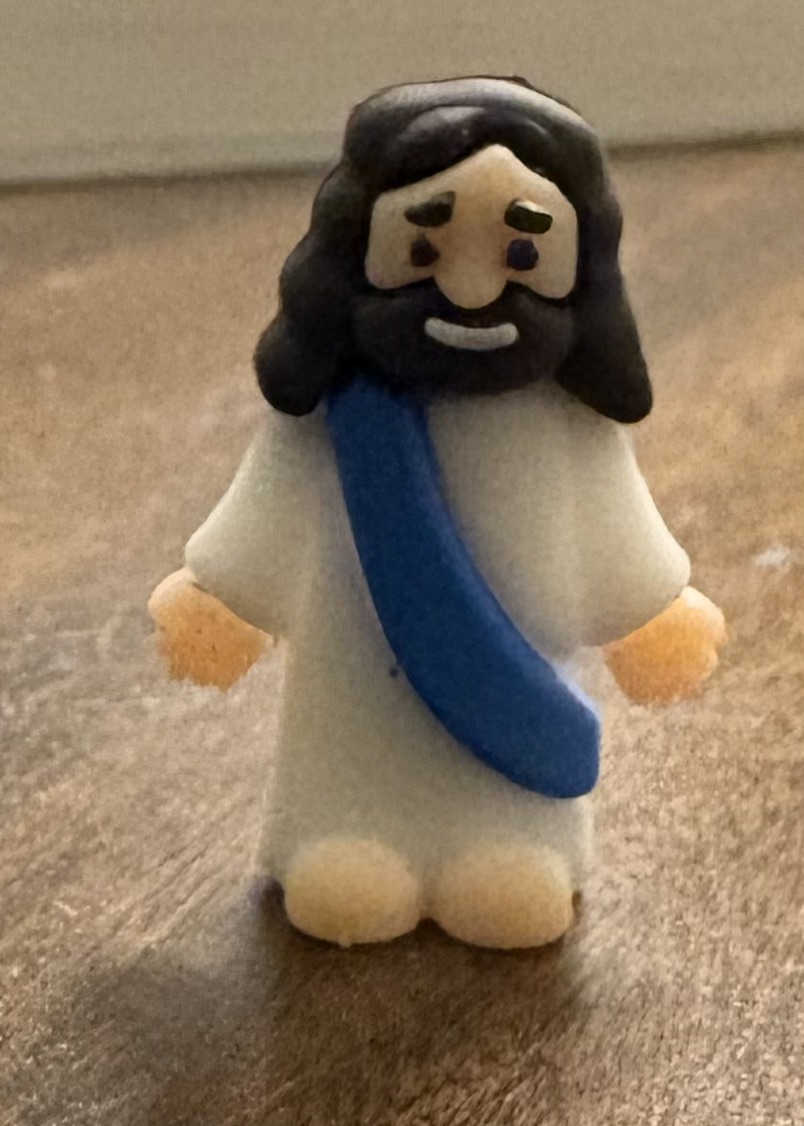
My wife has one on the dashboard of her car. The pharmacy where I get my medicine has about a dozen of them across the drive-thru window (and a “little” Mary, too–for the Catholics, I suppose). And now, five of my staff and I have a little Jesus.
This is not meant to be a knock on the concept of the “little” Jesus. It’s actually a very heartwarming trend designed to remind folks of the message of love, hope and faith. Folks are purchasing these in bulk to hide in places like public parks, grocery stores, and, in some cases, the U.S. Capitol, as a way to share their faith and remind people that they are loved.
It’s quaint. It’s cute. It’s encouraging. I was grateful to the customer who gave them to us. I appreciate his effort to encourage us and remind us that Jesus loves us. It even gave me the idea that I should keep a bag of them in the shop to give to customers occasionally.
My fear, however, is that the “little” Jesus becomes a distortion of our view of the real Jesus–the One who was revealed on Mount Tabor (so says tradition) in the Gospel accounts of Jesus’s transfiguration (see Mark 9:2-13, Luke 9:28-36 and Matthew 17:1-8).
Peter’s View
What do I mean? I mean that I don’t want my view of Jesus to be like Peter’s view before the encounter on the mountain. What does Mark tell us:
5 Peter said to Jesus, “Rabbi, it is good for us to be here. Let us put up three shelters—one for you, one for Moses and one for Elijah.” 6 (He did not know what to say, they were so frightened.) Mark 9:5-6 NIV
It’s Mark’s parenthetical phrase that captures me–“He did not know what to say, they were so frightened.” Peter is not being profound. He is being scared. And when people are scared in the presence of something they cannot explain, they try to manage it.
Peter’s suggestion sounds spiritual — build shelters, preserve the moment — but underneath it is this instinct: Let’s contain this. Let’s freeze this glory. Let’s put Jesus on equal footing with Moses and Elijah.
We do the same thing. We want a “little” Jesus. Nope! The transfiguration blows that view out of the water.
When Jesus disrupts our assumptions, we try to domesticate Him. We turn Him into a manageable advisor instead of a sovereign Lord. We build theological tents that keep Him from challenging us. We say, “I’ll listen to Jesus — but also to culture. Also, to my preferences. Also, to whatever feels comfortable.”
Peter wanted three equal shrines. God the Father would have none of it.
No “Little” Jesus
Let us have none of it either. Let the “little” Jesus remind us of the Jesus revealed on the mountain. Let it remind us of the One who was from the beginning (John 1:1), and the One whom Peter remembered when he wrote the early Church:
16 For we did not follow cleverly devised stories when we told you about the coming of our Lord Jesus Christ in power, but we were eyewitnesses of his majesty. 17 He received honor and glory from God the Father when the voice came to him from the Majestic Glory, saying, “This is my Son, whom I love; with him I am well pleased.”[b] 18 We ourselves heard this voice that came from heaven when we were with him on the sacred mountain. (2 Peter 1:16-18 NIV)
You and I do not live on mountains of visible glory. Yes, we have mountaintop moments in life. Like Peter, our lives are rollercoasters. The truth is we live more mundane Mondays and ordinary Tuesdays.
We live in doctor appointments. In business pressures. In strained relationships. In cultural confusion. But the command from the cloud still stands: “Listen to Him.”
There are so many voices competing for our allegiance. Voices telling us what matters most. Voices telling us what success is. Voices telling us what truth is. Voices telling us how to define morality. But when the noise clears (or the cloud, as it were), there is one voice that carries divine authority—Jesus only. Listen to Him.
When we are deciding whether to forgive or hold a grudge — don’t think we have a little Jesus. We have Him who forgave us completely. When we are tempted to cut ethical corners — don’t think we have a little Jesus. When suffering enters our life and we do not understand — we don’t have a little Jesus.
When fear creeps in about the future — we don’t have a little Jesus. We have a Jesus who is big enough to hold our future in His hands. When we wonder what really matters at the end of our life — we have a Jesus who is as big as God because He is God.
Eventually everything else fades. Careers fade. Health fades. Applause fades. Even religious systems fade. But, when the cloud lifts, and the mountain empties —there is Jesus! Larger than anything in this life. That’s the Jesus for me!
Keep your “little” Jesus (seriously, I mean keep him–I will), but keep him because he reminds you of the One who saves us from our sins, reconciles us to the Father, rose from the dead and will come again in the same glory that was revealed on the mountain that day.
Until next time, keep looking up…

 Not the Perfect Pastor