Reflection and Realignment, Part 2: The Advantages of Bi-vocational Ministry

I shared in last week’s blog the challenges I’ve faced after a year in this new season of bi-vocational ministry. Lest you think the past year has been nothing but challenges, I will share some positive aspects I’ve experienced as a bi-vocational pastor.

There are some personal advantages I’ve noted, but also some advantages for the congregation (or at least I see them as advantages). As I started writing my list, I thought I might divide them into personal and congregational, but I discovered they really work in tandem, so I’ll just make one list.

Many years ago, while I was serving as a District Superintendent with the United Methodist Church, I wrote a blog praising the efforts of bi-vocational pastors (read it here). Having now served a year in that same capacity, little did I know just what a sacrifice those guys and girls were making. That’s not to pat myself on the back, but to acknowledge my own failure to give proper respect and gratitude to those who paved the way before me.

Freedom

The first advantage I’ve noted personally is freedom. What do I mean? I mean when I’m dealing with a difficult passage that challenges the congregation, I feel a particular freedom to be more direct in my preaching–to say the hard thing, the challenging thing, to question their assumptions–because my livelihood is not dependent on the paycheck I receive from the congregation.

I’m not saying that I’ve pulled my punches in the past, but I am confessing that I might not have always been as challenging in every aspect of preaching (or leadership) because of who I might offend. Knowing that my livelihood was dependent on the congregation was always in the back of my mind. Call me a coward, but I know I’m not the only pastor who may or may not have done likewise.

I can tell you, personally, I’ve experienced a greater freedom in my preaching as a bi-vocational pastor. I believe that to be an advantage for the congregation as well.

Perspective

I certainly view my role with a new perspective. I get to see more of what the laity see week-in and week-out. The laity get up and go to work every day and we (and by “we” I mean clergy) expect them to have a devotional life and volunteer at the church. I never knew how challenging that was, and I see that challenge as a positive outcome of bi-vocational ministry. As a pastor, laity and clergy are now on the same playing field.

You mean you want me to work 40 – 50 (or sometimes 60) hours a week, raise a family, keep a home, volunteer in the community AND lead a bible study, teach a Sunday school and serve on the church board in addition to attending worship every Sunday and reading the Bible for 30 minutes a day? Well, yes, as a matter of fact, I do. But, I’m doing it, too, so…

Mission Engagement

This one is a no-brainer. Going to a “real” job every day puts me smack dab in the middle of the mission field. It affords me a very unique opportunity to engage the mission field and evangelize every day. I see people in my secular job that I might likely never see if I were in full-time ministry.

Now, do I always take advantage of the opportunity? Well, that’s a conversation for another blog post, but the opportunity exists, nonetheless.

Avoids Isolation

Let me make another confession: When I was in full-time ministry, I tended to isolate myself from the secular world. It was actually fairly easy to do. Always in the office. Making hospital calls. Going to church meetings. Attending denominational functions. Traveling to Christian conferences. Hanging out with other clergy. There was no (or very little) contact with the “real” world. We clergy could easily develop our own “ivory tower” syndrome, just from a religious perspective instead of an academic one.

Secular employment gets me out of the religious bubble that clergy can sometimes live in, and that’s an advantage for both clergy and the congregation.

Financial Freedom

Okay, so I don’t know if “freedom” is the correct word for what I’m trying to communicate. I didn’t take the pastoral position because I needed the money. The Lord has blessed us in our business, so I’m not talking about that aspect of it, but I will say that a part-time salary for many bi-vocational clergy serves as a means to financial security.

I know many retired pastors who supplement their retirement income by serving a congregation. I also know some bi-vocational pastors who use their church income to increase their generosity.

For the congregation as well, a bi-vocational pastor allows them to have a pastor when they otherwise might not be able to afford it. Technically, one might argue that if a congregation can’t afford a pastor, are they legitimately a congregation, but I would argue that the early church couldn’t afford clergy either. There are many, many small congregations that are making a significant Kingdom impact. I pray Haughton Methodist is one of them. Having a bi-vocational pastor frees congregational resources to be directed toward evangelism and outreach.

Leadership

Being a bi-vocational pastor has forced me to rely on laity for getting things done in the congregation. This is an advantage for me and for the congregation. I have had to “let go” of some aspects of congregational leadership, and as a former full-time clergy, this has forced me to deal with my own control issues. Of course, I now have control issues as a small-business owner, so am I really dealing with it on a spiritual level? That notwithstanding, it has definitely been an advantage in ministry.

Likewise, the laity has, of necessity, had to embrace leadership responsibility in the life of the congregation that having a full-time pastor may not have allowed. A healthier and more biblical leadership structure is developing in the life of our congregation as a result. That can only be a positive thing.

Strategic Conversations

By my count, that’s twice as many advantages to the challenges I noted last week. I guess that means I’m doubly blessed by serving in a bi-vocational role. Seriously though, I honestly believe the advantages far outweigh the challenges of bi-vocational ministry. I also believe more clergy and more congregations should explore God’s call to see where He might be leading them. Might bi-vocational ministry become an intentional strategy to enhance ministry and build the Kingdom?

I’d love to hear your answer to that question. Hit me in the comments with your thoughts.

Until next time, keep looking up…

Am I Doing it All Wrong?

I haven’t written for a couple of weeks. I’ve either been busy or lazy (or a bit of both), so the words getting on the page have been slow to come. The respite from writing has given me time to think, though, and that can be a dangerous thing.

What have I been thinking about? I’ve been thinking about my role as a “pastor.” Actually, not my particular role as pastor, but the “pastor” model of the church of church leadership.

I was a “pastor” vocationally for 28 years. I’ve been a “pastor” bi-vocationally off and on since 2019. That gives me a total of 34 years experience, so maybe I have some insight into the role. Then again, maybe not.

Let me preface this blog with the statement that I think most pastors do a fantastic job and fill their role with integrity, character, diligence and faithfulness. The question I’m about to posit isn’t a reflection on anyone’s service in ministry, nor is it a reflection on God’s calling on anyone’s life. After all, ministry has been my calling since the age of 27 (perhaps longer, but I was deaf to the call), so the question has shaken me to my core.

Pastor vs. Pastor-Model

What is it that has shaken me to my core? Drum roll, please! Is the “pastor” model of leadership as we know it even a biblical concept?

What has prompted the question in this season of my life? Well, I “pastor” a small local church. They call me pastor and I call myself their pastor, but what I really am is their Sunday preacher. I don’t mind being their Sunday preacher. They need a Sunday preacher and I like to preach, so it seems to be a good fit. The folks are wonderful, faithful people who love Jesus, and I’m blessed to be their Sunday preacher, but, they need a pastor, too (or someone who fills the role that is traditionally called the “pastor”)

Perhaps they don’t need a “pastor” as traditionally defined. What they need is leadership. And, here might be a good place to clarify that I’m not really talking about the “pastor,” but more the “pastor model” that the Church has developed through the years. Yes, the “pastor” is a biblical calling:

11 Now these are the gifts Christ gave to the church: the apostles, the prophets, the evangelists, and the PASTORS (emphasis mine) and teachers. 12 Their responsibility is to equip God’s people to do his work and build up the church, the body of Christ. (Ephesians 4:11-12 NLT)

As certain as I am that “pastor” is biblical, I’m not equally certain that the “pastor model” of church leadership is biblical. The Apostle Paul, in writing to the Ephesians, certainly seems to indicate that there is some sort of plurality of leadership in the body of Christ (the local church), not one person who is the “pastor,” or the “senior pastor,” or the “founding pastor” who makes all the decisions in the church, or does most of the leadership work in the congregation.

Actually, Paul makes the case that the local church is to be led by “overseers” and “deacons” who would shepherd (pastor?) the church:

Here is a trustworthy saying: Whoever aspires to be an overseer desires a noble task…, and

In the same way, deacons are to be worthy of respect, sincere, not indulging in much wine, and not pursuing dishonest gain

(1 Timothy 3: 1, 8 NIV)

Likewise, in Titus 1, Paul instructed Titus to appoint “elders” who would serve as “overseers” of the local congregation:

The reason I left you in Crete was that you might put in order what was left unfinished and appoint elders in every town, as I directed you. An elder must be blameless, faithful to his wife, a man whose children believe and are not open to the charge of being wild and disobedient. Since an overseer manages God’s household, he must be blameless—not overbearing, not quick-tempered, not given to drunkenness, not violent, not pursuing dishonest gain. (Titus 1:5-7 NIV)

I think the Bible is relatively clear that there is to be a plurality of leadership in the local congregation, with each one fulfilling the gifts given to the Church by Christ Himself. It is Jesus Christ who is the head of the Church/church. The plurality of leaders sit under His headship/Lordship. He is the One to whom we look for guidance. He is the One whom we follow.

Priesthood of All Believers

I also don’t see any biblical evidence for the distinction between clergy and laity in that plurality of leadership. Actually, I don’t see any distinction between clergy and laity at all. Sure, there were priests in the Old Testament, but I distinctly recall the passage in Matthew’s Gospel when Jesus breathed his last breath on the cross and “the curtain of the temple was torn in two from top to bottom” (Matthew 27: 51 NIV). Since the death of Jesus, anyone (I repeat-anyone!) could enter the holiest of places. The separation no longer exists.

Likewise, the Apostle Peter affirms that fact:

As you come to him, the living Stone—rejected by humans but chosen by God and precious to him— you also, like living stones, are being built into a spiritual house to be a holy priesthood, offering spiritual sacrifices acceptable to God through Jesus Christ. (1 Peter 2: 4-5 NIV)

This would be an excellent place to talk about men and women in leadership, and qualifications for elders, overseers and deacons, but I’m not perplexed by those questions, so I won’t chase those rabbits. I’m perplexed by the whole “pastor model” of church leadership, and I just wonder (as one who tries to live biblically) if I’ve been doing it wrong all these years?

I may not have been doing it wrong, but I certainly don’t believe I’ve been doing it biblically. I’ve been doing it the way I’ve been trained to do it, so it’s not necessarily the “wrong” way, it’s just not the biblical way. There’s nothing sinful about the way the pastor model has been/is being done, it’s just got me wondering if the pastor model has run its course and it’s time to get back to doing it the biblical way.

Perhaps all I’m doing is trying to justify my own inability to lead the congregation in a healthy, effective way these days. That, or the Lord is prompting me to dig more deeply into His calling upon my life and how He wants me to live that out. I pray it’s the latter. I fear it’s the former.

I suppose time will tell, but today is Sunday, and the folks need a Sunday preacher. So, until the Lord (or the congregation) tells me different, I’ll go be a Sunday preacher. That’s all I know to do right now. If you’ve got any clarity for me, please leave a comment below. I’d love to hear it.

Until next time, keep looking up…

A Most Difficult Grace…

Easter is fast upon us. In two weeks, disciples of Jesus Christ will gather in places across the globe to celebrate the pivotal event in the life of our faith—the resurrection. Yes, we’re headed to Easter and new life—new life is the promise, not the old life redone. We experience this new life through Jesus Christ and the grace he offers us in practicing habits in our lives that bring transformation—habits such as prayer, fasting and bible study. There is one habit that sits at the heart of new life, at the heart of Easter itself. It is the habit that most reflects the life of Jesus, and it is the habit that should most reflect the heart of his disciples. It is the habit of submission.

SUBMISSION

Mention the word submission these days and minds run in a thousand directions both positively and negatively. As Richard Foster says, “Nothing can put people into bondage like religion, and noting in religion has done more to manipulate and destroy people than a deficient teaching on submission.” Foster’s statement demonstrates the power of sin to take the best teaching and turn it upside down. For this reason, it is with trepidation that I take up the task of exploring this spiritual discipline, for this is meant to be life-giving, not life-taking. If it is life-giving, it can be life-changing, and I remind us, we are headed toward Easter.

There are a ton of passages we could refer to this morning, but Ephesians 5: 20 – 21, captures the essence of “how” the habit is formed and lived out. We get stumped by the passages that follow Ephesians 5:21, but the verses that precede it actually set the context. The Apostle Paul tells us to “submit to one another out of reverence for Christ.” What follows is perhaps the most misappropriated and misapplied passage in the Bible. The passage has been used for centuries to subject women, in many cases, to forced servitude, and to limit the status and role of women in leadership in the church. I believe it’s a terrible reading of Paul’s otherwise radical first-century teaching. That’s all I’m going to say about that matter because what is important to our understanding of submission is found in what precedes the verses we read this morning, and we find Paul’s opening imperative in verse two, where Paul says, “Live a life filled with love, following the example of Christ.” And what was his example? One of a life fully submitted to the Father—submitted even unto death.

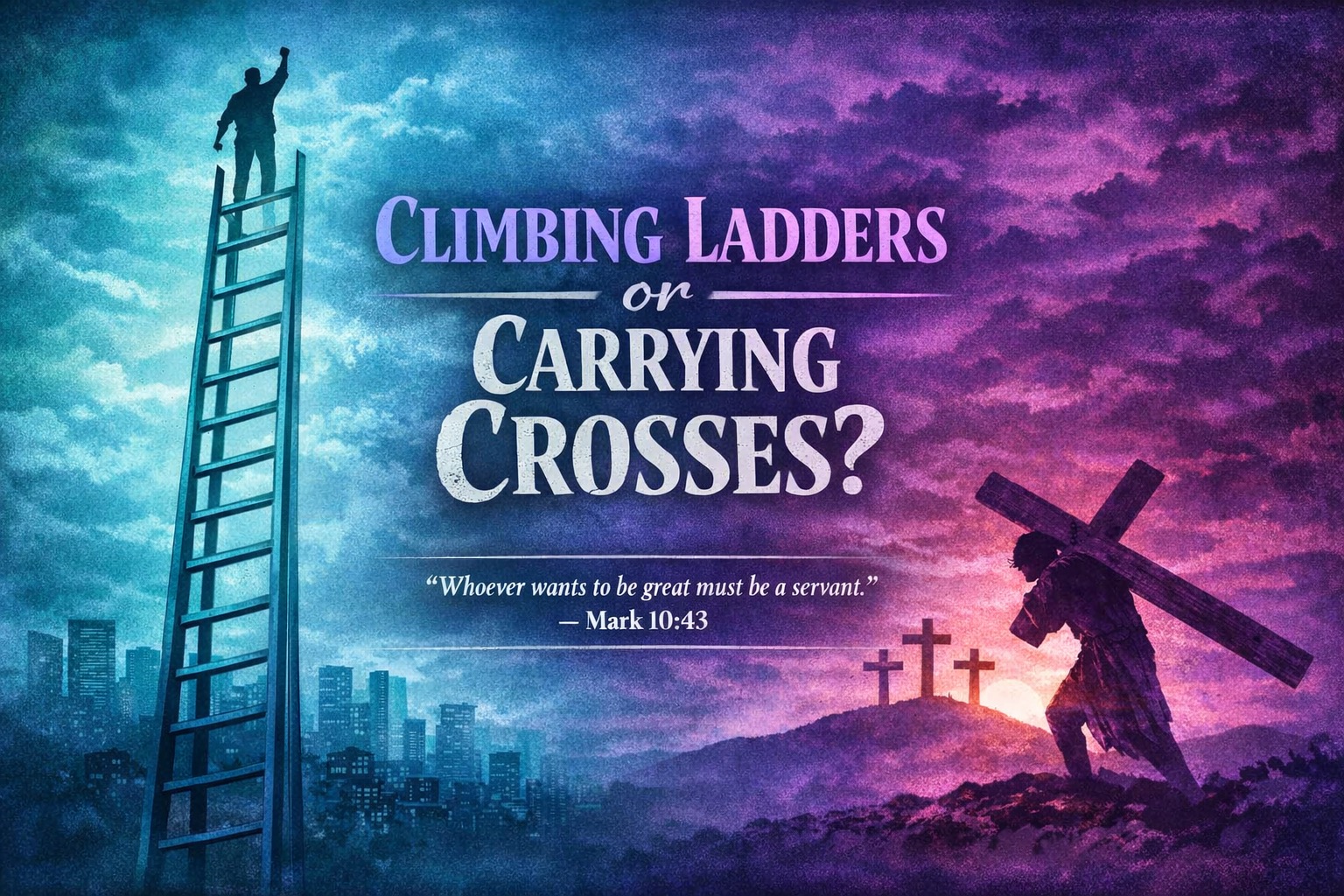
The cross is a symbol of death. It is the symbol of Good Friday. It is the symbol of the totality of Jesus’ submission. But, may I suggest it is also the symbol of life because Jesus was as submitted to the Father’s will in life as he was in death. Jesus died as he lived. He rejected power and position, telling his disciples not to let anyone call them Rabbi or teacher (Matt. 23:8-10). He lived his submission as he took women seriously and met with little children. He lived his submission as he took a towel and basin and washed his disciples feet, and then he said, “I have given you an example, that you should do as I’ve done to you” (John 13:15). Jesus’ life and teaching were revolutionary because it turned the cultural values of the day upside-down, and ushered in a new model of leadership—servant leadership.

FREEDOM

Servant leadership undermines power and self-interest because it is rooted in self-denial. Self-denial lies at the heart of submission. Remember when Jesus said, “If any of you wants to be my follower, you must give up your own way, take up your cross, and follow me” (Mark 8:34)? But do not confuse self-denial with either self-contempt or self-hatred. It is neither. Self-denial frees us to understand we don’t have to have our own way. It frees us to surrender our need to be right, or our need to win every argument. Self-denial frees us to realize that most things in life are not nearly as important as we think they are. Self-denial frees me to accept that, thank God, I’m not the center of the universe.

And, we need to know that submission is freedom for us because it is a choice. If self-denial is the foundation of submission, then we understand that submission is choosing to place ourselves under the authority of another. Forced submission is slavery. Chosen submission is sacrifice. There’s a big difference.

In the verses that follow Ephesians 5:21, Paul shares an example of how this idea of submission could be lived out. People like illustrations in the sermons I preach. Illustrations make abstract ideas a little more concrete for us. My hearers may not always remember the big idea of my sermon, but they most always remember a story if I tell one. So, to illustrate everything he’d been writing to the church in Ephesus, he uses the household relationships of husband and wife, parent and children and master slave. Read it today and the passage seems strange to us in the 21st century. It sounds oppressive, even. It’s not quite so strange or oppressive when we connect it to the concept of mutual submission—submission as a means of grace. Paul is simply laying out an illustration of how submission works in those relationships, and not just those relationships, but submission is meant to extend to EVERY relationship.

It’s a little easier to understand what submission is—choosing to place ourselves under the authority of another, to give the right of way to another, to put their needs ahead of our needs. It’s a bit more difficult to grasp the “how” of submission. What does submission look like? How do we practice this discipline so that it becomes a habit that opens us to God’s grace? Unfortunately, there are no hard and fast rules. Sometimes, it’s easy to determine what it needs to look like. Other times, it’s extremely hard to define. That’s why we need the Holy Spirit. Then again, if we had a book of rules for every circumstance, we’d be Pharisees, and we wouldn’t need the Holy Spirit. Let me just say, though, that submission looks a lot like service.

SEVEN AREAS OF SUBMISSION

Richard Foster, in his seminal work Celebration of Discipline, notes seven distinct acts of submission for a follower of Jesus Christ. First is our submission to the Triune God. The beginning of every day should begin with a simple prayer of submission. It can be as simple as the one prayed by E. Stanley Jones: “Lord, take me over and make me over.” A daily submission in body mind and spirit into the hands of God for His purposes can become a habit of submission, and it will be grace.

Second is a submission to Scripture. We submit ourselves to hear the Word, to receive the Word and to obey the Word, trusting the Holy Spirit who inspired the Word to interpret and apply it to our lives.

Third is our submission to our family. Freely and graciously we make allowances for each other. We give ourselves to one another, and that means surrendering our rights to the other. We also acknowledge the home is the primary incubator for developing this habit in our lives. What a transformation could take place in our world if husbands and wives could surrender themselves to this solitary discipline so that it becomes habit. It would be grace, indeed!

Fourth is our submission to our neighbors and those we meet in the course of our day. Random acts of kindness become the norm for us. No task is too small, for with each task, we have an opportunity to live in submission.

Fifth is our submission to the believing community—the body of Christ. There are opportunities to service to the body of Christ and service through the body of Christ. Submission is acknowledging that though I cannot do everything, I can do something.

Sixth is our submission to the broken and despised. In every culture there are people who are helpless and defenseless. We have a responsibility to be among them, to know them, and to do all we can to help them. Here is where we find self-denial most meaningful and transforming.

Seventh is our submission to the world. Our submission is a determination to live as a responsible member of an increasingly irresponsible world.

A story that captures the essence of practicing the habit of submission is told by author Stephen Beck. Beck tells of driving down a country road and coming to a narrow one-lane bridge. In front of the bridge, a sign was posted: “YIELD.” Seeing no oncoming cars, he continued across the bridge to his destination. On the way back, he came to the same bridge from the other direction. To his surprise, he saw another YIELD sign posted. He thought, “I’m sure there was one posted on the other side.” When he reached the other side of the bridge he looked back. Sure enough, yield signs had been placed at both ends of the bridge. Drivers from both directions were asked to give right of way. It was a reasonable and gracious way of preventing a head-on collision. When we practice submission it is a reasonable and gracious way to let the other have the right of way and to experience the life-changing grace of God in our lives and in the world.

Until next time, keep looking up…