Sometimes a guy just has to choose. No, I’m not talking about this past week’s election, though I certainly could. It is time to move on from that. It’s over and it was somewhat decisive, which are the two things I prayed for. If Donald Trump won, I wanted it to be a clear victory. If Kamala Harris won, likewise I wanted it to be a clear victory. We didn’t need four years of “Russian interference,” or four years of “stolen” elections.
A lot of folks I know gave a big thumbs-up to the election results on Wednesday morning, and an almost equal number of folks I know gave it the thumbs-down. Such is the nature of our divided nation these days, but here is what we followers of Jesus need to remember–we’re not working for a temporal kingdom.
Yes, politics is important and we need to pay attention to it and participate in the process (thankful we live in a country where we can), but it is time for the disciples of Jesus Christ to get down to the real business to which we’re called–building an eternal Kingdom.
Just as a reminder, I recall these words from Jesus’ “Sermon on the Plain” in Luke’s gospel:
27 “But to you who are willing to listen, I say, love your enemies! Do good to those who hate you. 28 Bless those who curse you. Pray for those who hurt you. 29 If someone slaps you on one cheek, offer the other cheek also. If someone demands your coat, offer your shirt also. 30 Give to anyone who asks; and when things are taken away from you, don’t try to get them back. 31 Do to others as you would like them to do to you.
32 “If you love only those who love you, why should you get credit for that? Even sinners love those who love them! 33 And if you do good only to those who do good to you, why should you get credit? Even sinners do that much! 34 And if you lend money only to those who can repay you, why should you get credit? Even sinners will lend to other sinners for a full return.
35 “Love your enemies! Do good to them. Lend to them without expecting to be repaid. Then your reward from heaven will be very great, and you will truly be acting as children of the Most High, for he is kind to those who are unthankful and wicked. 36 You must be compassionate, just as your Father is compassionate.
37 “Do not judge others, and you will not be judged. Do not condemn others, or it will all come back against you. Forgive others, and you will be forgiven. 38 Give, and you will receive. Your gift will return to you in full—pressed down, shaken together to make room for more, running over, and poured into your lap. The amount you give will determine the amount you get back.”
Luke 6: 27 – 38 (NLT)
Friends, it is time for us to choose to be different from the world because this old world is passing away. It is time for us to choose to live by different standards than power, utility and equal exchange. It is time for us to choose to follow Jesus in building an eternal Kingdom and to live the primary Kingdom principle of love. It is time for us to choose to tell the world about Jesus Christ.
Let’s choose not to be Democrat or Republican. Let’s choose to be Christians. After all, life is about choices.
Speaking of choices, I’m making the choice to step away from blogging for a while. I may return to it someday, but right now, I simply have too many other responsibilities that are demanding my attention, not the least of which is spending my early Sunday mornings preparing to lead worship at Haughton Methodist Church.
So, thanks to all of you who have read my blog over the past many years. It has brought joy to my heart and been a great encouragement when someone would respond to a blog I had written. I hope they have been an encouragement to those who read them.
All I can say now is “I’ll see ya’ on the flip-side!”
Until next time (whenever that might be), keep looking up…
Yes, this is a post about the election. Yes, it will probably offend a few people. No, I’m not going to tell you who to vote for, which will probably offend at least half of the people who read my blog. If you haven’t made up your mind, you have two days to do so. Just go vote, even if you don’t make up your mind until you enter the voting booth.
Actually, I’m writing this morning to a select number of people who may be reading–those who haven’t voted yet. My wife and I cast our ballots early, which it seems people are doing in record numbers this year. That’s great, but if you haven’t voted, let me remind you that your vote still counts. Go vote! Yes, it’s that important.
It is important that you go vote because we live in the United States of America and voting is a gift that the founders of our nation gave to us to help preserve our republic. Don’t take that gift for granted.
Voting has become so much easier (for better or worse) through the years that there really remains no excuse (save an emergency or illness) for registered voters not to vote.
Here are a few things I might suggest you do before heading to the polls. First, pray. Ask for the Lord’s guidance as you prepare to make this most important decision.
Second, turn off social media. You’ll only end up more confused.
Can I say that I hate the terms “misinformation” and “disinformation?” They seem like made-up words. I rather prefer to call all of that stuff “competing information.” Don’t the folks who want to censor all the “dis” and “mis” information believe the American people are smart enough to sort through the competing information to make an informed decision? I believe we are and I don’t need anyone censoring anything. I LOVE the First Amendment!
Third, remember that the Lord doesn’t love one candidate more than the other, nor does He love the people who vote for one candidate more than He loves people who vote for the other candidate. He loves all His children regardless of which candidate they vote for. Suffice it to say that each (every) candidate has his/her own foibles (just like the people casting their ballots). There is no perfect candidate. Never has been. Never will be.
Please also remember that no single candidate or political party ever won one soul to Christ. That’s our job. It’s called evangelism and we should be engaged in it regardless of who our leader is. People who need Jesus will never find Jesus in a political party. They will find Him in us.
Finally, maintain a biblical perspective. I remind us of Romans 13: 1–
“Everyone must submit to governing authorities. For all authority comes from God, and those in positions of authority have been placed there by God.”
Or, Psalm 47: 7 – 9–
7 For God is the King over all the earth. Praise him with a psalm. 8 God reigns above the nations, sitting on his holy throne. 9 The rulers of the world have gathered together with the people of the God of Abraham. For all the kings of the earth belong to God. He is highly honored everywhere.
The Bible repeatedly reminds us that God is sovereign in the affairs of men. God is God before this election, and God will be God after this election. Neither candidate will change that fact. If you trust the Lord now, you’ll trust Him then.
Don’t, however, use God’s sovereignty to blame Him for the outcome. That’s too easy! Can we, as disciples, acknowledge that the state of our nation is not God’s fault? It would also be too easy to blame one political party over the other, but the reality is that BOTH political parties have contributed to the steady progression away from the Judeo-Christian values upon which our nation was formed.
Let’s face it. It’s OUR fault for not holding our leaders to account to the Judeo-Christian values of our founding. One way we can hold them accountable is by just going to vote.
So, go vote. Vote your values. Vote for the candidate you believe the Lord is leading you to vote for. Regardless of who you vote for, please treat those who may vote differently than you with the respect and love due a fellow human being. That’s what we’re called to do as disciple of Jesus Christ.
I’m not the perfect pastor. I’m not the perfect pastor because I’m not a perfect person. Among the many foibles I possess is not know when to keep my mouth shut…well, let me clarify that. I know when I should keep my mouth shut. The foible is in actually keeping my mouth shut.
I should probably clarify that further. My tendency is to keep my mouth shut when I should speak up and to open my mouth when I shouldn’t speak up. I’m uncertain as to which I’m doing this morning, but here goes anyway…well, because I’m not the perfect pastor.
Faith and Politics…again!
Those who know me know (and I’ve confessed) that I am a bit of a political junkie. Naturally, the election season has my interest peaked. Because I’ve also been a pastor (and probably will be again someday), I’m always looking at the intersection of faith and politics. It always raises the question, “How does our faith inform our politics?”
Some people might proffer the question, “Should our faith inform our politics?” I say if our faith doesn’t inform our politics, it’s probably not much of a faith.
So, how is faith informing politics this election cycle? Well, I’m glad you asked!
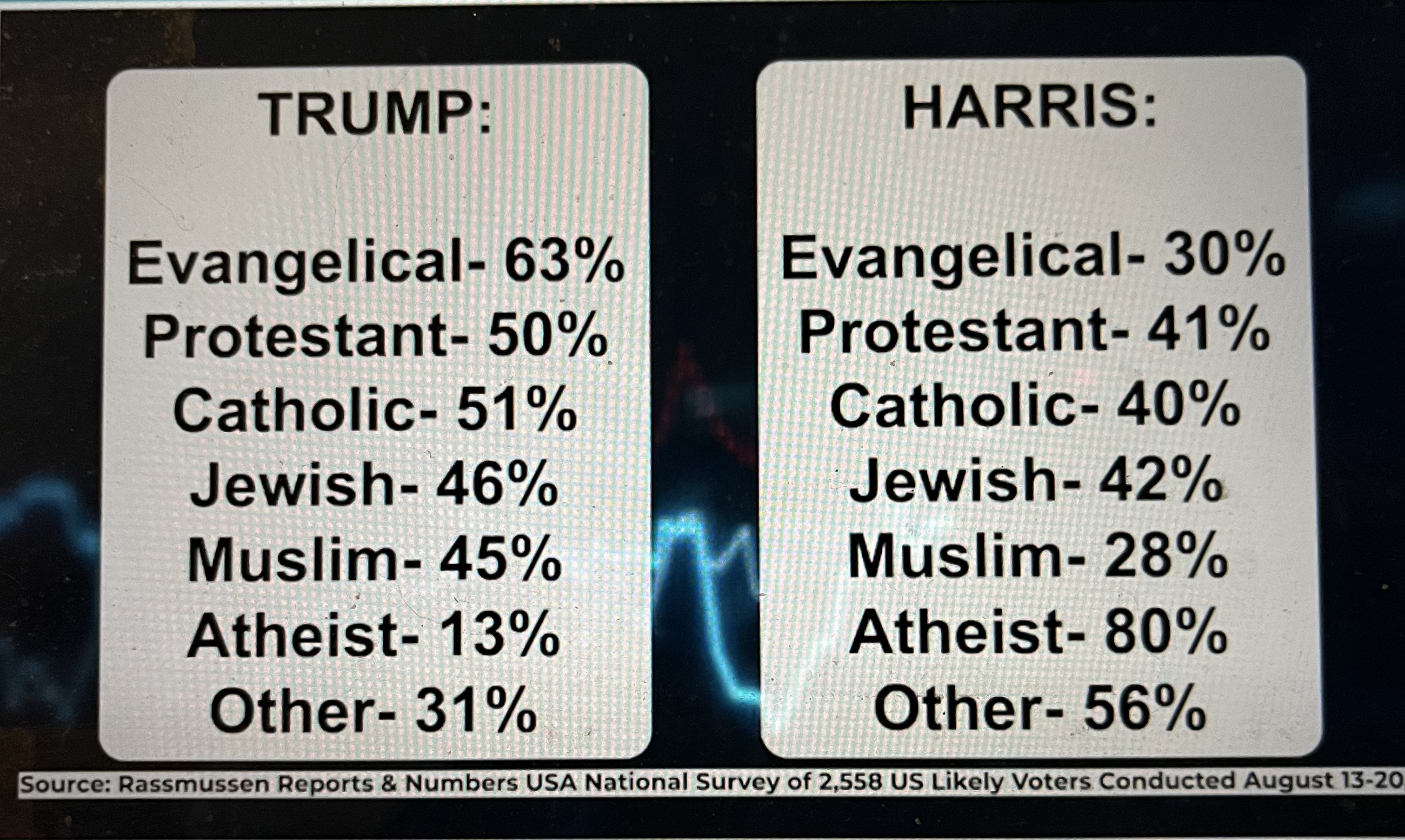
I came across this interesting survey from Rasmussen Reports last week. Rasmussen is an independent polling organization that polls daily through each election cycle. It is independent in the sense that it is neither left nor right leaning, and it does its best to “weight” its polls so that their polls aren’t skewed one way or the other. It is also independent in that they neither depend upon outside money, nor do they receive outside money to conduct polling. Seems to me that is how it should be.
Here’s what their polling found, and what I find interesting in the intersection of faith and politics: people of faith (all faith backgrounds) are generally voting for Donald Trump. Here’s the breakdown Rasmussen reported:
This poll is getting little attention in the media. The only reason I found it is because I was looking for it. Though it is getting little attention, I find it quite revealing in showing there really is a clash of cultures in this election and that clash is between the religious and the non-religious.
Every major faith group (except “other”) is voting in the majority for Donald Trump, and the only group even close to the margin of error is the Jewish faith. “Other” would include Hindu, Buddhist, et. al., and I only assume they were lumped together because the sample size of each was too small to be reliable.
While people of “other” faith backgrounds support Harris, the overwhelming majority of atheists support her. I’m sorry, but that just gives me pause as one who identifies as an evangelical believer in Jesus Christ.
It’s not that I believe Kamala Harris to be a non-religious person. According to Biography.com, she grew up in a black baptist church, has attended Hindu temples (as a result of her Indian heritage) and married a Jewish man. Now, that’s what I call an intersection of faith and politics!
Atheism in the Public Square
When I consider that the “atheists” could be the deciding factor in the most consequential election of our lifetime, I am concerned about the direction of our nation. Every national poll shows this election to be a toss-up (see here and here for two of the most recent). The atheist vote could very well make the difference.
Why do so many atheists support the Democratic Party? From what I’ve been able to discern, it comes down to two things: abortion rights and Christian nationalism. I’d post a few links here on abortion rights and Christian nationalism but you can do a simple Google search and find all the links you need. You’ll be reading for days.
Let me just get this out of the way: I am staunchly pro-life, and that is pro-life in the sense that life begins at conception and that every avenue must be pursued to protect that life. I am also a pragmatist (and not a Christian nationalist) and I believe that the Supreme Court of the United States got it right when they returned the abortion debate to the individual states. That is just one place where my faith informs my politics, and yes, I know it sets up its own clash of cultures. But, I’m just an old white guy, so what do I know?
A “Christian” Nation?
No, I’m not a Christian nationalist (as the term is most commonly defined–it’s a relatively new term, by the way). I do not believe that the United States must be a “Christian” nation, but I do believe that the United States of America was formed (and its underlying foundational documents designed) by people who were Christian, or whose philosophical/ideological perspective were rooted in the Judeo-Christian worldview.
The values and morals that shaped this nation are the values and morals that have their foundation in Scripture. The further we move away from those values as a nation, the more endangered the American experiment becomes…and the more godless the culture becomes. We are far down that road now. I’m wondering if there is a U-turn in our future? I’m wondering if this election cycle will tell us?
Not that Donald Trump is a bastion of Christian morality. His moral failures have been documented copiously, and you can do your own Google search on that, too. Honestly, I believe we are left with the two choices we have for President of the United States BECAUSE we have become unmoored from the Judeo-Christian values upon which this nation was founded.
I also believe the election of Donald Trump won’t provide the U-turn the nation needs to preserve our nation. It might slow it down a little, but it won’t turn it around. The U-turn that matters will happen in the Church through the power of the Holy Spirit. It will take a spiritual revival on the level of the first and second Great Awakenings. It will take prayer and preparation that can only begin in the faith communities of our nation.
The Ripkens
I won’t say who I’ll be voting for in this election. I’ll only say I won’t be voting with the atheists. You can if you want, but don’t come crying to me when we become a completely godless nation. Of course, becoming a completely godless nation might not be such a bad thing. Ask Nik and Ruth Ripken, they can tell you.
The Ripkens were missionaries to Malawi and Somalia, and it was while they were in Somalia that they lost one of their three sons. Their loss forced the Ripken’s to reconsider their calling, and after some reflective time, they were assured they were called to be missionaries, although the focus of their ministry shifted.
They felt called to go into the regions of the world where Christians were persecuted greatest to discover ways they could be in ministry to them. Nik Ripken began by traveling to Russia, China and Central Asia to interview members of the persecuted church.
What he discovered was not that we needed to do anything to help the persecuted church, but that it was his faith that was resurrected by the faithful witness of those Christians. They heard stories of pastors imprisoned and emaciated, yet still clung to their hope in Christ. They heard stories of fathers separated from their families because they smuggled bibles in for others to discover Christ.
In China, he was able to meet with about 150 house church pastors to hear their stories. He said no one really knew what they would find in China. In 1948, when communism came to China, the church was outlawed. At the time, there were between 400,000 and 700,000 Christians.
No one really knew if the church had survived after all these years. Yet, today there are over 10 million Christians in a nation that is openly hostile to their faith. The church flourished in conditions it should not have. The 150 pastors, after telling their stories to Ripken began to ask, “Has Christ made it to the rest of the world?”
What the Ripken’s discovered was that where the church was persecuted the greatest was the very place where faith has thrived the greatest. History has taught the same lesson. The burning question Ripken had for all he interviewed was, “Is Christ worth it?” Is Christ worth the suffering, the imprisonment, the loss of family and even death? As one interviewee said, “Oh, Christ is worth it!”
The lesson for me as I live in this culture that is shifting around me is to ask myself, “Is Jesus worth it?” When all cultural accommodation for the Christian faith ends, will Jesus be worth it? Will Jesus be worth my family? Will Jesus be worth my job? Will Jesus be worth my life?
I pray that I can say, “Oh, Christ is worth it!” My fear is I won’t have the courage.
Seventy-eight days. That’s how long it is until we choose the person who will lead our nation for the next four years. As I’ve gotten older, I’ve discovered that seventy-eight days is no time at all. What are we, as Christians, doing to be ready to choose the right leader?
I know! Our choices aren’t great, but then again, we probably get the leaders we deserve. I just have to ask: What have we done to deserve the choices we have? Sorry! Don’t answer that question. It is rhetorical.
Most people reading this have probably already made up their mind about the choice coming in seventy-eight days. Without becoming too political, let me take this opportunity to offer biblical four characteristics to look for in choosing our next leader.
Four Biblical Characteristics
What are the four characteristics? Humility, capability, responsibility and accountability.
Jethro & Moses
Let me start by calling to mind a conversation between Moses and Jethro in Exodus 18: 13 – 27 (click here to read the entire conversation). To set the context of Jethro’s conversation, it’s been just over a month since Moses led the people out of Egyptian bondage and Pharaoh’s oppression. In that time, they’ve seen God deliver them through the Red Sea, provide water from a rock and God is feeding them daily with manna and quail. They’ve also just won a military victory over a people group called the Amalekites.
Jethro gets word of all God has done for Moses and the people, so he takes Moses’ wife and two sons, loads up and prepares to take them back to Moses. At some point before going down to Egypt, Moses had sent them to live with Jethro while he went off to do God’s work.
Jethro arrives, they catch up on all the events since they were last together and had a party and a worship service to celebrate. The next day, Moses goes out to do what he always does…hear the complaints of the people against each other…he sits in judgment, day after day, deciding all the petty (and not-so-petty) complaints of over 600,000 men, not including women and children.
Humility
Jethro immediately notices a problem, so Jethro (verse 14) says, “Why are you trying to do this alone?” Jethro, in asking Moses the question, is trying to give Moses a lesson in humility. Humility is perhaps the greatest quality to look for in a leader. The original Hebrew spoken by Jethro leaves the impression that he sees Moses acting like a King over the people.
Moses considers himself uniquely qualified to judge the people and their issues, almost like he’s God’s partner in this deal. That’s the strength of the language in the text.
Jethro says, “That’s not good!” Basically, he’s saying, “Get over yourself, Moses. You’re killing yourself and you’re killing the people trying to do this alone.” It was a matter of respect. The whole tone of the conversation indicates that Moses’ ego was getting in the way of what is best for the people and for himself.
Egotistical leadership is devastating to any organization. Granted, it takes a pretty big ego for someone to run for President, or any other office, for that matter, but ego that is not tempered with humility is egomaniacal and is ultimately destructive.
There is a fantastic visual image contained in this entire episode, and it has to do with humility, and the power of humility.
The encounter begins with Moses sitting to judge the people, and the narrative indicates he’s sitting because he’s worn out. Jethro offers his advice and says, “If you do this, you’ll be able to “stand up” under the pressure.” It’s Jethro’s way of saying, “If you humble yourself and relinquish some leadership, you’ll really find yourself standing over the people instead of the people standing over you.”
That’s exactly what Jesus said, too. In Luke 22: 24 – 30, his disciples were discussing who would be greatest among them. When they arrived at the house, Jesus asked what they were discussing, though he already knew. They didn’t answer him, but he sat them down and said “If anyone wants to be first, he must be last of all and servant of all.” Servant leadership is a Kingdom principle. It’s driven by humility.
The cause that must be served is far greater than any one leader or individual. What’s true in business is also true in government, and in churches, and at home. No one leads alone. A leader needs the humility to acknowledge their own limitations.
Capability
A second characteristic I see in choosing leaders wisely is capability. We need leaders who are capable of leading us.
Jethro recognizes the necessity of leadership on different levels. Part of that capability has to do with honesty and integrity. We could make these their own traits, but they are what make a capable leader.
When I talk about honesty and integrity, I cringe when I look at the candidates we have to choose from. Of course, it’s nothing new. The effects of Huey Long’s patronage system are still felt in Louisiana today, and history reminds us of the corruption of Tammany Hall in New York City throughout the nineteenth and early twentieth centuries, and of the long history of alleged corruption in Chicago politics.
Politics and corruption seem to go hand in hand. Jethro reminds Moses that at the heart of capability are honesty and integrity.
Jethro told Moses to identify capable leaders and appoint them judges over thousands, hundreds, fifties and tens. Different leaders must fill different roles. Moses learns there are different levels of leadership, and each leader must fill the role he/she is uniquely gifted to fill.
We’re all leaders, we simply lead at different levels. Let’s face it…there are politicians who are great politicians at the local level but would be terrible at a higher level. One question we should ask of those running for public office, or seeking a leadership capacity is “Are they capable of fulfilling the role?” Not every leader is equipped to fill every role; choices must be made based on the individual’s gifts, skills and talents.
I experienced this as a District Superintendent for the United Methodist Church. The church is led by a great number of gifted pastors, but honestly, not every pastor is suited to be the pastor of a large church, and there are pastors whose giftedness far exceeds the level of church they currently serve.
There are fantastic pastors in small churches, but it would be disastrous for some of them and for the church to be appointed to a large church. There are natural born leaders who simply have the charisma to continually lead up, but there are equally gifted leaders capable and competent to lead on a smaller scale.
There are many leadership skills that are teachable. Parents are leaders, even though they may only lead one other person, and parents can be taught to be better leaders. The same with managers is true. Leadership skills can be taught, nurtured and developed, and a leader’s capability can be increased, but for many there is a ceiling. That doesn’t matter. They’re still leading, and can be great leaders, as long as they’re leading at their level of capability.
We need to be asking the question, “Which of these two candidates is capable of leading our nation right now?” The answer is obvious to me, but you have to answer the question in your own heart and mind.
Responsibility
A third characteristic I see in Jethro’s advice is that of responsibility. When we choose leaders, we must be willing to let them lead. We can’t extend leadership responsibility and then micromanage their efforts. We’ll destroy their spirits and we’ll undo the good that could be done through their efforts.
Jethro makes it clear to Moses that if you’ll follow this advice…identify leaders and let them lead…then Moses will be able to stand up under the pressure and the people will return in peace. Sharing power is what God wants and what God expects. It is truly a holy act.
Accountability
Are we willing to allow the leaders we choose to actually lead us? We must follow their leadership unless and until they prove they’re not capable, and that brings me to the final characteristic I see, and that is accountability.
Responsibility is nothing without accountability. Verse 24 says that Moses listened to his father-in-law’s advice. He submitted himself to the accountability offered. He was willing to be confronted with the cold, hard facts, and he demonstrated the humility to receive Jethro’s “constructive criticism.”
Okay, so there is one candidate who doesn’t often take constructive criticism well. I’m not sure about the other one yet, although a staff turnover rate of 90+% isn’t encouraging. Like I said…our choices aren’t great.
We should choose leaders who are willing to be held accountable. One of the great things about the American experiment is the “checks and balances” of the three branches of government. Part of the problem of governing by executive order is it circumvents the accountability component. But, then again, every four years, or two years, or six years as the case may be, is the election cycle. The accountability of the ballot box is always the accountability of last resort in the civic arena.
We, too, if we desire to be godly leaders, should submit ourselves to accountability. John Wesley was so concerned with building a righteous fellowship that he devised a series of questions for his followers to ask each other every week. Some found this rigorous system of inquiry too demanding and left.
Rev. Chuck Swindoll
Today, the very idea of such a procedure would horrify many disciples, yet some wisely follow just such a practice. Chuck Swindoll for example, has seven questions that he and a group of fellow pastors challenge each other with periodically:
1. Have you been with a woman anywhere this past week that might be seen as compromising? 2. Have any of your financial dealings lacked integrity? 3. Have you exposed yourself to any sexually explicit material? 4. Have you spent adequate time in Bible study and prayer? 5. Have you given priority time to your family? 6. Have you fulfilled the mandates of your calling? 7. Have you just lied to me?
Genuine accountability is transformative. Moses followed Jethro’s advice, and his life and the lives of his nation were transformed.
Everything rises or falls on leadership. If we choose leaders who demonstrate humility and capability, granting them responsibility and expecting accountability, then we’ll have leaders that will serve the greater good and perhaps, even grow the Kingdom of God.
I am thoroughly convinced that neither of the candidates running for President of the United States measure up to these characteristics. We Christians have a lot of praying to do over the next seventy-eight days. May God grant us the grace to do the best we can with the choices before us.
Prayer. Hmmmm? Now there’s an idea. Perhaps I’ll blog about that next week.




 Not the Perfect Pastor