When the “Smoke” Clears…

I spend a lot of time looking through my windshield. To pass the time, I listen to a lot of podcasts (and I mean a lot!). I came across one recently entitled “The Roys Report” that peeked my interest, so I gave it a listen.

I came across The Roys Report months ago when I was following news of the fall of several prominent megachurch pastors. I won’t say I’ve been a regular listener of the podcast, but if one pops up that sounds interesting, I give it a listen.

This particular podcast was an interview with the author of a new book entitled “Gods of the Smoke Machine: Power, Pain and the Rise of Christian Nationalism in the Megachurch” by Scott Latta. I found the conversation compelling so I ordered the book. What follows are my reflections after having finished reading it (I suppose that makes it a book review).
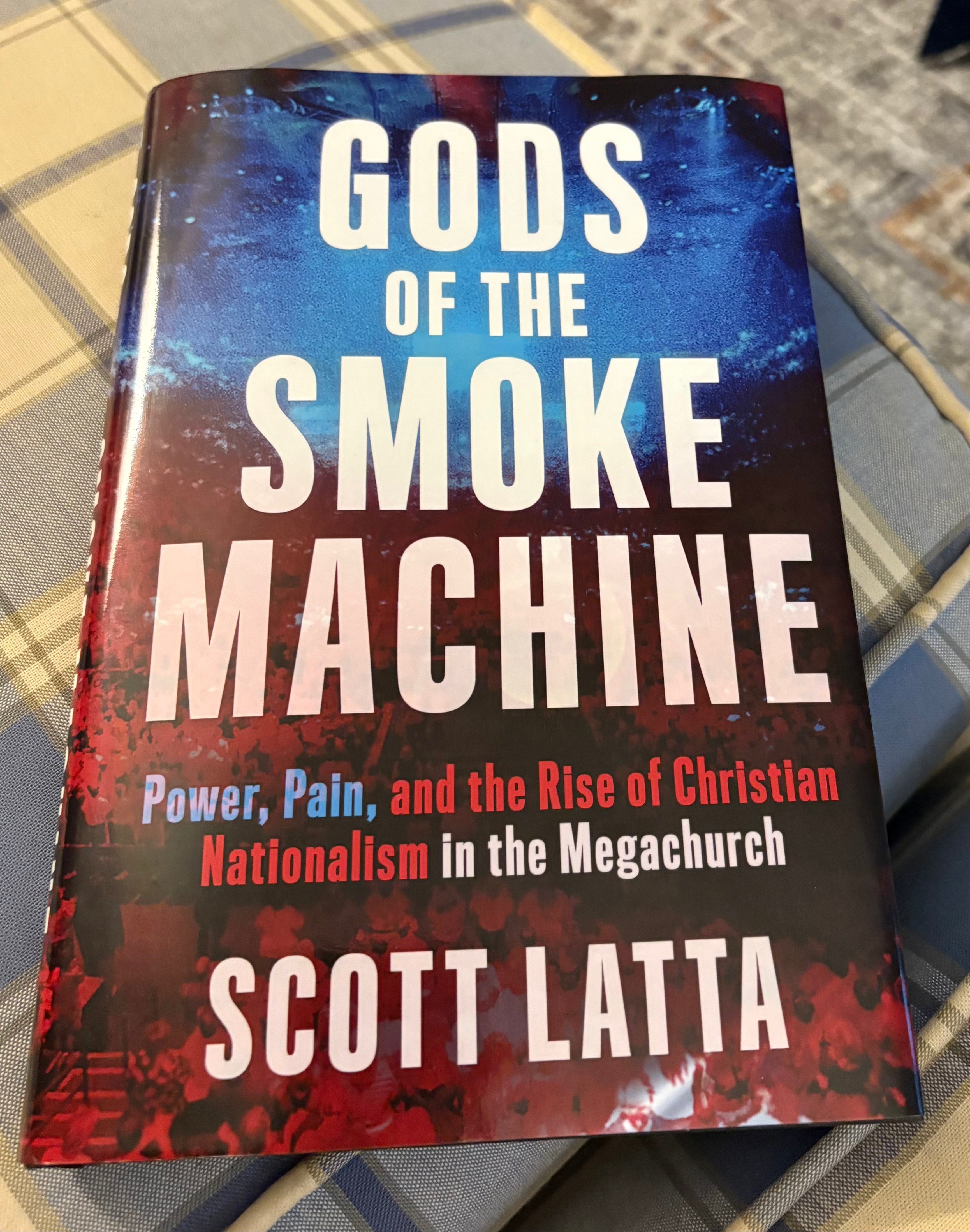
Okay, so the book was a page-turner for me. It is well-written. Latta’s writing style is quite engaging and easy to read, and I would recommend this book to pastors and church leaders who are on the front-lines of ministry in contemporary culture.

Hard Conversations

There are few topics more difficult for Christians to talk about than the failures of the church. I love the church. I’ve been formed by it, baptized in it, comforted and corrected by it. Yet, my own history and experience have taught me that love does not require blindness. Sometimes love requires truth-telling.

Latta attempts to shine light on a truth that many folks find difficult to talk about. Nevertheless, it is a conversation worth having. Reading the book caused me to ask the question: Are we worshiping God, or have we learned to worship the machinery built in His name?

Let me confess that Latta and I are not of the same “tribe.” He is one who is in the process of “deconstructing” his faith (or has completed the process–I’m not really sure after reading the book).

This is not a review of the somewhat new and novel idea of “deconstruction” of one’s faith, but if you’re unfamiliar with the term, you can Goggle it to learn more. Simply put, it is exactly what comes to your mind when you hear the phrase “deconstructing one’s faith.”

Though not of the same tribe, I found some value in reading the work. It does us good to get out of our echo chambers to hear other voices. They cause us to think and possibly find some common ground upon which we might build a relationship.

When Growth Becomes the Measure of Faithfulness

Latta reflects on the rise of the modern megachurch and the ways large congregations have learned to thrive even as church participation in America declines. He points out in the introduction that overall church attendance has fallen by about half over the past 25 years. Yet, while overall attendance has fallen, attendance in the megachurch (weekly attendance greater than 2,000 people) has increased by 10% between 2015 and 2020.

Yes, as Latta points out, the pie is getting smaller, but the megachurch’s piece has gotten larger.

Growth itself, of course, is not the problem. Scripture celebrates growth when it flows from faithfulness. But Latta raises a necessary concern: when numerical success, branding, and influence become the primary measures of God’s blessing, something essential is at risk of being lost.

From a pastoral perspective, this is not simply a critique of church size or style. It is a call to remember that the church is not a product to be managed but a body to be shepherded. Efficiency and excellence can serve the gospel—but they can never replace presence, humility, or accountability.

Listening to the Wounded

Perhaps the most sobering parts of the book are the voices of those who were hurt within church systems that should have protected them. Latta shares stories of people who experienced spiritual manipulation, silencing, and abuse, and who found that institutional loyalty often outweighed compassion, truth and accountability.

These stories deserve our prayerful attention. My pastor’s heart reminds me that the credibility of the church is not measured by attendance numbers or production quality, but by how we treat “the least of these”—especially when listening is inconvenient or costly. Repentance, not reputation management, is the way of Christ.

Of course, my more pragmatic (or cynical) self wants to say, “There are two sides to every story.” We only hear one side of the story in Latta’s book. In fairness, according to Latta, churches and pastors were given opportunity to comment, but most did not respond.

Faith, Power, and Allegiance

Latta also explores the uneasy relationship between some megachurches and political power, particularly the blending of Christian language with nationalist ideology. Viewed through my pastoral lens, my concern is not about political disagreement, but about ultimate allegiance. When loyalty to leaders, movements, or ideologies begins to eclipse allegiance to Christ, the church’s witness becomes distorted.

The church has always lived in tension with worldly power. The danger comes when that tension disappears—when the cross is replaced by the quest for influence, and when winning matters more than loving.

A Call to Self-Examination, Not Cynicism

While Gods of the Smoke Machine is clearly critical of the state of the American megachurch, I think Latta painted with a very broad brush. The focus of the book really is upon a very few megachurches and their pastors. He says very little about the majority of churches (there are approximately 1,800 megachurches in the U.S.) and pastors who are faithful to the Gospel and do their best to love one another.

Not to despair, though. The book became for me an invitation to self-examination. Not every church is a megachurch, and not every leader is compromised—but every Christian community must regularly ask hard questions about power, transparency, faithfulness and yes, accountability (there’s that word again).

This book challenges pastors, elders, and congregants alike to consider whether our structures reflect the character of Christ or simply the efficiencies of modern institutions. It urges us to remember that the Spirit of God is not manufactured by lighting cues, smoke machines or emotional crescendos, but is present where there is truth, repentance, and love (oh, and accountability).

Reading with Hope

Ultimately, Gods of the Smoke Machine is a book best read slowly, prayerfully, and with humility. It may stir grief, anger, or recognition. But it can also stir hope—hope that the church can still choose a better way, and that reform is possible when the people of God are willing to listen, repent, and return to the simplicity of the gospel.

For pastors, church leaders, and thoughtful Christians, this book offers an opportunity not to abandon the church, but to love it more faithfully—by seeking the health of Christ’s body rather than the success of its machinery.

There is a bit of the prophetic in the work. Unfortunately (or fortunately?), that prophetic word is coming from one outside the church (well, one who left the church). I don’t know if that makes him an outside insider or an inside outsider. Either way, it will do we leaders well to listen to that prophetic word and take it seriously.

Until next time, keep looking up…
Bowing to Cultural Approval…

Six Subtle Ways We Bow to Cultural Norms

Okay, so I’ve been reflecting on Daniel 3 all week because I’m preaching on that passage today. In my prayer and reflection, I began to consider what are some of the subtle ways we believers in Jesus Christ can sometimes bow to sins that have become culturally acceptable. They’re not likely to show up in today’s message, so I thought I might share them here.

Shadrach, Meshach and Abednego

Shadrach, Meshach and Abednego (along with the prophet Daniel) were part of the Hebrew upper class that were carted off to Babylon during the Babylonian captivity. While there, they were schooled in the best Babylonian schools, and after three years were placed into King Nebuchadnezzar’s (King Neb, for short) court for service to the empire.

Hey? If you’ve been in Sunday school at all, you’ve heard the story before (read it here). King Neb builds a gaudy statue and commands the entire empire to bow down before it when they hear the music play. The music plays and everyone bows except these three Hebrews (I’m not sure where Daniel is during all this). The three get tattled on to the King who calls them to himself to give them one more chance to submit.

The three refuse in one of the most remarkable ways recorded in the Bible:

1Shadrach, Meshach, and Abed-Nego answered and said to the king, “O Nebuchadnezzar, we have no need to answer you in this matter. 17 If that is the case,our God whom we serve is able to deliver us from the burning fiery furnace, and He will deliver us from your hand, O king. 18 But if not, let it be known to you, O king, that we do not serve your gods, nor will we worship the gold image which you have set up.” (Daniel 3: 16 – 18 NKJV)

I love the “But if not…” statement of verse 18. What faith! “King Neb, even if God doesn’t deliver us, we’ll not bow down to your idol.”

The Idol in Question

Neb’s idol was a 90 foot tall gold statue. It was pretty obviously an idol. Everyone knew it was an idol and no one really cared. Babylon was filled with idols. What’s one more? Idols were culturally acceptable in those days. What’s the big deal?

That’s probably the question that was on King Neb’s mind as he confronted the three Hebrew young men. And, I have to wonder if Shadrach, Meshach and Abednego hadn’t considered it themselves. I mean, perhaps they had the philosophy that the Apostle Paul later expressed to the Corinthian Christians:

Therefore concerning the eating of things offered to idols, we know that an idol is nothing in the world, and that there is no other God but one. For even if there are so-called gods, whether in heaven or on earth (as there are many gods and many lords), yet for us there is one God, the Father, of whom are all things, and we for Him; and one Lord Jesus Christ, through whom are all things, and through whom we live. (1 Cor. 8: 4-6 NKJV)

Yup! They could have adopted that mentality, bowed down to the idol and everything would have been fine. After all, everyone else was doing it, and they weren’t actually bowing down to anything that was real, so just go along to get along.

Thank God, they didn’t bow down! They chose obedience to God over cultural influence. What an example for us!

Six Cultural “Idols”

Okay, so they’re not really idols in the strictest sense, but they are areas of cultural influence that often cause us to bow down in contrast to the clear teaching of Scripture. What are they?

1. Gossip

Gossip is one of the most common places where we bow to cultural pressure because we can disguise it as conversation, or even…wait for it…prayer concerns. There is a fine line between sharing concern and gossip.

Gossip is talking about others in a way that does not honor them or God. I’m reminded of Solomon’s wisdom in Proverbs 16: 28–“A troublemaker plants seeds of strife; gossip separates the best of friends.

When someone tries to bring gossip to us we must kindly and gently shut the door, refusing to bow to the pressure to sully someone else…even in the name of prayer concerns.

2. Complaining (Grumbling)

Okay. This is one of my biggest temptations, and one place where I’m tempted to bow. In my defense, there is A LOT to complain about in our world today, and there are so many people doing it (including me) that no one notices anymore.

The Bible is clear, though, that we should do everything without grumbling (Philippians 2:14). Truly, life is filled with so many blessings and complaining takes the focus off our blessings and causes us to miss all the good that God is doing around us.

Complaining causes anxiety and discouragement and damages us spiritually. We can’t bow down to this culturally acceptable practice and maintain a faithful Christian witness.

3. Little White Lies

Whether we call it stretching the truth or use it as a means of dodging conflict, it’s still a lie. Everyone does it, so that makes it okay? I don’t think so.

Ephesians 4: 25 reminds us, “So stop telling lies. Let us tell our neighbors the truth, for we are all parts of the same body.” Paul’s reminder is a good one for faithful living in a culture that so easily accepts a lie for the truth.

4. Comparison

I said before that comparison is one of the things I’m not going to do at my age. What’s the point? It only creates envy and we know that envy is one of the seven deadly sins.

Social media feeds our need to compare ourselves to others, and again, comparison can take our focus off the myriad ways that God blesses us each and every day.

Comparing ourselves to others is such a subtle practice that it slips up on us before we know it. Faithfulness demands that we refuse to bow down before it. We can do this by thanking God for the blessings He has given to others. We don’t need someone else’s blessing. God has His own blessing for us if we’ll just stop and take note.

5. Getting Offended

In today’s culture, everyone is offended by something. Offense, however, can quickly become spiritual poison to us. Offense breeds bitterness, and bitterness keeps us stuck in hurt and anger.

We overcome offense through the spiritual practice of forgiveness. Christ forgave us. Ought we not to forgive those who offend us? Forgiveness is at the foundation of our faith, and when we bow to the pressure to take offense, we belie our faith.

6. Normalizing Sexual Sin

This one is a biggie in today’s culture. Of course, it’s been a big one for a long, long time, but even more so today. Modern culture treats so much sexual sin as normal, even many Christians. Cohabitation, sex before marriage, pornography, lust and adultery are commonplace.

Sexual sin damages the soul, distorts intimacy and welcomes shame and confusion. In short, it destroys our faith and undercuts the witness we offer the world when the Church and believers accept it as normal.

Once again, the Apostle Paul reminds us, “Run from sexual sin! No other sin so clearly affects the body as this one does. For sexual immorality is a sin against your own body” (1 Corinthians 6:18).

The Power of a Faithful Witness

There are probably a lot more than six ways we bow to cultural influence, but it’s late and I have to go to church. That fact notwithstanding, we take a cue from the three Hebrew guys who refused to bow down to King Neb.

Our faithfulness will invite scorn from the culture and there will probably be consequences for that faithfulness. Here’s the thing, though–the Lord is with us in the fire of public scorn. In the end, we’ll come out the other side with our witness intact. We’ll be stronger and the Lord will be glorified. Isn’t that what we’re aiming for?

Let me hear from you if there are other areas we may be tempted to bow to the culture and its expectations. Leave your comments below.

Until next time, keep looking up…

Honoring Mothers: Faithful Women Who Shape Our Lives

Happy Mother’s Day! Let me take a few lines on this special day to say “Thank you!” to the mothers in my life, and to all mothers everywhere. None of us (and I mean literally none of us) would be who we are without our mothers (for better or worse).

I say “for better or worse,” because I know not everyone has been blessed with incredible examples of motherhood in their lives, and that is truly unfortunate. I, on the other hand, have been blessed beyond measure with those mothers who are shining examples of what it means to be a mother.

Great is Thy Faithfulness

I tell folks that I was raised at the foot of a Methodist piano. My mother, Sonda Womack, played piano for three Methodist churches in our home area. She rode the circuit just like the circuit rider preacher every Sunday so that those congregations had the benefit of music in worship. Most Sundays, my brothers and I had to make that circuit with her, and there we would sit, often listening to the same sermon three times (talk about insufferable!) just for the opportunity to make it to the “big” church so we could be with all our friends.

I didn’t necessarily enjoy all that time at the foot of a Methodist piano, but her faithfulness in serving the Lord by serving those congregations gave me an early example of what discipleship and servanthood looks like. Being an accompanist for all those years was ministry for her. I know that because she was never paid a salary by any of those churches. Yes, there were frequent love offerings the congregations shared, but she never “charged” for her services. It was a gift of love to the Lord.

Her faithfulness shaped me and my brothers. Of that, I have no doubt. She was, for much of our early years, a single mom. She worked long, hard hours to insure that we had what we needed…not always what we wanted…but always what we needed. I can remember her working three jobs when we were little. She worked at the local bank. She would leave that job and head to the local post office where she was a part-time flexible worker. And, if you think playing piano at three churches on Sunday morning isn’t work (whether you’re paid or not), well you’ve got another think coming.

Even now, into her 80’s, she continues to serve two congregations through her gift of music. Still riding the circuit after all these years!

She was, and is, an example of faith and faithfulness and love for which I am forever grateful. Happy Mother’s Day, Mom!

The Heart of Our Family

Let me tell you something else. When I married, I married up. I mean I married way up! My wife, Vanessa, is the most amazing mother I know (my own mother notwithstanding). Vanessa has throughout our lives together demonstrated the sacrificial love of Jesus in the most profound of ways. I honestly believe that she was born to be a mother…and grandmother.

I have spent the last forty years watching her nurture our children and grandchildren. I can tell you that she raised our children while I was off going to school and pastoring churches and chasing dreams. Anything good our children have attained or become can be credited to her love and diligence in caring for them.

Raising our children was never a sacrifice for her. It was her gift. She was, for many years, the nurturer, the care-giver, the chauffeur, the cook, the cleaner, the confidant, the disciplinarian, the encourager, the helper and the friend to all four of our children, and she has quickly become that to our grandchildren, too. I might also add, she is all those things to me as a spouse. She is my best friend, and I’m not so sure our children wouldn’t also call her their best friend, either.

She is amazing and beautiful and funny and sacrificial and loving. Try as I might, there really aren’t words to describe what she is to me and to our family. She is the heart and soul of who we are as a family. Happy Mother’s Day, Vanessa!

An Enduring Legacy of Love

The examples of love and sacrifice goes back beyond our present generation. My grandmothers…well…what can I say about them?

My maternal grandmother, Aline Johnson Roberts, demonstrated for me how to serve your spouse. My Papaw lived with rheumatoid arthritis for as long as I have any memory of him. He was bedridden for most of later years of life. Mamaw never left his side.

Everyday, she busied herself waiting on him hand and foot. I never once heard her complain (and mind you, my brothers and I lived with them for several years) about his illness, or the necessity of her caring for him. She did it out of love. She did it out of compassion. And, that was after raising ten children and dealing with 18 (I think) grandchildren (nine of which either lived with them or next door to them).

She remains an example of self-giving love that demonstrates the heart of motherhood. Happy heavenly Mother’s Day, Mamaw!

My paternal grandmother, Kittie Oxford Malone, is a saint if there ever was one. We called her “Mama Kit.” Mama Kit earned her sainthood by putting up with my grandfather, my dad and my uncle. Don’t misunderstand me. I love all three of those men dearly, but they could be…oh, let’s just say…challenging to live with (that’s all I’ll say about that!).

When Vanessa and I married, we moved into her backyard. There we started raising our family. She was there when all our children were born. She was the go-to babysitter for our children. Every afternoon when the kids would arrive home from school, their first stop was usually her house. She generally had cheese toast or cinnamon toast prepared for them when they arrived.

She would spend countless hours reading to our oldest daughter and as she would read she would gently rub our daughter’s back. Our oldest daughter is her namesake, and I honestly think she still misses those back rubs today.

We discovered when ministry called us to Kentucky for seminary, that the worst part was not having Mama Kit to care for us from our backyard. Yes, we missed all our family, but not in the same way we missed Mama Kit. I only wish my grandchildren would have had the opportunity to know Mama Kit.

Mama Kit gave me an example of perseverance in the face of adversity, of commitment to life-long marriage and of selfless love. I am blessed to have her as part of the legacy of faithful motherhood in my live. Happy heavenly Mother’s Day, Mama Kit.

Thank You Mothers!

There are so many more memories and reflections I could share, but this is a long post already. Thank you for indulging me in this overly personal blog. And, thank you to all the mothers that we celebrate on this Mother’s Day.

If your mother is still with you, give thanks to God for her and make sure she knows how much you appreciate her. If your mother is no longer alive, then simply give thanks to God for the memories of love and faithfulness you have.

If you have no good memories of your own mother, can you at least be grateful to God that she gave you life? That is a gift unto itself and you should be grateful.

So, Happy Mother’s Day to all our mothers and grandmothers. May God bless you all on this special day.

Until next time, keep looking up…

Better Days Ahead…

Driving across north Louisiana a few days ago, I was reminded of how many little churches dot the countryside. Let’s just say…a lot! More than the number dotting the countryside are the number that also populate our small towns and cities. There are small congregations all across the landscape. Many of them are healthy, viable congregations. Others are struggling to pay the pastor (or find one) and keep the doors open. Still others have closed the doors, financially unable to sustain themselves due to the death of a certain congregation member, or through shifting demographics or through changing patterns of worship attendance.

Most of those churches (the ones still open, anyway), whether rural, small town or city are struggling to survive. I know of one congregation whose pastor made an impassioned plea to a gathered body for help in replacing the congregation’s HVAC system. To the pastor’s credit, the plea worked. The gathered body took up a collection and when all was said and done, they collected enough to fix the system. Good for them…I suppose.

I was participating in a meeting recently when the issue of struggling congregations came up. One of the other pastors noted that his congregation (a very healthy multi-site congregation) donated funds to a small, rural congregation to help them repair their HVAC system. I found it odd that two different congregations in two different denominations couldn’t afford to repair the A/C systems, but I took it as symbolic of the nature of the church these days. A large number of congregations are struggling to survive.

I don’t think that trend will reverse in the near future. The reality is that church attendance is on the decline. The Gallup Organization does a great job tracking church attendance, and their research shows a marked decline over the years in worship attendance. I’ll not rehash their research in this blog, nor will I speculate on the reasons for the decline. It’s real! All those struggling congregations are proof of the reality.

And, many more of those congregations will close. As sad as that reality might be, it is still a reality…a reality that few a willing to acknowledge.

“Well, if people would just…”

Fill in your own blank. Priorities. Congregations unwillingness to change. Lack of leadership. Failure to meet needs. The reasons are too numerous to mention. We could unpack them all and it still wouldn’t reverse the trend.

I also need to note that there are still multitudes of healthy, thriving congregations, but for every one of those, there are ten others that should close or will close over the next five years. Seriously, if a congregation can’t afford to fix its own HVAC system when it breaks, should it remain open?

It’s wonderful that others are willing to do what’s necessary to assist struggling congregations. It’s a reflection of our Christian witness. Bravo! But, isn’t it only delaying the inevitable? And, if so, is it something we should applaud? I really don’t think anyone wants to ask the hard questions to struggling congregations. Most likely, it’s because we have a bad theology of death (yeah, that should be unpacked more).

I didn’t intend for this to be a morbid and depressing blog about the death of congregations (or the church). I really intended it to be about a message of hope for the Church. I mean, really, our hope as the Church is not to be found in buildings. Our hope is to be found in the Lamb of God, Jesus Christ. The Church will always be, and against it the gates of hell shall not prevail. Isn’t that what Jesus said?

17 And Jesus answered him, “Blessed are you, Simon Bar-Jonah! For flesh and blood has not revealed this to you, but my Father who is in heaven. 18 And I tell you, you are Peter, and on this rock I will build my church, and the gates of hell shall not prevail against it. 19 I will give you the keys of the kingdom of heaven, and whatever you bind on earth shall be bound in heaven, and whatever you loose on earth shall be loosed in heaven.”

Matthew 16: 17 – 19 (ESV)

On this All Saints Sunday, I am reminded that the destiny of the Church (the Church Militant and the Church Triumphant) lies ahead of us. The best, truly, is yet to come! That is what motivates me to gather with the body of Christ each and every week. That is what motivates me to preach the Gospel to the gathered body week in and week out. That is what motivates me to lead a congregation faithfully, the challenges of our present situation notwithstanding.

I am reminded of John’s vision is The Revelation:

After this I looked, and behold, a great multitude that no one could number, from every nation, from all tribes and peoples and languages, standing before the throne and before the Lamb, clothed in white robes, with palm branches in their hands, 10 and crying out with a loud voice, “Salvation belongs to our God who sits on the throne, and to the Lamb!” 11 And all the angels were standing around the throne and around the elders and the four living creatures, and they fell on their faces before the throne and worshiped God, 12 saying, “Amen! Blessing and glory and wisdom and thanksgiving and honor and power and might be to our God forever and ever! Amen.”

13 Then one of the elders addressed me, saying, “Who are these, clothed in white robes, and from where have they come?” 14 I said to him, “Sir, you know.” And he said to me, “These are the ones coming out of the great tribulation. They have washed their robes and made them white in the blood of the Lamb.

15 “Therefore they are before the throne of God,
    and serve him day and night in his temple;
    and he who sits on the throne will shelter them with his presence.
16 They shall hunger no more, neither thirst anymore;
    the sun shall not strike them,
    nor any scorching heat.
17 For the Lamb in the midst of the throne will be their shepherd,
    and he will guide them to springs of living water,
and God will wipe away every tear from their eyes.”

Revelation 7: 9 – 17 (ESV)

Looking for diversity in the Church? Oh, it’s coming. It’s our destiny! Seeking true worship in the church? It will come. It’s our destiny!

Testing…tribulation, as John calls it, will be ours, as well. That, too, is the destiny of the Church. Yes, it will be experienced as the Church Militant, but it is through the testing that we shall know the great salvation of our God. It is through the testing that we will discover the Lamb who becomes the Shepherd who will lead us to springs of living water, and shall wipe every tear from our eyes.

This is where I find hope amid the closing of congregations and the diminishing worship attendance. Why? Because the Bible says it’s our destiny.

So, let us be faithful to work for diversity. Let us persevere in the face of trials and tribulation. Let us seek to worship in spirit and in truth until that Day comes and all the Church Militant shall be joined together with the Church Triumphant at the throne of God and the feet of the Lamb!

What a day that will be!

Until next time, keep looking up…

Life’s Greatest Challenge…

I’ve spent the past few weeks learning to love again. I say again. It may be for the first time, but I rather hope that it’s simply a reset of love. I have learned that love from the biblical perspective—that sacrificial, self-denying love—is first, the greatest characteristic that is displayed by those called disciples of Christ. I’ve also learned that love is also the greatest commandment as Jesus himself affirmed that we are to love God and love others. What I’m learning more and more is that love—transformative, life-giving love—is also the greatest challenge I will face as a disciple of Jesus.

Jesus tells me as much in the Sermon on the Mount of Matthew 5 – 7. Most times, it’s enough to let scripture speak for itself:

43 “You have heard the law that says, ‘Love your neighbor’ and hate your enemy. 44 But I say, love your enemies! Pray for those who persecute you! 45 In that way, you will be acting as true children of your Father in heaven. For he gives his sunlight to both the evil and the good, and he sends rain on the just and the unjust alike. 46 If you love only those who love you, what reward is there for that? Even corrupt tax collectors do that much. 47 If you are kind only to your friends, how are you different from anyone else? Even pagans do that. 48 But you are to be perfect, even as your Father in heaven is perfect.

Matthew 5: 43 – 48 (New Living Translation)

The Transformative Power of Love

In the Sermon on the Mount, Jesus has called his disciples together and said, “Come here and sit down. Let me tell you what life will look like as my disciples.” Jesus is seeking to give his disciples a new worldview—not so much new as corrected because Jesus wasn’t making new laws for his disciples but correcting some false assumptions about the law as it had evolved through the years.

Jesus would say to them, “You’ve heard it said…,” yet it’s like Jesus was recalling other parts of the law—parts like Leviticus 19:18–“Do not seek revenge or bear a grudge against a fellow Israelite, but love your neighbor as yourself. I am the Lord.” Or, perhaps Exodus 23: 4 -5–“If you come upon your enemy’s ox or donkey that has strayed away, take it back to its owner. If you see that the donkey of someone who hates you has collapsed under its load, do not walk by. Instead, stop and help.” Jesus was saying, “Let’s remember what the Law really says, and I remind you that we love everyone—even our enemies.”

Hard words, indeed! Love God? Sure. Love our neighbors? Working on that one. But, love our enemy? How do we do that? More importantly, why would we do that? Because Jesus knew that love–biblical love–is the most transformative force in the universe.

A little girl was given candy by her friend. She got home to show her mother, and mother said, “Your friend was really sweet.”

“Yes,” said the little girl, “she gave me more, but I gave some away.”

Mom said, “Who did you give it too?”

The daughter said, “I gave it to a girl who pushes me off the sidewalk and makes faces at me.”

“Why in the world would you do that,” the mother asked?

“Because I thought it would help her know I want to be kind to her, and maybe then she won’t be so unkind to me,” the daughter replied.

Perhaps Solomon knew something about the transformative power of love when he wrote “If your enemies are hungry, give them food to eat. If they are thirsty, give them water to drink. You will heap burning coals of shame on their heads, and the Lord will reward you” (Proverbs 25: 21 – 22).

I’ve learned that love–any love–requires an emotional engagement. If I love God with all my heart and soul, that requires emotional engagement. If I would love my neighbor, I must be moved with compassion (or pity), and that’s an emotions. If I would love my enemies, it’s really no different. It’s likely only to be that I hate them, but guess what? Hate is an emotion! The truth is our engagement may not necessarily be a positive one, but at least it’s a starting place.

Love is a Decision

Beyond connecting on the emotional level, I’ve also learned that love is a decision of the will. It is a decision of the will that transforms the heart. It is a victory of over our rational and our natural instincts. In Jesus’ day, the natural and rational had taken over the law. The Law was used for revenge and retribution. If we were to read the surrounding passages of scripture we’d hear all that “eye for an eye” and “tooth for a tooth” talk. That’s our natural inclination. Jesus wants to elevate us to a different level. He wants to elevate his disciples to God’s level, and he knew our love for even our enemies would do just that.

Corrie ten Boom shares this true story:

     “It was at a church service in Munich that I saw him, a former S.S. man who had stood guard at the shower room door in the processing center at Ravensbruck. He was the first of our actual jailers that I had seen since that time. And suddenly it was all there – the roomful of mocking men, the heaps of clothing, Betsie’s pain-blanched face.

     He came up to me as the church was emptying, beaming and bowing. “How grateful I am for your message, Fraulein.” He said. “To think that, as you say, He has washed my sins away!” His hand was thrust out to shake mine. And I, who had preached so often to the people in Bloemendaal the need to forgive, kept my hand at my side.

     Even as the angry, vengeful thoughts boiled through me, I saw the sin of them. Jesus Christ had died for this man; was I going to ask for more? Lord Jesus, I prayed, forgive me and help me to forgive him. I tried to smile, I struggled to raise my hand. I could not. I felt nothing, not the slightest spark of warmth or charity. And so again I breathed a silent prayer. Jesus, I prayed, I cannot forgive him. Give me Your forgiveness.

     As I took his hand the most incredible thing happened. From my shoulder along my arm and through my hand a current seemed to pass from me to him, while into my heart sprang a love for this stranger that almost overwhelmed me. And so I discovered that it is not on our forgiveness any more than on our goodness that the world’s healing hinges, but on His. When He tells us to love our enemies, He gives, along with the command, the love itself.”

Corrie ten Boom, The Hiding Place

The love that loves our enemies is not a natural thing. It is a supernatural thing. It comes only from God, yet it comes when we act in obedience to his call on our lives. See, we don’t have to like it to be faithful, we just have to do it.

If love is a decision of the will, I have to make three decisions to be obedient to Jesus. First, I must decide to bless my enemies. That’s how Luke’s gospel records this account of the Sermon on the Mount. In Luke 6: 27 – 28 (NIV), Jesus says, “Love your enemies, do good to those who hate you, bless those who curse you, pray for those who mistreat you.” In this same sermon, Jesus talks about “turning the other cheek,” and he introduces the Golden Rule of doing unto others as you would have them do to you. That’s what we do when we decide to bless our enemies.

Robert E. Lee was asked what he thought of a fellow Confederate officer who had made derogatory remarks about Lee. General Lee rated him to be a rather satisfactory fellow. Perplexed, the man who asked Lee the question said, “General, I guess you don’t know what he’s been saying about you?”

“I know,” Lee responded, “but, you asked my opinion of him, not his opinion of me.”

The second decision I need to make is to pray for my enemies. I am thoroughly convinced that I can’t pray for a person and hate them at the same time. It’s impossible. William Barclay says, “The surest way of killing bitterness is to pray for the man we are tempted to hate.” While we think prayer changes things, more times than not the thing it changes is us. I must decide to bless my enemies, and pray for my enemies.

Finally, I need to decide to forgive my enemies. Forgiveness, like love itself, is a choice. As Corrie Ten Boom gave testimony, forgiveness was transformative, not only for the relationship between her and the guard, but inside herself. Why is that so? Because forgiveness is what makes us “perfect.” The word Matthew uses for perfect is teleios, and it doesn’t mean without flaw or blemish, as we so often use it in English.

While we think prayer changes things, more times than not the thing it changes is us.

The word Matthew uses means “brought to completion, mature, full-grown.” We are made in God’s image. We are made to be like God, and when we love our enemies we are acting like children of God.  The Bible teaches that we realize our full humanity only by becoming more and more like Christ. The one thing that distinguishes us and makes us like God is the love which never ceases to care for people, no matter what they do to us. We realize our humanity, we become perfect, when we learn to forgive as God forgives and love as God loves.

Bambalang

That’s exactly what the people in the village of Bambalang, in Cameroon, Africa discovered. Pastor Pius Mbahlegue tells the story in March, 2011, the village had a dispute with a neighboring village over traditional burial rights. The rival village attacked. 300 homes were burned, and 3,000 people were displaced. The residents of Bambalang were unable to return to their village until the Cameroon military came and drove the rival villagers out.

The Bambalang residents returned and found nothing left. Even their rice field had been burned. The attack began on a Sunday and lasted through the following Thursday. As the villagers returned to worship the following Sunday, it was the very day planned to dedicate the Gospel of Luke which had been translated into their native language. As the residents read from Luke’s Gospel, they came to chapter 6:27 and read of loving your enemies.

One resident, upon reading the words in her own language said it was like a dream, that the words were for her and for her village, and with that the villagers made the decision to overcome hate with love, and to love the rival villagers with the love of Christ. Thus, began a transformation in them, and in their relationship with the rival village. As one villager said, “I can’t hate them and not forgive them because I would want people to forgive me.” 

I’ve learned a lot as I’ve sought to reset the love in my life. I’ve learned that love is, indeed, hard work. It’s hard work to love God with all my heart, soul, mind and strength. And, it’s hard work to love my neighbor as myself. As hard work as those two loves are, there is no harder work than loving my enemy. It is, perhaps, this life’s greatest challenge.

Until next time, keep looking up…