Long Songs and Love Affairs…

Don McLean’s 1971 hit American Pie is a long song. It goes on for over 8 ½ minutes telling the story of “the day the music died.” 

Let’s call American Pie one of the longest songs to become a hit and receive regular airplay on U. S. radio stations, because generally, we don’t sit still for long songs. American Pie pales in comparison to the length of some other songs, though. Pink Floyd is known for some rather lengthy songs: Dark Side of the Moon runs almost 43 minutes, and Echoes coming in at just under 24 minutes are but two. Neither of those compare with Longplayer, though. Longplayer is a one thousand year long musical composition. It began playing at midnight on the 31st of December 1999, and will continue to play without repetition until the last moment of 2999, at which point it will complete its cycle and begin again. Conceived and composed by Jem Finer, it was originally produced as an Artangel commission, and is now in the care of the Longplayer Trust. Longplayer can be heard in the lighthouse at Trinity Buoy Wharf, London, where it has been playing since it began. It can also be heard at several other listening posts around the world, and globally via a live stream on the Internet.[1] I’ve listened to it. It’s actually very weird! But, I suppose a 1,000 year-long song should be weird.

I mention these long songs because of Psalm 119. Psalm 119 goes for 176 verses, making it the longest chapter in the entire bible. Here’s what’s interesting about the 119th Psalm: There are 22 letters in the Hebrew alphabet. There are 22 stanzas to the 119th Psalm. Each stanza of this song coincides with a letter of the Hebrew alphabet. For example, the first stanza represents the letter aleph, and all eight verses of the first stanza begin with the Hebrew letter aleph. Likewise, the second letter beth begins the second stanza, and all eight verses of the second stanza begin with the Hebrew letter beth. That pattern continues through all twenty-two stanzas.

heart wordsOh, that the English language could capture the pain-staking labor of love that is the 119th Psalm! It truly expresses the love affair the author has with God’s word. In these 176 verses, the author (whom many commentators believe to be David) magnifies God’s word, praises God’s word, thanks God for it, describes it and asks God to continue to use it in his life. The Psalm is also a testimony to the knowledge the author has of God’s word. We’ve said the best songs are those written out of the writer’s own experience. Luke Bryan, reigning Country Music Association Entertainer of the Year, recently said, “I like to hunt, fish, ride around on my farm, build a big bonfire and drink some beers — and that’s what I sing about. It’s what I know.” Well, that may be what Luke Bryan knows, but the Psalmist knows God’s word, and the advice he offers was not wishful thinking on his part. He had lived it, believed it, practiced it and had seen the benefits throughout his life. He was simply trying to communicate that value to others, and he chose to do it through the longest song in the Hebrew hymnbook.

So, what is the value in having a love affair with God’s word? If we took the time to survey the entire Psalm we would hear the Psalmist tell us there is no more rewarding endeavor, and no exercise pays greater spiritual dividends than reading, and dare I say, memorizing God’s word. Here’s what we’d find through these 176 verses:

  • Our prayer life strengthened,
  • Our ability to share our faith sharper and more effective,
  • People would seek us out for advice,
  • Our attitude and our outlook would be transformed,
  • Our mind would be more alert and observant (might cure a little of our ADHD),
  • Our confidence and assurance would be enhanced, and most of all
  • Our faith would be solidified.

Every one of these traits of the spiritual life are addressed by the Psalmist, but I especially like verses 9 – 16:

How can a young person stay pure?
    By obeying your word.
10 I have tried hard to find you—
    don’t let me wander from your commands.
11 I have hidden your word in my heart,
    that I might not sin against you.
12 I praise you, O Lord;
    teach me your decrees.
13 I have recited aloud
    all the regulations you have given us.
14 I have rejoiced in your laws
    as much as in riches.
15 I will study your commandments
    and reflect on your ways.
16 I will delight in your decrees
    and not forget your word.

Verse 11 is especially telling: “I have hidden your word in my heart that I might not sin against you.” Knowing God’s word can keep us from falling to temptation. What do I mean?

Jesus is our example. Matthew records after Jesus’ baptism, he went into the wilderness for forty days, and during those forty days, Satan came to tempt Jesus on three different occasions. Once, he came when Jesus was hungry and said, “Turn these stones to bread.” Jesus replied by quoting Deuteronomy 4:3: “No! People need more than bread for life; they must feed on every word of God.” Jesus quoted scripture when facing temptation. Another time, Satan came and challenged Jesus to jump from the pinnacle of the Temple. Satan even quoted scripture in an attempt to deceive Jesus (Yes! There’s a correct way and an incorrect way to interpret scripture), but Jesus responded with his own quotation of scripture, again from Deuteronomy 6:16: “The Scriptures also say, ‘Do not tempt the Lord your God’.” In the third instance, Satan took Jesus to the top of a high mountain and showed him the kingdoms of the earth, and said “I’ll give you all these if you will bow down and worship me.” Once more, Jesus answered from Deuteronomy 6:13: “Get out of here, Satan. For the Scriptures say, ‘You must worship the Lord your God; serve him only’.” Jesus was prepared to meet every temptation because he had “hidden” God’s word in his heart. When temptation came, he went to the Word.

Notice, though that hiding God’s word in our hearts is more than simple Bible memorization. Hiding God’s word in our hearts means to have his word live within us and transform us in the process. The written word becomes the living word, and it breathes life into our weak mortal bodies. The Holy Spirit works through the written word to transform it into the living word as he moves in our old, dead spirit, and the word becomes a source of life and strength.

Many years ago in a Moscow theater, matinee idol Alexander Rostovzev was converted while playing the role of Jesus in a sacrilegious play entitled Christ in a Tuxedo. He was supposed to read two verses from the Sermon on the Mount, remove his gown, and cry out, “Give me my tuxedo and top hat!” But as he read the words, “Blessed are the poor in spirit, for theirs is the kingdom of heaven. Blessed are they that mourn, for they shall be comforted,” he began to tremble. Instead of following the script, he kept reading from Matthew 5, ignoring the coughs, calls, and foot-stamping of his fellow actors. Finally, recalling a verse he had learned in his childhood in a Russian Orthodox church, he cried, “Lord, remember me when Thou comest into Thy kingdom!” (Luke 23:42). Before the curtain could be lowered, Rostovzev had trusted Jesus Christ as his personal Savior.[2] The written word had become the living word in Rostovzev’s life, and so it may in ours, as well.

So, here are some simple ways to begin to hide God’s word in our hearts.

  • Read the Bible every day, even if it’s only one verse.It’s better to learn a little bit perfectly than to learn a lot poorly. The New Living Translation is one I’ve found that is easier to read.
  • Join a Bible study group.
  • Start memorizing verses.

Isn’t it time to begin a love affair with God’s word? Can we hide God’s word deep in our hearts, and let the Holy Spirit breathe into our spirit so it becomes the living word so that we can live the kind of life God is calling us to lead—a life of holiness, even when we face temptation. I remind us that God is not calling us to lead a happy life. God is calling us to lead a holy life. Perhaps then, our lives will reflect the deep, abiding love affair about which the Psalmist sang.

Until next time, keep looking up…

[1] http://www.funtrivia.com/askft/Question108744.html

[2] https://bible.org/illustration/romans-1017

Because I’m Happy…

minion stuartDo you remember the “minions?” They are the adorable yellow little helpers for Gru in the films Despicable Me and Despicable Me 2. They’ve shown up in advertising, television programs and music since those two movies, and now, on July 10th, is the debut of their own movie entitled simply, Minions. I mention the minions because one of the more popular connections with them is The Happy Song by Pharrel Williams. It’s an incredibly uplifting number that was the theme song for Despicable Me 2.  Watch it here:


The Happy Song is an incredibly happy, fun song that seeks to communicate the attitude we all should have as we go through life—no matter what happens, we should be happy. If we have a “happy” attitude, everything will look bright and sunny and better than it really is. While attitude may be 90% of life’s battle, a happy attitude will not always color the circumstances of life because as we define happiness, it is too dependent upon what happens to us.

In contrast, as we survey Psalm 1, we find what I like to call “The Original Happy Song.”

Psalm 1

Blessed is the one
    who does not walk in step with the wicked
or stand in the way that sinners take
    or sit in the company of mockers,
but whose delight is in the law of the Lord,
    and who meditates on his law day and night.
That person is like a tree planted by streams of water,
    which yields its fruit in season
and whose leaf does not wither—
    whatever they do prospers.

Not so the wicked!
    They are like chaff
    that the wind blows away.
Therefore the wicked will not stand in the judgment,
    nor sinners in the assembly of the righteous.

For the Lord watches over the way of the righteous,
    but the way of the wicked leads to destruction.

The First Psalm opens up with the phrase translated “blessed is the man.” The Hebrew word is esher, and is often translated as an interjection that says, “Happy is the man!” The New Living Translation says, “Oh the joys of those…!” This is a holy moment, and David seems to be overwhelmed with joy as he shouts this great truth in song. We need to be aware, too, that as David sings, this is the opening song of the Hebrew hymnbook. He’s writing a sacred song to a sacred people. The tune would not be on the top ten iTunes playlist. This is a song for those who desire to know God. What David says, in essence, is that if you want to discover happiness, live this way. Live this way, not that way, and you will find happiness. It’s the first instruction given to the faith community in their life of worship.

It’s interesting that Jesus started in the same place David started. You remember how Jesus began his ministry? He gathered his disciples on a hillside in Galilee, sat them down, and in the Beatitudes, gave them the keys to a happy life: “Blessed (happy) are the meek, for theirs is the Kingdom of God.” Live this way, and you’ll find happiness. Jesus and David on the same page. That’s probably not an accident. It’s probably not an accident, either, that like David does in this first psalm, Jesus talked about trees, well, more specifically, vines and branches, and he also talked about a path, as does David in Psalm 1. In the same message in which Jesus preached about happiness, he closes that message with this admonition: “Enter through the narrow gate. For wide is the gate and broad is the road that leads to destruction, and many enter through it. But small is the gate and narrow the road that leads to life, and only a few find it” (Matthew 7: 13 – 14 NIV). Compare that to David’s, “For the Lord watches over the path of the godly, but the path of the wicked leads to destruction” (verse 6).

Both David and Jesus tell us there’s a way for people of faith to live their lives to discover the fullness of God’s salvation. It includes both positive and negative behavior. Don’t do that. Do this. There’s a right way to live, and a wrong way to live.

Here’s a point to ponder today: There are two different roads in life, and no matter how much we don’t like to talk about it, not every road leads to the same place. It might be time to ask, “Which road am I on?”

Until next time, keep looking up…

Dealing with Difficulties…

psalm 46Henry David Thoreau once said every writer’s duty was to give “first and last, a simple and sincere account of their own life.” Most songwriters take that philosophy to heart, too. That’s certainly true with Taylor Swift. Almost all her songs have to do with break-ups with former boyfriends. I don’t want to diminish the pain felt by a teenager who endures a break-up—after all, pain is pain no matter the source, but the truth is that many great songs have been written out of the depth of painful experiences. It’s true of the great hymn of the church—A Mighty Fortress is Our God.

Martin Luther, the great reformer, penned the hymn in the 1520’s after the Diet of Worms at which he was charged with heresy, ex-communicated from the church and declared an outlaw. He lived the rest of his life in hiding. Through his trials and tribulations, Luther would proclaim, “A mighty fortress is our God…” Luther would take his famous hymn from another whose life had known hardship, the psalmist who penned Psalm 46.

God is our refuge and strength,
    a very present help in trouble.
Therefore we will not fear, though the earth should change,
    though the mountains shake in the heart of the sea;
though its waters roar and foam,
    though the mountains tremble with its tumult. Selah

There is a river whose streams make glad the city of God,
    the holy habitation of the Most High.
God is in the midst of the city; it shall not be moved;
    God will help it when the morning dawns.
The nations are in an uproar, the kingdoms totter;
    he utters his voice, the earth melts.
The Lord of hosts is with us;
    the God of Jacob is our refuge. Selah

Come, behold the works of the Lord;
    see what desolations he has brought on the earth.
He makes wars cease to the end of the earth;
    he breaks the bow, and shatters the spear;
    he burns the shields with fire.
10 “Be still, and know that I am God!
    I am exalted among the nations,
    I am exalted in the earth.”
11 The Lord of hosts is with us;
    the God of Jacob is our refuge.  Selah

Psalm 46 is a song of radical trust in the face of overwhelming threat. The author never clarifies the nature of the threat, but reading the psalm it would indicate that is was likely a political threat, or possibly even in the midst of a war. One commentator speculates this was another of David’s psalms and was written at the time of the Assyrian invasion of Judah to give hope and assurance of God’s presence, protection and provision in the face of the invasion.

We Americans have our own illustration of that which the psalmist sang. We call it 9-11, and most of us here remember that date, don’t we? We remember where we were and what we were doing on that day. Even on the evening, we opened our churches and held prayer meetings, and it didn’t matter what pastors planned to preach that following Sunday, it was changed so that words of comfort and hope could be spoken. There were countless sermons that called on this 46th Psalm to bring words of comfort and hope to people whose foundation had been shaken. Politically, our world has been shaken. We don’t know quite what to do with it.

Culturally, too, we feel the ground shaking around us. There are some significant cultural shifts taking place in this world. They are happening so quickly it’s like the earth is shifting underneath our feet and we can’t seem to get our footing solidly underneath us before the next shift is taking place. Technology has hastened much of that shift. The changing of societal norms has hastened that shift. We scratch our heads dealing with one cultural earthquake, and before we can figure out how to deal with that one, the next one is already overwhelming us. From same-sex marriage to climate change to immigration reform to the disintegration of the family to the legalization of drugs we’re faced daily with questions and more questions, and we’re not sure we like all the answers.

Individually, too, we can feel the earth move under our feet. We get the word from the doctor—“It’s cancer”—and the mountain crumbles. Our marriage fails and we wonder what happened. We lose a child tragically and there seems to be no reason to live. We lose our job and we’re left to wonder how we’ll manage to feed the kids and pay the mortgage. We lose again the battle with some addiction and we just get tired. All we want to do is give up the fight. Our interior lives can be shaken by the brokenness of our own sin. And, the ground shakes, the earth quakes, the mountains crumble, and we need hope. What do we do? We do exactly what the psalmist did. We cry out to God. We put our trust in him.

I see three truths the psalmist acknowledges that allowed him to put his trust in God. The first truth the psalmist acknowledged is this: God is real. The psalmist begins, “God is…” I’ve been a pastor for almost 25 years, and the one thing I’ve learned is the more I learn about God the more I discover I don’t know about God. The closer I get to God, the more questions I have about God. That does not, however, cause me to doubt the existence of God. William Murray says, “Humanism or atheism is a wonderful philosophy of life as long as you are big, strong, and between the ages of eighteen and thirty-five. But watch out if you are in a lifeboat and there are others who are younger, bigger, or smarter.”

We live much of our lives as what Craig Groeschel calls Christian athiests. Christian athiests are those who believe God exists but live their lives as though He doesn’t. We’re like the atheist in London making a speech at Hyde Park who said, “My hatred of religion is inherited; my grandfather was an atheist; my father was an atheist; and, thank God, I’m an atheist, too.” When we live as Christian atheists, we wander away from God. We foster violence in movies, television and music. We become obsessed with lust. We allow greed to possess us. We kill unborn children for the sake of convenience. And, when the ground shakes beneath our feet, we tremble in fear and live with the anxiety. but, when we believe God is real, we find God is our refuge and strength. We don’t live in fear. I love how the psalmist says it in verse 10: “Be still, and know that I am God.” We hear the words “be still,” and immediately we think of getting quiet. We think of solitude and silence. There is an element in that, but the Hebrew literally means “cease and desist”—stop what you’re doing. It’s like God is speaking to two fighting children and says, “Stop that!” Stop what you’re doing. Stop being afraid. Stop worrying. Trust me. Acknowledge that I am.

I wish I could prove God is real. I would want to point to the beach to prove God is real. I lay at the beach, especially at night, and I see the stars spread across the vast universe and I think, “This couldn’t just happen!” I hear the waves roaring and beating against the shore, and it reminds me of God’s majesty and power. The apostle Paul said creation was the best evidence of God’s existence. He wrote, “For since the creation of the world His invisible attributes, His eternal power and divine nature, have been clearly seen” (Rom. 1:20). I lie there and I know it’s the sun and moon and gravity all working together, but I consider the fact that the earth is the perfect distance from the sun to support life. If we were any farther away from the sun, we would freeze; if we were even slightly closer to it, we would burn up. It’s obvious (to me, anyway) that God is real. I would also point to babies and beetles, to the bible and to the fact that the church exists. I would point to Jesus, and to my relationship with him, but it would all be pointless if I proved he were real because then it wouldn’t be faith. By faith, we acknowledge that God is real, and though our whole world crumbles around us, we will not be afraid.

The second thing I see the psalmist acknowledge is that God is present—always! We experience tragedy in our lives, or in our culture, or in our nation and we ask, “Where was God?” Where was God on 9/11? Where was God at Sandy Hook Elementary School? Where was God in my cancer? Where is God in all this cultural upheaval? The same place he was in the Garden of Eden when Adam and Eve were rebelling. God was present waiting to cover their sin. Was He really present? Couldn’t He have stopped it before it began? Oh, it is not a matter of whether or not He could have. It is a matter of our choice. But, He was there!

God was with Joseph when he was rotting in jail – ever present. (Gen 37-50) If ever anyone’s world came crashing down, it was Joseph’s. Yet with all his hardships, problems and abuse, Joseph was able to honestly say, “You meant it for harm, but God meant it for good.” God was there when his brothers sold him into slavery, and God was there when Potiphar’s wife accused him of rape, and God was even there as he languished in prison. Every step of the way, God was able to take Joseph’s circumstances and mold him ever more closely into the man he would one day become. He was there all the time, though I am sure Joseph must have wondered at times where God was, in the end all knew well He was there all the time.

We could go on and on and tell of experiences such as Moses (Ex. 1-4) on the backside of the desert – being prepared for greater service. Or, Samson (Jud 14-16) groping in darkness – being strengthened in his hour of weakness. Or, Peter & John (Acts 3-5) beaten for preaching the Gospel – being given greater opportunities for sharing the good news of Christ. Or Paul (Acts 14-28) being stoned, shipwrecked and imprisoned – yet being assured that all things work together for good to them who love God.

“Where was God?” The same place He was on a Friday when His own son’s life was being taken from Him. Ever present – Jesus was God in the flesh, enduring the pain for the benefit of others. And even the Father didn’t flee the scene. Even Jesus felt forsaken, and asked God why His presence wasn’t felt. But God was present, and sin ran its course, and that is always a most ugly scene! Where was God when His Son hung dying on the cross? Didn’t He know? Shouldn’t Jesus have been able to come down from that cross? Couldn’t the Father have prevented it? Was He helpless? Didn’t He care?

Of course, He knew! Of course He could have stopped it! And, Of course He cared! The Father knew it was happening, could have stopped it, but He didn’t. And, aren’t we glad! There was a greater good to be accomplished by the suffering and death of Jesus. Through the suffering of One, many would be made whole. Through the sacrifice of One, many would have their sins forgiven. Through the death of One, many would be made alive.

God is ever present, even when the world comes crashing down around us.

One final thing to acknowledge, briefly—God is in control. That knowledge should enable us to see our circumstances in the light of eternity. Sometimes, life is like being in a waiting room. You know there’s something wrong but you’re not quite sure what it is. You just want to see the doctor and find out what’s wrong so you can get it fixed. A waiting room can be an unpleasant and unhappy place. You want this to be over and not have to wait any more. It is all you can do to obey the scripture that says, “Trust in the Lord with all your heart and lean not on your own understanding” (Proverbs 3:5).

Jill Briscoe says, “I remember a time when I was waiting for soon to become now. I went down in Oconomowoc to a little lake where we live, and I sat there very early in the morning, praying, pleading with God that my soon would become now. ‘God, I cannot see you working. What about all these prayers that people are praying? This is a terrible situation. What are you doing about it?’ God said to me, ‘Any fish in that lake?’ I looked at the lake, which was like glass, and I said, ‘Sure. Of course there are fish there.’ ‘How do you know? Do you have to see fish jump to believe they’re there, Jill?’ I remember sitting there for a long time until I could say to God, ‘If I never see a fish jump, I will believe they’re there and active. If I never see you answer a prayer, I will believe.’ We all have a choice when trouble comes knocking at our door. We can curse God and die, or we can trust God and grow.”

Whatever circumstance you’re facing—God’s got it. Whatever our culture is facing—God’s got it! Whatever our church is facing—God’s got it! Let’s put our trust in Him. Let’s live obediently to Him! Let’s be faithful, come what may. That’s the song the psalmist is singing. If we sing it, too, we’ll discover that God is actually writing a song from our lives, taking the good and making it better, and taking the bad and working it for good, and in the end, it’ll be a sweet, sweet song of faith and hope.

Until next time, keep looking up…
R & R…

I thought I needed to post some random thoughts (more like observations) on a recent rest and recreation trip the wife and I took. Before I begin I need to offer a disclaimer (may I refer you to the name of the website?). I went to a casino. There, I’ve said it. I could insert the phrase “Don’t judge me!” here, but that would be pointless because some of you already have, and the rest of you may before you get to the end of the blog. But, there exists the reality that I could probably use a little judgment in my life (we all could, probably–might be what’s missing in our world today), so I won’t insert that phrase. Go ahead! Judge me! I went to a casino, and it was quite an interesting trip.

casinoThe only time I’ve been to a casino previously was when a church member invited me to a buffet for lunch. He wanted to take me to lunch. That’s where he wanted to eat (something about a military discount). I like food (my favorite food is free food), so I figured if anyone saw the pastor at a casino, at least they’d see me with a church member. I could legitimately call that a ministry opportunity. That trip was a few years ago. This most recent trip was last week.

I should also add that I’m not judging those who choose to go to casinos (hint: when someone says they’re not judging, they probably are). I’ve simply made it a practice throughout my adult life not to waste my money in THAT way. I waste it in a lot of other ways, but I figure why waste money on a losing proposition. I mean, really? Where else does a person walk in the door saying, “I’ve got $20 to lose”? I also need to add that I didn’t gamble while I was at the casino. Seriously, how good would it look if someone saw the preacher sitting at a gaming table (like what they call it?) with cards in front of him? Can you see that picture on Facebook?

So, how did we get to a casino, anyway? Well, I was invited by a couple who attends the church I pastor to officiate their wedding. It was being held in a Gulf Coast community known for its gaming opportunities. It was the week after Easter (always a good time for pastors to take a little R & R), so Vanessa and I thought we’d go down a few days early since it was a community we’d never spent time in before, and it was on the beach (the beach is my happy place). The only accommodations “on the beach” were the casinos. It wasn’t until after we arrived that we discovered “on the beach” does not mean access to the beach (that’s probably the reason the bell hop looked at us funny when we asked him to put our beach chairs on the luggage cart!). I guess management figures if they allowed access to the beach, people might spend more time on the beach, and the whole point is to keep people in the casino. Not only are the casinos the only properties “on the beach,” but they’re also the most elegant properties in town. We wanted nice accommodations “on the beach,” so we figured, let’s stay at a casino (not to mention I got bonus points on my credit card for booking through their travel site at this casino–take that Dave Ramsey!). Now you know how we ended up at a casino.gambling

Here are a few things I noticed while at the casino:

  • First, I thought I was at a Hoveround Scooter convention! I couldn’t believe how many old people were there. Everywhere I looked there were people on scooters, canes and walkers (yes, walkers). I asked one of the staff if there was an old-folks convention (I’m not making fun of old folks–I hope to be one myself someday) at this casino. He answered, “No, it’s this way all the time.” I didn’t know so many old folks went to casinos. Is this what retired people do? And, these old folks came to gamble, too. As I walked around the casino floor watching the action, most of them were pulling the one-armed bandits, but many others were sitting at the table games throwing chips at numbers and making bets. I just scratched my head, wondering “What gives?”
  • On the opposite extreme, I was struck by the number of families there. It was a spring break week, and I never, ever thought of taking my children to a casino for spring break. But, there were children everywhere…even on the casino floor. I didn’t actually see any playing the games, but there was a big arcade at the end of the “retail promenade” (nothing like getting them started early in life). Yeah, there was a nice pool, but there are nice pools in lots of places. I just scratched my head, wondering “What gives?”
  • Apparently, it’s still legal to smoke indoors in public places in this particular town. The lobby of the casino was very pleasant in its atmosphere, and there was an overwhelming scent of perfume. Once leaving the lobby, it quickly became apparent to me why. People were smoking…everywhere…the hallways, the casino floor, the restaurants, the pool, you name it. The only place I didn’t encounter anyone smoking was in the fitness facility. Now, that would have been a paradox. We were worried about packing up our dirty clothes in the suitcase. We didn’t want our suitcase to end up smelling like smoke. I just scratched my head, wondering “What gives?”
  • Take your wallet to the casino! I guess that’s the whole point, though. The only thing they gave away at the casino was air to breath (smoke-filled as it was), and water by the pool. Everything else carried a charge, and that was in addition to the $10.70/day resort fee (what is that for anyway?) that was charged in addition to the rate paid for the hotel room. Not even in-room coffee was complimentary. Really? I can get in-room coffee at Super 8 for a whole lot less money, though I’ll say nothing about the quality of the coffee I might get at Super 8. I’ve rarely spent so much money to spend three days at the beach, and we didn’t really spend a lot of time on the beach! I just scratched my head, wondering “What gives?”

As I’ve re-read what I’ve been writing, I’m wondering why I’m even writing this blog. Perhaps it is to assuage some guilt I’m feeling for having gone to a casino. I’m sure I’m not the first pastor who ever went to a casino, and I’m certain I won’t be the last. I hope when I get to the pearly gates, the Lord doesn’t ask me why I went to that casino. If he does, I’m sunk! I don’t think “because I wanted to be ‘on the beach'” will be an acceptable answer. (No! He probably won’t ask me that question.)

I find myself wondering if anyone who knew me saw me there, would my presence become a stumbling block to them in their faith, and I also wonder if my writing about it might become a stumbling block, too. Perhaps I’m over-thinking it (Vanessa says I do that), and I should just chalk it up to another experience lived. Who knows? It could even be that I’m hoping to stave off the potential problems that will arise should a picture of me surface on Facebook at some time in the future. I’ll say, “Sure, I wrote a blog about it.” Of course, I could simply say, “I was trying to experience life as my congregation experiences it.” After all, I hear my congregation members saying all the time they went to the casino. I’m just simply trying to share their faith journey. I’m almost certain if Jesus were around today, he’d probably spend time at a casino. There is a lot of brokenness in places like that, you know?

I’m sure I’ll get some negative feedback for writing this blog post. I’ll get some folks who’ll say what a bad witness it is for a pastor to be in a casino, and that I should be ashamed of myself for going to such a place. I know all the arguments against gambling, and as a pastor, should my community ever reconsider the possibility of legalized gambling (I’m sorry–gaming), I’ll stand in opposition to it. At least, now, I’ll have some frame of reference from which to legitimately speak.

There’s really no judgment or condemnation intended toward anyone who chooses to spend their time and money in a casino. If judgment or condemnation is to come, I’ll save that for the Lord to do at the appropriate time. I can honestly say now that I’ve had the experience (no, I didn’t buy the T-shirt), it’s not likely I’ll ever go back again. I’ll not say “never” because I’ve learned to never say never, but as of now, I don’t plan to return to a casino any time soon. It was an interesting experience. It was an enlightening experience. And, it was a challenging experience. If you’ve never had that experience, there’s nothing about mine that would encourage me to encourage you to go to a casino. You’ll be wasting your time and your money. But, hey! It’s your time and your money, so…I’ll just scratch my head and wonder, “What gives?”

Until next time, keep looking up…

The Malone Family Annual 2014…

I started a “tradition” in 2003 of writing an annual letter to send to friends and family to catch them up on the happenings of the Malone family. Not that anyone cared about the happenings of the Malone family, but a letter seemed an easier (and less expensive) method of staying in touch with friends from churches we served, and with family that we rarely ever saw, than purchasing tons of cards, writing a personal note in each one, and getting them in the mail.

So, 2014 will mark the 12th letter in the series, and the web and Facebook have made connecting with friends and family old and new easier than ever before. I’m posting the annual letter on my blog, I’ll link it to Facebook, and there’ll be a link on Twitter. All that kind of makes mailing the letter seem a little archaic, but we’ll mail as many as we ever do (actually, a few more–we add a few more each year), only those we mail will be later (you’ll probably get them after Christmas–it has something to do with four funerals in a week, preparations for three Christmas Eve worship services, and the lack of color ink for the printer). So, read it now…or, wait for the print edition…or, don’t read it. The choice, as always, is yours!

The Malone Family Annual

Christmas 2014

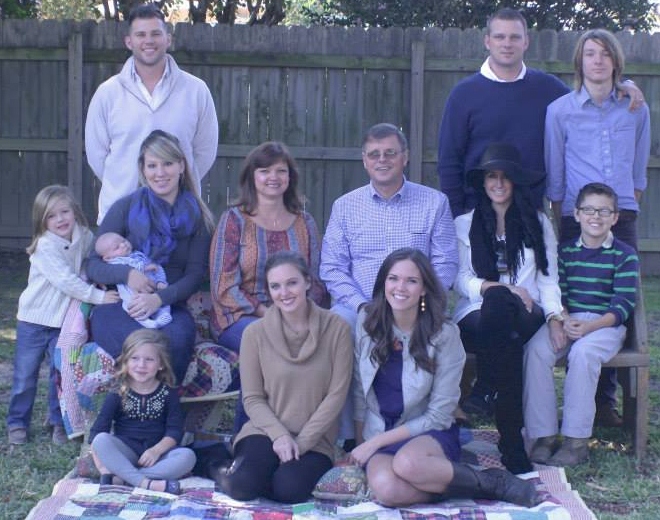
Malone Family 2014 (2)One more year behind. It doesn’t seem quite possible that an entire year has passed since I last wrote. I must confess this has been the fastest year of my life. I’ve blinked and it’s gone. I’ve blinked and the children are bigger (grandchildren, I mean—I suppose “older” might be a better word). I’ve blinked and my hair is a little grayer (at least it turned gray and not loose).

I’m not sure how much news there is to report this year, and I’m so late writing that this is more apt to be a New Year’s update rather than a Christmas update. I’ve just been too busy to sit down and write, and when I’ve not been busy, I’ve simply been too tired. Yes, I know. “You’re a pastor. You only work one day a week!” Yes, but that one day is a killer. Takes a whole week to recover!

Where should I begin? Vanessa and I have completed another year at First UMC, Monroe. It’s been a great year, too. We still enjoy spending as much time as we can on our back porch, especially by the fire pit, and Vanessa is enjoying spending as much time as possible being grandma. She travels every Thursday to Minden to keep Josh’s three—that’s right, three—but I’ll share more about that in a moment. One thing I’ve even considered is that with Facebook, this annual letter is becoming a little obsolete. Want to know what’s happening with the Malone Family? Just log on to Facebook. We post way too much stuff on there.

So, here’s the skinny on the Malone Family for 2014. Adam is at home in West Monroe with Felicia and their two boys, Kade (15) and Kobyn (11). Both the boys are quite musical, and we hope they continue to hone those talents in the future. They are all very active at FUMC, Monroe, and that’s a blessing, too. Also, Adam is now a professional writer. He writes a regular article at www.whodatdish.com. It’s all about the New Orleans Saints, a passion he and I both enjoy, so I’ve had fun reading his musings. He continues working for Noble Drilling Corporation, and is headed for Australia (probably by the time you receive this letter).

skyler (2)Josh and Piper’s big news, of course, is the birth of their third child at the end of September. Skyler Augustus Malone was born on September 29th. Mom and Dad call him Skyler (well, everyone else, too), but Poppy prefers to call him Gus-Gus. We’ll see how long he (or they) let me get away with that. Of course, the twins (Peyton and Ryder) have already taken Skyler under their wing and are teaching him all their mischievous ways. We’ll see where that leads.

Brittney and Kelsey are living at home now. Kelsey graduated from LA Tech University (Go Dawgs—we’re now a three Dawg family) in May, is exploring permanent, long-term (at least, that’s what Dad hopes) employment options, and continues to play the keyboard for our contemporary worship service as well as for J-Force, our children’s choir. Brittney will be moving to Bossier City in January. She’s taken a new position as manager at Hooter’s in Bossier City. She’s commuting from Monroe right now (send money, please), but will have her apartment beginning January 1. We’re happy for her. It’s the job she’s wanted for a long time. We’re glad it finally came to fruition.

That about catches everyone up on the happenings of the Malone Family for 2014. Seriously, just check Facebook. You’ll learn more than you ever wanted to know. We love you all. Merry Christmas and Happy New Year!

Until next time, keep looking up…