Power and Purpose…

The great Methodist hymn writer, Fanny Crosby, is known for some great hymns of the church. Among those hymns are Blessed Assurance, Rescue the Perishing, Pass Me Not, O Gentle Savior. Historians have noted that Crosby is responsible for over 9,000 hymns in her lifetime. That’s incredible when we remember that she was blind from the time she was six weeks old. She died in 1915 just shy of her 95th birthday, and the final verse she wrote said, “You will reach the river brink, some sweet day, bye and bye.”

Long before she penned those last words, in 1869 she penned another of her now famous hymns. That hymn resonates with me as I spend this Lent at the cross of Jesus. Hear the words of the first verse of her hymn Jesus, Keep Me Near the Cross:

Jesus, keep me near the cross;

There a precious fountain,

Free to all a healing stream,

Flows from Calvary’s mountain.

“Keep me near the cross” is my prayer this Lenten season. It is near the cross that we not only see Jesus, but we hear the words he speaks from the cross. Jesus made seven statements while He hung on the cross. They were the last words of Jesus; each one has significance and meaning, and teach us something about the heart of God.

Famous Last Words

First, He said, “Father, forgive them for they know not what they’re doing.” In the midst of being unjustly wronged, Jesus was still able to offer a prayer of forgiveness. Next, he interacted with two criminals being crucified beside Him. One rejected Him, the other repented and cried out to Him to save him to which Jesus responded, “You will be with me in paradise,” a wonderful word of salvation.

Then, Jesus spoke a third time from the cross. In his anguish, he looked down from the cross and saw his mother and the disciple whom he loved–the Apostle John. Here is what John recorded:

25 Standing near the cross were Jesus’ mother, and his mother’s sister, Mary (the wife of Clopas), and Mary Magdalene. 26 When Jesus saw his mother standing there beside the disciple he loved, he said to her, “Dear woman, here is your son.” 27 And he said to this disciple, “Here is your mother.” And from then on this disciple took her into his home. (John 19: 25 – 27 NLT)

As I read these words, I make two discoveries.

The Power of a Passionate Love

The first discovery is the power of a passionate love. I see the passionate love of Jesus. Let’s remember all that happened to Jesus in the past 24 hours. He had been whipped, His back being completely torn to shreds. He had been punched repeatedly in the face. Romans had taken a crown of thorns and crushed it down upon His head. He had suffered an incredible loss of blood. He was desperately weak and thirsty. They took spikes, driving them into His wrists and feet, fastening Him to a cross, slamming it into the ground with all of His weight being held only by those spikes. He knew he was dying.

Samuel Johnson, the 18th century British author and poet said, “Depend upon it, sir, when a man knows he is to be hanged in a fortnight, it concentrates his mind wonderfully.” Here is Jesus, hanging on the cross watching the soldiers gamble for his clothes. If there was ever a time Jesus would be justified in being selfish, it was now, but his mind turned not to himself, but to others—particularly, his mother. Jesus dying concern is for his mother.

Jesus saw his mother and said, “Woman, he is your son.” Jesus was taking care of his mother’s needs. It was his tender compassion at work, even from the cross. Joseph was likely dead, and in ancient near eastern culture widows had no means of support. It was the oldest son’s responsibility to care for his widowed mother. Jesus was doing what I’ve witnessed so many others do through 28 years of ministry. As I’ve journeyed with many through their last days the concern most expressed is not for themselves, but for the one’s they leave behind. Who will care for them? Did I leave enough for them? Will they be alright? Jesus had a deep, passionate love for his mother, and he was expressing it from the cross.

Jesus wasn’t the only one expressing a passionate love, though. So was his mother, Mary. What mother could choose to watch her son die such a gruesome and painful death? Don’t you know that with every blow of the hammer, Mary felt the nails going into Jesus’ feet and hands? Don’t you know that with every labored breath of Jesus she lost a little of her own? It was a mother’s love that kept her near the cross in the face of such pain.

A few years ago, a newspaper report out of south Florida reported of a little boy who decided to go for a swim in the lake behind his house. In a hurry to dive into the cool water, he ran out the back door, leaving behind shoes, socks, and shirt as he went.

He flew into the water, not realizing that as he swam toward the middle of the lake, an alligator was swimming toward the shore. His mother in the house was looking out the window saw the two as they got closer and closer together. In utter fear, she ran toward the water, yelling to her son as loudly as she could.

Hearing her voice, the little boy became alarmed and made a U-turn to swim to his mother. It was too late. Just as he reached her, the alligator reached him. From the dock, the mother grabbed her little boy by the arms just as the alligator snatched his legs. An incredible tug-of-war began between the two. The alligator was much stronger than the mother, but the mother was much too passionate to let go. A farmer happened to drive by, heard her screams, raced from his truck, took careful aim and shot the alligator.

Remarkably, after weeks and weeks in the hospital, the little boy survived. His legs were scarred by the vicious attack, and on his arms were deep scratches where his mother’s fingernails dug into his flesh in her effort to hang on to the son she loved.

The newspaper reporter, who interviewed the boy after the trauma, asked if he would show him his scars. The boy lifted his pant legs. And then, with obvious pride, he said to the reporter, “But look at my arms. I have great scars on my arms, too. I have them because my Mom wouldn’t let go.”

This was Mary hanging onto Jesus as long as she could. Her passionate love kept her from turning away.

The power of passionate love was at the cross that day. Jesus, keep me near the cross that I might know such a passionate love.

The Power of an Incredible Purpose

The second discovery I’d like for us to make is the power of an incredible purpose. We find this power in the Apostle John—the one whom Jesus loved. It was this John who had a special place in the inner circle of Jesus’ disciples. It was Peter, James and John who saw Jesus gloriously transfigured on the mountain. It was Peter, James and John who were invited by Jesus to witness the raising of Jairus’ daughter, and they were invited to go with Jesus deeper into the Garden of Gethsemane to pray before his arrest. It is an awesome lesson for us that those who are close to Jesus will be entrusted with great opportunity to serve in the Kingdom: to do for Jesus what he could not do for himself.

Jesus was saying to John, “You have to take my place. You have to do what I cannot do.” We see in these words, not simply a concern of a son for his mother, but also a demonstration of the re-ordering of relationships based on Kingdom principles. Jesus was affirming what he taught in his ministry. In Mark’s Gospel, Jesus had been confronted by great crowds, so much so that Mark says his family was looking for him because they thought he has “lost his mind.” Word came to Jesus that his mother and brothers were outside:

33 Jesus replied, “Who is my mother? Who are my brothers?” 34 Then he looked at those around him and said, “Look, these are my mother and brothers. 35 Anyone who does God’s will is my brother and sister and mother” (Mark 3: 22 – 34 NLT).

We are familiar with the saying, “Blood is thicker than water.” In Kingdom relationships, Spirit is thicker than blood. This was John’s commissioning to become the hands and feet of Jesus and demonstrates to us that the purpose of the church is to become the hands and feet of Jesus. As the elder son was responsible for the mother, so those who are becoming people of Christ are responsible for the forgotten of society. You and I are responsible for others. What an incredible purpose!

I am reminded of the story of the husband who had an affair and divorced his wife so he could marry his mistress. The two married and had children. After the children were born, the new wife was diagnosed with terminal cancer. As her days final days drew near, she asked the ex-wife to visit her. The ex-wife reluctantly went to see the dying woman. As the two chatted, the dying woman looked intently at the ex-wife and said, “I have a request.”

“What is that?” the ex-wife replied.

“When I’m gone, will you take care of my children? I don’t know anyone I could trust more with their care,” was the woman’s request.

The ex-wife hesitated for a few moments and the air became heavy as the mother thought about the request she had made. Finally, the ex-wife replied, “I’ll gladly care for your children after your death.”

Later, friends asked the ex-wife, “How could you consent to do that after she destroyed your marriage?”

“God’s love has given me the power to forgive. I think I can accept her children as my own,” was the woman’s answer.

God’s children become our own when we stand near the cross. Like John, we are charged to do for Jesus what He can no longer do for himself–care for others. What an incredible purpose!

Want to know your life purpose? Stand near the cross. That’s where we discover the power of an incredible purpose.

Until next time, keep looking up…

Once the Dust Settles…

Now that the dust has settled on #gc2019, I thought I’d make one last post as a means of processing my reflections on the whole debacle in St. Louis. Honestly, the dust hasn’t settled on #gc2019. If you follow any social media at all, or anything remotely connected to the United Methodist Church, you are well aware that emotions are still high–I’m wondering if the dust will ever settle. Additionally, the Judicial Council will review the “Traditional Plan” in April and I suspect many of these same emotions will show up again…assuming, of course, that the dust has settled.

Here are my ruminations on #gc2019:

I can’t imagine the people who gathered in 1968 could ever envision a General Conference like the one in St. Louis. Surely they could never forsee a denomination birthed in the unifying of two parts of the body of Christ which produced a “big tent theology” could devolve into what the world witnessed in St. Louis. It was not a show of unity in the body of Christ. If anything, the gathering showed just how broken is this denomination called United Methodist.

Notice that I did not say “congregations.” I intentionally wrote “denomination.” Our denomination is broken. I’m grateful to David F. Watson for admitting that here. In spite of the denomination’s brokenness, there are many, many local congregations that are healthy and even growing. For that I am also grateful. It just proves the point that all church is local church. The local congregation is where disciples are made. The local congregation must be the focus of energy for the people called United Methodist now that the dust has settled.

The Traditionalist Plan prevailed at #gc2019. Notice I did not say it won. Nobody won. The Traditionalist Plan received the most votes by roughly a 6% margin. It didn’t matter which plan prevailed in voting there would be an emotional response by the other side. It wasn’t a matter of “if” someone was going to be upset, it was only a question of “who” was going to be upset. We should have seen that fact before we ever got to St. Louis. Our first clue should have been when the Commission on “a” Way Forward finished its work with “three” ways forward. If a group of 32 couldn’t agree on a single proposal, it was fairly certain a group of 864 wouldn’t find one either.

The results of #gc2019 sets up the denomination for more of the same once the dust settles. Some of our leaders have said as much–you can view that here. Some of our bishops will continue to enforce the Discipline. Others will not. Some of our clergy will continue to uphold the Discipline. Others will not. Some of our congregations will continue to welcome and celebrate same-sex marriages. Others will not. And, everyone will feel justified in the actions they take. Perhaps this fact indicates the obsolete nature of our polity in the United Methodist Church. Perhaps it is an indication that restructuring our polity needs to be the topic of conversation when the General Conference next meets in May of 2020 in Minneapolis, MN. It won’t be, but perhaps it should.

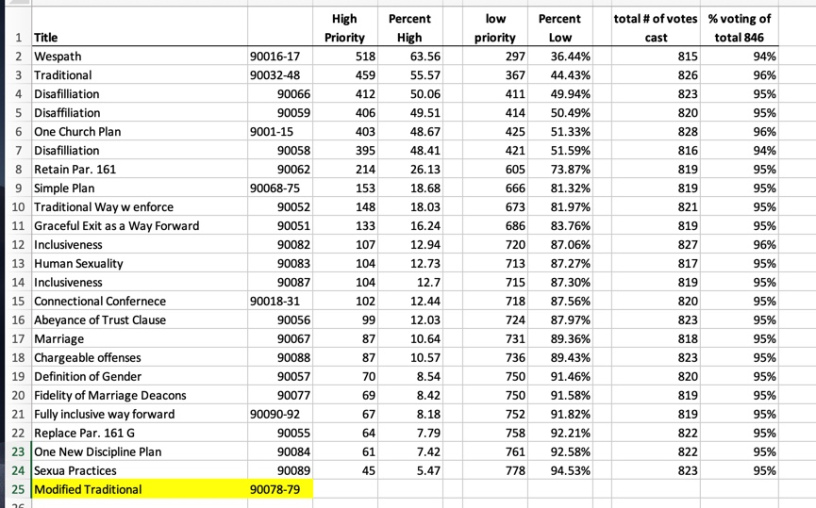
I believe that #gc2019 lost the one chance it had to provide a legitimate way forward. The Connectional Conference Plan was perhaps that vehicle. It would have provided space for all of us to stand firm in our convictions while maintaining some sense of missional unity. It is abundantly clear that we United Methodists are not functioning practically as one denomination. Very few (including myself) gave it much consideration. On legislative day, only 12.44% of the delegates voting gave it “high priority” status. The potential of passing all the constitutional amendments necessary to enact the plan was just too daunting for many to give it serious consideration. We may wish we would have reconsidered once the dust settles.

After witnessing #gc2019, I wonder who in their right mind would offer themselves to serve as a delegate in 2020? I know some Annual Conferences sent newly elected delegations to St. Louis, but most will return to their Annual Conference gatherings this spring and summer to elect new delegates for GC 2020.  Will there be any who offer themselves? Sure there will be. Will I be one of them? Probably.

Perhaps desiring to return to GC 2020 is like watching a train wreck. You want to look away, but you just can’t. My prayer is that those delegation elections don’t become a reflection of what happened at #gc2019. Hopefully, the relationships we’ve built with one another through years of ministry together will prevail once the dust settles, and we’ll elect strong, faithful leaders who will listen to one another, pray with one another and trust one another enough to move the United Methodist ship forward.

These ruminations notwithstanding, it’s time for me to refocus my energy on the local congregation I serve. There is enough mission and ministry right here to occupy my time. This is where we’ll make disciples of Jesus Christ for the transformation of the world. I’m going to engage my passion for seeing the world connect to Jesus Christ. I’m going to engage my passion for growing with one another in Jesus Christ, and I’m going to engage my passion for being a local congregation positioned to serve the world for Jesus Christ. Once the dust settles, isn’t that what life in the church is all about?

I’m moving on now from #gc2019. I’ll not write anymore blogs about it (which only means there won’t be as many people reading it). I’ve committed to one more conversation in our congregation concerning it, but that won’t happen until after Easter. Otherwise, I’m moving on.

It’s time to observe a holy Lent. It’s time for me to repent of my own sin, not only as it regards the brokenness of our church, but also as it regards the brokenness of my own life. It’s time to ask God to forgive me, and it’s probably time to ask a few others to forgive me, too. It’s time to focus on the sacrifice of our Lord and Savior, Jesus Christ, and it’s time to focus on how I can be more like him and less like myself.

So, I’m moving on now. General Conference has spoken (for better or worse). Who’ll join me?

Until next time, keep looking up…

#GC2019–Praying from the Cheap Seats, Part 2

The Dome at America’s Center set up for #gc2019.

Saturday was a day of prayer, but so was Sunday. When I tell you we’re in the cheap seats, I mean we’re a long way from the delegates on the floor, and an even longer way from the stage upon which the Council of Bishops sit and lead the General Conference. The Dome at America’s Center was designed and built for the St. Louis Rams (don’t get me started about the Rams!), so it’s designed to hold over 66,000 people. Believe me when I say it feels a bit cavernous with only a few thousand Methodists present.

I going out on a limb here to say the distance between the cheap seats and the stage where the Bishops preside might just be a metaphor. It might be a metaphor for how far removed our Council of Bishops seems to be from the “mainstream” of United Methodism. How so, you ask?

Much of yesterday was spent assigning priority to the legislation that would come before the GC. Delegates voted on each “batch” of petitions, assigning either a “high” priority or a “low” priority. The process was designed to help the delegates do the work that needs doing in such a short period of time. The vote was basically a way to rank the order in which petitions would be handled.

The results of the “ranking” were interesting (and I think telling). The Council of Bishops “overwhelmingly” support the One Church Plan, but in the General Conference, the OCP only garnered 48% of delegates who voted it “high priority.” Conversely, the Traditional Plan (which only received a passing nod from the Commission on a Way Forward) received over 55% of the delegates voting it “high priority.” Additionally, two plans for “disaffiliation” received more “high” priority votes than the OCP. At first glance…and this is only a first glance…it appears that the OCP will have a difficult time passing this General Conference.

Thanks to Rev. Chris Ritter for the photo of the ranking results.

You can read more about the process here.

There is still much to anticipate. Again, this vote was only a first glance. Legislative work continues today on the plans, and there will be opportunities to amend, substitute and table petitions. I suspect the supporters of the OCP have spent most of last night devising a strategy to advance their favored position, and I expect the parliamentary gymnastics will begin in earnest. It will be interesting, informative and educational to watch.

Here’s a video recap of the day produced by the LA Annual Conference:

Until next time, keep looking up…

Packing a Heart of Love…

It’s time to pack our bags for St. Louis. The special called session of General Conference of the United Methodist Church is set to begin this Saturday, February 23rd with a day of prayer, and will continue through Tuesday, February 27th. One thing is certain–everything will be different in the United Methodist Church on February 28th. No one knows what that “different” will look like, but no matter what happens, I predict everything will be different. I dare not speculate on what the difference will be. Heaven knows! There’s been enough speculation already to last a lifetime.

There’s one thing I hope all the 864 delegates, alternates and observers pack as they prepare for departure. That one thing is a heart of love.

We have just celebrated the day of love—Valentine’s Day. According to the National Retail Federation, people spent $20.7 billion on Valentine’s Day in celebration of love. Valentine’s Day is the second largest Hallmark holiday, and it has, unfortunately, become the world’s definition of love—emotional, romantic and sometimes (judging from the Facebook memes), downright corny.

The Bible talks a lot about love, too, but it’s not the type of love the world talks about or that we celebrate on Valentine’s Day. It’s a different kind of love, a love that requires more from us than romantic love or even brotherly love. It’s the different kind of love Jesus talked about as he taught his disciples about living the ethic of Kingdom of God. It’s an upside-down kind of love. It’s a willful, self-sacrificial love that is best reflected in the cross of Jesus Christ.

Listen to how Jesus describes how this love acts in Luke 6:

27 “But to you who are willing to listen, I say, love your enemies! Do good to those who hate you. 28 Bless those who curse you. Pray for those who hurt you. 29 If someone slaps you on one cheek, offer the other cheek also. If someone demands your coat, offer your shirt also.30 Give to anyone who asks; and when things are taken away from you, don’t try to get them back. 31 Do to others as you would like them to do to you.

As Jesus flips the world upside-down for those first disciples, I wonder if they had as much difficulty understanding what he meant as we do. I wonder if they had as much difficulty living them as we do. It’s one thing to understand. It’s another thing to translate that understanding into action.

Loving our enemies goes against our natural inclinations. Love our friends? Naturally. Love those who love us? Easy-peasy! Love our enemies? Why would I even want to do that?

It’s a clear call from Jesus for his disciples to swim upstream, to go against the flow, to be (in a word) different. We think Jesus wants to make us better. You know how it is, right? Come to Jesus and be a better person, be a better parent, a better spouse, a better employer/employee, a better citizen. Jesus’ words remind me that being a disciple is not about being better, it’s about being different–different from the world. Yes, being different will make us better, but better comes as a by-product of living a different ethic.

Jesus’ words are hard words to hear. It’s not really the message we want to hear in a sermon. We’d rather hear “How to Have Your Best Life Now,” or “Three Steps to a Better Parenting.” Yeah! Those are sermons that will really help us be better disciples! The sermon Jesus preached this day reminds me there is a vast difference between what I want to hear and what I need to hear. And, I need to hear these words as I pack my bags for St. Louis.

I need to hear these words as I pack because there have been a few times in the past two and a half years that I haven’t had a heart of love. We in the church can be really mean. Oh, not to those outside the body of Christ, but to one another. I’ve spent a lot of time since 2016 reading many articles and blogs and Facebook posts concerning the issues before GC 2019, and I have read a lot of very mean and hurtful things–I’ve probably written, or said, or thought a lot of mean and hurtful things myself somewhere along the way. For those times that I did (knowingly or unknowingly), I repent and ask forgiveness.

Here’s a side-bar: Just don’t read the comments! Comments get argumentative, and the internet and social media give us just enough cover to allow us to write hurtful and demeaning words that we would likely never say to a person face-to-face. Just don’t read the comments!

Frustration or anger (or grief) are no justifications to act unlovingly. No, that’s the way of the world. Jesus said, “If someone slaps you on one cheek, offer the other cheek also. If someone demands your coat, offer your shirt also.” That’s a very different reaction, indeed. It’s a different kind of love, too. It’s not what I want to hear, but it is what I need to hear.

I need to be reminded that the “great reward” that Jesus promises to those who live this different kind of love doesn’t have to do with big houses or full pockets, but it has to do with who we become–disciples.  There is much grace and transformation needed for us to live out the radical faith Jesus demands, and there is no greater reward than to live and act the way Jesus does. Jesus knows that we will never love our enemies without the amazing grace that transforms us and makes us different than we are. What changes us and allows us to love is God’s grace; a grace that is greater than all our sin.

I’m not speaking for anyone else, nor am I accusing anyone else who may be headed to St. Louis. I’m simply making my own confession that I have not always lived this ethic, or loved in the way Jesus demands. I’m not saying everyone going to St. Louis needs to pack a heart of love. I’m saying I do. If someone else happens to overhear the conversation Jesus and I have been having over the past week and are convicted by it, well, that’s lagniappe.

So, along with my toothbrush and changes of underwear, I’ll pack a heart of love. I pray that all the 864 delegates, the alternates and observers do, as well.

Until next time, keep looking up…

This Fruit is Always in Season…

I’ve been teaching from A Firm Foundation: Hope and Vision for a New Methodist Future on Wednesday evenings. The book is a collection of essays designed to cast a compelling vision for a renewed Methodist movement, specifically in light of the current debate within the United Methodist Church.

I bring the book up only because of the chapter I read/taught last week–“When the Holy Spirit Comes with Fire.” I won’t unpack the chapter here for you, but reading the chapter and preparing to lead the Wednesday night group caused me to dig deeper on the Holy Spirit. My digging reminded me of much I had forgotten (okay, not forgotten, but taken for granted) about the work and power of the Holy Spirit in our lives.

My digging deeper took me specifically to the Apostle Paul’s letter to the Galatian Christians. In Galatians 5, Paul instructs the Galatians on living the Spirit-filled life (read the whole chapter here), and in that context he offers his list of he calls the “fruit of the Spirit.” You know the list, right?

22 But the Holy Spirit produces this kind of fruit in our lives: love, joy, peace, patience, kindness, goodness, faithfulness, 23 gentleness, and self-control. There is no law against these things!

I’ll confess my own conviction as I read that list again (I’ve probably read it one thousand times before). I was convicted because there was one noticeable fruit that I can acknowledge has been absent from my life, and I believe the fact that I’ve been consumed with General Conference 2019 has put me in this place. The missing fruit, you ask? Joy!

We are, by the presence of the Holy Spirit, supposed to be joy-filled people.  One of my favorite stories about a person with a grumpy personality begins with a man going into the doctor’s office.  As he walked in, he was met by the receptionist.  He told her that he had a sore on his chin that he wanted the doctor to examine.

She said to him, “Down the hall, first door to the right, and take off your clothes.”

“But ma’am,” he said, “it’s just a sore on my chin. I don’t think all that is necessary.”

She repeated, “Down the hall, first door to the right, and take off your clothes.”

“But ma’am,” he said.

“Down the hall, first door to the right, and take off your clothes.”

So he went down the hall, took the first door to the right, walked in and saw another man already sitting there in his boxer shorts, shivering. He said to him, “Boy, that receptionist is really something, isn’t she? I just have a little sore on my chin and she told me to come down here, go through this door and take off my clothes.”

The man in the boxer shorts said, “You think that’s bad? I’m the UPS delivery man.”

There a lot of days recently that I felt like that nurse. But, joy is supposed to be one of the fruits that is always in season in the Christian.

What is this fruit of joy? The Greek word is chara, meaning “cheerfulness, calm delight.”  Unfortunately, I confuse joy with happiness. If I’m happy, then I am joy-filled, and if I’m joy-filled then I’m happy. That is incorrect. Joy is not happiness, and happiness is not joy. Actually, I can be happy and full of joy, but I can be unhappy and still be full of joy. Happiness is external. Joy, in the biblical sense, is internal. Happiness is based on chance. Joy is based on choice. Happiness is based on circumstances. Joy is based on Christ. Happiness is too often conditioned on what is “happening” to me. If people treat me well, and things are going good around me, then I am happy, but if things go wrong then my happiness is likely to be as fleeting as my circumstances.

Joy, however, goes beyond my circumstances. Joy throbs throughout Scripture as a profound, compelling quality of life that transcends the events and disasters which may dog God’s people. Joy is a divine dimension of living that is not shackled by circumstances. The Hebrew word means, “to leap or spin around with pleasure.”  Listen to the Psalmist:

16 But as for me, I will sing about your power.
    Each morning I will sing with joy about your unfailing love.
For you have been my refuge,
    a place of safety when I am in distress. Psalm 59: 16

The Apostle Paul understood this, too. He wrote to the Corinthian Christians: Our hearts ache, but we always have joy (2 Cor. 6:10). Joy should never be dependent on what is happening around us. Too often, unsatisfied expectations, unresolved conflict (like we have in the UMC right now), or unconfessed sin can serve to steal our joy from life. These are just three reasons that joy seems such an elusive fruit.

But there’s hope!  And that hope is spelled J-O-Y! I was reminded of this pattern on a church sign not far from my house. I think it’s really what solidified the message I’ve reflected on over the past couple of weeks. It is Jesus, Others, and You. Joy starts with a relationship with Jesus Christ. Jesus is the source of our joy, and Jesus is the example of our joy. If we don’t know Jesus, we don’t know joy. If we know Jesus, we should know joy.

Then, others. If we’re serious about desiring to bear the fruit of joy, we must make sure we are doing OK on the horizontal dimension of life by living in biblical community with others. We will never know joy apart from others.

Finally, you. You have the challenge, and here it is: Go to church, get connected to Jesus and serve others. You’ll find joy in great abundance, and you’ll discover that the  fruit of joy is always in season.

Until next time, keep looking up…

The Injustice of it All…

The Power of Sports

Okay, so last week’s blog is officially the most read blog I’ve ever written…and it dealt with football! I’m going to forget for a moment what that might say about our passion for football (is football our idol? <–click the link to the left to hear David Platt‘s take on the matter) and focus on the issue of injustice since we all seem to be concerned with how unjustly the Saints were treated.

I find it interesting that the week after the Saints lose the game in such an unjust manner that I was scheduled to preach a sermon on the question, “Why does life seem so unfair?” God’s sense of humor continues to amaze me.

You may recall that one of the points of last week’s blog was that life is simply not fair, we just need to deal with it. I shared about Paul’s unjust treatment at the hands of the Philippians, but an even more compelling example is the life of Job in the Old Testament. Talk about injustice!

Job

You remember Job? (click here to read the summary of Job’s story) The Bible calls him a good, rich man–blameless and full of integrity who had ten children, land and livestock. In Job’s story, the curtain of eternity is peeled back and we overhear a conversation between God and Satan. God actually brings Job into the supernatural conversation. God, in bringing up Job, shows His trust in Job to choose rightly. This conversation reveals the inherent nature of humanity to choose the path we will walk through this life—this is God’s revelation of humanity’s free will.

Were we to read Job’s story (you can read the whole story here), we’d discover in the supernatural battle between good and evil, Job gets put in the middle, loses his family, land and livestock and becomes painfully ill. It’s a long story, but you get the point–Job is treated unjustly…and it appears to be God’s fault!

God chose humanity to be participants in the redemption of creation. The Bible opens in paradise and it ends with a restoration of paradise in the Book of Revelation. It’s the in-between that throws us the curve balls of life. In between, we see the entrance of sin and its destructiveness on God’s good creation. Literally, from cover to cover, the Bible is about God restoring His creation, and God chose humanity to be participants in that restoration. We participate by faith. The story of Job illustrates the difference faith makes in both the physical and eternal realms.

As God’s chosen participants in the redemption of His creation, God created humanity with the freedom for making moral choices. The result of that freedom is sometimes bad choices. A person chooses to drink to excess and then drive a car. That person wrecks and kills other people. Bad decision, bad circumstances. One of people’s favorite saying is, “Everything happens for a reason.” Yes, and sometimes that reason is people are dumb and make dumb decisions. I must be careful to never blame God for my own stupidity!

But, what of innocent suffering? When a child is stricken with cancer, or the forces of nature take their toll on families and communities and nations. What of those times? The same rule applies. Return to the Garden of Eden and the curse of original sin. That one event began an unraveling of God’s creation that has caused pain and sickness, and unleashed the power of the forces of nature for destruction, and we are left to deal with the consequences. Yet, God wants to use the suffering of this world to accomplish His purpose of redeeming and reconciling the creation to Himself.

The Source of Our Hope

Romans 8: 28 is one of the most overused verses in the Bible: “And we know that God causes everything to work together for the good of those who love God and are called according to his purpose for them,” but it holds out the hope that God is still on the throne even when evil has the world in its grip. God sent His son, Jesus Christ, to die on the cross. God entered the world, limiting Himself to time and space, and when He did, He played by the same rules we play by. He suffered and died. It was in his suffering and death that the world finds its redemption, and it is in his suffering and death that we are called to be participants by faith in God’s eternal plan.

God doesn’t answer us for two reasons, I think. First, knowing the answer would not make the burden any less hard to bear. Second, God doesn’t answer because we are incapable of comprehending the answer.

We cannot see how God uses the ordinary circumstances of our daily lives to bring redemption, but that doesn’t mean God isn’t doing it. It’s been compared to making a cake. Raw flour by itself does not taste so good. Certainly, raw eggs are not something we include in our daily diet because they taste good—unless we’re Rocky Balboa. Bitter chocolate, baking powder and shortening are not good alone, but when we combine all the ingredients we get a wonderfully delicious cake.

God is faithful to trust us in the fight between good and evil. We fight by faith: faith in the One who has won the battle already, and we bear our pain and suffering knowing that, like Job, our faith matters. In the here and now, we make a difference by faith. In eternity, we make a difference by faith.

Yeah, I know that doesn’t answer the question for all time, but it is the best I can do for now. And, I bet this blog post won’t get nearly as many views as last week’s. I guess I should write more about sports!

Until next time, keep looking up…

“More” Controversy…

Apparently, I should have chosen to be “more” controversial during my self-proclaimed “Year of More.” One of the neat things about writing a blog is metrics. WordPress tells me how many people have viewed my blog, what pages they’ve clicked on, what countries they viewed from, and so on. It’s really pretty cool.

Here’s the metric I find most interesting: the blogs with the most views and the most clicks are ones that deal with more controversial topics. The more controversial the topic, or at least if I can come up with a “click bait” headline, the more views the blog receives. I’ll be anxious to see the number of clicks the headline to this blog generates.

There are certainly plenty of topics to write about when it comes to controversy. Our world is becoming more polarized (well, at least in the good ole’ US of A), and this polarization makes every subject controversial. I bet you (if I was a betting man) that my article on controversy has the potential of being controversial.

Seriously, people have sparked controversy by saying or doing something that when the person said or did whatever it was, had no intention of sparking controversy. Yet, someone got offended by what the person said or did, so controversy arose. Civil discourse has ground to a halt in our culture. Oh! There’s discourse. It’s just that none of it is very civil.

There is controversy in the political realm. If I wanted to create a firestorm of controversy, I would say that I voted for Donald Trump in the 2016 election. I might have to close my comments section and delete the post from Facebook because of the responses I would likely receive. The problem is that I could conversely say that I voted for Hillary Clinton and get the same vitriolic response, except those responses would come from different people. No, I’m not going to tell you who I voted for in 2016. Suffice it to say that I held my nose while I voted, and that’s as controversial as I’ll get in that regard.

There is controversy in the cultural realm. Let’s see…I could do a Google search of the most controversial topics for 2019 and find abortion topping the list. I’m pro-life, just so you know (and that’ll stir no little amount of controversy, I’m sure). Of course, even Google has become somewhat controversial as there have been recent concerns about privacy issues (Google is now “Big Brother”), spying, censorship, tax avoidance, sexism and racism. I suppose I should stay off Google, but really, how does anyone stay off Google?

Other topics on the “controversial” list are gay marriage, gender identity, LGBT (I know, I’m leaving out some letters, which in and of itself is controversial) adoption rights, Planned Parenthood funding, women in combat, the First Amendment, the Second Amendment, the Confederate flag, and the death penalty. I could go on, but you get the picture—our culture abounds with controversy, and following the debate on any issue on Youtube is like falling in a deep, dark hole (be careful…Youtube is owned by Google!).

The debates in larger culture have made their way into the church, too. Controversy in the church? Oh! My! Our denomination (the United Methodist Church) is currently embroiled in a debate concerning same-gender marriage and the ordination of homosexuals. We are divided (almost as equally as the broader culture) on these issues (read my position here), and the debates have been ugly at times. These ugly debates have taken place amidst calls for “unity,” which interestingly enough, has become its own controversial topic.

Unity. That’s an interesting concept. How do you define it? Do we even know it when we see it? Can there ever be genuine unity? After all, opinions, someone said, are like armpits. Everyone has them and most of them stink. I have my own ideas about unity…and unity in the body of Christ…but I’ll save those for another controversial blog…perhaps one entitled “More Unity.”

There is one place, though, where I will choose to be ardently controversial—the power of Jesus Christ to change a life. I will continue to proclaim that Jesus is the Way, the Truth and the Life, and that no one comes to the Father except through him. Yes, even those simple proclamations are controversial and I may have to close my comments, but so be it. I really don’t mean to be controversial. I really don’t mean to offend. But, if believing Jesus Christ is King of kings and Lord of lords, then call me controversial. I only ask that you do it in a civil way.

Until next time, keep looking up…

The Final Nail in the Mainline Coffin?

Let me say–“I am a traditionalist.” There. Now that’s out of the way. You know where I stand.

I have been reluctant to comment on the current state of affairs in the United Methodist Church as we head into the special called session of General Conference scheduled for St. Louis, February 23 – 26, 2019. The special session was called by the Council of Bishops after the 2016 General Conference for the purpose of dealing (definitively?) with the issue of “full inclusion” of LGBTQI+ individuals in the life of the church. The debate centers primarily on the issues of same-gender marriage and the ordination of self-avowed, practicing homosexuals.

There are several reasons I have not commented (at least not very publicly). For one, I serve a diverse congregation, and discretion being the better part of valor, I want to be able to be a pastor to everyone no matter where they lie along the spectrum from traditional to progressive.

Another reason I’ve been reluctant to comment is my own acknowledgement that I could be wrong. After all, I’m “Not the Perfect Pastor,” so my imperfections do tend to get in my way.

My prayer for 20+ years has been, “Lord, change my heart if I’m wrong.” Being the traditionalist I am, I believe God actually hears and answers prayer, so I continue to pray, but as of this writing, the Lord has not answered this prayer (at least in relation to the presenting issue facing the UMC). I also know that there is still more for me to learn. I take to heart the advice Jordan Peterson offers in his book 12 Rules for Life. Rule # 9 states, “Assume that the person you are listening to might know something you don’t.” If I offered too many comments, I might have to walk some of them back, and being of the male species, I don’t like to walk statements back.

Yet one more reason I’ve been reluctant to comment is the fact that there really hasn’t been enough information to have an informed conversation on the matters before us. Prior to July 8th about all one could say is “We really don’t know what the possibilities are at this point.” Everything until that point was pure speculation (although there is still much speculating to be done), and I figured why confuse the conversation or risk upsetting people dear to me if I couldn’t have an informed conversation. Besides, I have numerous colleagues with whom I disagree on the issue of same-gender marriage and the ordination of homosexuals, and I dearly love them. I have no desire to have our relationships broken because a speculative conversation devolved in to name-calling and accusations. Not worth it!

Then, of course, there is the issue of giving my focus to the work of the congregation I serve. As an alternate delegate to General Conference, it is very easy to get distracted by all the information, blogs, speculation and social media posts concerning the future of United Methodism. Yes, we are a connectional church, but at the end of the day, I’m appointed to a local congregation, and the mission of the United Methodist Church (to make disciples of Jesus Christ for the transformation of the world) gets carried out in the local congregation. People’s lives will be transformed in and through the local church. That is my primary focus.

Now that sufficient information has been made available and petitions filed with General Conference, it’s time for me to weigh in on the situation we United Methodists find ourselves in. Many people have asked my thoughts over the past few months, so I figured this medium is the best way to communicate to the broadest number of people.

I know a post such as this will get feedback, both positively and negatively, and I’ll probably get called a few names if I don’t take the position that someone thinks is the correct one. But, I suppose I will take that chance. February will soon be upon us and the conversation can no longer be avoided.

The Commission on the Way Forward

The Commission on the Way Forward

The Commission on a Way Forward was appointed by the Bishops subsequent to the 2016 General Conference to “do a complete examination and possible revision of every paragraph of the Book of Discipline concerning human sexuality and explore options that help to maintain and strengthen the unity of the church.” The Commission completed its work and submitted its report to be translated for General Conference. The report includes three possible ways forward for the UMC. The Traditional Plan, the Connectional Conference Plan and the One Church Plan. I’ll unpack each later in the post.

The Council of Bishops has recommended adoption of the One Church Plan. That is their preferred future for the UMC. Initially, the bishops sought to direct the debate of General Conference, but after a challenge before the Judicial Council, the Judicial Council ruled that any United Methodist with standing could submit legislation to General Conference. That means, obviously, there will be a plethora of legislation presented to General Conference. As a side note, the bishop’s recommendation was moved to a footnote in the report.

General Conference, 2019

The General Conference is slated to last four days. With a plethora (I’ve used that word twice!) of legislation, the work will be daunting, and the reality is it may not get done at all. Historically, the work of the General Conference begins with adopting the rules of order. There may be a four-day fight on the rules and the Conference may never get around to doing the actual work. Can you imagine having two years of conversations and meetings, and spending millions of dollars to accomplish nothing? That’s exactly what could happen.

Other than a significant waste of time and money, nothing happening would not be the worst thing to happen (in my humble opinion). The status quo would remain, which means the Discipline would not change (of course, neither would the current lack of enforcement). The proverbial can would get kicked down the road to General Conference 2020. Speculation? There will be some laity, clergy and congregations who depart out of sheer frustration, and the United Methodist Church would be weakened. It would also break my heart.

One thing that could happen even before February is the Judicial Council could rule one, two or all three plans included in the report as unconstitutional. The Council of Bishops has asked for a declaratory decision on the constitutionality of the three plans. If all three plans are declared unconstitutional, there would be no work for the Conference to complete. I suppose it would be cancelled, still costing an unknown amount of money and kicking the can down the road. There will be some laity, clergy and congregations who depart out of sheer frustration, and the United Methodist Church would be weakened. It would also break my heart.

The Three Plans

The Traditional Plan

The Traditional Plan retains the current language in the Book of Discipline that states all persons are “of sacred worth, created in the image of God” and also states that the practice of homosexuality is “incompatible with Christian teaching.” The Traditional Plan dramatically enhances accountability to the church’s requirements and closes many of the loopholes currently being used to avoid accountability by those who, in practicing “biblical disobedience,” conduct same-gender weddings and ordain “self-avowed, practicing” homosexuals. At the same time, the Plan offers a gracious exit for annual conferences, congregations, bishops, and clergy who cannot in good conscience abide by the church’s historic standards. 

This plan has the best possibility of passing General Conference (again, in my humble opinion) simply based on the votes of previous General Conferences in similar matters.  It will likely be supported by evangelicals, southern delegates and the delegations from the Central Conferences (outside the U. S.). The groups together constitute a majority. I won’t bore you with every single detail of the Traditional Plan. For a more comprehensive treatment, my colleague Thomas Lambrecht has an article here, or you can read the legislation by clicking here.

I am a supporter of the Traditional plan because it maintains our current position which I believe is grace-filled even if it doesn’t sound like it in this 21st Century shifting culture. I believe it remains faithful to the biblical witness and to 2,000 years of church history and tradition. It also remains faithful to almost every cultural understanding in the world of marriage as being between one man and one woman.

There will likely be some people who depart the United Methodist Church should the Traditional Plan pass, but they would likely be fewer in number. Many of the most progressive leaders in our denomination have stated they will not depart under any circumstances. Of course, that means acts of disobedience would continue, so it is a realistic possibility that the Plan would ultimately be ineffective, in which case, laity, clergy and congregations would depart out of sheer frustration, and the United Methodist Church would be weakened. That would break my heart.

The Connectional Conference Plan

The Connectional Conference Plan is perhaps the most confusing of the three. The plan as proposed would do away with our current five jurisdictions and replace them with three “Conferences” aligned along theological perspectives. There would be a traditional Conference (maintaining the current Disciplinary language), a progressive Conference (ordaining homosexual clergy and performing same-gender marriage) and a centrist Conference (each did what was right in their own eyes).

Each of the three conferences would continue to operate under the umbrella of the United Methodist Church, and as I understand the legislation, each Annual Conference would choose to align with one of the Conferences. Each would continue to share some doctrinal standards, missions work globally and administrative infrastructure (think General Boards and Agencies here).

If a local church did not want to affiliate with the Connectional Conference chosen by its Annual Conference, it could vote to become a member of one of the other Conferences. Clergy would have the same option, but would be obligated to abide by the standards of the chosen Conference. If I understand the legislation correctly, the Bishop and Cabinet of the Annual Conference will still control the appointive process. I’m not sure how that would work, but that’s what it says. Consideration for re-affiliation would be provided every four years.

As for bishops, the current Council of Bishops would be retained with each Connectional Conference having a College of Bishops composed of those bishops who chose to affiliate with each Conference. They would continue to lead in ecumenical relationships and in oversight of the administrative agencies of the Church. Funding for bishops inside the U. S. would be provided by each bishop’s respective Connectional Conference, and bishops outside the U. S. would be supported by the umbrella organization. Confusing, huh?

Each Connectional Conference would adopt its own Book of Discipline starting with the Articles of Religion, Doctrinal Standards, Confessions of Faith and General Rules. Everything else would be contextual to the particular Connectional Conference. Still confusing, huh?

Again, for the full plan you can click here and read the enabling legislation for yourself. I wouldn’t recommend it unless you’re a legal nerd.

I believe this is the most impossible plan offered. It would take up to six years to implement and the passage of five constitutional amendments. Does anyone realize how hard it is to pass a constitutional amendment in the United Methodist Church? Each amendment requires a two-thirds vote of the General Conference and a two-thirds vote of the aggregate members of each of the Annual Conferences voting. What it really means is this plan isn’t likely to gain any traction in 2019 (assuming that GC 2019 gets around to voting on any plan).

The confusion created should this plan be adopted would likely lead to many laity, clergy and congregations departing out of sheer frustration and the United Methodist Church would be weakened. Heart-breaking, no?

The One Church Plan

The One Church Plan as proposed would remove the “restrictive” language (some have called it “hurtful” language) in the Discipline as it refers to the practice of homosexuality, and would change the definition of marriage from “between one man and one woman” to being between “two adults.” Additionally, each Annual Conference Board of Ordained Ministry would be allowed to determine its own ordination standards as it relates to human sexuality.

Okay, this is where it gets sticky. Some have referred to this as the “local option” plan because individual clergy would not be compelled to violate conscience if he/she was opposed to same-gender marriage. The clergy would not be required to perform weddings in celebration of the aforementioned, nor would local congregations be compelled to host same-gender weddings in violation of its collective conscience. (Here’s why I don’t believe this plan would ever work.)

Likewise, bishops are not required to ordain or license homosexual persons in violation of their conscience, but it does make provision if the Annual Conference has opted to ordain, for another bishop to ordain the individual in that bishop’s stead. It does not, however, protect a bishop from having to appoint a clergy person that he/she believes to be unfit for ministry. The Plan does include provisions that prevent a bishop or District Superintendent from retaliating against a clergy who refuses to violate her/his conscience.

I’ll not go into greater detail about the One Church Plan. I’ve linked to the entire plan in a couple of different places already. Read it at your leisure (or at your peril!). I will tell you why I think this plan is untenable.

The Council of Bishops of the United Methodist Church

Proponents of the One Church Plan (including the Council of Bishops–though not every Bishop agrees) believe it is possible for those who disagree on issues of human sexuality to peacefully coexist in one denomination. I think nearly 50 years of continuous debate over the issue proves that theory incorrect. Proponents of the plan see human sexuality as a non-essential. Opponents of the plan disagree greatly, and based on the conversations I’ve had, are not likely to change that understanding.

Adopting the One Church plan will accomplish one thing: It will remove the debate from the General Church level. What it will do, in the alternative, is take it down to the local church level where each local congregation will have to determine and debate its own understanding of human sexuality, thus increasing the conflict in the denomination rather than lessening it.

The One Church Plan would also weaken the understanding of what it means to be United Methodist. Well, it would just set up a situation where neighboring UM churches could have differing standards–UM churches in the same town…on the same street, for heaven’s sake! Talk about brand confusion (forgive the secular marketing reference, but…)! We can call it the One Church Plan, but it does, by default, create two (or more?) churches with its implementation. It is, at best, a false unity.

The One Church Plan makes me ask the question, “If we can choose our standards on human sexuality, why can’t each local congregation (or clergy) choose their own standards on baptism or communion?” Seems to me to be only one of the Pandora’s boxes we open with the passage of the One Church Plan.

Additionally, as a former District Superintendent, I can see the nightmare the appointive process would become under such a plan. It was difficult enough to connect clergy and congregations in a fruitful way without the One Church Plan, and for Annual Conferences with a shortage of clergy, the issue would be multiplied even more. I also envision a time in the not too distant future when bishops and cabinets would say, “Sexual preference is not a consideration in the appointment-making process.”

All this, and I haven’t even mentioned the fact that this Plan disregards the historic, biblical understanding of marriage and sexuality, and puts the United Methodist Church firmly outside the broader global community of the body of Christ on the issues of marriage and human sexuality. Do we really want to do that?

If the One Church Plan passes GC 2019, it will precipitate the departure of many evangelical, traditional members (both lay and clergy) and congregations for whom the issue of human sexuality is a non-negotiable. Their departure will weaken the United Methodist Church, and that breaks my heart.

Other Considerations

This has become a long blog (I apologize), so I will only briefly mention a few other considerations involved in the debate. Bishop Bruce Ough has rightly discerned, “Let’s be clear, if we divide, nearly all our essential unifying institutional activities would be lost or severely diminished.” Our UM institutions will be harmed, and the future of many will be uncertain–some will, in fact, cease to exist. Our global mission partnerships will end or be financially limited. Pension obligations may go unmet (especially pre-1982 pensions [Methodist nerds will know what that is]), and that would be devastating to countless faithful clergy. Property fights would ensue, diverting precious resources away from the mission of making disciples of Jesus Christ for the transformation of the world.

I contend that each of those things will happen regardless of which plan is passed. Perhaps not on the scale of a full-blown dissolution, but harm will come nonetheless.

The Final Nail in the Mainline Coffin?

The decline of the mainline church in North America is well documented, and while our denomination is growing globally, membership and attendance continues to decline in the U. S., and has since I entered vocational ministry in 1991. Ed Stetzer wrote a piece in 2017 noting that unless something happen, mainline Protestantism has a mere 23 Easters left. My heart aches as I consider the possibility that General Conference 2019 will hasten that decline, and will serve as the final nail in the mainline coffin (at least in the U. S.).

United Methodism is still the largest of the remaining “mainline” Protestant denominations, and the singular one which has not yet embraced the ordination of LGBTQI+ persons or same-gender marriage. Only the Traditional Plan will (ostensibly) prevent this from happening, but even if it passes, the UMC is likely to come out bruised and weakened. Regardless of what happens February 23-26, 2019, in St. Louis, everything will be different in the UMC on February 27th. At least, that’s my speculation.

Alarmist, you say? Negativity? Hyperbole? Divisive? Well, I prefer the term realistic.  I don’t want our church divided. I don’t want to see our congregations diminished. I don’t want the United Methodist name to be tarnished. I don’t want to break fellowship with sisters and brothers with whom I’ve traversed the highway of ministry. Each of those possibilities break my heart.

Yet, I am not one who is without hope. I do believe in miracles, and I am praying for a miracle to happen in St. Louis. I believe God has the power to work a miracle among the people called United Methodist. The problem doesn’t lie with God’s ability, but rather with our openness to the move of the Holy Spirit among us as the work is done. So, I pray that all our hearts will be open to what the Holy Spirit desires to accomplish in us and through us during that time.

In the meantime, I’m going to focus as much effort as I’m able to reach the lost in the community around me. I’m going to look to the future with plans for continuing ministry to the broken among us. I’m going to do all I can do to make disciples of Jesus Christ for the transformation of the world. That mission hasn’t changed.

Even still, I’m not without hope. Should February 2019 drive the final nail in the mainline coffin, I am certain the work of the Kingdom will continue. God is in the resurrection business, and we all know there has to be a death before there can be a resurrection.

Until next time, keep looking up…

Decisions, Decisions, Decisions…

On April 28, 2017, the Judicial Council of the United Methodist Church issued its ruling regarding the July 2016 election and consecration of Rev. Dr. Karen Oliveto as Bishop in the United Methodist Church. Almost everyone I know (from a Methodist perspective anyway) was waiting for this ruling, and many of them have asked me what I thought of the ruling. My answer has been: “I think it’s better than it could have been and worse than it should have been.”

BETTER THAN IT COULD HAVE BEEN

It’s better than it could have been because the Judicial Council could have decided it didn’t have jurisdiction over the matter. That is, in essence, what they ruled in part of the case. The Council concluded it did not have jurisdiction over the nomination, election and assignment as Bishop (you can read the entire decision here), but that it did have jurisdiction over the consecration of a homosexual bishop, and in that matter, the Western Jurisdiction violated church law. The decision goes on to say that any clergy who participated in the consecration are subject to a “chargeable offense.”

I’m not going to comment on the intricate details of the case because I’m not an attorney steeped in church law, but I will say that any intelligent person could read The Book of Discipline of the United Methodist Church and conclude that the consecration of a “self-avowed practicing homosexual” is a violation of church law. No matter how one parses the words, they say what they say, and no matter a person’s gifts and graces for ministry, the words say what they say. If we don’t like what the words say, then the words should be changed, but every four years for forty plus years, the wording has been reaffirmed by the General Conference of the United Methodist Church.

So, the ruling is better than it could have been. The Western Jurisdiction violated church law when it consecrated Rev. Dr. Oliveto bishop (although Oliveto was not specifically named in the petition). I believe it was the correct decision, and it helped to bring some clarity to the current debates within the United Methodist Church around human sexuality.

WORSE THAN IT SHOULD HAVE BEEN

But, the decision is worse than it should have been. I know many will disagree with that statement, and that’s perfectly okay with me (this is me assenting to your right to dissent–so please keep the nasty and snarky comments to a minimum). The decision left Oliveto in “good standing” in the office of Bishop, and remanded the case back to the Western Jurisdiction for what is called an “administrative process.”

Yes, others have asked what that means, too. Let me see if I can explain it briefly. Just like in the secular world, a person has a right to “due process,” so in the church a clergy person has the right to “due process” before any action can be taken against him/her (this is a good thing), so the ruling sends it back to the Western Jurisdiction for the process to play itself out.

So, while that’s good, it’s bad because the Western Jurisdiction is the entity that elected  and consecrated Oliveto in the first place, so I anticipate that nothing of substance will be done through the process, and when all is said and done, Oliveto will still be a Bishop in the United Methodist Church, and those of us who hold to the traditional biblical understanding of marriage will continue to be frustrated with the politics of it all (I’m speaking purely of church politics here). It’s also bad because it will continue to be a distraction from the mission of the church, and will continue to drain time, energy and resources away from the mission of making disciples for the transformation of the world.

WHAT NOW?

So, what do we do now? We wait…just like we’ve been doing. We’ll wait to see how the administrative process works itself out in the Western Jurisdiction. We’ll also continue to wait and see what the Commission on a Way Forward recommends when it completes its work, and we’ll wait to see what the special called session of General Conference does with that information when it meets in February of 2019, in St. Louis, MO.

In our waiting, we might discover that the Holy Spirit is prepared to do a new work with these people called United Methodist. The Holy Spirit could, in fact, be giving birth to a new Methodist movement. If we react now with frustration and anger (no matter which “side” of the debate we take), we might just miss the greatest move of the Holy Spirit in Methodism since John Wesley‘s heart was strangely warmed at a meeting on Aldersgate Street. Let’s all remain faithful with our prayers, our presence, our gifts, our service and our witness (those are the vows every person takes when she/he joins the United Methodist Church).

There is one thing we can do in the waiting, and that is to pray. We must pray for unity…but not unity for an institution…we must pray for unity in the body of Christ that goes far beyond any human institution. We must also pray for unity in the proclamation of the gospel of Jesus Christ. We must also pray for the Holy Spirit to fill us with fire so that our singular purpose will be a people who have nothing to do but save souls.

More than waiting, though, is the necessity of work…the work of the Kingdom. We must continue to be in ministry to the least, the last and the lost. There are homeless people to feed. There are foster children to care for. There are churches to build. There are souls to save (there’s my evangelical bent coming through). There are people to love, there’s a God to worship and adore and there’s Jesus to follow. Nothing any Council (Judicial or otherwise) could ever do will change the commandment Jesus gave us to “go and make disciples of all the nations, baptizing them in the name of the Father and the Son and the Holy Spirit.  Teach these new disciples to obey all the commands I have given you. And be sure of this: I am with you always, even to the end of the age” (Matthew 28: 18-20 NLT).

So, I’ll wait, and pray and work. May I invite you to join me in that endeavor.

Until next time, keep looking up…

The Golden Grace…

Silence is golden! It reminds me of the Psalmists words from Psalm 46:10, where he wrote, “Be still, and know that I am God!” Silence makes us uncomfortable, though, and if you find yourself uncomfortable sitting in silence for 30 seconds, you might need to develop the habit of solitude.

Solitude and silence are two sides of the same coin, for they are both about quietness—inward quietness and outward quietness. We can remove people from our lives but still fill the void with noise, and we can be in a great crowd of people and remain empty and lonely. The habit of solitude is a means of grace that brings inner fulfillment.

What do I mean when I talk about the habit of solitude? If fasting is the abstaining from something (primarily food) for spiritual purposes, then solitude is withdrawing to privacy for spiritual purposes. It is a “going away,” or “getting away” for the purpose of listening for the voice of God. We should note, however, that solitude is as much a state of mind and heart as it is a particular place. We don’t necessarily have to go away to get away. We can possess inward solitude that can set us free from loneliness and fear no matter where we are.

LONELINESS AND FEAR

Let’s talk about that for a moment because it is loneliness that keeps many of us from developing this habit of solitude. I have over the years had the opportunity to go on a few silent retreats—most of them at Catholic abbeys. I remember the first one I attended. I was a first year “resident in ministry.” That means I was fresh out of seminary, beginning the “provisional” process toward ordination and the Conference begins that process by the practice of silence and solitude. I will confess I was scared to death. I’d never been on one before, and this was going to be for three days. I had four children and a spouse. I had just completed three years in seminary with friends and colleagues. I was appointed to a new church with people I needed to get to know. I’m a people person! What in the world was I going to do on a silent retreat for three days? I was going to go crazy, that’s what! But, when it was over, I couldn’t wait for the next one!

Loneliness is inner emptiness—so says Richard Foster. For some of us, we don’t like to be alone because we don’t much like our own company, or because our personality is so shaped by the people around us, we don’t even know who we are when we are alone. It may have to do with whether we are an introvert or an extrovert – introverts gain their energy from within, and are drained by exterior stimulation. Extroverts, on the other hand, gain their energy from exterior stimulation and are drained by interior work. Whether we’re an introvert or an extrovert, whether we don’t like our own company, or whether we don’t know who we are when we’re alone, we need to cultivate this habit because as a means of grace it strengthens our soul.

JESUS’ HABIT

Jesus knew the power of solitude and he practiced it often. Mark’s Gospel records a time when Jesus and his disciples had been busy doing miracles and ministry across Galilee. There were so many people coming and going that Jesus and the disciples didn’t even have time to eat. In this span of ministry, Jesus has been rejected in his hometown, commissioned his disciples for a ministry tour and received the tragic news that his cousin John the Baptist has been beheaded. He’s literally “had it up to here,” and so he says to his disciples, “Come on! Let’s get away to a quiet place and rest.” He knew that the clamor of busy-ness will sap even the greatest person’s strength.

Mark’s account wasn’t the only time scripture records Jesus getting away. Jesus began his earthly ministry by spending forty days alone in the wilderness (Matt. 4). With three disciples He sought out the silence of a lonely mountain as the stage for the transfiguration (Mt. 17:1—9). We could go on, but you get the picture that seeking out a solitary place was a habit for Jesus. So it should be for us, too.

GET REAL

What grace comes from solitude? What benefits? Let me mention only two. First, solitude provides an opportunity to get real with God. Charles Caleb Colton once said “Character is who you are when no one else is looking.” If we are going to be real with God, we need to get alone with God. In the quiet of solitude, all pretensions can be stripped away, all the things in life that are trying to mold us in their image are removed, all the requirements of the world disappear, and we can stand before God “just as I am” as the song says.

This is scary for some, but it is in solitude that we am reminded that above all else our identity is caught up in the fact that we are God’s chosen child. If we are not really sure of what God thinks about us, being alone with him might be pretty scary! If we’re not so sure that God loves us, get alone with him, listen to his voice – the first thing that the Holy Spirit teaches our spirit is how to say “Abba, Father” If we can get alone in silence with God, the first thing we will hear is the Spirit whispering in our ear “you are God’s adopted child – he chose you, he loves you.”

Dallas Willard, who wrote The Spirit of the Disciplines, said that the discipline of solitude is for strengthening. You may remember the story of Elijah from the Old Testament. Elijah was God’s prophet to the nation of Israel at a time of great apostasy under King Ahab and his queen, Jezebel. There was one instance when Elijah challenged 450 false prophets of the god Baal on Mount Carmel. Elijah even did so mockingly, and he called fire down from heaven that destroyed all 450 prophets of Baal and the surrounding altar and their sacrifice. It was a victory of monumental proportions. Immediately after the victory, though, Elijah flees because he’s afraid for his life. Weary and worn out, it’s on a mountain in the Sinai desert that Elijah encounters God, not in a windstorm, not in an earthquake, not even in the fire, but in a still small voice. It was after Elijah encountered God on that mountain that he was able to complete his calling. He poured out his heart to God, he got real with God, and God strengthened him.

When you and I get alone with God, we’ll hear him say he loves us, and we’ll find strength to face life whatever challenge it might bring our way.

GET CENTERED

Second, solitude provides an opportunity to get centered. Jesus sought out solitude before he made big decisions in his life and ministry. Before he chose the twelve who would be his closest disciples, Luke tells us Jesus spent the entire night alone in the wilderness. Following the healing of a leper Jesus “withdrew to the wilderness and prayed” (Lk. 5:16). As he prepared for His highest and most holy work, Jesus sought the solitude of the garden of Gethsemane (Mt. 26:36—46).

Billy Graham, in his autobiography Just as I Am, recounts the period in his life when he was being pressured by Charles Templeton to give up his belief in the inspiration and authority of the Scriptures. Graham took some time in solitude and he realized that intellect alone would not solve his problem – that it was an issue of faith. So he placed his Bible on a stump in the middle of the woods, and knelt down and said, “Oh God; I cannot prove certain things. I cannot answer some of the questions Templeton is raising and some of the other people are raising, but I accept this book by faith as the Word of God.” And through that time of solitude Billy Graham was shaped into the man the world came to know as the greatest evangelist of the 20th century. We get perspective when we get centered, and we only get centered when we get alone with God.

PRACTICAL STEPS

Solitude is as much a state of mind and heart as it is a place, but even so, we can’t forget that habits are actions, whether inward or outward. We can be pious and talk about the solitude we practice in our hearts, but if that doesn’t issue itself in how we act, we missed it altogether. We need to take it from theory and put it into real life. How do we do that?

Why not start simply? Start with those first few moments as we awaken each morning. Rather than thinking, “Oh, I’ve got to get up,” why not think, “God, you love me and I love you”? My daily solitude comes with that first cup of coffee in the morning. Nothing but my Lord, my coffee and myself. No computer. No television. No telephone. Just silence…well, and the ticking of the clock. Silence is often hard to achieve.

Could you try silence and solitude while you’re driving? Turn the radio off for a time. Sure, you’ll hear road noise and passing cars, but you also might just hear God’s voice. Could you, instead of saying a blessing as your family gathers at the table, simply bow and sit in silence for a minute? Parents, why don’t you challenge your children when you’re on that long vacation road trip to a game of silence? See who can be silent the longest. It may only last five minutes, but those will be blessed minutes. We might do something as simple as slip outside for five minutes before bed to taste the silence of the night. We can redeem the time in many, many ways. Grab little moments that help us reorient ourselves to who we are and whose we are.

There are other more intentional and intense things we can do. We might not want to immediately through ourselves into a three-day silent retreat, but we can be intentional about designating a place to be quiet. My place is my couch early in the morning. It’s comfortable. It’s quiet. It’s cozy. Perhaps some of you have heard of Joel Hemphill. He’s a Christian singer and songwriter. Vanessa and I visited with him and his wife when they were building their new home in Nashville a few years ago, and the pride he had to show us was the room he had specially built to be his “quiet place.” Why can’t we find a room, or designate a space in our home to be quiet? Maybe your space needs to be a park, or by a stream. Wherever it is…find it…and use it!

Here’s another idea: Try to live one entire day without words. Spouses, please tell your significant other if you chose to do this! Otherwise, they might just think you’re mad at them, and that won’t do anyone any good.

Others have suggested three or four times a year, take three or four hours to get away and reflect on your life’s goals. You can stay late at the office, or you can go sit by the river. Better yet, use it as an excuse to go to the beach. Take a journal and write it all down. God may just surprise us with some new alternatives we never considered.

Then again, you might just want to try that three days of silence in a retreat. Here’s a way to make that happen.

The fruit this habit will bear in our lives is a more acute awareness of the voice of God. That’s grace to us. But, it will also bear an increased sensitivity and compassion for others. Like Jesus, we must go away from people so that we can be truly present when we are with people. There is a new attentiveness to their needs and a new responsiveness to their needs, and that becomes grace to them. Solitude is the habit that can be grace for everyone, and that is just perfect!

Until next time, keep looking up…