Is Jesus Worth It?

I’m not the perfect pastor. I’m not the perfect pastor because I’m not a perfect person. Among the many foibles I possess is not know when to keep my mouth shut…well, let me clarify that. I know when I should keep my mouth shut. The foible is in actually keeping my mouth shut.

I should probably clarify that further. My tendency is to keep my mouth shut when I should speak up and to open my mouth when I shouldn’t speak up. I’m uncertain as to which I’m doing this morning, but here goes anyway…well, because I’m not the perfect pastor.

Faith and Politics…again!

Those who know me know (and I’ve confessed) that I am a bit of a political junkie. Naturally, the election season has my interest peaked. Because I’ve also been a pastor (and probably will be again someday), I’m always looking at the intersection of faith and politics. It always raises the question, “How does our faith inform our politics?”

Some people might proffer the question, “Should our faith inform our politics?” I say if our faith doesn’t inform our politics, it’s probably not much of a faith.

So, how is faith informing politics this election cycle? Well, I’m glad you asked!

I came across this interesting survey from Rasmussen Reports last week. Rasmussen is an independent polling organization that polls daily through each election cycle. It is independent in the sense that it is neither left nor right leaning, and it does its best to “weight” its polls so that their polls aren’t skewed one way or the other. It is also independent in that they neither depend upon outside money, nor do they receive outside money to conduct polling. Seems to me that is how it should be.

Here’s what their polling found, and what I find interesting in the intersection of faith and politics: people of faith (all faith backgrounds) are generally voting for Donald Trump. Here’s the breakdown Rasmussen reported:
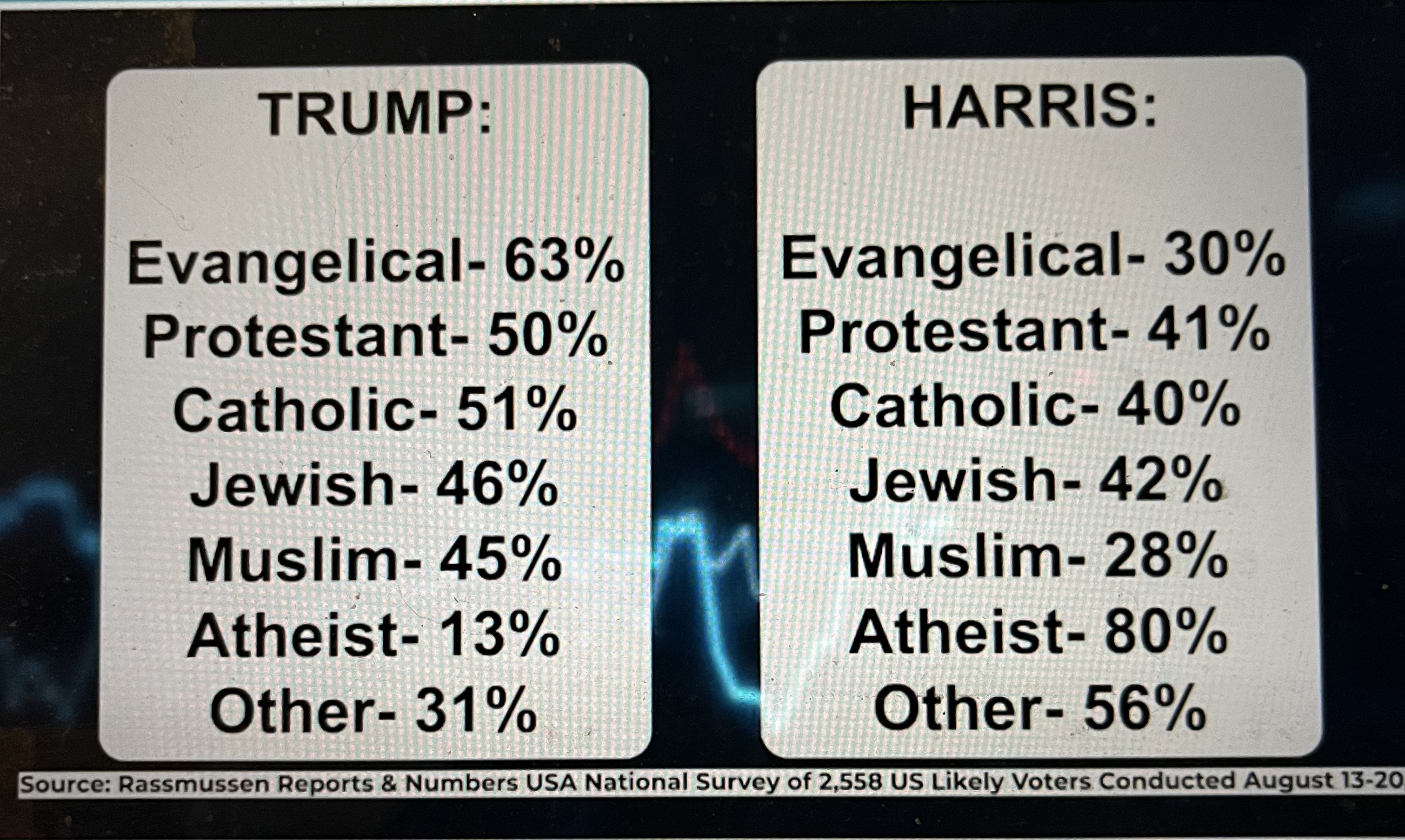
This poll is getting little attention in the media. The only reason I found it is because I was looking for it. Though it is getting little attention, I find it quite revealing in showing there really is a clash of cultures in this election and that clash is between the religious and the non-religious.

Every major faith group (except “other”) is voting in the majority for Donald Trump, and the only group even close to the margin of error is the Jewish faith. “Other” would include Hindu, Buddhist, et. al., and I only assume they were lumped together because the sample size of each was too small to be reliable.

While people of “other” faith backgrounds support Harris, the overwhelming majority of atheists support her. I’m sorry, but that just gives me pause as one who identifies as an evangelical believer in Jesus Christ.

It’s not that I believe Kamala Harris to be a non-religious person. According to Biography.com, she grew up in a black baptist church, has attended Hindu temples (as a result of her Indian heritage) and married a Jewish man. Now, that’s what I call an intersection of faith and politics!

Atheism in the Public Square

When I consider that the “atheists” could be the deciding factor in the most consequential election of our lifetime, I am concerned about the direction of our nation. Every national poll shows this election to be a toss-up (see here and here for two of the most recent). The atheist vote could very well make the difference.

Why do so many atheists support the Democratic Party? From what I’ve been able to discern, it comes down to two things: abortion rights and Christian nationalism. I’d post a few links here on abortion rights and Christian nationalism but you can do a simple Google search and find all the links you need. You’ll be reading for days.

Let me just get this out of the way: I am staunchly pro-life, and that is pro-life in the sense that life begins at conception and that every avenue must be pursued to protect that life. I am also a pragmatist (and not a Christian nationalist) and I believe that the Supreme Court of the United States got it right when they returned the abortion debate to the individual states. That is just one place where my faith informs my politics, and yes, I know it sets up its own clash of cultures. But, I’m just an old white guy, so what do I know?

A “Christian” Nation?

No, I’m not a Christian nationalist (as the term is most commonly defined–it’s a relatively new term, by the way). I do not believe that the United States must be a “Christian” nation, but I do believe that the United States of America was formed (and its underlying foundational documents designed) by people who were Christian, or whose philosophical/ideological perspective were rooted in the Judeo-Christian worldview.

The values and morals that shaped this nation are the values and morals that have their foundation in Scripture. The further we move away from those values as a nation, the more endangered the American experiment becomes…and the more godless the culture becomes. We are far down that road now. I’m wondering if there is a U-turn in our future? I’m wondering if this election cycle will tell us?

Not that Donald Trump is a bastion of Christian morality. His moral failures have been documented copiously, and you can do your own Google search on that, too. Honestly, I believe we are left with the two choices we have for President of the United States BECAUSE we have become unmoored from the Judeo-Christian values upon which this nation was founded.

I also believe the election of Donald Trump won’t provide the U-turn the nation needs to preserve our nation. It might slow it down a little, but it won’t turn it around. The U-turn that matters will happen in the Church through the power of the Holy Spirit. It will take a spiritual revival on the level of the first and second Great Awakenings. It will take prayer and preparation that can only begin in the faith communities of our nation.

The Ripkens

I won’t say who I’ll be voting for in this election. I’ll only say I won’t be voting with the atheists. You can if you want, but don’t come crying to me when we become a completely godless nation. Of course, becoming a completely godless nation might not be such a bad thing. Ask Nik and Ruth Ripken, they can tell you.

The Ripkens were missionaries to Malawi and Somalia, and it was while they were in Somalia that they lost one of their three sons. Their loss forced the Ripken’s to reconsider their calling, and after some reflective time, they were assured they were called to be missionaries, although the focus of their ministry shifted.

They felt called to go into the regions of the world where Christians were persecuted greatest to discover ways they could be in ministry to them. Nik Ripken began by traveling to Russia, China and Central Asia to interview members of the persecuted church.

What he discovered was not that we needed to do anything to help the persecuted church, but that it was his faith that was resurrected by the faithful witness of those Christians. They heard stories of pastors imprisoned and emaciated, yet still clung to their hope in Christ. They heard stories of fathers separated from their families because they smuggled bibles in for others to discover Christ.

In China, he was able to meet with about 150 house church pastors to hear their stories. He said no one really knew what they would find in China. In 1948, when communism came to China, the church was outlawed. At the time, there were between 400,000 and 700,000 Christians.

No one really knew if the church had survived after all these years. Yet, today there are over 10 million Christians in a nation that is openly hostile to their faith. The church flourished in conditions it should not have. The 150 pastors, after telling their stories to Ripken began to ask, “Has Christ made it to the rest of the world?”

What the Ripken’s discovered was that where the church was persecuted the greatest was the very place where faith has thrived the greatest. History has taught the same lesson. The burning question Ripken had for all he interviewed was, “Is Christ worth it?” Is Christ worth the suffering, the imprisonment, the loss of family and even death? As one interviewee said, “Oh, Christ is worth it!”

The lesson for me as I live in this culture that is shifting around me is to ask myself, “Is Jesus worth it?” When all cultural accommodation for the Christian faith ends, will Jesus be worth it? Will Jesus be worth my family? Will Jesus be worth my job? Will Jesus be worth my life?

I pray that I can say, “Oh, Christ is worth it!” My fear is I won’t have the courage.

Until next time, keep looking up…

Perhaps the Problem is Us…

Sometimes, I struggle on these Sunday mornings to find something to write. Other times, I have too much that I want to write and have a hard time knowing what to cull. Today is one of the latter times.

There is an abundance of subjects that I have decided opinions on, but I know I can’t write something on all of them. Based on the stats of these blogs, I can discern that most people want short, quick reads. Sorry. Today probably won’t accommodate you. You are forewarned!

Facebook Jail

I’ll begin by saying that Facebook let my wife out of Facebook jail, so I’ll probably remain on the platform. For those of you who may not know, Facebook put my pretty wife in Facebook jail for a second time.

Seriously, she only posts Bible verses, pics of grandchildren and household projects, but some of the Facebook arbiters found them to be against community standards, so they suspended her. After an appeal, she was reinstated. Guess I’ll stay on a while longer.

That’s probably a good thing. Most folks find the blog through Facebook, although a good number do get email alerts when I publish. I suppose I should try to build my subscriber base by encouraging folks to sign up with email, but I’m not trying to “monetize” the blog so it doesn’t much matter.

However, should you want to receive a notification when I publish, you can like and subscribe below and you’ll be able to find me apart from Facebook.

Now, on to other things on my mind…

Politics is Life

Politics is “top of mind” (as the en vogue saying goes) for almost everyone these days, and so it is for me. This year’s election is seventy-one days away and there is both anticipation and anxiety as that day approaches. We go to the polls seeking to change the direction of the nation, or to stay the course because the circumstances of the nation are such that the majority is pleased with the direction the leadership has set.

This year, we will not “stay the course” necessarily, for we will elect a new president. Some people believe electing one particular candidate will, in essence, be staying the course, though that candidate is doing much to draw distinctions between herself and her predecessor. Others believe electing the other candidate will lead the nation in a new, more prosperous direction.

I’m a bit of a political junkie myself. I don’t try to hide that fact. I don’t (well, not often anyways) make my political views known. You won’t see me (often) posting political articles on social media, promoting particular candidates or particular parties. We’re all in this together and part of our problem is not being able, or willing, to put aside our differences in order to overcome the divisiveness our system finds itself in.

This election cycle is an historic time for our nation. As in the election cycle of 2008 when we elected our nation’s first African-American president, we may this cycle, elect our nation’s first female president. Some say, “It’s been a long time coming,” while others say, “This is not the woman we need to elect.”

The anxiety of the moment is heightened by the cultural circumstances we are experiencing as a nation. Consider these circumstances—a stock market, that while reaching new heights, its volatility is shown by the constant swings from one day to the next, a world economy that still languishes mostly in recession, job market volatility and when we factor in the shifts in cultural values over the past few years, there’s no wonder anxiety is up.

My generation is concerned whether Social Security will be around for our retirement. Healthcare costs, in spite of an overhaul of the system, continue to rise. We have 35 trillion dollars of debt as of this past Friday morning. The Middle East is on fire, there is a war in Ukraine and China is threatening Taiwan. Do we believe a new president will change any of these circumstances?

Perhaps that’s not the appropriate question. Perhaps the appropriate question is “Whom or what do we trust?” Is our trust in a political party? Is our trust in a candidate for president or the government? I am reminded of the words of King David (that’s right KING David) writing in Psalm 20:7—

Some trust in chariots and some in horses,
    but we trust in the name of the Lord our God (Ps. 20:7 NIV)
.

As those who are called to follow Jesus Christ, our hope is in Him and in Him alone. We are citizens of the United States, but we are disciples of Jesus Christ, and if our hope is in the government or a political candidate, it is a misdirected hope.

A Biblical Example

When the nation of Israel left Egyptian bondage and became a nation, Moses and then Joshua was their national leader. They weren’t elected, but rather chosen by God for leadership of the nation. Afterward, God led with a group of judges over the people. There were twelve tribes with different leaders yet they were not united. They had problems working together.

The leadership they did have was corrupt and made poor choices, so the people demanded that God give them a new leader. They wanted a king like all the other nations around them. When things were not going well, the people thought what they needed most was a change in leadership, a new administration, a new structure of government. The people thought: 

“If we just get this new leader everything will be okay. He’ll solve all of our problems. He will protect us from our enemies, he will bring a sense of unity among our divided people (bipartisanship?), he will stabilize our economy, he will provide a new direction, he will provide the change we need.”

Sound familiar? Certainly! Every presidential candidate promises it.

God had a response to the nation in those days. Listen to what God told the prophet Samuel, who was the judge of the nation at the time:

And the Lord told him: “Listen to all that the people are saying to you; it is not you they have rejected, but they have rejected me as their king.As they have done from the day I brought them up out of Egypt until this day, forsaking me and serving other gods, so they are doing to you.Now listen to them; but warn them solemnly and let them know what the king who will reign over them will claim as his rights. (1 Samuel 8: 7 – 9 NLT)

God said the reason people put their hope in new leadership to solve their problems is because they rejected God as their leader. They no longer looked to God as their hope. Sounds a lot like us…

I feel relatively certain Kamala Harris or Donald Trump, believe they will do their best to lead our nation through these challenging times. But, both candidates are human beings and that means they’re flawed…just like the rest of us. God told Samuel to make sure the people knew any leader they chose would have flaws. Did they ever!

The Problem as I See It

The problem wasn’t with the leaders. The problem was with the people. As we survey the landscape of our nation, the problem is not the economy or the culture. The problem is not with terrorism or health care, with crime or poverty. The problem is sin.

We can’t lay the problem at the door of the White House, or the state house. We can’t lay the problem at the door of the courthouse or the school house. We must lay the problem at the door of the church house, and at the door of our house. Simply put, the government can’t fix that problem.

Sin works itself out in many ways. Pride comes to mind. The government can’t fix pride.

Self-centeredness comes to mind. The government can’t fix self-centeredness. Almost no one votes against self-interest. We elect representatives to represent OUR interests. We want representatives who will bring home the bacon to our district, never mind that the interests of our district may stand in direct opposition to the interests of a neighboring district. If they don’t bring home the bacon, we get new representatives. 

The government can’t fix greed. We want more and bigger stuff. We mortgage the future to have stuff we want now. As one cliché states it, “We buy stuff we don’t need with money we don’t have to impress people we don’t like.” The government can’t fix that! Oh, the government can (apparently?) forgive student loan debt, but it can’t change the inner desire for more and bigger and better stuff.

The government can’t fix gluttony. We’re concerned about the escalating costs of health care, yet we continue to overindulge in every guilty pleasure. I’m preaching to myself now. We make poor health choices, fail to exercise and live healthy lives and then want the government to deal with the obesity problem, and heart problems and circulation problems. Don’t shout me down, please! I’m simply pointing out the obvious. 

I love you, but the problem is not with the government. The problem is with us. Our problem is a spiritual problem. Sin comes when we reject God, when we do what is right in our own eyes.

Hope in the Darkness

Perhaps I’ve painted a dark picture with a broad brush, but there is hope. There is a prescription for what ails us. Both political parties talks about the need for change, and promises change, but real change won’t happen with a new leader or new legislation. Real, lasting change will occur when God’s people choose to trust God and turn to Him.

I’m reminded of a most famous Old Testament passage from 2 Chronicles this morning. At the time the passage was written Israel was at its zenith. They had just finished all of King Solomon’s building projects with the high point being the Temple in Jerusalem.

It was a time of great prosperity and peace, and national pride was running high. It was during the dedication of the temple that God gives a warning. God said when the rain doesn’t fall and the locusts eat your crops—in other words—when the nation does into a downturn, this is what needs to happen:

14  “Then if my people who are called by my name will humble themselves and pray and seek my face and turn from their wicked ways, I will hear from heaven and will forgive their sins and restore their land.” (2 Chronicles 7:14 NLT)

The prescription for us and our nation is prayer.

The Temple was to be a reminder of God’s sacred presence among the people.

Were we to read all of King Solomon’s prayer at the dedication of the Temple, we would discover the importance of the practice of prayer in maintaining the nation’s covenant relationship with God. Solomon, and later Isaiah, understood the Temple was “a house of prayer for all nations” (Is. 56:7), and Jesus, himself echoed that sentiment when he drove the moneychangers from the Temple upon his entry into Jerusalem.

Right relationship with God, whether in the Old or New Testament, is rooted in prayer. Understand though, that prayer is not effective because of our righteousness, but because of the power possessed by the One to whom prayer is offered.

What was once true of a building in Jerusalem is now true of a body…the body of Christ, the Church. The Apostle Paul states it this way: 

19 “Or do you not know that your body is the temple of the Holy Spirit who is in you, whom you have from God, and you are not your own? 20 For you were bought at a price; therefore glorify God in your body and in your spirit, which are God’s.” (1 Corinthians 6:19 – 20 NLT)

We bring glory to God when we pray. We cannot pray without humility. Humility is nothing more than acknowledging our dependence upon God.

F.B. Meyer said, “I used to think that God’s gifts were on shelves one above the other, and that the taller we grew in Christian character the easier we could reach them. I now find that God’s gifts are on shelves one beneath the other. It is not a question of growing taller, but of stooping down, to get His best gifts.”

Humility brings us to God, and our coming gives Him glory.

There is no effective prayer without devotion. That’s what it means to “seek” God’s face. Worship, generosity and service are tangible ways we show our devotion. It also means seeking God’s will for every area of our lives, and passing the faith to our families and communities.

There also is no effective prayer without repentance. Both the Old and New Testament words for repentance mean “to turn.” It means a change of direction from sin and toward God—an about-face, if you will.

Repentance is a faith response to God’s offer of forgiveness. We believe God will forgive, therefore we turn to him. When we repent of our sin—our pride, our self-centeredness, our greed, our gluttony and our idolatry—then, we’ll see the power of God revealed in Jesus Christ. We’ll find the help for which we search.

Prayer has the power to fix our problems because prayer brings us into the sacred presence of God Almighty, and it is God’s power in Jesus Christ that heals and forgives and reconciles all that is broken…in this nation…in every nation…     

Here’s our challenge: to humble ourselves before God, seek His face and repent of all that separates us from Him and from each other.

Join me as I pray for our nation, for the election and those leaders who have offered themselves to lead us.

That’s as neutral as I can be these days, though I believe the cultural moment demands that the disciple of Jesus Christ be something other than Switzerland.

This post is already too long and I’ve still got too many things I want to write. I’ll just stop now by reiterating: Pray, pray, pray!

The problem really is with us.

Until next time, keep looking up…

Seventy-eight Days to Choose…

Seventy-eight days. That’s how long it is until we choose the person who will lead our nation for the next four years. As I’ve gotten older, I’ve discovered that seventy-eight days is no time at all. What are we, as Christians, doing to be ready to choose the right leader?

I know! Our choices aren’t great, but then again, we probably get the leaders we deserve. I just have to ask: What have we done to deserve the choices we have? Sorry! Don’t answer that question. It is rhetorical.

Most people reading this have probably already made up their mind about the choice coming in seventy-eight days. Without becoming too political, let me take this opportunity to offer biblical four characteristics to look for in choosing our next leader.

Four Biblical Characteristics

What are the four characteristics? Humility, capability, responsibility and accountability.

Jethro & Moses

Let me start by calling to mind a conversation between Moses and Jethro in Exodus 18: 13 – 27 (click here to read the entire conversation). To set the context of Jethro’s conversation, it’s been just over a month since Moses led the people out of Egyptian bondage and Pharaoh’s oppression. In that time, they’ve seen God deliver them through the Red Sea, provide water from a rock and God is feeding them daily with manna and quail. They’ve also just won a military victory over a people group called the Amalekites.

Jethro gets word of all God has done for Moses and the people, so he takes Moses’ wife and two sons, loads up and prepares to take them back to Moses. At some point before going down to Egypt, Moses had sent them to live with Jethro while he went off to do God’s work.

Jethro arrives, they catch up on all the events since they were last together and had a party and a worship service to celebrate. The next day, Moses goes out to do what he always does…hear the complaints of the people against each other…he sits in judgment, day after day, deciding all the petty (and not-so-petty) complaints of over 600,000 men, not including women and children.

Humility

Jethro immediately notices a problem, so Jethro (verse 14) says, “Why are you trying to do this alone?” Jethro, in asking Moses the question, is trying to give Moses a lesson in humility. Humility is perhaps the greatest quality to look for in a leader. The original Hebrew spoken by Jethro leaves the impression that he sees Moses acting like a King over the people.

Moses considers himself uniquely qualified to judge the people and their issues, almost like he’s God’s partner in this deal. That’s the strength of the language in the text.

Jethro says, “That’s not good!” Basically, he’s saying, “Get over yourself, Moses. You’re killing yourself and you’re killing the people trying to do this alone.” It was a matter of respect. The whole tone of the conversation indicates that Moses’ ego was getting in the way of what is best for the people and for himself.

Egotistical leadership is devastating to any organization. Granted, it takes a pretty big ego for someone to run for President, or any other office, for that matter, but ego that is not tempered with humility is egomaniacal and is ultimately destructive.

There is a fantastic visual image contained in this entire episode, and it has to do with humility, and the power of humility.

The encounter begins with Moses sitting to judge the people, and the narrative indicates he’s sitting because he’s worn out. Jethro offers his advice and says, “If you do this, you’ll be able to “stand up” under the pressure.” It’s Jethro’s way of saying, “If you humble yourself and relinquish some leadership, you’ll really find yourself standing over the people instead of the people standing over you.”

That’s exactly what Jesus said, too.  In Luke 22: 24 – 30, his disciples were discussing who would be greatest among them. When they arrived at the house, Jesus asked what they were discussing, though he already knew. They didn’t answer him, but he sat them down and said “If anyone wants to be first, he must be last of all and servant of all.” Servant leadership is a Kingdom principle. It’s driven by humility.

The cause that must be served is far greater than any one leader or individual. What’s true in business is also true in government, and in churches, and at home. No one leads alone. A leader needs the humility to acknowledge their own limitations.

Capability

A second characteristic I see in choosing leaders wisely is capability. We need leaders who are capable of leading us.

Jethro recognizes the necessity of leadership on different levels. Part of that capability has to do with honesty and integrity. We could make these their own traits, but they are what make a capable leader.

When I talk about honesty and integrity, I cringe when I look at the candidates we have to choose from. Of course, it’s nothing new. The effects of Huey Long’s patronage system are still felt in Louisiana today, and history reminds us of the corruption of Tammany Hall in New York City throughout the nineteenth and early twentieth centuries, and of the long history of alleged corruption in Chicago politics.

Politics and corruption seem to go hand in hand. Jethro reminds Moses that at the heart of capability are honesty and integrity.

Jethro told Moses to identify capable leaders and appoint them judges over thousands, hundreds, fifties and tens. Different leaders must fill different roles. Moses learns there are different levels of leadership, and each leader must fill the role he/she is uniquely gifted to fill.

We’re all leaders, we simply lead at different levels. Let’s face it…there are politicians who are great politicians at the local level but would be terrible at a higher level. One question we should ask of those running for public office, or seeking a leadership capacity is “Are they capable of fulfilling the role?” Not every leader is equipped to fill every role; choices must be made based on the individual’s gifts, skills and talents.

I experienced this as a District Superintendent for the United Methodist Church. The church is led by a great number of gifted pastors, but honestly, not every pastor is suited to be the pastor of a large church, and there are pastors whose giftedness far exceeds the level of church they currently serve.

There are fantastic pastors in small churches, but it would be disastrous for some of them and for the church to be appointed to a large church. There are natural born leaders who simply have the charisma to continually lead up, but there are equally gifted leaders capable and competent to lead on a smaller scale.

There are many leadership skills that are teachable. Parents are leaders, even though they may only lead one other person, and parents can be taught to be better leaders. The same with managers is true. Leadership skills can be taught, nurtured and developed, and a leader’s capability can be increased, but for many there is a ceiling. That doesn’t matter. They’re still leading, and can be great leaders, as long as they’re leading at their level of capability.

We need to be asking the question, “Which of these two candidates is capable of leading our nation right now?” The answer is obvious to me, but you have to answer the question in your own heart and mind.

Responsibility

A third characteristic I see in Jethro’s advice is that of responsibility. When we choose leaders, we must be willing to let them lead. We can’t extend leadership responsibility and then micromanage their efforts. We’ll destroy their spirits and we’ll undo the good that could be done through their efforts.

Jethro makes it clear to Moses that if you’ll follow this advice…identify leaders and let them lead…then Moses will be able to stand up under the pressure and the people will return in peace. Sharing power is what God wants and what God expects. It is truly a holy act.

Accountability

Are we willing to allow the leaders we choose to actually lead us? We must follow their leadership unless and until they prove they’re not capable, and that brings me to the final characteristic I see, and that is accountability.

Responsibility is nothing without accountability. Verse 24 says that Moses listened to his father-in-law’s advice. He submitted himself to the accountability offered. He was willing to be confronted with the cold, hard facts, and he demonstrated the humility to receive Jethro’s “constructive criticism.”

Okay, so there is one candidate who doesn’t often take constructive criticism well. I’m not sure about the other one yet, although a staff turnover rate of 90+% isn’t encouraging. Like I said…our choices aren’t great.

We should choose leaders who are willing to be held accountable. One of the great things about the American experiment is the “checks and balances” of the three branches of government. Part of the problem of governing by executive order is it circumvents the accountability component. But, then again, every four years, or two years, or six years as the case may be, is the election cycle. The accountability of the ballot box is always the accountability of last resort in the civic arena.

We, too, if we desire to be godly leaders, should submit ourselves to accountability. John Wesley was so concerned with building a righteous fellowship that he devised a series of questions for his followers to ask each other every week. Some found this rigorous system of inquiry too demanding and left.

Rev. Chuck Swindoll

Today, the very idea of such a procedure would horrify many disciples, yet some wisely follow just such a practice. Chuck Swindoll for example, has seven questions that he and a group of fellow pastors challenge each other with periodically:

1. Have you been with a woman anywhere this past week that might be seen as compromising? 
2. Have any of your financial dealings lacked integrity? 
3. Have you exposed yourself to any sexually explicit material? 
4. Have you spent adequate time in Bible study and prayer? 
5. Have you given priority time to your family? 
6. Have you fulfilled the mandates of your calling? 
7. Have you just lied to me?

Genuine accountability is transformative. Moses followed Jethro’s advice, and his life and the lives of his nation were transformed.

Everything rises or falls on leadership. If we choose leaders who demonstrate humility and capability, granting them responsibility and expecting accountability, then we’ll have leaders that will serve the greater good and perhaps, even grow the Kingdom of God.

I am thoroughly convinced that neither of the candidates running for President of the United States measure up to these characteristics. We Christians have a lot of praying to do over the next seventy-eight days. May God grant us the grace to do the best we can with the choices before us.

Prayer. Hmmmm? Now there’s an idea. Perhaps I’ll blog about that next week.

Until next time, keep looking up…