A Crown or a Cross?

What Palm Sunday Teaches Us About Shattered Expectations and True Faith

This Sunday is Palm Sunday—the day we remember the crowds waving palm branches and shouting “Hosanna!” as Jesus rode into Jerusalem. But here’s what haunts me every year: Less than a week later, many of those same voices were shouting “Crucify Him!”

How does a crowd go from crowning a King to demanding His death in just a few days? And what does that say about us when God doesn’t meet our expectations?

On Palm Sunday, we often focus only on the triumphal entry. This year, let’s do something different. We’ll look at Mark’s account of Jesus entering Jerusalem—and then jump straight to the trial before Pilate on Good Friday. In less than a week, the same city saw the crowd shift from “Hosanna!” to “Crucify Him!” They began the week expecting a crown. They ended it demanding a cross.

The Triumphal Entry (Mark 11:1-11)

As Jesus approached Jerusalem, riding on a young colt, the crowd erupted in praise straight from Scripture:

Hosanna! Blessed is he who comes in the name of the Lord! Blessed is the coming kingdom of our father David! Hosanna in the highest!” (Mark 11:9-10, quoting Psalm 118)

They spread their cloaks and leafy branches on the road, anointing Him as King in a festal procession. These weren’t outsiders. They were good, religious people who knew and loved the Word of God.

From “Hosanna” to “Crucify Him” (Mark 15:1-15)

Fast-forward to the trial before Pilate. The chief priests, elders, scribes, and the crowd—still religious people—now cried out, “Crucify Him!” They chose Barabbas, a rebel and murderer, over Jesus.

In just days, their cheers turned to condemnation. Why?

They knew the Scripture… but they did not understand the Word made flesh standing before them. They wanted a crown on their terms—a political deliverer who would overthrow Rome and restore Israel’s glory immediately. When Jesus refused to fit their expectations, their hearts turned.

The heartbreaking truth is that both crowds were driven by the same root issue: Jesus shattered their expectations.

The Same Struggle Today

If we’re honest, the same thing can happen to us. Many of us are “good, religious folks” who love the Bible and love Jesus. We pray for healing, deliverance from addiction, or for our children to come home—expecting the crown of quick answers and comfortable outcomes.

When God says “no,” or “not yet,” or when the cross of suffering comes instead of the comfort we wanted, our hearts can waver just like that first-century crowd.

Yet here is the wonder of the gospel: God’s “no” to our agenda is often His greater “yes” to a better, eternal life—resurrection life. He does not abandon us to our sin or our pain. He uses even the hardest things to redeem us.

The very thing we think will destroy us, the Lord uses to shape us.

Jesus Knows the Pain of “No”

Remember Jesus in the Garden of Gethsemane, praying, “Let this cup pass from me.” Even the Son of God asked for a different way, and heaven was silent. Not because the Father didn’t love Him, but because the cross was the only way to save us.

That temporary “no” from the Father became our eternal “yes.” Because Jesus went to the cross, the crown comes through the cross—one of the beautiful paradoxes of God’s Kingdom.

Our God is a big-picture God. As He declares in Isaiah 46:10, “I make known the end from the beginning, from ancient times what is still to come.” He sees the whole story. We see only the painful circumstances right in front of us. But He is already turning our “no” into resurrection victory.

What This Means on Monday Morning

When the medical scan comes back worse, when the phone call brings bad news, or when the prodigal still hasn’t come home—what then?

We have a daily choice: Will I demand the crown on my terms right now, or will I trust the King who leads through the cross?

Here are four practical steps when your expectations are shattered:

  1. Name the disappointment honestly to God. Jesus did this in Gethsemane—pour out your heart without pretense.
  2. Remember you are not abandoned. The same God who said “no” to His own Son is working something far greater than we can see.
  3. Choose to worship anyway. Sing “Hosanna” even when you don’t feel it. Sunday is coming.
  4. Cling to your baptism. Those waters marked you as belonging to the King whose crown came through the cross.

When you feel your heart beginning to waver like that ancient crowd, run back to the cross and whisper, “Lord, I don’t understand, but I trust You. You are still King of kings.”

We Are Barabbas

Nowhere is this clearer than at the trial before Pilate. The crowd was given a choice: Jesus or Barabbas. Barabbas was exactly what they wanted—a man of action promising quick deliverance. Jesus was what they (and we) needed—the innocent Son of God who would take their place.

They chose Barabbas. And Jesus took Barabbas’s place on the cross.

We are Barabbas. We are the guilty ones who deserve judgment, yet because of Jesus we go free. He took our place so that our temporary “no’s” could become God’s eternal “yes.”

We want a quick, revolutionary fix. Jesus offers sacrificial love. We want a crown on our terms right now. Jesus gives us the cross that leads to the crown of life.

The Crown That Comes Through the Cross

One day, the same Jesus will return riding a white horse. On His robe and on His thigh will be written: “King of kings and Lord of lords” (Revelation 19:16). The crown of thorns becomes the crown of glory. The cross was never the end—it was the path to His eternal reign.

The crowd had a choice: a crown or a cross. Which choice will we make?

Until next time, keep looking up…
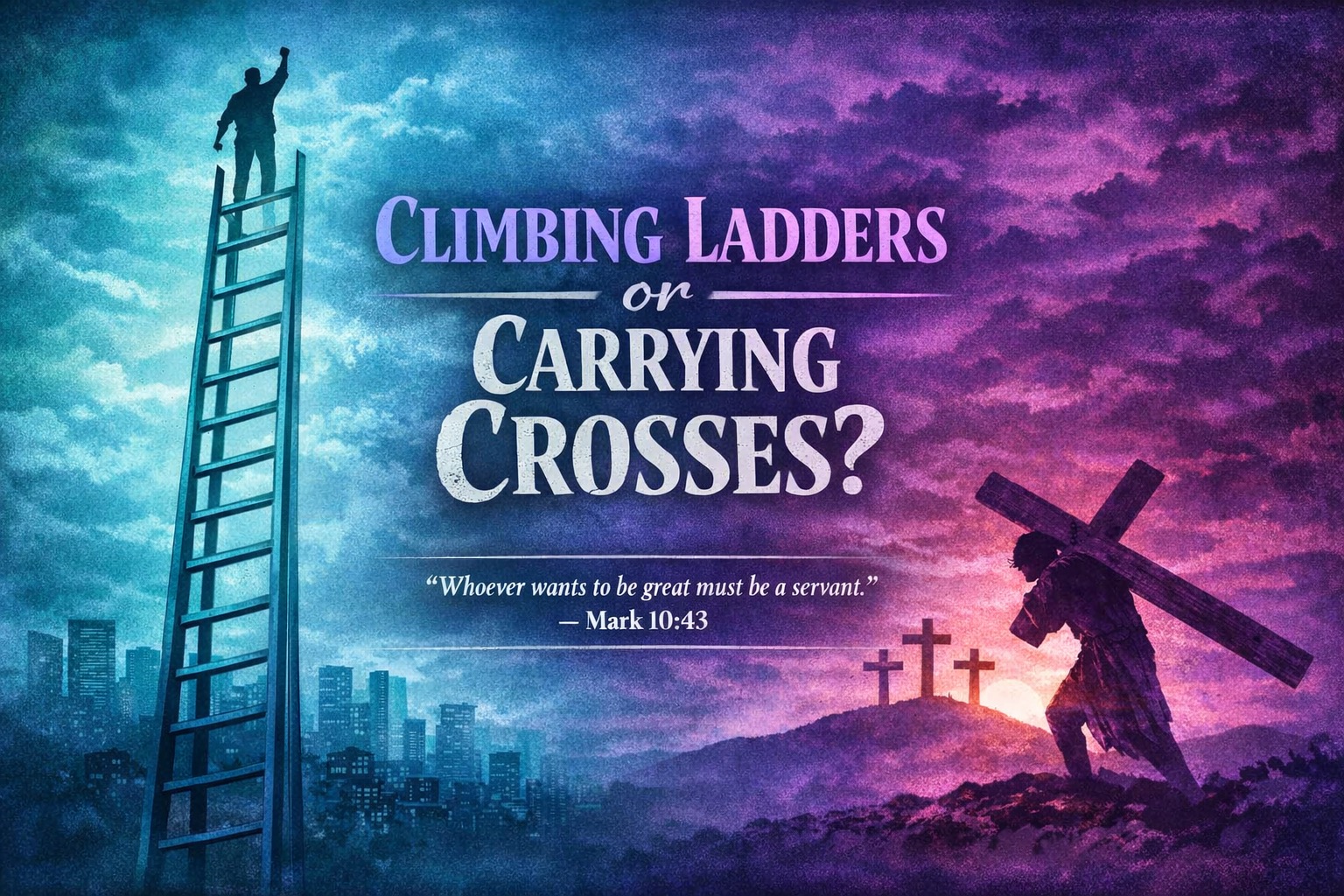
Climbing Ladders or Carrying Crosses…

Here’s what I’ve been wrestling with all week…Mark 10:35-45.

If James and John—the Sons of Thunder—showed up in our church today asking Jesus for the VIP thrones in His kingdom, what would we say?

We might high-five their ambition. “Guys, you’ve got vision! That’s the drive we need.” We’d probably hand them a leadership book and say, “Keep climbing—sacrifice a little now to go up later.” 

In business, politics, and even too many church circles, we celebrate the climbers. Success looks like ascending the ladder.

But Jesus doesn’t applaud them. Right after predicting His own suffering and death—for the third time—He responds, in essence: “You have no idea what you’re asking.”

This passage in Mark 10 turns my idea of leadership upside down. Here’s where I’ve landed this morning: Kingdom greatness doesn’t climb ladders. It descends—through service, sacrifice, and ultimately the cross.

The World’s Way

James and John approach Jesus: “Teacher, do for us whatever we ask… Grant us to sit, one at Your right hand and one at Your left, in Your glory.” Thrones. Honor. Prime seats.

These are the same disciples who once wanted to call down fire on a rejecting village (Luke 9:51-56). Ambitious? Yes. Evil? Not really—just blinded by the world’s definition of success. And the timing stings: this comes immediately after Jesus warns them again about His coming rejection, death, and resurrection.

Jesus doesn’t scold. He asks, “Are you able to drink the cup I drink, or be baptized with the baptism I’m baptized with?” The cup is suffering. The baptism is immersion in pain and death.

They boldly reply, “We are able.” Jesus affirms they will share in that suffering (James martyred, John exiled), but the seats aren’t His to grant.

The other disciples hear and get indignant—jealousy erupts. Sound familiar? We’ve all wrestled with “Who’s the greatest?” in our hearts, families, workplaces, or churches.

Jesus gathers them and contrasts the world’s model: “You know that those considered rulers of the Gentiles lord it over them… But it shall not be so among you. Whoever wishes to become great among you shall be your servant, and whoever wishes to be first shall be slave of all.

In the world, leaders climb ladders. In the Kingdom, leaders carry crosses.

It’s one thing to wash feet. It’s another to carry a cross.

We read good leadership books—even Christian ones. John Maxwell’s Law #18 says a leader must give up to go up. Helpful principle. But for Jesus, sacrifice isn’t one law among many—it’s the only law. “Going up” isn’t the goal. Going down is.

The Jesus Way

Jesus doesn’t just teach this. He embodies it:

For even the Son of Man came not to be served but to serve, and to give His life as a ransom for many.” (Mark 10:45)

The Son of Man—with all authority—didn’t come to be waited on. He came to serve. And the ultimate service? Laying down His life to ransom captives free. That’s the Suffering Servant of Isaiah 53.

Paul captures the full descent in Philippians 2:

Have the same mindset as Christ Jesus: Who, being in very nature God, did not consider equality with God something to be used to his own advantage; rather, he made himself nothing by taking the very nature of a servant… he humbled himself by becoming obedient to death— even death on a cross! (Philippians 2:5-8)

The cross doesn’t just save us. It shapes us—how we live, serve, and lead.

A Little Confession

This passage has confronted me hard during Lent. For years in ministry, I climbed the ecclesiastical ladder. I started wanting to help people (that’s why I left law enforcement for pastoring—more room for grace). But I brought worldly expectations: success meant bigger churches, bigger roles, maybe even bishop.

The Church encouraged it—leadership seminars, conferences, principles adapted from the world. I rose to District Superintendent, then a large church. I eyed the next rung.

And yes, jealousy too—just like the disciples. Seeing others promoted to “big” churches, I wondered, “Why not me? Why hasn’t God blessed me that way?”

Lent is for repentance. Jesus never tires of leading us home. By grace, He’s reshaping that ambition in me—not perfectly, but continually.

What About You?

Everything rises or falls on Mark 10:45. Jesus didn’t climb a ladder—He descended to the cross so we could be set free. That ransom wasn’t for our comfort or status; it was so we could become like Him: servants who lead by laying down our lives.

So here’s the question: Will you lay down the ladder you’ve been climbing? Maybe it’s ambition for recognition in your family, workplace, church role, or your own heart. Will you pick up your cross instead—not dramatically, but in daily choices: to serve rather than be served, listen rather than demand, give rather than grasp?

The same John who chased thrones later wrote: “This is how we know what love is: Jesus Christ laid down his life for us. And we ought to lay down our lives for our brothers and sisters” (1 John 3:16).

If God transformed him, He can transform us.

Here is the prayer I’ve been praying all week: “Lord, I lay down my ladder. I pick up my cross. Reshape me like You.”

Would you pray it with me? Share your thoughts in the comments—I’d love to hear and pray with you.

Until next time, keep looking up…

(If this stirred something, feel free to share it. Lent is a season for turning toward the cross together.)

Finding the Perfect Church…

It’s been FIVE years since I stepped away from full-time vocational ministry. For parts of those five years my wife and I were church “homeless.” That’s right! We didn’t have a church home. We became church shoppers…looking for the perfect church.

The sad thing? We haven’t found one. The sadder thing? I uttered a lot of the same excuses I heard other people utter in my 28+ years in vocational ministry.

Making Excuses

Perhaps you’ve heard some of these excuses. Perhaps you’ve made some of these excuses if you’ve ever been church “homeless.” Perhaps you’re saying some of these things right now if you’re currently church “homeless.” What are those excuses?

  • “This church is too small…”
  • “This church is too large…”
  • “There aren’t any children here…”
  • “There are too many children here…”
  • “The youth group is too small…”
  • “The youth group is too large…”
  • “The youth pastor is too (well, there are a lot of things we can say about youth pastors!)…”
  • “There’s no youth group…”
  • “I don’t like contemporary music…”
  • “I don’t like traditional music…”
  • “The music is too loud…”
  • “There are too many old people…”
  • “The pastor’s sermons aren’t good…”
  • “The pastor doesn’t know me…”
  • “I don’t like the pastor…”
  • “I’m not being fed…”

That is certainly not an exhaustive list of excuses I’ve heard through the years. You could add your own. The problem with church shopping is that it betrays an appropriate understanding of what the church is, and it feeds into our consumer mentality–the fact that we have become “consumers” of religion.

Going to church should not be like going shopping. I’m going to church to find what I need and I’ll keep shopping until I find it. Looking for a church that “I” like is one of the most selfish endeavors on the planet. Oh, and it is also one of the most un-biblical, too!

Reasons to “Church Shop”

Actually, there are very few reasons we should be church “homeless.”

One reason is because we’ve moved to a new community. A job or career change takes us to a new community and we’re forced to move away from our current church home.

Another reason is a change in our relationship status, i.e., we got married or divorced or remarried. The change in relationship affords a new opportunity to go to church with the other, or to begin again with the other.

Yet another reason to leave a church is because the church has abandoned orthodoxy. This is the primary reason that Vanessa and I were church homeless. I don’t intend to get into a discussion here about orthodoxy or my former church home. That can be for another time, but suffice it to say we believed (and still believe) that our former church home abandoned the “faith once delivered to all the saints.” We could be wrong (I often am!), but apparently a lot of other people agree with me.

I’ve gone a long way out of the way to say, “Stop looking for the perfect church. You’re not going to find it!” What’s the old saying? If you find the perfect church, don’t go! You’ll mess it up! Actually, that’s not true. You can’t mess up what’s already messed up. There is NO perfect church. Looking for one missed the point entirely.

The Uncomfortable Church

When we look for the perfect church, we usually mean the perfect church for us. We mean we want a church that meets my needs. We want to be with people who generally look like us, who generally act like us, who generally make the same amount of money as we do, who are in the current life stage we are in, etc. What we really mean is we want a church where we can feel comfortable.

Guess what? Church is not about our comfort. Guess what? We’re supposed to be uncomfortable in church! We’re supposed to be uncomfortable with our sin because we are in the presence of a holy God.

We’re supposed to be uncomfortable because there are people in church who aren’t like me. We’re supposed to be uncomfortable in church because the teaching challenges me to be transformed.

We’re supposed to be uncomfortable in church because I’m being asked to surrender myself…my wants…my likes…my dislikes…my desires…all of me…to Jesus and to one another.

Dang! All of that makes me uncomfortable. Welcome to the perfect church!

I kind of think that’s what the Apostle Paul had in mind when he wrote the Ephesian church in its infancy:

12 …remember that at that time you were separate from Christ, excluded from citizenship in Israel and foreigners to the covenants of the promise, without hope and without God in the world. 13 But now in Christ Jesus you who once were far away have been brought near by the blood of Christ. 14 For he himself is our peace, who has made the two groups one and has destroyed the barrier, the dividing wall of hostility, 15 by setting aside in his flesh the law with its commands and regulations. His purpose was to create in himself one new humanity out of the two, thus making peace, 16 and in one body to reconcile both of them to God through the cross, by which he put to death their hostility.  (Ephesians 2: 12 – 16 NIV)

Making Us One in Christ

One humanity out of the two. What two? Jews and Gentiles. Let’s face it. In the first century, Jews and Gentiles did not like each other very much (understatement!). Yet, they were called by Christ to be together…to worship together…to serve together…to love God together…and…wait for it…to love one another together. Talk about out of their comfort zone! That’s exactly where Christ is calling us to be and it is exactly what Christ is calling us to do.

Imagine how evangelistic it is for the world to see people who are normally at each other’s throat worshipping and serving together. The world sees it and they wonder, “How can that be?” It is through this imperfect church that the world (and we) see how powerful and amazing His grace is to save a bunch of people who really don’t like each other.

Don’t go looking for a church online. Yeah, I know. We look for the Google reviews when we’re looking for a church home. Why go to a four-star church when you can find a five-star one? Let me remind you that church health can’t be measured by Google reviews.

Yes, I know that when you’re shopping for a new church home that you’ve already watched the sermons online and you’ve perused the church website or Facebook page. It’s what we do.

Do you really want to grow in Christ? Then, how about go to the church that doesn’t have an online presence? Yeah, preacher, you’re really stretching it now!

Do you really want to grow in Christ? Then how about look for the church home that you’ll probably like the least…that is least like you. Perhaps that is where real growth will occur, and maybe…just maybe…that’s because it is as Jesus intended it.

Yeah, I don’t know, either. I’m really just processing my own church homelessness over the past five years. Perhaps my processing it will help others get off the couch and find their new church home and will give them pause while they do. Then again, maybe not.

Finding a new church home is not about “me.” It is about finding Jesus, loving Him and loving one another. THAT is the perfect church.

Until next time, keep looking up…

Palm Sunday Ponderings…

It is Palm Sunday. You know what that means? Yes, it is marked as the day Jesus made His triumphal entry into Jerusalem before His arrest, crucifixion and resurrection. It is such a pivotal moment in Jesus’s life that all four Gospel accounts mark the event (Matthew 21: 1-11; Mark 11: 1-11; Luke 19: 28-40; John 12: 12-19).

You know what else it means? It means that Lent is almost over! As I’ve mentioned before, this has been a challenging Lenten season for me and I can’t wait for Easter Sunday. The season began without much fanfare for me. I was quite willing to let it pass without much notice. The Lord had other plans. It’s been a good Lent, albeit a very challenging one.

The challenges of the Lenten season have been numerous, and this past week has been no different. The Lord has particularly challenged me in the area of prayer this week. I think I’ve discerned that in this season of the Church’s life, the greatest need is for prayer warriors.

The Church doesn’t need CEO’s and entrepreneurs. It needs prayer warriors. The Church has tried the CEO/Entrepreneur model (really since the 1970’s and the emergence of the Church Growth Movement). As was its purpose, the CGM got the Church a lot of megachurches. The CGM is proof that strategies work. It also go the Church a lot of Christian celebrities and celebrity pastors. I’m not knocking the CGM. I was on that train for a long time. I rode that train until it ran ME out of steam. Now, I think the steam is finally running out of that train for the Church.

Though the CGM got the Church a lot of megachurches and celebrity pastors, it also got the Church declining attendance and fewer disciples who are willing to take up their cross and follow Jesus in the way of surrender and sacrifice. There are some who will blame the free fall in church attendance on the Covid pandemic, but I suggest the pandemic only hastened what was clearly already taking place in the life of the Church. CEO’s and Entrepreneurs cannot sustain the Church. They were never intended to. Though megachurches do show up in many places around the world, they are a uniquely western invention.

The Church (and the world) are in desperate need of revival. Revival always starts with prayer, thus the greatest need of the Church in this culture is for prayer warriors. The Church needs leaders who pray–both lay and clergy. Leaders who pray will bring change to the Church, and the Lord will use the Church to change the world. That’s been His plan from the beginning.

Makes me ask the question “How many churches have a prayer ministry?” When I say prayer ministry, I’m not talking about a prayer group that meets and prays over the prayer requests that come into the congregation. I am NOT discounting the need for that type of ministry, nor am I denying there is power in that type of prayer. Unfortunately, most of those type of groups (and most of that type of prayer) are really just gossip sessions disguised as prayer groups. There is some value in praying for Aunt Sally’s ingrown toenail or Uncle Joe’s gout, but that is not the prayer that will change the world.

When I say prayer, I mean gathering for an intentional time of seeking God’s face…of the people of God asking God what His will is, asking the Lord for His vision, gathering to actually hear from the Lord. I mean the people of God coming together to confess their sin (individually and collectively) and to repent before Him publicly so that grace and forgiveness is sought and found so that the way is cleared for a fresh invasion of the Holy Spirit can bring clarity and direction to His people concerning His vision.

How about a prayer meeting where we pray for boldness to proclaim the Gospel? How about a prayer meeting where we pray for the Lord to put people in our path who need healing and salvation? How about a prayer meeting where we read one verse of Scripture and then sit silently for an hour pondering that singular passage to hear what the Lord wants us to hear?

Yeah! That would probably be too uncomfortable for too many people. But, hey! We’ll never grow until we get out of our comfort zone. Just as our physical muscles won’t grow until we push past what we think are our limits, so our spiritual muscles won’t grow until we push past what is comfortable and easy.

I’ve lived with a great amount of conviction over this Lenten season as I’ve reflected on my own participation in and leadership of prayer group gossip sessions. I need to repent for that. I hope I have repented for that. Prayer in my congregation won’t change until prayer changes in me. Revival won’t come to the Church until revival comes in me.

So, my prayer is for revival to come…to the Church and to the culture…but first, let revival come to me. Let me pray to hear the voice of God. Let me pray for boldness to proclaim the Gospel. Let me pray for people in my path who need Jesus. Let me pray for a revival in me. Let me pray for a transformation in my attitudes and desires and priorities. Then, perhaps I can begin to pray for each of those for the Church and the culture.

The Church and our culture…our world…are in desperate need of revival. So am I! The Church and our world are in desperate need of prayer warriors who will pray for the same. I pray I can become one of those warriors. Do you have the guts to pray the same prayer?

And you thought this was going to be a blog about Palm Sunday. Silly you!

Until next time, keep looking up…