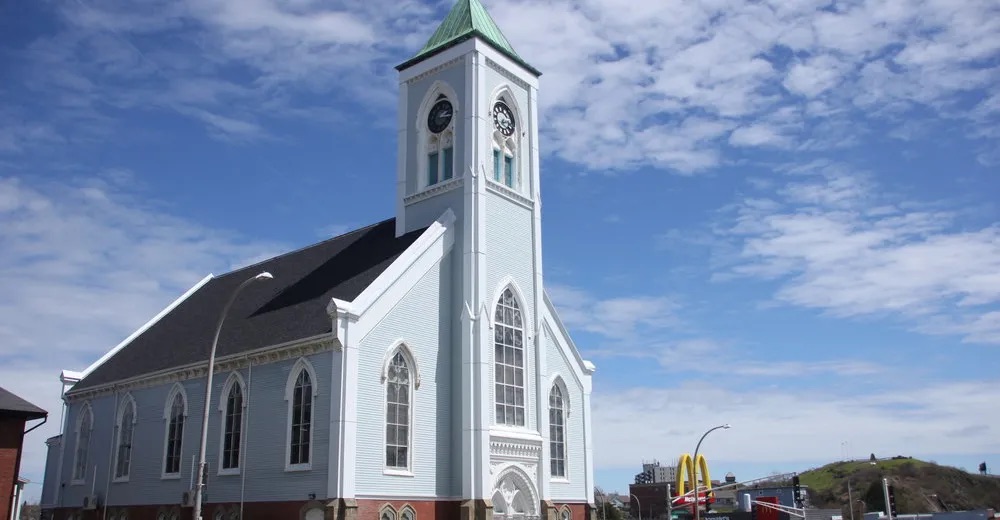
The Church of Jesus Christ is always on the move, and today the Haughton Global Methodist Church begins worship in its new home. It is a new place and a new space and I know the congregation is excited about worshipping for the first time in this new place.
The space is located at 966 Highway 80 in Haughton, LA. It was a church in one of its former lives, but it has been a physical therapy office in its most recent life. We will re-consecrate the space this morning at 10:30 a.m. for use as a place of worship, and I’d love to invite you to join us if you’re in the Haughton/Bossier City area.
I need to commend the congregation on its hard work over the past month in getting the space ready to occupy. Countless hours of service have gone into the process of converting the space back to its original purpose. Let me say, “Thank you” to all those servants who have been so diligent (and so generous) in doing what was necessary to accomplish the task. Great work!
Today will be my first opportunity to see the space after all the work is completed (will it ever really be completed?). I’m excited to see it and to lead worship for the first time in this new place. I’m excited to see all that the Lord has planned for the space and for the congregation.
I’m looking forward to getting to know the Haughton community in a deeper way. It’s going to be a challenge for me as a bi-vocational pastor, but I pray the Lord opens doors and provides opportunities for the congregation to grow and flourish in the community. I covet your prayers for the congregation, too.
Perhaps this new space in this new place will be an encouragement for new people to explore the Kingdom of God. Maybe there are those in the Haughton/East Bossier area who have been waiting for a new place and I pray the Holy Spirit will open their hearts to take a step of faith in hearing His call to salvation in their lives. Would you pray that prayer with me, too?
This new space and new place is located right next door to an oil change place. I find that only a little humorous and ironic. I spend six days a week at an oil change place and now I’ll be leading worship next door to an oil change place. Providential? Who know? I’m just trying to figure out ways we can be a good neighbor. I must confess that I’m also trying to figure out ways to use it evangelistically. We’ll pray the Lord opens doors for both to occur. Will you pray that prayer with us?
Anyway, my blogs may become less frequent now. Most of my Sunday morning time will be spent preparing for worship. They may even be spent finishing the message for that day. Of course, that’s happened before. Either way, the Lord’s got this. The Lord guided us into this, and I know that where the Lord guides, the Lord provides. I’m anxious to see how He does so in this case.
So, that’s all for this week’s blog. I don’t know when the next one might be written, but I’m anxious to see the story He is writing in the life of the Haughton Methodist Church.
It’s been FIVE years since I stepped away from full-time vocational ministry. For parts of those five years my wife and I were church “homeless.” That’s right! We didn’t have a church home. We became church shoppers…looking for the perfect church.
The sad thing? We haven’t found one. The sadder thing? I uttered a lot of the same excuses I heard other people utter in my 28+ years in vocational ministry.
Making Excuses
Perhaps you’ve heard some of these excuses. Perhaps you’ve made some of these excuses if you’ve ever been church “homeless.” Perhaps you’re saying some of these things right now if you’re currently church “homeless.” What are those excuses?
“This church is too small…”
“This church is too large…”
“There aren’t any children here…”
“There are too many children here…”
“The youth group is too small…”
“The youth group is too large…”
“The youth pastor is too (well, there are a lot of things we can say about youth pastors!)…”
“There’s no youth group…”
“I don’t like contemporary music…”
“I don’t like traditional music…”
“The music is too loud…”
“There are too many old people…”
“The pastor’s sermons aren’t good…”
“The pastor doesn’t know me…”
“I don’t like the pastor…”
“I’m not being fed…”
That is certainly not an exhaustive list of excuses I’ve heard through the years. You could add your own. The problem with church shopping is that it betrays an appropriate understanding of what the church is, and it feeds into our consumer mentality–the fact that we have become “consumers” of religion.
Going to church should not be like going shopping. I’m going to church to find what I need and I’ll keep shopping until I find it. Looking for a church that “I” like is one of the most selfish endeavors on the planet. Oh, and it is also one of the most un-biblical, too!
Reasons to “Church Shop”
Actually, there are very few reasons we should be church “homeless.”
One reason is because we’ve moved to a new community. A job or career change takes us to a new community and we’re forced to move away from our current church home.
Another reason is a change in our relationship status, i.e., we got married or divorced or remarried. The change in relationship affords a new opportunity to go to church with the other, or to begin again with the other.
Yet another reason to leave a church is because the church has abandoned orthodoxy. This is the primary reason that Vanessa and I were church homeless. I don’t intend to get into a discussion here about orthodoxy or my former church home. That can be for another time, but suffice it to say we believed (and still believe) that our former church home abandoned the “faith once delivered to all the saints.” We could be wrong (I often am!), but apparently a lot of other people agree with me.
I’ve gone a long way out of the way to say, “Stop looking for the perfect church. You’re not going to find it!” What’s the old saying? If you find the perfect church, don’t go! You’ll mess it up! Actually, that’s not true. You can’t mess up what’s already messed up. There is NO perfect church. Looking for one missed the point entirely.
The Uncomfortable Church
When we look for the perfect church, we usually mean the perfect church for us. We mean we want a church that meets my needs. We want to be with people who generally look like us, who generally act like us, who generally make the same amount of money as we do, who are in the current life stage we are in, etc. What we really mean is we want a church where we can feel comfortable.
Guess what? Church is not about our comfort. Guess what? We’re supposed to be uncomfortable in church! We’re supposed to be uncomfortable with our sin because we are in the presence of a holy God.
We’re supposed to be uncomfortable because there are people in church who aren’t like me. We’re supposed to be uncomfortable in church because the teaching challenges me to be transformed.
We’re supposed to be uncomfortable in church because I’m being asked to surrender myself…my wants…my likes…my dislikes…my desires…all of me…to Jesus and to one another.
Dang! All of that makes me uncomfortable. Welcome to the perfect church!
I kind of think that’s what the Apostle Paul had in mind when he wrote the Ephesian church in its infancy:
12 …remember that at that time you were separate from Christ, excluded from citizenship in Israel and foreigners to the covenants of the promise, without hope and without God in the world. 13 But now in Christ Jesus you who once were far away have been brought near by the blood of Christ. 14 For he himself is our peace, who has made the two groups one and has destroyed the barrier, the dividing wall of hostility, 15 by setting aside in his flesh the law with its commands and regulations. His purpose was to create in himself one new humanity out of the two, thus making peace, 16 and in one body to reconcile both of them to God through the cross, by which he put to death their hostility. (Ephesians 2: 12 – 16 NIV)
Making Us One in Christ
One humanity out of the two. What two? Jews and Gentiles. Let’s face it. In the first century, Jews and Gentiles did not like each other very much (understatement!). Yet, they were called by Christ to be together…to worship together…to serve together…to love God together…and…wait for it…to love one another together. Talk about out of their comfort zone! That’s exactly where Christ is calling us to be and it is exactly what Christ is calling us to do.
Imagine how evangelistic it is for the world to see people who are normally at each other’s throat worshipping and serving together. The world sees it and they wonder, “How can that be?” It is through this imperfect church that the world (and we) see how powerful and amazing His grace is to save a bunch of people who really don’t like each other.
Don’t go looking for a church online. Yeah, I know. We look for the Google reviews when we’re looking for a church home. Why go to a four-star church when you can find a five-star one? Let me remind you that church health can’t be measured by Google reviews.
Yes, I know that when you’re shopping for a new church home that you’ve already watched the sermons online and you’ve perused the church website or Facebook page. It’s what we do.
Do you really want to grow in Christ? Then, how about go to the church that doesn’t have an online presence? Yeah, preacher, you’re really stretching it now!
Do you really want to grow in Christ? Then how about look for the church home that you’ll probably like the least…that is least like you. Perhaps that is where real growth will occur, and maybe…just maybe…that’s because it is as Jesus intended it.
Yeah, I don’t know, either. I’m really just processing my own church homelessness over the past five years. Perhaps my processing it will help others get off the couch and find their new church home and will give them pause while they do. Then again, maybe not.
Finding a new church home is not about “me.” It is about finding Jesus, loving Him and loving one another. THAT is the perfect church.
It is always good to be with friends! I met a friend for coffee this week and the course of the conversation soon turned to our common journey of vocational ministry.
My friend mentioned a sermon he recently heard that challenged him. After our conversation, I was challenged, too.
A Moment of Conviction
Well, challenged is not really the correct word. Conviction is more appropriate in this case. The message of the sermon my friend heard, and the subsequent course of our conversation, centered around the nature of the gospel we have preached in our years of ministry.
It basically comes down to asking, “Have we preached a ‘value-added’ faith?” What do I mean?
“Value-added” faith is, in essence, coming to Jesus for what we can get out of it. Need a better marriage? Come to Jesus. He’ll fix your marriage. Want to be a better parent? Come to Jesus. He’ll make you a better parent. Financial problems? No worries! Follow these six biblical principles and soon your financial problems will straighten out. You get the picture.
Get Jesus…and this is the value He will add to your life!
And there was where the conviction came in! I am guilty of preaching a “value-added” faith. I also must confess that I didn’t do it occasionally, I did it often.
Enough with the Excuses
Don’t get me wrong, I have several excellent excuses. First, of course, is my desire to be relevant because if the preacher isn’t relevant, what good is he? How many sermons and sermon series have I designed based on topics rather than scripture? Too many, I’m afraid.
I looked back through my preaching calendars over the years. Here are the titles to a few sermon series I preached:
Breaking Bad (Circumstances, Decisions, Attitudes, Relationships)
Faith and Politics (Culture, Leadership, Role of Government)
Inside Out (Series on mental health)
I also looked back through the files for sermon titles. Again, here is what I found:
Learning How to Love
Living in Shades of Gray
Practical Advice for Surviving the Season
Priorities of Life
Racing is Life
There are too many others to list here, but you get the gist. They are all designed to speak to the value of having Jesus in one’s life. The routine was choose the topic, find a passage or two of scripture and craft a sermon that would be “relevant” to the congregation.
Another excuse is that I thought (or was taught) that in order to reach people with the gospel, sermons had to address a “felt need” in the listener (congregation). Actually, “felt need” and relevance are close cousins as you can see from the sermon and series titles above.
A “felt need” can be:
Financial security
Stability
Love
Peace
Stress (worry)
Loneliness
Again, the routine was to discover a “felt need”, find a passage or two from scripture and craft a message that would address that “felt need.” Sometimes it worked. Often times, it didn’t.
No matter how many times I sought relevance or addressed a felt need, the congregation always left pretty much like they came–at least time and reflection has proven it to be so. The Church in culture has been on the decline for generations. I’m not so sure that it isn’t because we preachers of the gospel have too often chosen relevance over honesty, felt needs over accountability. Perhaps it is only part of the reason.
I don’t mean to insinuate that my friend does that, or indict any other pastors. I speak purely from my own experience, and the conviction is mine and mine alone. Although, as I’ve conducted a few Google searches I can say there are a lot of sermons on the internet that, based on the title, are seeking the same end.
Having acknowledged my fault and repented of my failures, may I share a commitment for the future?
A Call to Surrender & Sacrifice
I believe what the Church (and the world) needs now more than ever is an honest, simple presentation of the Gospel. The world and the Church need to hear the Truth in a simple, straightforward way. I am reminded of the words of Dietrich Bonhoeffer:
“The cross is laid on every Christian. The first Christ-suffering which every man must experience is the call to abandon the attachments of this world. It is that dying of the old man which is the result of his encounter with Christ. As we embark upon discipleship we surrender ourselves to Christ in union with his death—we give over our lives to death. Thus it begins; the cross is not the terrible end to an otherwise god-fearing and happy life, but it meets us at the beginning of our communion with Christ. When Christ calls a man, he bids him come and die. It may be a death like that of the first disciples who had to leave home and work to follow him, or it may be a death like Luther’s, who had to leave the monastery and go out into the world. But it is the same death every time—death in Jesus Christ, the death of the old man at his call.” (The Cost of Discipleship, 99)
Bonhoeffer only echoes the words of Jesus to the ruler in Luke’s Gospel:
22 When Jesus heard this, he said to him, “You still lack one thing. Sell everything you have and give to the poor, and you will have treasure in heaven. Then come, follow me.” (Luke 18:22).
Or, of what Jesus told His disciples (also in Luke’s Gospel):
23 Then he said to them all: “Whoever wants to be my disciple must deny themselves and take up their cross daily and follow me. 24 For whoever wants to save their life will lose it, but whoever loses their life for me will save it. 25 What good is it for someone to gain the whole world, and yet lose or forfeit their very self? (Luke 9:23-25).
The call of the Gospel, the call of Jesus Christ, the call to discipleship is a call to die to self, a call to surrender, a call to sacrifice. I fear I have not preached that enough. I fear that I have not lived that enough. I fear that is part of the reason the Church is where it is in culture today. I am heartily sorry for my part in bringing the Church to that place.
The message of the Gospel is self-surrender, not self-help. I’ve yet to see a “self-surrender” section in any local bookstore. Surrender and sacrifice are not popular topics in today’s culture. Perhaps those topics will be a little more relatable if I untuck my shirt and wear skinny jeans while preaching them. Yeah…perhaps not (this body wasn’t made for skinny jeans!).
This blog has gotten way too long, so let me close with my commitment to do better in my preaching. I’ll do my best to “give ’em Jesus.” He’s relevant enough. I’ll trust the Holy Spirit to do His work if I do mine.
It is Palm Sunday. You know what that means? Yes, it is marked as the day Jesus made His triumphal entry into Jerusalem before His arrest, crucifixion and resurrection. It is such a pivotal moment in Jesus’s life that all four Gospel accounts mark the event (Matthew 21: 1-11; Mark 11: 1-11; Luke 19: 28-40; John 12: 12-19).
You know what else it means? It means that Lent is almost over! As I’ve mentioned before, this has been a challenging Lenten season for me and I can’t wait for Easter Sunday. The season began without much fanfare for me. I was quite willing to let it pass without much notice. The Lord had other plans. It’s been a good Lent, albeit a very challenging one.
The challenges of the Lenten season have been numerous, and this past week has been no different. The Lord has particularly challenged me in the area of prayer this week. I think I’ve discerned that in this season of the Church’s life, the greatest need is for prayer warriors.
The Church doesn’t need CEO’s and entrepreneurs. It needs prayer warriors. The Church has tried the CEO/Entrepreneur model (really since the 1970’s and the emergence of the Church Growth Movement). As was its purpose, the CGM got the Church a lot of megachurches. The CGM is proof that strategies work. It also go the Church a lot of Christian celebrities and celebrity pastors. I’m not knocking the CGM. I was on that train for a long time. I rode that train until it ran ME out of steam. Now, I think the steam is finally running out of that train for the Church.
Though the CGM got the Church a lot of megachurches and celebrity pastors, it also got the Church declining attendance and fewer disciples who are willing to take up their cross and follow Jesus in the way of surrender and sacrifice. There are some who will blame the free fall in church attendance on the Covid pandemic, but I suggest the pandemic only hastened what was clearly already taking place in the life of the Church. CEO’s and Entrepreneurs cannot sustain the Church. They were never intended to. Though megachurches do show up in many places around the world, they are a uniquely western invention.
The Church (and the world) are in desperate need of revival. Revival always starts with prayer, thus the greatest need of the Church in this culture is for prayer warriors. The Church needs leaders who pray–both lay and clergy. Leaders who pray will bring change to the Church, and the Lord will use the Church to change the world. That’s been His plan from the beginning.
Makes me ask the question “How many churches have a prayer ministry?” When I say prayer ministry, I’m not talking about a prayer group that meets and prays over the prayer requests that come into the congregation. I am NOT discounting the need for that type of ministry, nor am I denying there is power in that type of prayer. Unfortunately, most of those type of groups (and most of that type of prayer) are really just gossip sessions disguised as prayer groups. There is some value in praying for Aunt Sally’s ingrown toenail or Uncle Joe’s gout, but that is not the prayer that will change the world.
When I say prayer, I mean gathering for an intentional time of seeking God’s face…of the people of God asking God what His will is, asking the Lord for His vision, gathering to actually hear from the Lord. I mean the people of God coming together to confess their sin (individually and collectively) and to repent before Him publicly so that grace and forgiveness is sought and found so that the way is cleared for a fresh invasion of the Holy Spirit can bring clarity and direction to His people concerning His vision.
How about a prayer meeting where we pray for boldness to proclaim the Gospel? How about a prayer meeting where we pray for the Lord to put people in our path who need healing and salvation? How about a prayer meeting where we read one verse of Scripture and then sit silently for an hour pondering that singular passage to hear what the Lord wants us to hear?
Yeah! That would probably be too uncomfortable for too many people. But, hey! We’ll never grow until we get out of our comfort zone. Just as our physical muscles won’t grow until we push past what we think are our limits, so our spiritual muscles won’t grow until we push past what is comfortable and easy.
I’ve lived with a great amount of conviction over this Lenten season as I’ve reflected on my own participation in and leadership of prayer group gossip sessions. I need to repent for that. I hope I have repented for that. Prayer in my congregation won’t change until prayer changes in me. Revival won’t come to the Church until revival comes in me.
So, my prayer is for revival to come…to the Church and to the culture…but first, let revival come to me. Let me pray to hear the voice of God. Let me pray for boldness to proclaim the Gospel. Let me pray for people in my path who need Jesus. Let me pray for a revival in me. Let me pray for a transformation in my attitudes and desires and priorities. Then, perhaps I can begin to pray for each of those for the Church and the culture.
The Church and our culture…our world…are in desperate need of revival. So am I! The Church and our world are in desperate need of prayer warriors who will pray for the same. I pray I can become one of those warriors. Do you have the guts to pray the same prayer?
And you thought this was going to be a blog about Palm Sunday. Silly you!
9 If you declare with your mouth, “Jesus is Lord,” and believe in your heart that God raised him from the dead, you will be saved. 10 For it is with your heart that you believe and are justified, and it is ith your mouth that you profess your faith and are saved. 11 As Scripture says, “Anyone who believes in him will never be put to shame.” 12 For there is no difference between Jew and Gentile—the same Lord is Lord of all and richly blesses all who call on him, 13 for, “Everyone who calls on the name of the Lord will be saved.”
14 How, then, can they call on the one they have not believed in? And how can they believe in the one of whom they have not heard? And how can they hear without someone preaching to them?15 And how can anyone preach unless they are sent? As it is written: “How beautiful are the feet of those who bring good news!”
16 But not all the Israelites accepted the good news. For Isaiah says, “Lord, who has believed our message?” 17 Consequently, faith comes from hearing the message, and the message is heard through the word about Christ.
Romans 10: 9 – 17 (NIV)
This passage from Romans was part of my devotional reading on Thanksgiving day this past week. As I read this passage, I did so with mixed (?) feelings simply because this passage was so central in helping me discern God’s call to ministry over 32 years ago. Why were the feelings so mixed? My feelings were mixed because there are many days that I wonder if I am continuing to live out His call. To use the Apostle Paul’s imagery, I should state it this way: I’m not feeling like my feet are very beautiful these days.
Perhaps the feelings were also being fueled by a recent book I read entitled Goodbye Jesus: An Evangelical Preacher’s Journey Beyond Faith by Tim Sledge. Let me save you the pain of reading the book by offering a synopsis. Young man is called and begins preaching at age 16. Young man goes to college and seminary and graduates with multiple degrees. Young man marries. Young man serves numerous congregations until arriving as pastor of what becomes a “mega-church.” Young man starts vital ministries that impact congregations throughout the nation while leading the mega-church congregation. Pastor gets booted from mega-church congregation for no apparent reason. Pastor eventually gets divorced. Pastor gets re-married and divorced again. Pastor leaves ministry. Pastor loses faith in Jesus Christ and His Church.
While that is definitely the abridged version of the story, reading it did prompt me to reconsider what I believe about Jesus Christ and His Church, and why I believe it. As of today, I did not come down on the same side as the former Rev. Dr. Sledge.
Today, I am more committed to Christ and HIs Church than perhaps that day in October 1990 when I walked down the aisle at (what is now) Chatham Community Church and announced that I felt called to ministry.
May I say that I’ve been living the dream ever since!
Honestly, as a young man I never dreamed of being in ministry. It’s just nothing I ever considered. If you asked me as a teenager what my dream was, I would have told you to go into communications (I wanted to be Bob Barker, remember?).
Later, as a young man I would have told you I saw myself owning and running a business. Sure, I was working in law enforcement at the time, but I knew that would never be a career for me. I would be an entrepreneur, or hey, I might even go into politics (yup, tried that, too!), or why not do both? That was the dream in my early adult life. Let’s just say that God has a great sense of humor!
God’s sense of humor had me communicating on a weekly basis, engaging my entrepreneurial bent in growing congregations and managing the politics of leading a church. Yeah, funny right? God called me to ministry and gave me opportunity to do all the things I dreamed about as a kid and as a young man. It is called “living the dream,” just not in the way I thought.
There were days I thought the dream might become a nightmare. It’s on those days that I can understand how the former Rev. Dr. Sledge might reach the conclusion he did. Those sentiments came to a head for me in February 2019 as I watched events unfold at the special session of General Conference of the United Methodist Church. I’ve never seen the Church so ugly…or so ugly toward one another. Yes, I know the Church has a long history of ugly episodes, but I didn’t live through them. Experiencing the ugliness in real time takes a toll…or, at least it did on me.
I won’t say I lost my faith as a result of General Conference 2019, but I did lose a lot of faith in the institution and its leadership. If I didn’t lose my faith, I at least surely questioned it. I questioned His call to ministry. I questioned my commitment to Christ and His Church…and particularly the United Methodist Church. Could the Church be broken beyond repair? Could I make a difference anymore? Did I want to make a difference anymore? Was it worth the fight?
In 2019, my answer to the last three questions was “no.” I wouldn’t call it a crisis of faith, but I would call it a challenge to my faith, and I wasn’t sure I had the energy to withstand the challenge. The dream had become a nightmare and the nightmare led me to make the decision to leave ministry and the United Methodist Church. By far, the hardest decision I’ve ever made, but with it came a sense of relief…like a burden was lifted…like the way a person is supposed to feel when he/she comes to faith in Jesus Christ. It seemed to be working in reverse, though.
I can certainly understand how the former Rev. Dr. Sledge came to his conclusion. He sought healing and restoration through the church only to be rebuffed at every turn. Yes, there were moral lapses and ethical failures, but (for heaven’s sake!) the church is supposed to be a place of healing and restoration, isn’t it? We’re not supposed to shoot our own! He wasn’t booted from his pastoral position as a result of those moral lapses or ethical failures. They came after the fact. His living of the dream certainly turned into a nightmare. As the conclusion of the book reveals, the nightmare impacted his view of faith and the church. I sympathize with him, but I am eternally grateful I didn’t reach the same conclusion.
No, my time away from ministry brought me a new perspective. It gave me time to breathe, to think, to pray, to reflect and to reassess the call to ministry. When I made the decision in May 2019 to walk away, I thought surely I was done with ministry. Yes, I knew I would probably fill a pulpit for a vacationing pastor from time to time, but otherwise, enough was enough. It was time for a new dream, new plans and a new life.
Want to make God laugh? Tell Him your plans.
Initially, I didn’t receive many calls to fill in for clergy. I suppose I was damaged goods, or folks didn’t think I would be interested in pulpit supply (after all, I DID walk away). It’s probably a good thing. It gave me more time to miss the work of ministry, more time to reflect, more time to pray. Then, after seven months, the world changed–Covid-19!
The pandemic changed the way the church functioned. It was an absolute necessity. I watched with curiosity as pastors and lay leaders “pivoted” the way they did church. I felt a stirring in my bones that the challenges of adapting to the new reality would have been right up my alley. Perhaps the Lord knew the stress would kill me, so he delivered me from it, but that would certainly be a very narcissistic perspective (you mean it’s not all about me?). Covid actually made me miss the work of ministry. Covid caused me to reassess my call to ministry.
This blog is already too long, so I won’t go into all the ways the pandemic got my entrepreneurial juices flowing. Suffice it to say the pandemic (and watching pastors and churches adapt to it) reignited a vision within me for doing and being the church. It also wasn’t long before my phone started to ring to fill pulpits. I do find the timing interesting…just as my juices started flowing my phone started ringing. Coincidence? Probably not.
Let me make a long story short–today, I’m living the dream in a whole new way. Vanessa and I purchased a business in 2021, so I get to scratch my entrepreneurial itch every day, and now serving in my third congregation as an interim pastor, I have the opportunity to serve the Kingdom for His glory using the gifts and graces He supplies.
In this season of ministry, I’m content in helping congregations in transition. There are a lot of them that need the help (don’t even get me started on why!), so there is plenty of work to be done. I’ve also developed an even deeper appreciation for the work of bivocational clergy during this season of ministry.
The “dream” for now is knowing that the call is real because Christ is real and that I get to live it out every day. I am blessed in knowing that my disillusionment with the institution of the Church didn’t cause me to lose my faith in Jesus Christ, but that it opened doors to new ways of doing ministry…to new ways of living the dream…which I get to do every day. Praise God!
Okay, so my feet may not be that beautiful, but I have feet, and I’ll use them to share the Gospel. The Lord will transform that which was broken and make it beautiful. It’s what He does. Of that, I’m certain.
Oh, and one more thing of which I’m certain? If the world will know Christ, the world will know Christ because someone preached the Word. That’s where the Apostle Paul left it. Let me leave it right there, too!
Driving across north Louisiana a few days ago, I was reminded of how many little churches dot the countryside. Let’s just say…a lot! More than the number dotting the countryside are the number that also populate our small towns and cities. There are small congregations all across the landscape. Many of them are healthy, viable congregations. Others are struggling to pay the pastor (or find one) and keep the doors open. Still others have closed the doors, financially unable to sustain themselves due to the death of a certain congregation member, or through shifting demographics or through changing patterns of worship attendance.
Most of those churches (the ones still open, anyway), whether rural, small town or city are struggling to survive. I know of one congregation whose pastor made an impassioned plea to a gathered body for help in replacing the congregation’s HVAC system. To the pastor’s credit, the plea worked. The gathered body took up a collection and when all was said and done, they collected enough to fix the system. Good for them…I suppose.
I was participating in a meeting recently when the issue of struggling congregations came up. One of the other pastors noted that his congregation (a very healthy multi-site congregation) donated funds to a small, rural congregation to help them repair their HVAC system. I found it odd that two different congregations in two different denominations couldn’t afford to repair the A/C systems, but I took it as symbolic of the nature of the church these days. A large number of congregations are struggling to survive.
I don’t think that trend will reverse in the near future. The reality is that church attendance is on the decline. The Gallup Organization does a great job tracking church attendance, and their research shows a marked decline over the years in worship attendance. I’ll not rehash their research in this blog, nor will I speculate on the reasons for the decline. It’s real! All those struggling congregations are proof of the reality.
And, many more of those congregations will close. As sad as that reality might be, it is still a reality…a reality that few a willing to acknowledge.
“Well, if people would just…”
Fill in your own blank. Priorities. Congregations unwillingness to change. Lack of leadership. Failure to meet needs. The reasons are too numerous to mention. We could unpack them all and it still wouldn’t reverse the trend.
I also need to note that there are still multitudes of healthy, thriving congregations, but for every one of those, there are ten others that should close or will close over the next five years. Seriously, if a congregation can’t afford to fix its own HVAC system when it breaks, should it remain open?
It’s wonderful that others are willing to do what’s necessary to assist struggling congregations. It’s a reflection of our Christian witness. Bravo! But, isn’t it only delaying the inevitable? And, if so, is it something we should applaud? I really don’t think anyone wants to ask the hard questions to struggling congregations. Most likely, it’s because we have a bad theology of death (yeah, that should be unpacked more).
I didn’t intend for this to be a morbid and depressing blog about the death of congregations (or the church). I really intended it to be about a message of hope for the Church. I mean, really, our hope as the Church is not to be found in buildings. Our hope is to be found in the Lamb of God, Jesus Christ. The Church will always be, and against it the gates of hell shall not prevail. Isn’t that what Jesus said?
17 And Jesus answered him, “Blessed are you, Simon Bar-Jonah! For flesh and blood has not revealed this to you, but my Father who is in heaven. 18 And I tell you, you are Peter, and on this rock I will build my church, and the gates of hell shall not prevail against it. 19 I will give you the keys of the kingdom of heaven, and whatever you bind on earth shall be bound in heaven, and whatever you loose on earth shall be loosed in heaven.”
Matthew 16: 17 – 19 (ESV)
On this All Saints Sunday, I am reminded that the destiny of the Church (the Church Militant and the Church Triumphant) lies ahead of us. The best, truly, is yet to come! That is what motivates me to gather with the body of Christ each and every week. That is what motivates me to preach the Gospel to the gathered body week in and week out. That is what motivates me to lead a congregation faithfully, the challenges of our present situation notwithstanding.
I am reminded of John’s vision is The Revelation:
9 After this I looked, and behold, a great multitude that no one could number, from every nation, from all tribes and peoples and languages, standing before the throne and before the Lamb, clothed in white robes, with palm branches in their hands, 10 and crying out with a loud voice, “Salvation belongs to our God who sits on the throne, and to the Lamb!” 11 And all the angels were standing around the throne and around the elders and the four living creatures, and they fell on their faces before the throne and worshiped God, 12 saying, “Amen! Blessing and glory and wisdom and thanksgiving and honor and power and might be to our God forever and ever! Amen.”
13 Then one of the elders addressed me, saying, “Who are these, clothed in white robes, and from where have they come?” 14 I said to him, “Sir, you know.” And he said to me, “These are the ones coming out of the great tribulation. They have washed their robes and made them white in the blood of the Lamb.
15 “Therefore they are before the throne of God, and serve him day and night in his temple; and he who sits on the throne will shelter them with his presence. 16 They shall hunger no more, neither thirst anymore; the sun shall not strike them, nor any scorching heat. 17 For the Lamb in the midst of the throne will be their shepherd, and he will guide them to springs of living water, and God will wipe away every tear from their eyes.”
Revelation 7: 9 – 17 (ESV)
Looking for diversity in the Church? Oh, it’s coming. It’s our destiny! Seeking true worship in the church? It will come. It’s our destiny!
Testing…tribulation, as John calls it, will be ours, as well. That, too, is the destiny of the Church. Yes, it will be experienced as the Church Militant, but it is through the testing that we shall know the great salvation of our God. It is through the testing that we will discover the Lamb who becomes the Shepherd who will lead us to springs of living water, and shall wipe every tear from our eyes.
This is where I find hope amid the closing of congregations and the diminishing worship attendance. Why? Because the Bible says it’s our destiny.
So, let us be faithful to work for diversity. Let us persevere in the face of trials and tribulation. Let us seek to worship in spirit and in truth until that Day comes and all the Church Militant shall be joined together with the Church Triumphant at the throne of God and the feet of the Lamb!
Studying for a recent message, I was led to reflect on the number of times the New Testament talks about our relationship with “one another.” I was prompted by the Apostle Paul’s admonition to the church at Ephesus…
4 Therefore I, the prisoner of the Lord, urge you to walk in a manner worthy of the calling with which you have been called, 2 with all humility and gentleness, with patience, bearing with one another in love…
Ephesians 4: 1-2 (NASB)
So, here is what I found in my reflection:
Love one another.
Serve one another.
Accept one another.
Strengthen one another.
Help one another.
Encourage one another.
Care for one another.
Forgive one another.
Submit to one another.
Commit to one another.
Trust with one another.
Be devoted to one another.
Be patient with one another.
Be interested in one another.
Be accountable to one another.
Confess to one another.
Live in harmony with one another.
Do not pass judgment on one another.
Do not slander one another.
Instruct one another.
Greet one another.
Admonish one another.
Spur one another on toward love and good deeds.
Meet with one another.
Agree with one another.
Be concerned for one another.
Be humbled to one another in love.
Be compassionate to one another.
Do not anger one another.
Do not lie to one another.
Do not grumble to one another.
Give preference to one another.
Be at peace with one another.
Be of the same mind with one another.
Comfort one another.
Be kind to one another.
Live in peace with one another.
Carry one another’s burdens.
By my count, that’s 38 “one anothers” in the New Testament. There are probably more and if I took more time, I’d probably find them, but time is a precious commodity and the deadlines are pressing, so I invite you to add to my list if I missed any. I promise that you won’t offend me if you correct me. Please correct me. It’s called accountability, which is one of the “one anothers.”
My point is simply this: that’s a lot of “one another-ing!” One another-ing only happens in the context of the Body of Christ. It is what we’re called to as the church.
My reflection also raises the question: How are we doing with our one another-ing?
We’re (I’m) not doing it perfectly, but that’s okay. I’m not perfect. And, the church isn’t perfect. That’s why we (I) need grace. The church isn’t perfect because it is made up of imperfect people. How does the saying go? If you ever find a perfect church, don’t go! You’re sure to mess it up.
I do think, though, that all this one another-ing is not simply about going to church. It is about belonging to the church. The Church! You know? The Communion of Saints! Yes, that holy, catholic body that exists across time and space, and in all places where the name of Jesus Christ is exalted. Yes, that Church that is, at one and the same time, both global and local. This Church is meant to make a difference in the world, but it will only do so as we grow in our capacity to “one another” properly. We grow by the grace of God in Jesus Christ by the power of the Holy Spirt.
I’m approaching a milestone birthday, and no, I’m not going to say which one, but as it approaches I must confess that I’ve struggled greatly over the past few years with finding a balance between a pastor’s heart and the prophetic voice that is part of a preacher’s calling. The older I’ve gotten, the more I hear the prophetic voice dominating my reactions to things I see and hear around me. I find myself often wanting to stand up and shout, “Repent, for the Kingdom of God is at hand!”
I often justify my reactions by the fact that one of my seminary professors many years ago said to me, “Lynn, you have the gift of prophetic utterance.” Then, he added, “That won’t often sit well with congregations you will serve. Find balance.” In recent years, I think I’ve lost that balance (if I ever had it).
I’ve actually probably never had balance. I’m going to admit that I’ve always tried to err on the side of the pastor’s heart. Nothing wrong with that, I suppose, until I acknowledge the reason I did: approval addiction. I wanted to be liked more than I wanted to be obedient. I wanted to be a “successful” pastor more than I wanted to be an obedient disciple. The older I get, the more I realize that I need to call my own self to repentance. The older I get, the more I realize how much grace I need…and how much grace I’ve been shown. Helps to strengthen the pastor’s heart, but if I’m not careful it can quench the prophet’s voice. Lord, I need balance.
I think the prophetic voice is more predominate these days because I’ve been separated from the body of Christ. No, I haven’t left the church. I’ve preached plenty of times in plenty of places, but Vanessa and I haven’t called a single congregation home for a long time. I don’t count the two and a half years we served a small congregation (wonderful congregation, wonderful folks, good friends). It was where we attended worship, but time and distance prevented us (me) from investing ourselves in the life of the congregation in ways that form deep connections that nurture the pastor’s heart. That’s totally on me, not the congregation.
I admit. I was running a new business and I was investing way more time and effort in that enterprise than I was in nurturing the congregation. For that, I owe them a sincere apology. They deserved better. It was during that time that I sensed my preaching moving toward the prophetic voice, and I lost a sense of the pastor’s heart. See, if you try real hard, you can justify anything, but just because something is justifiable doesn’t mean it is justified. Then again, maybe I’m just getting older. Maybe it’s just that I’m suffering from GOMS (grumpy old man syndrome), and I don’t feel the need to be liked as much.
Of course, it could be that I look around me and see our culture and the church coming off the rails. I mean really, who would have thought…even 10 minutes ago…that we’d be having a cultural conversation concerning sex change operations for children? FOR CHILDREN! (<<<<<that’s me shouting in my most prophetic sounding voice). Or, that Congress would be holding hearings on the matter and having trouble deciding if it is “gender-affirming care,” or “genital mutilation.”
The prophetic voice in me wants desperately to shout that the practice of sex change operations for CHILDREN is getting awfully close to the Old Testament practice of child sacrifice. The prophetic voice in me wants to shout Genesis–
So God created mankind in his own image, in the image of God he created them; male and female he created them.
Genesis 1: 27 (NIV)
Let’s start the debate there and see where it leads us. There are just some things in this world that are immutable. Maybe we need the prophet’s voice to remind us.
Then, I remember when the pastor’s heart was more real to me, and I consider the circumstances and issues that bring a child and his or her parents to such a decision and I want desperately to show compassion and empathy and grace. I want desperately to understand what brought them to this place so that I might in some way be in ministry to them, to lead them to the Truth in Jesus Christ. And, I realize that can never happen until there is a deep relationship that is formed between us. That relationship can only be formed in the context of community…the community that is found in the church.
I need a church home. We all do, really. Without a church home, I know the prophetic voice will increasingly dominate my calling and I’ll continue to see the pastor’s heart diminished…for the worse, I think. For those who aren’t pastors/preachers, without a church home you’ll likely grow more cynical and self-centered (but maybe not) as you get older. Just another sign that we all need grace…and balance.
So, Lord, I’m looking for balance…balance between the prophet’s voice and the pastor’s heart. If it’s true that I have both, I don’t want to lose either. May the Holy Spirit guide us all to the place of full obedience so that we might be perfectly balanced in the center of His will.
Church. It is a changin’! So say the statistics published recently by the Gallup organization and reported on Churchtrac.com. According to Churchtrac, attendance at regular weekly religious services has fallen consistently in the 21st century, from 32% in 2000 to 20% in 2022 (view chart here). That’s a fairly precipitous decline in such a short period of time. Yes, I know, Covid-19 happened (and the pandemic may have accelerated the decline), but the decline started long before the pandemic, so let’s not blame it all on that.
And, we wonder why our culture is in decline! Yes, the culture is in decline. I invite you to change my mind. When I say the culture, I mean the American culture. Seriously, can any of us say we are better off than a generation ago? It has always been the desire of one generation to leave a better world for the next generation (you know, your children and grandchildren). I’m not so sure that we ( I mean my generation–I was born the last year of the “boomer” generation) will be leaving our progeny a better world. I think the decline in church attendance is one of the primary reasons why. What do I mean?
We haven’t passed on the faith to the next generation. We (I mean my generation) have lost our perspective when it comes to faith formation. According to Barna Research, Boomers had the highest drop off rate in returning to worship post-Covid at 22%. I don’t mean to bore you with numbers, but research shows our failure in passing on the faith. I can hear the words of Deuteronomy 6 in my ear:
4 Hear, O Israel: The Lord our God, the Lord is one. 5 Love the Lord your God with all your heartand with all your soul and with all your strength. 6 These commandments that I give you today are to be on your hearts. 7 Impress them on your children. Talk about them when you sit at home and when you walk along the road, when you lie down and when you get up. 8 Tie them as symbols on your hands and bind them on your foreheads. 9 Write them on the doorframes of your houses and on your gates.
The primary place of faith formation is in the home, but we need the church (and we need to go to church) to be reminded of who we are and Whose we are. We need to go to church to remind us that we are connected to something greater than ourselves, to remind us that we are not the center of the universe (and neither are our children or grandchildren). We need to go to church to experience the transcendent nature of the Almighty, to remind us that morality matters and why it matters. We need a church family (yes, I said need!) for connection and community.
I know the argument that community is found in so many other places nowadays, but too many of the places people are finding community are in places where connection and community can happen without any moral compass. Yes, people have ethics and each of those communities have boundaries that define them, but too often those boundaries are rooted in activities rather than in any type of moral foundation. The morals and ethics brought to those communities come from outside those communities (generally), and my point is that the more we move away from the place that we find a moral compass, the further we drift from a firm foundation. The church, with all its faults and failures, is STILL the place we will find a moral compass and a firm foundation.
But, the Church is a mess, right? Of course it is! Guess what? It always has been. There have been (and there will always be) times when Christians individually, and the Church corporately, have failed to live up the standards set by Jesus and the Apostles (man! Am I living proof of that fact!). The Church has sometimes failed to embody its own values. Here’s the thing, though: the values survive the failures! That’s why there’s hope, and that’s why I want to go to church.
I am reminded of the words of Jesus in Matthew:
Now I say to you that you are Peter, and upon this rock I will build my church, and the gates of hell shall not prevail against it. Matthew 16: 18
I take this as Jesus’ promise that the Church will not go so far astray that it becomes something it was never meant to be. Though the Church may not be perfect does not mean that Jesus is not perfectly faithful in keeping His promises. Otherwise, hell would win, and well, that’s just not going to happen!
The Church is rooted not in the failures of individuals or institutions, but in its creeds, doctrines and sacraments. These give the Church anchor, and they give we who attend regularly anchor in our lives. When we miss church (and the more we miss church) we lose a little bit of our anchor…our foundation. The more un-moored we become from the church the more the culture will drift from any firm foundation holding it together.
I believe there is still time, though, to recover our foundations. How will it happen? Not by waiting on bishops or clergy to change the world. It will happen when we look in the mirror. You and I are the Church. You and I must to be connected to one another with a common thread of faith because whatever the Church is going to be or whatever the Church is going to do, it will be or do because you and I step up and participate. You and I, as imperfect as we are, are perfectly suited to be vessels the Holy Spirit can use to change the world. It won’t happen if we’re not connected to each other.
Maybe I had to write this today because I’ve been singing this song all week:
By now, you’re saying, “Enough already! Is why you’re starting The House Church Movement all you have to write about?” This will be the last blog I write that deals with the “why” of house church (or, at least MY why).
Jesus gave a very simple mission to His church immediately before His ascension–go make disciples (Matthew 28: 18-20). I wonder how such a simple mission has gained so much complexity over the centuries. Jesus’ first disciples were told to disciple others, and the only example they had was Jesus. In Luke 9 and Matthew 10, we find Jesus going house-to-house throughout Galilee and Judea, and then Jesus telling his disciples to do the same. The Book of Acts certainly confirms this model of ministry.
The Apostle Paul, in writing his letters to the early church, wrote to churches that were meeting in homes, and the instructions he gave them were given with this model in mind. The concept of spiritual gifting was given to the Church with the understanding that the gifts of believers would be lived out in the community of faith–the house church.
A word of clarity, though. The Apostle Paul would use the word for church when referring to both the individual house churches and the gathered body, so using the one does not detract from the other. Again, I’m not anti-institutional (the fact that I keep mentioning that does make me wonder a little though). Wherever the body of Christ gathers, there is the Church.
Unfortunately, the “gifts” for ministry became formalized as the Church grew and transitioned from a house-based movement to the more “traditional” model we know today throughout most of the west. Pastors, teachers, evangelist, et. al., became church professionals. In the early church, there was a team of leaders–bishops, pastors, elders–who led the church in making disciples. Now, we depend on professional staff teams to lead us, and the individual giftedness of disciples is underutilized in the Kingdom economy.
The Apostle Paul was very specific in writing to the early church at Ephesus about the role of leaders in the church. He wrote:
11 So Christ himself gave the apostles, the prophets, the evangelists, the pastors and teachers,12 to equip his people for works of service, so that the body of Christ may be built up … (Ephesians 4: 11 – 12, NIV).
Each of these giftings were given by Christ Himself for the building up of His church, and the most fruitful discipleship model utilizes these gifts in their fullness to increase the Kingdom. This is the model wherein disciples disciple disciples, thus fulfilling the Great Commission Christ gave to His Church.
Paul wrote to the Corinthian church that “to each one the manifestation of the Spirit is given for the common good” (1 Cor 12:7). He lists many different gifts that the Spirit gives to believers for the sake of the body. Then he explains how every part of the body is needed, and that we must be careful to not start to develop a mindset that some gifts are more necessary than others. Does every single believer in a church realize that they are just as needed and important as anyone else in the church? Or do they tend to think that the preacher and worship leader are more important?
The House Church Movement is designed to create space for everyone in the body to contribute in the meetings and in everyday life. The “pastor’s” is not the only voice that needs to be heard. Long monologue sermons are not meant to be the norm in house church meetings because no one person should dominate things.
Everyone is called to make disciples. We are all called to share the gospel with non-believers in hopes that they would follow Jesus. We are all called to take responsibility for the spiritual care of other believers. But discipleship is hard and messy. It involves intentionally getting to know someone, having hard conversations when sin is evident, working through conflict, and spending extra time with them when life gets hard.
The temptation in the church has been to replace discipleship with programs. If there is a married couple struggling, we suggest they read a book, enroll in a marriage class, or go on a retreat. Discipleship means having an older couple who loves Jesus to come alongside of them and do life with them through life’s challenges. Though marriage retreats, classes and seminars can be helpful, we hide behind them and ignore our responsibility to make disciples. It’s not that these programs are bad, but they run the risk of undermining what is best and most important. We end up trading the best for the good.
In The House Church Movement, the pastors are not responsible for discipling everyone, but rather they will each disciple a few and then ensure that those disciples are also discipling a few. And for those who are new to the faith, though they might not be fully responsible for the spiritual care of another person, they will be actively engaged in evangelistic efforts and be trained to take responsibility for others.
The House Church Movement, with its small, intimate, intentional group of believers provides no room to hide. Each person’s life is consistently before someone else. It means that each person is expected to be transparent with a few other believers about the things they would hide, while those believers walk with them through healing, repentance, and believing the promises of God. There shouldn’t be any room for people just “attend church” when everyone is being discipled for life and ministry.
Discipleship is taking responsibility for the spiritual care of somebody else. It doesn’t mean you’re the only one invested in that person, but it does mean you should be aware of what’s going on in that person’s life. Discipleship is life on life. Discipleship doesn’t happen with coffee dates once a week. You need to be around each other and observe each other’s lives almost daily.
Disciples discipling disciples. It can be messy work, indeed! But, it can also be the most fulfilling and transformative work a disciple can ever do. It’s another reason I feel called to lead The House Church Movement.
So, there you have it. The five reasons I feel called to do this new thing. Now, maybe we can move on to something else.