Bold Predictions for 2026…

Let me establish upfront that I am no great prognosticator. As a matter of fact, as best I can remember, I’ve never made a list of predictions before in my life. It is presumptuous, and that is one thing a follower of Jesus Christ should never be. I’m reminded of what the Apostle James wrote to the early Church:

1Now listen, you who say, “Today or tomorrow we will go to this or that city, spend a year there, carry on business and make money.” 14 Why, you do not even know what will happen tomorrow. What is your life? You are a mist that appears for a little while and then vanishes. 15 Instead, you ought to say, “If it is the Lord’s will, we will live and do this or that.” 16 As it is, you boast in your arrogant schemes. All such boasting is evil.17 If anyone, then, knows the good they ought to do and doesn’t do it, it is sin for them. James 4:13-17 (NIV)

Image created using AI

We can’t predict the next hour with great certainty much less the next year, so it is a bit bold to attempt a list of predictions as we roll into this new year.

So, why embark on such a fool’s task? Well, one, I’m probably a fool, but two, because I have followed the Christian landscape fairly closely over the past few years and I see some things on the horizon that I’m concerned about. Perhaps, then, they are not so much predictions as they are points of interest to watch or look for as the year progesess. I share them so that you might watch with me.

So, without further ado, here are FIVE BOLD PREDICTIONS CONCERNING THE CHURCH IN 2026 (in no particular order):

5) The United Methodist Church will continue to decline.

I hope this doesn’t sound like sour grapes, nor do I wish you to think I relish in this prediction, but this one really is a no-brainer without the direct intervention of the Holy Spirit. The trajectory over the past few years is relatively clear–it’s down and to the right.

That trajectory was hastened by the “disaffiliation” process the denomination instituted a few years ago. Statistics for my old Annual Conference shows a total membership of 53,085 in 2024 (the last year available) and total weekly attendance of 22,281. My final year as a member of the Annual Conference (2019) showed 105,992 membership/104,501 attendance. I’ll grant that Covid occurred in the interim, but so did disaffiliation. Between the two, the Annual Conference saw severe decline.

The number of congregations constituting the Annual Conference also saw a significant decrease during that same period. The denominational statistical website (UMData.org) lists 267 congregations in the Louisiana Annual Conference at the close of 2024. Likewise, at the end of 2019, there were 486 congregations.

By my math (which ain’t great, by the way), that equates to approximately a 50% drop in membership, an over 80% drop in attendance, and a 45% drop in the number of congregations. None of those are encouraging numbers.

According to Google, between 7,600 – 7,900 congregations departed the denomination since 2019. That’s over 25% of all the congregations that once constituted the United Methodist Church. The numbers also don’t tell us how many members were “quiet departures”–meaning they simply left their congregations without fanfare.

Hey? This isn’t new information. The United Methodist Church was in decline pre-Covid and pre-disaffiliation. Both only hastened the process. Long before Covid or disaffiliation, economist Don House warned UMC leadership that collapse was inevitable.

Honestly, the UMC is only going the way of all mainline denominations. The Pew Research Center has catalogued this decline for years. Count the decline to whatever reason you will (there are many and it is complex), failing the Holy Spirit’s intervention, this prediction is rather easy to make.

4) Large churches will get larger and small churches will get smaller.

This prediction, too, is a safe one. Researchers say that overall church attendance is down while megachurch (over 2,000 people in attendance) is up 10%. Here’s what’s happening: Many believers are leaving the small congregation and migrating to the large one.

It’s another example of “consumer” Christianity. For better or worse, it’s a fact and we need to acknowledge it. Church members migrate to the larger churches in favor of programming, activities and events that smaller congregations can’t or don’t have. Also, many people embrace the anonymity that comes by being a part of a large church. One can slip in and slip out un-noticed, and if they leave the congregation no one notices.

Yup, in a megachurch, one never has to look another person in the eye. In a small church, a newcomer may have to navigate (or hope to avoid) every person in the congregation. Talk about no longer living in a culture where that possibility is comfortable is understatement.

Additionally, smaller congregations are “graying,” meaning its members are getting older. When we get older, we don’t attend as often. Illness and mobility limit our participation. It’s a fact of life. Smaller congregations are finding it difficult to replace those graying members. The reasons are, again, diverse and complicated. Failing the Holy Spirit’s intervention, this prediction, too, is an easy one to make.

3) Artificial Intelligence will become more prominent in Christian worship.

I’m really going out on a limb with these predictions, aren’t I? Though it is an easy prediction to make, this one concerns me more than the rest. Why?

The use of Artificial intelligence removes the human element and removing the human element from Christian worship distorts the reality of Christian worship.

Consider this: recently, the number 1 song in Christian worship was written by AI and performed by an AI generated personality (see the story here). There is no Holy Spirit engagement, no human struggle, no human/Divine interaction, no witness/testimony. Each of these are necessary in authentic worship of the Lord.

Yes, I know. The integration of AI is just another use of “technology” in the worship experience, but is it a good one? How about AI writing your pastor’s sermons? Good idea? I don’t think so!

I’ll confess. I have utilized AI in my sermon preparation. It is a great tool to use for research. When I left full-time vocational ministry, I sold (or gave away) the lion’s share of my library. AI has kept me from having to repurchase volumes and volumes of commentaries, dictionaries and the like now that I’m serving bivocationally. As a tool, AI is great. As a replacement for prayer, study and preparation, not so much.

Honestly, AI can probably write a better sermon than I can. I tried it one time (read the results here). It was a very good sermon. No, I did not preach it.

AI can read all the Bible commentaries in the world in seconds, categorize their meanings and spit out a 2,000 word sermon in under a minute. What pastor wouldn’t love to free up 8 – 10 (or more) hours per week to devote to other responsibilities? But, using AI to write one’s sermon is equally as bad as a pastor plagiarizing another pastor’s sermon (which happens far too often, anyway). Then again, wasn’t it Mark Twain who said, “The key to originality is the ability to conceal one’s sources.” Ouch!

Let’s not even mention the impact that AI is going to have on the use of resources that could otherwise be used to promote human flourishing. Do you know how much energy (electricity) these AI data centers are going to need? WE ARE NOT PREPARED FOR THE FULLY FUNCTIONING AI EXPERIENCE!

AI will be the death of the human race. That’s a far more bold prediction than predicting it will be used more in Christian worship. Pastors and lay persons need to seriously assess the use of AI in the body of Christ. We need the Holy Spirit’s intervention if we are to be faithful stewards of this transformative technology.

2) Christian persecution will grow in 2026, especially in the United States.

It was November of last year that saw gunmen enter St. Mary’s Catholic School in Nigeria kidnapping over 300 students and a dozen teachers. Only a few days earlier, attackers targeted a church in Nigeria, killing two and injuring 38 more (story here). These types of attacks are increasing in frequency, so to predict more in 2026 is yet another easy call (see how bold I am?).

For a sampling of areas of persecution, see the Wikipedia statement below:

“According to the United States Commission on International Religious Freedom‘s 2020 report, Christians in BurmaChinaEritreaIndiaIranNigeriaNorth KoreaPakistanRussiaSaudi ArabiaSyria, and Vietnam are persecuted; these countries are labelled “countries of particular concern” by the United States Department of State, because of their governments’ engagement in, or toleration of, “severe violations of religious freedom”.[15]: 2  The same report recommends that AfghanistanAlgeriaAzerbaijanBahrain, the Central African RepublicCubaEgyptIndonesiaIraqKazakhstanMalaysiaSudan, and Turkey constitute the US State Department’s “special watchlist” of countries in which the government allows or engages in “severe violations of religious freedom“.[15]: 2 

“Much of the persecution of Christians in recent times is perpetrated by non-state actors which are labelled “entities of particular concern” by the US State Department, including the Islamist groups Boko Haram in Nigeria, the Houthi movement in Yemen, the Islamic State of Iraq and the Levant – Khorasan Province in Pakistanal-Shabaab in Somalia, the Taliban in Afghanistan, the Islamic State as well as the United Wa State Army and participants in the Kachin conflict in Myanmar.[15]: 2 

I know…Wikipedia, right?

A little more bold prediction is for the type of persecution that is happening around the world is going to increase in the United States. What some call persecution, others call inconvenience. I see inconvenience soon becoming persecution with the increasing secularization of western culture, and the encroachment of Islamic influence and socialist/communist polices and politicians in our nation.

Examples of the “creeping” nature of this persecution are when churches were forced to close in 2020 while casinos, bars and strip clubs remained open, and the recent legal suits against Christian business owners who refused to serve LGBT+ customers. Okay, so I would have made the cake, but I shouldn’t be forced to or made to pay if I refuse. Need I even mention the targeting by the IRS of Christian non-profits?

Of all of my “bold” predictions, this is the one that is least likely to come to pass (at least I hope it is), but it is, nonetheless, a legitimate possibility.

And for my final prediction…

1) Jesus will continue to save the lost.

Talk about the no-brainer of no-brainers. The Holy Spirit will be active in the Church to make a difference in people’s lives and bring them to a saving relationship with Jesus Christ.

Our task, as disciples, is to live faithful, obedient and holy lives so that the Holy Spirit might actually use us in that process.

Evangelism is a cornerstone of the growth of the Kingdom of God and will be integral to the work the Holy Spirit will do if predictions 4 & 5 are to be avoided in 2026 and beyond. Unfortunately, I am afraid evangelism is no longer in the theological wheelhouse of the mainline church, or in many small congregations (regardless of affiliation).

Let us be diligent in sharing the Gospel because we know the Lord Jesus Christ is still in the saving business. His grace is enough.

I’m 100% certain of this prediction because no liberal, mainline theological drift, no congregational decline, no technology and no persecution can change the power of Jesus Christ to save a life. He is the One who builds His Church. He is the One who transforms lives. The Church, that invisible, eternal body of Christ will continue to grow and make a difference in this old world. How do I know? Because Jesus Himself said so:

And I say also unto thee, ‘That thou art Peter, and upon this rock I will build my church; and the gates of hell shall not prevail against it’.” Matthew 16:18 (KJV)

That, my friends, is good news, indeed!

So, none of my predictions were really that bold after all. Well, anyway, here’s to a blessed 2026.

Until next time, keep looking up…

When the “Smoke” Clears…

I spend a lot of time looking through my windshield. To pass the time, I listen to a lot of podcasts (and I mean a lot!). I came across one recently entitled “The Roys Report” that peeked my interest, so I gave it a listen.

I came across The Roys Report months ago when I was following news of the fall of several prominent megachurch pastors. I won’t say I’ve been a regular listener of the podcast, but if one pops up that sounds interesting, I give it a listen.

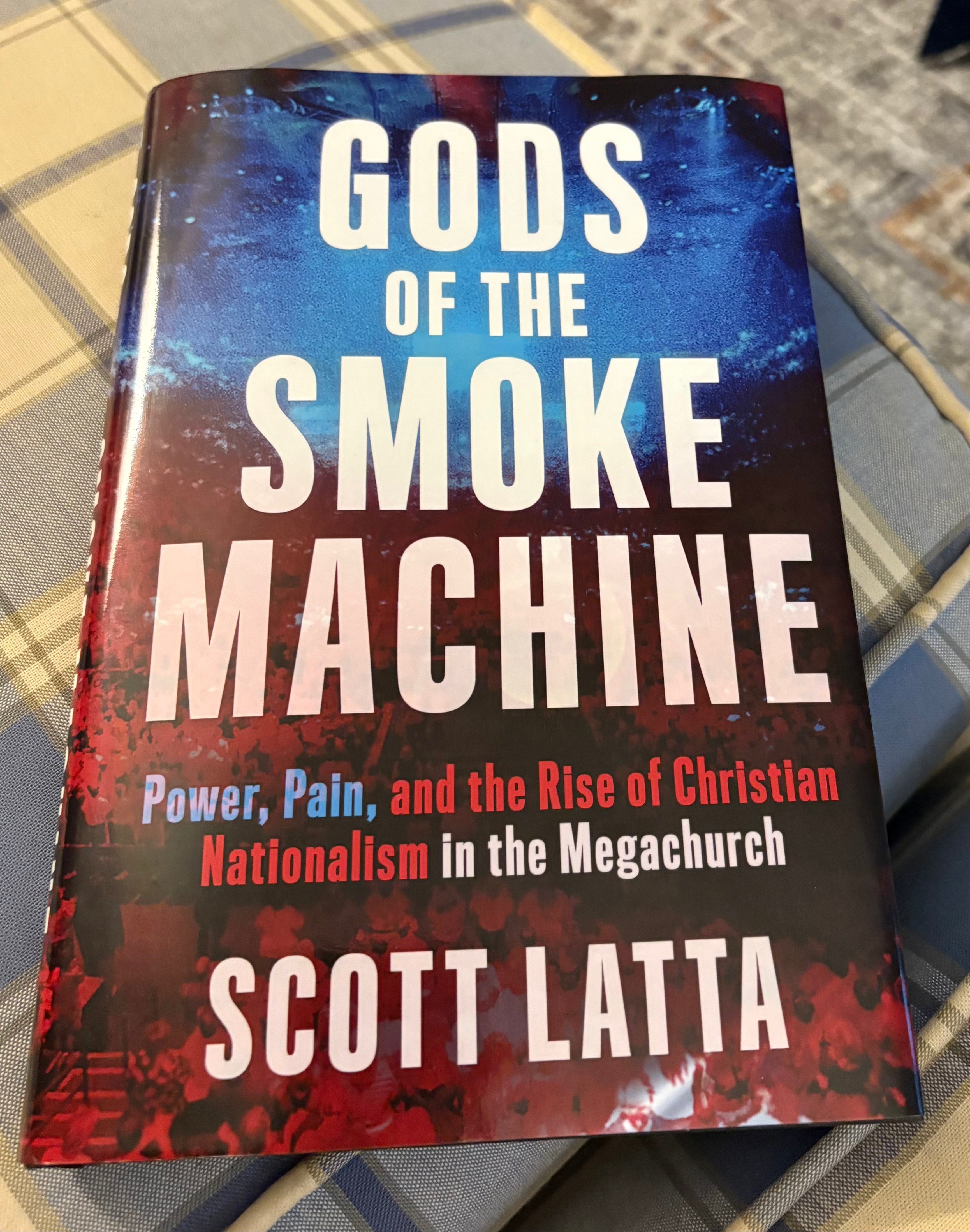
This particular podcast was an interview with the author of a new book entitled “Gods of the Smoke Machine: Power, Pain and the Rise of Christian Nationalism in the Megachurch” by Scott Latta. I found the conversation compelling so I ordered the book. What follows are my reflections after having finished reading it (I suppose that makes it a book review).

Okay, so the book was a page-turner for me. It is well-written. Latta’s writing style is quite engaging and easy to read, and I would recommend this book to pastors and church leaders who are on the front-lines of ministry in contemporary culture.

Hard Conversations

There are few topics more difficult for Christians to talk about than the failures of the church. I love the church. I’ve been formed by it, baptized in it, comforted and corrected by it. Yet, my own history and experience have taught me that love does not require blindness. Sometimes love requires truth-telling.

Latta attempts to shine light on a truth that many folks find difficult to talk about. Nevertheless, it is a conversation worth having. Reading the book caused me to ask the question: Are we worshiping God, or have we learned to worship the machinery built in His name?

Let me confess that Latta and I are not of the same “tribe.” He is one who is in the process of “deconstructing” his faith (or has completed the process–I’m not really sure after reading the book).

This is not a review of the somewhat new and novel idea of “deconstruction” of one’s faith, but if you’re unfamiliar with the term, you can Goggle it to learn more. Simply put, it is exactly what comes to your mind when you hear the phrase “deconstructing one’s faith.”

Though not of the same tribe, I found some value in reading the work. It does us good to get out of our echo chambers to hear other voices. They cause us to think and possibly find some common ground upon which we might build a relationship.

When Growth Becomes the Measure of Faithfulness

Latta reflects on the rise of the modern megachurch and the ways large congregations have learned to thrive even as church participation in America declines. He points out in the introduction that overall church attendance has fallen by about half over the past 25 years. Yet, while overall attendance has fallen, attendance in the megachurch (weekly attendance greater than 2,000 people) has increased by 10% between 2015 and 2020.

Yes, as Latta points out, the pie is getting smaller, but the megachurch’s piece has gotten larger.

Growth itself, of course, is not the problem. Scripture celebrates growth when it flows from faithfulness. But Latta raises a necessary concern: when numerical success, branding, and influence become the primary measures of God’s blessing, something essential is at risk of being lost.

From a pastoral perspective, this is not simply a critique of church size or style. It is a call to remember that the church is not a product to be managed but a body to be shepherded. Efficiency and excellence can serve the gospel—but they can never replace presence, humility, or accountability.

Listening to the Wounded

Perhaps the most sobering parts of the book are the voices of those who were hurt within church systems that should have protected them. Latta shares stories of people who experienced spiritual manipulation, silencing, and abuse, and who found that institutional loyalty often outweighed compassion, truth and accountability.

These stories deserve our prayerful attention. My pastor’s heart reminds me that the credibility of the church is not measured by attendance numbers or production quality, but by how we treat “the least of these”—especially when listening is inconvenient or costly. Repentance, not reputation management, is the way of Christ.

Of course, my more pragmatic (or cynical) self wants to say, “There are two sides to every story.” We only hear one side of the story in Latta’s book. In fairness, according to Latta, churches and pastors were given opportunity to comment, but most did not respond.

Faith, Power, and Allegiance

Latta also explores the uneasy relationship between some megachurches and political power, particularly the blending of Christian language with nationalist ideology. Viewed through my pastoral lens, my concern is not about political disagreement, but about ultimate allegiance. When loyalty to leaders, movements, or ideologies begins to eclipse allegiance to Christ, the church’s witness becomes distorted.

The church has always lived in tension with worldly power. The danger comes when that tension disappears—when the cross is replaced by the quest for influence, and when winning matters more than loving.

A Call to Self-Examination, Not Cynicism

While Gods of the Smoke Machine is clearly critical of the state of the American megachurch, I think Latta painted with a very broad brush. The focus of the book really is upon a very few megachurches and their pastors. He says very little about the majority of churches (there are approximately 1,800 megachurches in the U.S.) and pastors who are faithful to the Gospel and do their best to love one another.

Not to despair, though. The book became for me an invitation to self-examination. Not every church is a megachurch, and not every leader is compromised—but every Christian community must regularly ask hard questions about power, transparency, faithfulness and yes, accountability (there’s that word again).

This book challenges pastors, elders, and congregants alike to consider whether our structures reflect the character of Christ or simply the efficiencies of modern institutions. It urges us to remember that the Spirit of God is not manufactured by lighting cues, smoke machines or emotional crescendos, but is present where there is truth, repentance, and love (oh, and accountability).

Reading with Hope

Ultimately, Gods of the Smoke Machine is a book best read slowly, prayerfully, and with humility. It may stir grief, anger, or recognition. But it can also stir hope—hope that the church can still choose a better way, and that reform is possible when the people of God are willing to listen, repent, and return to the simplicity of the gospel.

For pastors, church leaders, and thoughtful Christians, this book offers an opportunity not to abandon the church, but to love it more faithfully—by seeking the health of Christ’s body rather than the success of its machinery.

There is a bit of the prophetic in the work. Unfortunately (or fortunately?), that prophetic word is coming from one outside the church (well, one who left the church). I don’t know if that makes him an outside insider or an inside outsider. Either way, it will do we leaders well to listen to that prophetic word and take it seriously.

Until next time, keep looking up…

A Methodist Firing…

Don’t Fire Your Preacher the Wrong Way

Well, it happened. I knew it would eventually. What happened? A Methodist preacher got fired. We’re not accustomed to that.

See? What used to happen before the big “split” in the United Methodist Church was a pastor got “moved” whenever a congregation wanted a change in pastoral leadership. Every year, the Staff-Parish Relations Committee would meet to do an evaluation of the pastor.

Generally, at the end of the evaluation, there were two options: move, or stay. If the Committee (congregation) wanted the pastor to return, they checked stay. If they wanted to “fire” the pastor, they checked move. That’s the simplified version, but basically the process.

Pastors filled out an evaluation, too. It was basically the same process in reverse. It was a means of communicating to the denominational higher ups whether the pastor wanted to stay at the congregation, move to a new one, or was open to either prospect (meaning “I’d take a better appointment”).

Well, for those Methodist pastors (including myself) who left the United Methodist Church, times have changed. Especially for those pastors serving congregations who remained independent. We can get fired–just like our colleagues in most Baptist denominations (and a few others).

I had a friend and former colleague who “resigned” from his congregation recently. He was “asked” to resign (which is code for “resign or we’re going to take a vote and fire you”). Mind you, this was not a pastor who had only served the congregation for a short time and it just didn’t work out. The pastor had served them for over a decade, so he wasn’t an unknown quantity.

I don’t know all the specifics of the separation (and I don’t want to know), and no, I’m not going to name names or point fingers. This isn’t a blog about that. This is a blog about this brave new world many Methodists are living in, and is offered as an encouragement for independent Methodist congregations to act in Christian ways when they feel like it’s time for a change in pastoral leadership.

I’m not saying this congregation acted in an un-Christian way, though from some conversations I’ve had with folks in the congregation I’ve surmised it was not handled in a healthy way for either the pastor/family or the congregation. This is not about that. It is about being faithful in the inevitable event that a pastoral change is necessary.

As I’ve reflected on and prayed about my friend’s situation, I’ve hit upon some advice I’d like to share with Methodist congregations as they live in their new reality.

Be Transparent

First, be transparent (or as transparent as the situation allows). When a pastor “resigns” or is unexpectedly fired from his/her position, it raises a lot of questions for the congregation. Those questions, when they go unanswered or unaddressed, can easily give fuel to gossip in the congregation. That gossip can also easily damage the pastor’s reputation.

Can you hear the gossip now? “Oh, what did he/she do?”

“He must have stolen money!”

“There must have been a moral failure.”

“Who did he/she offend?”

Transparency quells the gossip–well, mostly. Gossips are going to gossip, but leadership owes the congregation and the pastor the truth.

If leadership wants to fire the pastor, own it. Don’t put the onus on the pastor as if it was his/her decision. And, don’t put in place any non-disclosure agreements (unless the law necessitates it). Don’t say to the pastor, “We’ll pay you a severance if you don’t say anything to anyone.” That’s just more fuel on the fire.

Be Generous

Speaking of severance, that brings me to the second point I want to make: Be generous to the pastor and the pastor’s family, regardless of the circumstances of the separation. Three to six months of salary should be offered to the departing pastor.

Why? Well, consider everything the pastor loses when he/she loses their position. First, they (generally) lose their home. If the church owns a parsonage, the pastor and family have to move. They may even have to purchase a new home.

Even if they already own their own home, the likelihood is they will need to sell it and move to a new community because full-time ministry positions don’t grow on trees. Seriously, how many opportunities for vocational Methodist ministers exist in your town? That’s what I figured.

It will take a minimum of three to six months for the pastor to find a new position, move to a new community and settle in new environs. Congregations need to consider this when choosing to fire a pastor. If the congregation (or congregational leadership) made the decision to transition to new leadership, count the cost and own it–every stinking bit of it. It’s the Christian thing to do.

Secondly, the pastor and his/her family loses their friendship network. Most of a clergy’s friendship network is within the congregation. In one fell swoop, those relationships are gone. They also lose their church family, too. The children (if there are any) lose their schools and their friends. The spouse also has to find a new job.

Think about this: You’re a teacher and you lose your position. You still have your friendship network. You still have your church home. You (most likely) still have your home. For the pastor and his/her family? All three are gone in one decision by a church board or congregation.

Every congregation initiating a move should graciously provide counseling as part of a severance package and job search assistance to the pastor/family. I’m reminded of what the Apostle John wrote in 1 John 3: 17–“If someone has enough money to live well and sees a brother or sister in need but shows no compassion—how can God’s love be in that person?

Be generous, my friends. It’s the Christian thing to do!

Be Patient

Perhaps I should have started with this advice–be patient. What do I mean by patient? Well, unless the leadership has worked with the pastor through a remediation plan before they ever come to a “firing” decision, well, you’ve already done it wrong.

When problems arise (and they will), the first step should be for the person designated by the church by-laws (Discipline) to sit down with the pastor to provide a clear explanation of the issues at hand. There should always be a process in place to work with the pastor to address any issues the congregation may be facing.

That process may include counseling, continuing education or even arbitration, and there must be (let me stress MUST) a process to continually re-evaluate the situation. It’s simply a matter of justice, folks.

Don’t blind-side your pastor with a list of complaints (especially anonymous ones) and then say, “We think it’s time for a change.” That is the most unjust thing that can ever happen. If your congregation’s “firing” happens like that, well, your congregation has deeper issues that a new pastor isn’t going to change.

Sit down. Develop a plan. Work the plan…for a minimum of twelve months. Communication is key. Conflict avoidance only heightens the conflict. Working through a remediation plan is the most gracious and healing way to deal with issues involving pastoral leadership.

Granted, there will be some pastors who don’t respond well to remediation. Believe me. When I was a District Superintendent, I encountered some of those pastors. I’ll share with you what I recently shared with my congregation: Don’t let someone else’s misbehavior be an excuse for your misbehavior.

Honestly, if a pastor isn’t open to working through and responding positively to a process of conflict resolution, he/she will make the decision to initiate a transition. Most pastors don’t want to move. Most pastors are serving their congregations in a self-sacrificial way. Congregations need to repay that sacrifice with transparency, generosity and patience.

A Word to Pastors

Let me just say a brief word to pastors who may be reading this–this advice works in reverse, too. Don’t blind-side your congregation with the news that you quit! It’s not fair to them. Seriously, if you feel the Holy Spirit’s nudging to a new season of ministry, sit down with your congregation’s leadership and be transparent. Give plenty of notice. Hey? The congregation (leadership) may even be helpful in the discernment process.

If we, as pastors, want congregations to be fair with us, we must be fair with them. After all, pastors don’t grow on trees. Leaving on short-notice brings harm to the congregation and thus, to the Body of Christ. Don’t be one of those pastors.

Just Do the Right Thing

Let me reiterate: All this advice is absent moral failure on the pastors part. The moral failure of a pastoral leader opens up a whole other can of worms. Talk about harm to a congregation and to the Body of Christ! There’s nothing that does more damage to the life and health of a congregation than a moral failure of its leader. That’s for another blog…or not!

Let me just say to congregations, don’t be one of those congregations that changes the locks to the church when the pastor is on vacation (it really happened). Trust me. That makes you like the Church of Laodicea (Revelation 3: 14 – 22). Jesus just wants to vomit you out of His mouth.

Just do the right thing. It honors Christ. It builds up the body of believers. It gives a good witness to the world.

Besides, for both pastors and congregations, the grass is rarely greener. Pastoral leadership is rarely the reason for dying congregations, and difficult congregations are rarely the reason for bad pastoral leadership.

Also, keep this in mind, congregations–pastors are in short supply. Pastors, keep this in mind–good pastoral appointments are in short supply. Especially in this new Methodist environment. It’s a new world we’re living in. Let’s navigate it with transparency, generosity and patience. We’ll all be better off in the end.

Until next time, keep looking up…

Nine Things For a Church in Transition…

So, I’m pastoring a small congregation these days. As I reflect on my past leadership as a vocational minister, and I think about where God is calling me to lead as a bi-vocational pastor, I’ve sought to define the necessary actions that will help our congregation be faithful to God’s calling for this stage in our life.

What stage is that? I can’t actually answer that question, but if I attempted to provide an answer, it would be the transitional stage. We are a congregation that is in transition. We’re meeting in a storefront. I would define that as transitional. The storefront can’t be our permanent home unless we are content to be who we are where we are, and I don’t believe the Lord ever wants us to be content with who we are where we are, so we’ll see how that plays out.

We’re also transitional in our mission. As a congregation that was displaced from its property, there is a time of defining who God is calling us to reach with the Gospel. Our “target” now is not who the “target” was a year ago, because our storefront is located in a different part of the community. We’re in transition in figuring this out.

We’re also transitional in our worship style. The Lord has provided us with some amazing musicians to lead us in worship, and working to their strengths has made us adapt from a more traditional worship style to a more “contemporary” worship style. It is definitely a transitional time for the congregation.

One other transition the congregation is facing is in leadership. No, not in finding new leadership, but in understanding what it means to have a truly bi-vocational pastor. How does the congregation provide leadership in tandem with a bi-vocational pastor? Certainly a transitional aspect of life for the congregation.

These transitional aspect of congregational life have forced me to consider this question: What are nine things we MUST do to be faithful as a congregation in this time of transition? In no particular order, here are the nine things I’ve defined as necessary to navigate the transitions:

1. Biblical Teaching/Preaching

This almost goes without saying, but I’ll say it anyway. Let me clarify what I mean: I mean keeping the message simple without all the smoke and mirrors, sounds and light shows and video driven illustrations. It’s not about flash, it’s about truth and the Gospel message is a simple message for everyone. Keep it simple. Preach the Bible. Preach truth. The fluff is a distraction from the truth.

Technology is great, and it can really bring a “Wow” factor to worship, but in this transitional time, we need to let God wow us, not the technology.

2. Participatory Worship

Traditional worship (and by traditional I mean pretty much every church worship service these days) has become more of an observation exercise than anything else. Folks show up, sit in rows, listen to singers perform and preachers preach. Worship has become more performance than anything else.

Nope! Worship is meant to be a participatory experience. From music, to prayers, to preaching and teaching, to communion. All of the body of Christ is meant to participate in worship. Participatory worship will be another way that we encounter God, and we need to encounter Him over and over again during this period of transition.

3. Holy Spirit Led

One of my old mentors used to pray before he entered worship, “Lord, let something happen today that is not in the bulletin!” During this time of transition, we have to leave room for the Holy Spirit to move. We’re looking for flexibility not rigidity, allowing room for the Holy Spirit to move, even in our corporate worship.

That scares a lot of people, and it kind of scares me, too. It’s also a little bit counter to the argument that the Spirit works in our preparation for worship. Well, yes He does, but He can also lead in the present and we have to attune ourselves to His presence and moving.

4. More Fellowship Time

One of the reasons we have divisions is because we don’t spend enough time sharing meals together and doing activities outside the worship setting. No, I’m not talking about Sunday school or small group time. I’m talking about playing together. I’m talking about having fun together.

What does that look like? That’s yet to be determined, but it is necessary to navigating transitions in a healthy way. It will also help us define who God is calling us to be as a congregation.

5. Hear the Bible Again

I have to confess that I’ve been guilty of listening more to what other people say about what the Bible says than simply reading the Bible and letting the Bible say what it says.

Do you know what I mean? I mean I want to listen to what Billy Abraham says the Bible says than what the Bible says it says. Don’t get me wrong. Biblical scholars are great, and we shouldn’t be anti-scholarship, but often we hear 90% of what someone thinks what the Bible says and 10 of what the Bible actually says.

How about we start with hearing the Word and start with the Word we just heard?

6. Less Clock, More Connection

How did we ever come to believe that church/worship needed to be limited to one hour? Yes, I know the adage “The mind can absorb only what the seat can endure.” And, yes, I know there is the one guy always sitting in the back of the congregation checking his watch.

Seriously, we have to move past that mentality if we’re going to encounter the living God. Just when the Holy Spirit starts to move the preacher says, “Well, we’re out of time, so I’ll close.” I’ve said it many times. I wonder how often I quenched the Holy Spirit by making that statement?

Yup, I get hungry, too, but we can’t let our need to finish in an hour cause us to miss the Spirit.

7. Talk About Sin

I’m not talking about making every worship encounter fire and brimstone. I’m talking about acknowledging the reality of sin and acknowledging the destructive nature of sin. Sin has become unpopular topic in many churches these days. That’s unfortunate because unless we realize the destructive nature of sin, how can we know the saving grace of the Lord Jesus Christ?

Who needs salvation when there is no sin?

8. Engage the Community Spiritually

We love giving backpacks and school supplies to kids. We love feeding the hungry and clothing the naked. We love, love, love meeting physical needs and we love to pat ourselves on the back when we do so. There’s absolutely nothing wrong with that. We are supposed to minister to the needs of others (read Matthew 25), but people’s greatest needs are more often spiritual.

What are we doing to engage our community on a spiritual level? What are we doing to address their spiritual needs? Those are questions we must ask during this transitional period of our congregational life.

9. Develop a Kingdom Vision

For too many congregations in transition, the vision is to simply stay afloat–to keep the doors open, to keep the bills paid, to hang on to the status quo. Transitional congregations must be intentional in developing a Kingdom vision–a vision for the future and for growth. It is about a vision for expanding the Kingdom of God, not about keeping people inside the walls of the church.

Developing a Kingdom vision takes time and intentionality. It takes patience and it takes relying on the Holy Spirit to move among us. Don’t rush it.

Conclusion

One would think I could come up with one more thing for the congregation to do in this transition. We like top ten lists, right? Honestly, though, anything I might add to the list above would really just dovetail off one of these nine, so I’ll leave the list at nine.

We could also spend more time unpacking each of the nine, but I offer them hear as conversation starters. I’d love to hear your feedback, and I’d also love to hear if you have any you would add to the list. Add them in the comments and let’s keep the conversation going.

Until next time, keep looking up…

A Stroll Down Memory Lane…

Due to some unforeseen circumstances, Vanessa and I took a flying trip to Morgan City, LA on Saturday. Morgan City’s Pharr Chapel United Methodist Church was the first congregation we served after I graduated from seminary in 1998. The unexpected trip became a stroll down memory lane for both of us as we rode around town reminding ourselves of our time there.

As best I recall, I haven’t been back to Morgan City since August 2013–almost exactly 12 years ago. I returned then for the funeral of a prominent member of the congregation who passed away. His name was “Boogie” Hamilton.

“Boogie” was a great guy. He was a local pharmacist who owned the Standard Drug Co., of Morgan City. As best I can remember, Standard Drugs was a family business that Boogie took over from his dad.

We drove by Standard Drugs yesterday (it was at the end of 8th St. right in front of Morgan City High School. It looked like it was no longer Standard Drugs. I know he sold the business to a fellow pharmacist when he decided it was time to retire, but that was what seems like a long time ago.

Boogie was faithful to Pharr Chapel. He was the “head usher” at the 8:30 a.m., worship service. He was always there on time to get things ready for the service and to line up those who would assist him with ushering for the day.

Better still, Boogie was a guy who took care of his pastor. Well, I can’t speak for all his pastors through the years, but I can certainly speak for this one. At least once a month, Boogie would call me up and treat me to lunch at one of the popular seafood restaurants. Knowing my love for catfish, also about once a month, he would show up at the church or the parsonage with five pounds of fresh catfish filets caught right out of the Atchafalaya River.

I know they were fresh caught catfish because I know where he got them. He got them (most of the time) from Lester Duvall, who was also a member of the congregation. Lester was a commercial fisherman. Lester, on several occasions, took me with him down the Atchafalaya to run his fish traps. I suppose he wanted me to see the lifestyle of the fishermen of the region. I never left a trip with Lester without some fresh catfish.

Boogie was also the guy who kept his ear to the ground for me. Boogie was such a long-time, prominent member of the congregation that if something was afoot, or if someone was upset, or if something needed to be addressed, he was the first to know. He was also (generally) the first to let the pastor know. He would always pass along that information quickly and without judgment on the situation. He just needed the pastor to know, so he made sure I did.

We drove by the church at 517 Federal Avenue. The congregation has cared for the facility very well. The “old” parsonage, that sat directly in front of the educational building on Federal Avenue is gone. It served as a rent house when I was pastor there. I never thought it was a good idea for a congregation to be in the rental business, but I was a young pastor fresh out of seminary, so I can honestly confess I wasn’t savvy enough to know how to approach that battle. It’s good to see one of my subsequent colleagues was savvy enough to accomplish that task.

We drove by the “new” parsonage (which is now actually the “old” parsonage) at 3013 Carrol Drive. We spent three years in that home. I’ll say it was one of the finest parsonages we have lived in through our years of vocational ministry.

The parsonage was a block off Lake Palourde, and a half a block from the levee of the swamp. We remembered the golden lab we rescued from the local pound. Shadow would jump the fence in our back yard and make his way to the swamp. We were forever looking for him. No matter what I did to the fence, he was able to jump over it or climb it to get out. Animal Control even picked him up a few times before we could find him. We ended up rehoming him before we left Morgan City.

Pharr Chapel was/is a great congregation. We had fruitful ministry there. Morgan City is/was a great place to call home. Unfortunately, it is also the only appointment that we requested a move from. It absolutely has nothing to do with the congregation or the community. We loved both. It had to do with family.

We were raising four children, and without going into detail, suffice it to say we were being challenged in our parenting skills. We thought a move closer to family might be helpful to our situation and better for our family. As it turns out, that wasn’t exactly the case, and our move from Morgan City remains one of the biggest regrets of my time in vocational ministry.

For all the good memories this stroll down memory lane evoked, there are a few regrets that surfaced, too. First, there is the regret of leaving fruitful ministry. The congregation was growing. Our faith community was thriving and reaching out into the community.

I was deeply involved in the community, as well. I served on the hospital ethics board and I was the go-to pastor for the two local funeral homes when they had a death and the family had no church connection. By my count, I officiated 37 funerals in the 36 months I pastored in Morgan City. It was in Morgan City that I developed a deep appreciation for the liturgy for funerals. When one performs more funerals for people you didn’t know than for ones you did, the liturgy becomes your friend.

In addition, the local radio station was located directly across the alley behind the church. I became friends with the owner, and through that friendship, became the color analyst for the Morgan City High School football games. Who knows? I could have been the next Vin Scully or Pat Summerall.

Next, I regret leaving (and subsequently not maintaining) the strong friendships we developed in our three short years there. I’ve already mentioned two that were meaningful to me, but there were others that were meaningful to both Vanessa and me together. There were several couples in the congregation who were at the same life stage as us. Our friendship just clicked. We shared Sunday school together. We shared meals together. We shared social functions together. We shared birthdays together. Vanessa even shared work together with two of them. We were, by my account, great friends.

I don’t know why those friendships diminished so through the years. Well, of course I do. First, time does that to all our relationships. We can add distance to that equation, too. We moved five hours away. Five hours is a long way when we were at the life stage (all of us) we were in. Of course, not long after we moved, Morgan City received an evacuation notice for an incoming hurricane. A group of those friends landed with us for two days in our new appointment. It was a fantastic time. Good friends, indeed!

I also want to lay part of the blame on the “system” of the United Methodist Church. It used to be (I don’t know if it still is) that it was drilled into pastors that when you leave a congregation, you leave a congregation. You don’t go back for any reason. You give the new pastor an opportunity to become the congregation’s pastor. Being the good company man I was, I sought to fulfill that expectation to the fullest extent.

I refused calls to officiate both weddings and funerals. I didn’t engage myself in conversations with former church members when they were upset that the new pastor didn’t do things the same way I did. Oh yes, there were the occasional calls back to friends, and the Christmas cards and what not, but the friendships withered. I know I wasn’t intentional in maintaining them.

Of course, the same can be said for every congregation we’ve served. Looking back over our years in vocational ministry, I regret not maintaining the relationships better after we departed. That’s on me. I’ve learned through the years that my wanting to “leave” a congregation well stemmed from my own insecurities about being perceived as a good “company man.”

This stroll down memory lane has taught me that relationships are more important than that. To have friends, we have to be a friend. I don’t think I’ve been a very good friend through the years. Oh, I have lots and lots of acquaintances, but very few friends. That, too, is on me.

We’ve never served a bad appointment in vocational ministry. I say that without equivocation. We’ve been blessed by every congregation…every last one. Each of them has been great in its own way, and I am proud (if a follower of Jesus can be proud) to have served each one. With that qualifier, I’ll say Morgan City/Pharr Chapel is absolutely at the top of the list.

Yeah, I’m probably getting myself in trouble with this blog, so I’ll just go ahead and beg forgiveness from all the other congregations I’ve served. This stroll down memory lane has challenged me to be more direct in building and maintaining friendships.

I’ve also come to realize that we pastors don’t need to be quite so insecure. You don’t want to return for fear of interfering with the new pastor? Get over yourself. Go back. Be in ministry to your friends. In the big picture, they won’t remember you for the friendship you developed. They’ll remember you didn’t minister to them in their time of need.

You don’t want a former pastor returning to the congregation you’re now pastoring? Ha! Get over yourself. You’re not the end all and be all of pastors. Give it time and extend the invitation to former pastors when requested. It’s the greatest ministry you can offer someone in their time of need–to affirm the relationship of a trusted friend. Besides, you’ll develop your own relationships that you won’t want to leave behind. It’ll be okay.

A lot of people will disagree with the two previous statements, but that’s okay. I’m old enough and secure enough now to not care. I’m going to be intentional in building friendships and maintaining relationships in the years I have left.

I’m grateful for the stroll down memory lane that Vanessa and I enjoyed yesterday.

Until next time, keep looking up…

Am I Doing it All Wrong?

I haven’t written for a couple of weeks. I’ve either been busy or lazy (or a bit of both), so the words getting on the page have been slow to come. The respite from writing has given me time to think, though, and that can be a dangerous thing.

What have I been thinking about? I’ve been thinking about my role as a “pastor.” Actually, not my particular role as pastor, but the “pastor” model of the church of church leadership.

I was a “pastor” vocationally for 28 years. I’ve been a “pastor” bi-vocationally off and on since 2019. That gives me a total of 34 years experience, so maybe I have some insight into the role. Then again, maybe not.

Let me preface this blog with the statement that I think most pastors do a fantastic job and fill their role with integrity, character, diligence and faithfulness. The question I’m about to posit isn’t a reflection on anyone’s service in ministry, nor is it a reflection on God’s calling on anyone’s life. After all, ministry has been my calling since the age of 27 (perhaps longer, but I was deaf to the call), so the question has shaken me to my core.

Pastor vs. Pastor-Model

What is it that has shaken me to my core? Drum roll, please! Is the “pastor” model of leadership as we know it even a biblical concept?

What has prompted the question in this season of my life? Well, I “pastor” a small local church. They call me pastor and I call myself their pastor, but what I really am is their Sunday preacher. I don’t mind being their Sunday preacher. They need a Sunday preacher and I like to preach, so it seems to be a good fit. The folks are wonderful, faithful people who love Jesus, and I’m blessed to be their Sunday preacher, but, they need a pastor, too (or someone who fills the role that is traditionally called the “pastor”)

Perhaps they don’t need a “pastor” as traditionally defined. What they need is leadership. And, here might be a good place to clarify that I’m not really talking about the “pastor,” but more the “pastor model” that the Church has developed through the years. Yes, the “pastor” is a biblical calling:

11 Now these are the gifts Christ gave to the church: the apostles, the prophets, the evangelists, and the PASTORS (emphasis mine) and teachers. 12 Their responsibility is to equip God’s people to do his work and build up the church, the body of Christ. (Ephesians 4:11-12 NLT)

As certain as I am that “pastor” is biblical, I’m not equally certain that the “pastor model” of church leadership is biblical. The Apostle Paul, in writing to the Ephesians, certainly seems to indicate that there is some sort of plurality of leadership in the body of Christ (the local church), not one person who is the “pastor,” or the “senior pastor,” or the “founding pastor” who makes all the decisions in the church, or does most of the leadership work in the congregation.

Actually, Paul makes the case that the local church is to be led by “overseers” and “deacons” who would shepherd (pastor?) the church:

Here is a trustworthy saying: Whoever aspires to be an overseer desires a noble task…, and

In the same way, deacons are to be worthy of respect, sincere, not indulging in much wine, and not pursuing dishonest gain

(1 Timothy 3: 1, 8 NIV)

Likewise, in Titus 1, Paul instructed Titus to appoint “elders” who would serve as “overseers” of the local congregation:

The reason I left you in Crete was that you might put in order what was left unfinished and appoint elders in every town, as I directed you. An elder must be blameless, faithful to his wife, a man whose children believe and are not open to the charge of being wild and disobedient. Since an overseer manages God’s household, he must be blameless—not overbearing, not quick-tempered, not given to drunkenness, not violent, not pursuing dishonest gain. (Titus 1:5-7 NIV)

I think the Bible is relatively clear that there is to be a plurality of leadership in the local congregation, with each one fulfilling the gifts given to the Church by Christ Himself. It is Jesus Christ who is the head of the Church/church. The plurality of leaders sit under His headship/Lordship. He is the One to whom we look for guidance. He is the One whom we follow.

Priesthood of All Believers

I also don’t see any biblical evidence for the distinction between clergy and laity in that plurality of leadership. Actually, I don’t see any distinction between clergy and laity at all. Sure, there were priests in the Old Testament, but I distinctly recall the passage in Matthew’s Gospel when Jesus breathed his last breath on the cross and “the curtain of the temple was torn in two from top to bottom” (Matthew 27: 51 NIV). Since the death of Jesus, anyone (I repeat-anyone!) could enter the holiest of places. The separation no longer exists.

Likewise, the Apostle Peter affirms that fact:

As you come to him, the living Stone—rejected by humans but chosen by God and precious to him— you also, like living stones, are being built into a spiritual house to be a holy priesthood, offering spiritual sacrifices acceptable to God through Jesus Christ. (1 Peter 2: 4-5 NIV)

This would be an excellent place to talk about men and women in leadership, and qualifications for elders, overseers and deacons, but I’m not perplexed by those questions, so I won’t chase those rabbits. I’m perplexed by the whole “pastor model” of church leadership, and I just wonder (as one who tries to live biblically) if I’ve been doing it wrong all these years?

I may not have been doing it wrong, but I certainly don’t believe I’ve been doing it biblically. I’ve been doing it the way I’ve been trained to do it, so it’s not necessarily the “wrong” way, it’s just not the biblical way. There’s nothing sinful about the way the pastor model has been/is being done, it’s just got me wondering if the pastor model has run its course and it’s time to get back to doing it the biblical way.

Perhaps all I’m doing is trying to justify my own inability to lead the congregation in a healthy, effective way these days. That, or the Lord is prompting me to dig more deeply into His calling upon my life and how He wants me to live that out. I pray it’s the latter. I fear it’s the former.

I suppose time will tell, but today is Sunday, and the folks need a Sunday preacher. So, until the Lord (or the congregation) tells me different, I’ll go be a Sunday preacher. That’s all I know to do right now. If you’ve got any clarity for me, please leave a comment below. I’d love to hear it.

Until next time, keep looking up…
Preaching in the Storefront, Part 2: Five Drawbacks to Storefront Church…

I wrote last week concerning the advantages of preaching in a storefront church (read it here). I figured I should also share some of the limitations that come with having a storefront church. These limitations affect both our congregation and the community.

Space Limitations

Our storefront church faces significant constraints due to limited physical space. Unlike traditional church buildings, which are purpose-built to accommodate a large congregation, classrooms, offices, and multipurpose spaces, our space (though originally a church) was fitted for commercial use.

Our space lacks the architectural features needed for worship, such as high ceilings, sanctuaries, and designated areas for fellowship. We’re going to struggle to figure out how to hold events in our space, or to expand to Sunday school or small group ministry. And, potluck…well, we’ll just have to see about that.

Additionally, our storefront has a relatively small seating capacity. Yes, there is a wall we can take out, but even then, limited space can lead to overcrowding, discomfort, and an inability to host special events, such as weddings, funerals, or community outreach programs.

One other thing to note, the lack of auxiliary spaces like nurseries, kitchens, and meeting rooms may hinder the church’s ability to offer vital services, such as childcare, Bible studies, and community meals.

Perception and Identity

The perception of a church operating in a storefront can also pose challenges. Traditional church buildings convey a sense of permanence, sanctity, and history, which can attract members and foster community respect.

In contrast, a storefront church can struggle to establish the same sense of legitimacy and stability. Passersby may view it as a temporary or informal operation rather than a dedicated place of worship.

This perception issue can extend to potential members, who might associate the storefront location with financial instability or a lack of resources. For some, the absence of traditional symbols such as steeples, stained glass windows, and pews may detract from the spiritual atmosphere they expect in a church setting. Over time, these perceptions can impact the church’s ability to grow and sustain itself.

Acoustics and Ambiance

Storefronts are not designed with worship services in mind, and this often leads to challenges with acoustics and ambiance. Traditional church buildings are constructed to enhance sound quality, ensuring that sermons, music, and prayers resonate effectively within the space. Storefronts, on the other hand, often have flat ceilings, hard floors, and minimal soundproofing, which can result in poor acoustics and echoing.

Luckily, the acoustics are not very bad in our storefront. I preach without a microphone every Sunday (not a hard thing to do when our average attendance is 30, but if we grow, I’ll probably have to rethink it). More people absorb more sound. Without a microphone, I might become muffled. Heck, they might think I’m muffled now, but they haven’t said so if that’s the case.

The lack of ambiance in a storefront can also hinder the spiritual experience. Traditional church buildings often feature architectural elements like vaulted ceilings, intricate woodwork, and natural lighting, all of which contribute to a sense of reverence and awe. I’ll confess that our team has done a fantastic job of creating a worshipful ambiance in our space, but many storefronts can feel sterile or utilitarian, which can make it difficult for congregants to feel spiritually connected or inspired.

Zoning Issues

Operating a church in a storefront can also lead to zoning and legal challenges. Many municipalities have specific zoning regulations that restrict or limit the use of commercial spaces for religious purposes. I haven’t found that to be the case with Bossier Parish, but if you’re thinking about a storefront church in another community, it’s best to check zoning early in the planning process.

Churches may be required to apply for special permits or variances, which can be time-consuming and costly. Additionally, these regulations often limit the types of activities that can take place within the space, further constraining the church’s ability to serve its congregation and community.

Parking is another common issue associated with storefront churches, and it certainly it with ours. We’ve got four spaces in front of the church and have to utilize a parking lot for a strip center next door. Spots fill up fast when we have a large (40 people) crowd for church. Any growth we experience will ultimately be impacted by limited parking.

Financial Limitations

Storefront churches are a cost-effective alternative to traditional buildings, as I mentioned in my previous blog. That notwithstanding, they can also present significant financial challenges in the long term.

Leasing or purchasing a storefront space is initially more affordable, but the costs associated with retrofitting the space for worship can be substantial. Churches may need to invest in sound systems, seating, lighting, and signage to make the space functional and welcoming.

Additionally, rent will go up at some point, which can strain the church’s budget. Unless your landlord is a member of the congregation and has mercy on it, rent will increase. If rents become unaffordable or the property owner decides not to renew the lease, the congregation may be forced to relocate, disrupting their operations and sense of community.

Deep Roots

Traditional church buildings often serve as landmarks and gathering places, hosting events, providing shelter, and offering a range of social services. Storefronts, by contrast, may not have the space or facilities needed to support such activities. This can restrict the church’s ability to act as a hub for community life and outreach.

Moreover, the transient nature of storefront operations can make it difficult for a church to establish deep roots in the community. If the congregation frequently moves or struggles to maintain a visible presence, it may struggle to build trust and foster long-term relationships with local residents and organizations.

Conclusion

This much I know: For every advantage a storefront may offer a congregation, there is an equal disadvantage. The task of the pastor and the congregation is to weigh the advantages and disadvantages appropriately, pray and then follow the leading of the Holy Spirit.

I’m uncertain how the storefront will impact our congregation yet. We haven’t been in the space long enough to know. I know God has put us here for now, so we’ll seek to be faithful to the call we hear going forward.

But still, if you’re in the Bossier Parish, Caddo Parish or Webster Parish area, please come join us. Perhaps you’ll help us figure it out.

Until next time, keep looking up…

Preaching in the Storefront…

Yup! I preach in a storefront every week. Who would have thought after over 30 years in ministry that I’d end up in a storefront church? Well, apparently the Lord thought it because here I am.

Haughton Methodist Church (the church I began pastoring late last year) meets in a rented storefront. Well, actually the building was originally a church that outgrew the facility. It was converted to an office building and was used as such for the last couple of decades.

I must say the rented storefront is much better than the rented hotel room the congregation used for the better part of nine months. I gotta give props to the faithful in the congregation who were committed enough to set up and tear down that hotel room week in and week out. That’s a lot of work and a lot of commitment.

Of course, Haughton Methodist Church was meeting in the hotel room (and now the rented storefront) due to its disaffiliation from the United Methodist Church. Well, not really disaffiliation. They missed that boat for reasons I won’t go into, but suffice it to say, they walked away from their property…just threw the Louisiana Annual Conference the keys…and began the journey as nomads. I applaud the congregation’s faith and faithfulness. It’s one reason I’m blessed to serve them as pastor.

Preaching in a storefront has really had me thinking and praying about a strategy for the congregation moving forward. That part of being a pastor hasn’t left me. In my contemplation, research and prayer, I’ve discovered there are a few advantages to meeting in a rented storefront. I thought I’d share a few of those with you today.

Financial Flexibility

The first (and perhaps major) benefit of renting a storefront for church meetings is the financial flexibility it provides. Establishing a permanent church building requires significant upfront capital for purchase or construction, not to mention ongoing maintenance, utilities, and other operational costs.

I did a little investigating and discovered the congregation’s old facility is listed for sale by the Annual Conference for $445,000.00 (you can check it out here). That’s a lot of money to a small congregation like ours! If someone wanted to purchase it and gift it back to the congregation, now that’s a conversation we’d be open to!

For a small or growing church, this financial burden can be overwhelming and will divert resources from ministry programs, outreach, or other crucial areas. Renting a storefront, on the other hand, often provides a more affordable alternative. The monthly rental cost is predictable and easier to manage, allowing us to allocate our resources to other vital areas such as outreach efforts or mission work.

Additionally, renting avoids the long-term financial commitment and debt associated with owning property, offering us the flexibility to adjust as our needs evolve. Hey? We’ve got a one-year lease. That gives us time to discern God’s next steps for the congregation.

Visibility and Accessibility

Another benefit that a storefront location can offer is significantly more visibility and accessibility than a traditional church building, particularly if the church is situated in a busy commercial area like ours. There’s not a lot of foot traffic where we’re located, but we get great exposure to passing drivers, and our proximity to local businesses makes our storefront church a visible part of the community.

We’re located right next door to an oil change shop, which I find incredibly ironic, but that’s for another blog.

I’m praying this increased visibility can attract new visitors who might not have otherwise considered attending church, whether due to curiosity or the convenience of being located near their place of work, shopping, or living.

Community Engagement

A third advantage (should we choose to capitalize on it) to renting a storefront can be an intentional decision to engage with the surrounding community. Unlike churches housed in large, traditional buildings that may be tucked away in suburban areas, a storefront church is situated in the heart of the local community.

This proximity offers numerous opportunities for interaction with people who may not otherwise step foot inside a traditional church building. Church members can become familiar faces in the neighborhood, and the church itself can become known for its commitment to the well-being of the community.

I’ve already made several visits to the neighboring oil change facility to carry left over treats from our fellowship time. I hope to build an on-going relationship with those guys.

Additionally, I can see our storefront offering opportunities to host events, activities, and programs that reach a wide array of people. Whether it’s offering after-school programs, hosting community events, or providing social services like food banks or job training, a storefront church can effectively serve as a community hub.

Because of its location in a commercial area, a storefront church is more likely to attract people who are not actively seeking a church but may be drawn to the church’s services or outreach activities. This creates a sense of accessibility and relevance, positioning the church as an integral part of the community rather than as a separate entity.

Adaptability

Renting a storefront gives our congregations the ability to remain adaptable and flexible in our growth and development. As we grow, our needs will change, and our storefront offers us the flexibility to move to a larger or different location when necessary.

Unlike a permanent building, a storefront will allow us to scale up or down based on attendance, financial health, and ministry priorities. This adaptability is especially beneficial for us in what I’m calling “our formative years.” It will allow us to respond quickly to changing circumstances without being tied to a long-term commitment.

Furthermore, our storefront landlord has given us some flexibility in changing our layout as growth and needs dictate. Our storefront can be customized to suit the needs of the congregation and community. Unlike traditional church buildings, which often have fixed architectural features such as pews, stained glass windows, or large sanctuaries, storefront spaces are usually more neutral and open.

This gives us the freedom to design our space according to our unique vision and style. Whether it’s creating an inviting, contemporary worship space or setting up an area for fellowship and community gatherings, a storefront can be easily adapted to accommodate various church activities.

A Final Thought

As I’ve had time to pray and reflect on our situation at Haughton Methodist Church, I’ve discerned that being in a storefront is both practical and strategic. It’s a choice that can support our long-term growth and success (even more than getting our old property back).

Ultimately, the success of our congregation will not be defined by the building we meet in, but by the relationships we foster, the ministries we engage in, and the impact we have on our community.

So, if you’re in Bossier Parish, Caddo Parish or Webster Parish, and you’ve never considered the possibility of worshipping in a storefront, why don’t you join us at Haughton Methodist Church. We’d love to have you on this incredible journey!

Until next time, keep looking up…

Advice to Young Preachers (and maybe some old ones, too)…

I’ve been preaching for 34 years. It was 34 years ago this month that I preached my first sermon in my home church of Chatham, LA. I’ve been reflective this week as I look back on that event. I remember being scarred stiff, nervous as a long-tailed cat in room full of rocking chairs and utterly exhilarated, all at the same time.

What I remember most, though, is that the sermon was short and I read through it at supersonic speed. It probably lasted all of ten minutes, but for the kid who was delivering the sermon, it felt like an eternity.

I think I’ve come a long way in 34 years. As I reflect on 34 years of preaching, I thought I’d share a few things I’ve learned along the way with any young preachers (and old ones, too) who might read this blog. So, here goes…

1) Stay Teachable

I don’t care that we live in the Information Age and that you grew up with a phone in your hand that holds more information than all the books in the Smithsonian Library. You don’t know it all. How do I think you think you know it all? Because as a 27 year-old young man, I thought I knew it all, too. I didn’t!

No matter how many years you’ve been preaching, there’s always more to learn. Stay humble, be open to correction, and continually seek growth. Whether it’s from books (yes, books!), mentors, or life experience, always be a student of the Word and the world around you.

2) Guard Your Heart

Listen to me, you young whipper-snapper: The Devil is coming after you. No matter what you think, he is working to defeat you and God’s Word, and he will use every tool at his disposal. You are not invincible. How do I know you’re not invincible? Because I wasn’t.

I have fallen. Many times. The Devils attacks never cease. That’s why it is necessary to ALWAYS guard our hearts. The demands of ministry will lead to burnout (been there, done that), frustration, and even moral failure (ask this preacher, and this one and this one, too).

This veteran preacher would warn you to protect your heart—stay faithful to your spouse, keep your integrity intact, and be wary of the temptations that come with being in a position of power or influence.

3) It’s Preparation over Performance

It’s easy for preachers (both young and old) to get caught up in the performance aspect of preaching—delivering a good sermon, impressing the congregation, or even gaining popularity.

Preaching isn’t about performing. Yes, there are aspects of “performance” that every preacher brings to the pulpit. But, preaching isn’t about the performer. It is about communicating the Truth of God’s Word. That can only happen after the preacher has spent time in the Word, given his heart to preparation and been obedient to the Holy Spirit.

This old preacher would remind you to keep Christ at the center of everything you do. The goal is to be a humble vessel for the Lord’s message, not the messenger that gets all the attention. Our job is to point people to Jesus, not to make them admire us.

4) Don’t Fear Failure

I always wanted my next sermon to be better than my last sermon. It is a lofty goal, and one worthy of pursuing. After all, we are supposed to offer our best to the Lord. Give him the best fruit, not the last fruit.

Let this old preacher remind you that you will not hit a home run every time you step up to the plate. Home run? Heck, you’re not even going to get a single every time. A fellow by the name of Josh Gibson holds the all-time record for batting average in professional baseball at .3716. That’s getting a hit less than 40% of the time.

Do your best to prepare (see #3 above). Seriously, I used to contemplate theatrics and drama, bells and whistles, etc., to make the sermon better. I’ve shared about the philosophy that drove that mentality before (see it here), so I won’t unpack that again. I no longer seek out those “dramatic” elements, but the desire for the next sermon to be better than the last one hasn’t gone away.

If you fail (and you will), fail in the delivery. Please, please, please, do not fail in the preparation. Failure is part of the journey. Learn from it (see #1 above), and keep moving forward.

5) Stay in Love with the Lord

This should probably be number 1. Oh, well! I’m not reorganizing the list now. Our ministry can only be as deep as our personal relationship with the Lord. We cannot lead our people where we have not been.

Ministry is a calling that requires spiritual depth. This old preacher would stress the importance of prayer, Bible study, and personal devotion. Without these, your ministry risks becoming shallow and empty, and you’ll struggle to minister effectively to others.

Put another way, your next sermon may be better than the last, but it will only be from the performance aspect.

Staying in love with the Lord will also help you guard your heart (see #2 above).

6) Preach the Gospel, Not the Culture

It’s tempting to give people what they want to hear, but this seasoned preacher would encourage you to always stick to the truth of God’s Word, even when it’s difficult. Our role is not to appease the crowd but to communicate the life-changing truth of the Gospel, which may not always be easy to hear.

You will hear from your congregation occassionally these words: “I come to church to feel good, to get a re-charge.” How do I know you’ll hear that? Because I’ve heard it, too…in every congregation I’ve served. Don’t fall for it. Sometimes the Gospel is meant to challenge us. Live into that reality.

Don’t preach only what’s easy to preach. Preach what is True!

7) Love Your Congregation

It’s easy to get caught up in programs, projects, or numbers, but might this old preacher remind you to genuinely care for your people? Ministering to them requires listening, understanding, and showing them love in practical ways, not just delivering a sermon on Sundays. People need to know you genuinely care about their lives, their struggles, and their joys. Besides, you can’t preach Truth to people you don’t really know.

8) Don’t Do it Alone

Never stop seeking the wisdom of those who’ve been in the trenches before you. The value of mentors is immeasurable. I encourage you young preachers to find and lean on those who have walked the path before, seeking counsel, encouragement, and accountability. You don’t have to figure it all out alone.

9) Take Care of Your Family

Your ministry at home is as important as your ministry in the pulpit. Let this old preacher stress the importance of balancing family life with church responsibilities. A healthy marriage and family will not only keep you grounded but will also provide a good model for your congregation. Don’t neglect the people closest to you in the name of serving others.

10) Embrace the Responsibility

Do not take your calling lightly. It is the greatest calling in the world. It is also the most humbling calling in the world when one considers the spiritual destiny of others is in our hands. This old preacher would tell you to be mindful of the heavy burden that comes with leading people in their spiritual journey. Be cautious with your words, actions, and decisions because they can have a profound impact on others’ faith.

Conclusion

So, there are ten things I would say to a young preacher after 34 years in the pulpit. I probably didn’t say them very well. There is probably more I could add, but I figure ten is a solid list to begin with. Maybe we could share a cup of coffee and come up with more.

Maybe you could add more to the list. Please do so in the comments. I’d love to hear them because old preachers need advice, too.

Until next time, keep looking up…

Coming Full Circle (and other random thoughts)…

It’s almost 2025! Can you believe it? I can’t. As always, a new year’s dawning has caused me to be reflective. I thought I’d share a few of those reflections with you.

Coming Full Circle

I suppose this is not so much a reflection as it is a revelation. Christmas Eve was last Tuesday evening. I was preparing for the Christmas Eve Candlelight & Communion Service by laying candles out on the seats in the sanctuary pre-service when it dawned on me that I have come full-circle in ministry. I was doing this Christmas Eve what I was doing the first many Christmas Eve’s of my ministry.

You know how it is in a small church, right? Pastor Fetch does it all to get ready for every service. This is not a complaint in any way, just a revelation that I’ll end ministry the way I began ministry over thirty years ago. And, I’m okay with that. Countless pastors serve their congregations faithfully doing all the little things that make “church” happen from week to week. Being back in the middle of weekly ministry has renewed my appreciation for all those pastors who ARE the church staff.

Yes, I was blessed to climb the ecclesiastical ladder through my years of ministry. I was blessed to grow to and go to congregations that had staff that assisted in the preparations for those “Super Bowl” services like Christmas Eve and Easter. It was real easy to get lazy (lazier?) when you had staff to do a lot of the work for you.

I was likewise blessed to serve as a denominational administrative officer for a period of ministry. Yeah, I got to spend a couple of years not even worrying about those “special” services. The toughest past of Christmas and Easter for me in those days was trying to figure out where I would attend those services. So challenging!

Then, of course, there was the time I spent away from vocational ministry altogether. Yes, it was a brief time, but it was a time that I didn’t know if I would ever lead one of those special services again. I did as “interim” pastor, but for some reason, it just wasn’t the same as those early years of ministry (no offense to those congregations I served as “interim” pastor).

This year was different for some reason. Thirty-three years after entering ministry and I’m the one preparing the sanctuary. That’s coming full circle for me. Kudos to all those pastors in the small churches who have been the ones every year for every service preparing the sanctuary. You are the true warriors of the Kingdom, and with this end of the year reflection, I salute you!

2025 Awaits

Enough of the reflection. The new year also affords us an opportunity to look ahead. I’m especially mindful of the Apostle Paul’s words to the Philippian church as we head into 2025:

12 I don’t mean to say that I have already achieved these things or that I have already reached perfection. But I press on to possess that perfection for which Christ Jesus first possessed me. 13 No, dear brothers and sisters, I have not achieved it, but I focus on this one thing: Forgetting the past and looking forward to what lies ahead, 14 I press on to reach the end of the race and receive the heavenly prize for which God, through Christ Jesus, is calling us. (Philippians 3: 12 – 14 NLT)

There are three words that capture my attention as I read Paul this morning.

Forget

Taking a cue from Paul, I could make a list of all the things about 2024 that I’d like to forget. My problem is I’d likely want to forget the wrong things. Some things are best forgotten, and I’m grateful that God has the capacity and the desire to forget my sins, and to forgive them through the blood of Jesus Christ. I’d want to list all the bad circumstances, the losses, the failures and sadness, but I don’t think that’s what Paul had in mind. 

No, Paul had in mind the things he once considered so important:

We put no confidence in human effort, though I could have confidence in my own effort if anyone could. Indeed, if others have reason for confidence in their own efforts, I have even more! I was circumcised when I was eight days old. I am a pure-blooded citizen of Israel and a member of the tribe of Benjamin—a real Hebrew if there ever was one! I was a member of the Pharisees, who demand the strictest obedience to the Jewish law. I was so zealous that I harshly persecuted the church. And as for righteousness, I obeyed the law without fault. I once thought these things were valuable, but now I consider them worthless because of what Christ has done.  (Philippians 3: 3b-7 NLT)

Paul forgot the worldly successes in his life. He forgot the achievements that once mattered so much to him. Those are the same things I need to forget going forward.

My achievements don’t really matter in the grand scheme of things. What matters most are the times when I’ve grown closer to Christ. I can say without a doubt that my greatest growth has occurred in my failures. Those are the times when God truly revealed His faithfulness and my own faith was strengthened. Those times–I want desperately to remember.

Being a “large” church pastor? Yes, it was nice. Yes, I was blessed. Yes, I am grateful for the opportunity, but I could also count it to my own human effort. Let me forget so that I might consider what the Lord has done, and so that I might gain Him and become one with Him.

Being a District Superintendent? Same thing as above. Nice. Blessed. Grateful. But, if I’m honest, I have to admit I spent a lot of years working the levers of the ecclesiastical machine…serving on the right boards, going to the right meetings, pressing the right flesh…that I could say I achieved those things. Let me count it all loss so that I might gain Him and become one with Him.

Lord, let me forget the right things.

Stretch

One of the images Paul uses in his words to the Philippians is that of a runner stretching toward the tape at the end of a race. Life is certainly a race, but it is a marathon and not a sprint. We’re in it for the long-haul, and we have to keep growing and keep going as we run the race. What ways can I stretch myself in 2025?

One of the ways I’m going to stretch myself in 2025 is to invite more accountability into my life. It’s so easy for each of us (but especially for pastors) to isolate ourselves, and pretend that we can make it on our own. The reality is we can’t. We need each other, and part of what we need each other for is accountability–at least that’s what I need. That’ll be my stretch. What’ll be yours?

Focus

Paul had a goal. He would call it “this one thing.” A good word of advice for this new year is to define the “one thing.”

If we know what the goal is, then we can develop strategies to help make THE goal become the reality. I think, too often, I’ve failed because I’ve tried to do too many things and to be too much to too many.

Certainly, for those of us who call ourselves disciples of Jesus Christ, the goal is to always be a better disciple, but simply stating that fact leaves the achieving a bit nebulous. Focus is specific. State the goal in the beginning. Write it down. Review it daily.

I can’t define your focus for you. Only you can do that. I can tell you my focus for the year. It’s to be a better spouse.

Sure, I need to be a better pastor. My children probably think I need to be a better parent. I know I need to be better engaged in the community, and I’m certain I could be a better follower of Jesus. I want to be all those things, but this year, I’m going to start by being a better spouse.

Does it mean all those other things I want to be are not important? Of course not! But I have to believe that being a better spouse will help me to be better in those places, too. That’s the focus I hear God calling me to in this new year. What about you?

Going for the Gold

Forget. Stretch. Focus. Sounds like my new year is planned. These are not resolutions. They’re just words to guide my new year. I’ll use them in the hope that I’ll come to the end of next year and will have run the race of life with intention and faithfulness. Maybe they’ll help you do the same.

Until next time, keep looking up…