The Hard Pill of Accountability…

It is no secret that I hate reports. When I left full-time ministry, I said to myself, “Self, you’re done with reports.”

What I hate more than reports? Lying to myself! I lied to myself when I said I was done with reports because I just finished my “Pastor’s Report” for the small church where I serve. I suppose if I didn’t want to do reports then I shouldn’t have signed on to pastoring again–even part-time.

I will admit that I was convicted by the report, which I suppose reporting is meant to accomplish. The report asked the question, “What is the Lord currently speaking to you about your personal discipleship?” I must say that I didn’t want to answer the question.

Here’s the answer I gave: “The primary place the Lord is challenging me is in my personal accountability. Since beginning to serve as pastor at Haughton, it has been difficult to stay in a meaningful relationship with my accountability partners. Time and distance have prevented those relationships other than the occasional phone call. The Lord is convicting me to be more intentional in staying connected.”

A Means of Grace

Accountability. That’s my growing edge. Accountability is much easier in full-time vocational ministry. As a bi-vocational pastor, I have struggled to maintain any legitimate accountability relationships. The accountability of reporting brought that reality front and center. Ironic, huh?

I could offer several excellent excuses (time, distance, blah, blah, blah) as justification for allowing my accountability relationships to fall by the wayside, but the truth is personal accountability simply became an afterthought after stepping away from full-time ministry.

I don’t know why that happened. I’m nothing if not Wesleyan in my understanding of grace, and for Wesley, accountability (he called it Christian conferencing) is at the heart of faithful discipleship. Accountability is a means of grace–a means of experiencing the sanctifying grace of our Lord Jesus Christ. I suppose I haven’t been a very faithful disciple in recent years.

Of course, accountability partners are useless unless there is honesty in the process. It’s easy to be dishonest when there’s an issue you want to cover-up. Maybe not even cover-up…one simply doesn’t want to deal with it…so, just don’t say anything.

Accountability and a Fall from Grace

The necessity of honest accountability was brought home, not simply by the accountability of filling out reports, but also by the news that another (yes, one more) popular Christian leader had fallen from his lofty perch. Author and speaker Philip Yancey announced that he was leaving public life after confessing to an eight-year affair.

The news was heart-breaking for me, not only because another prominent Christian was found to be a sinner (like me), but because Yancey’s books were meaningful in my own spiritual development. His book, “What’s So Amazing About Grace?” was published while I was in seminary and was seminal in fleshing out my own understanding of God’s grace. When I left full-time ministry, I actually wrestled with giving my copy of the book away (alas, I did). So, to say the news was disappointing is an understatement.

Of course, the news made me wonder about Yancey’s own accountability. Apparently, it didn’t matter (at least not for eight years), but then again, it only matters if we surround ourselves with true accountability partners and surrender ourselves to the process. See, accountability is real easy to talk about. It is much harder to accomplish.

Surrender to Accountability

I think one reason accountability is so hard is because we have to surrender to it. When we surrender, we are no longer in control, and we like nothing more than we like control. For many of us surrender is not in our vocabulary. Yet, surrender is exactly what we must do if we are to live faithful, Christian lives. Surrender is the essence of becoming the “living sacrifice” that the Apostle Paul mention is Romans 12: 1-2–

“Therefore, I urge you, brothers and sisters, in view of God’s mercy, to offer your bodies as a living sacrifice, holy and pleasing to God—this is your true and proper worship. Do not conform to the pattern of this world, but be transformed by the renewing of your mind. Then you will be able to test and approve what God’s will is—his good, pleasing and perfect will.”

I’m not going to be mad at Yancey for being a sinner (like some people I’ve read). I’m going to remind myself about the grace of which he wrote. I’m also going to remember that Truth is still true even if the Truth is spoken by a flawed messenger. We are all flawed messengers. That’s why we all need grace.

I’m also not going to be mad at God. God didn’t have a thing to do with Yancey’s fall. It was all on Yancey (well, and whoever he had the affair with). This was a them problem, not a God problem. It won’t lessen my faith in Him. If anything, it may strengthen it. It will certainly remind me of my continual need for Him.

What I am going to do is reflect on my own sinfulness and put in place those measures necessary to guard my own heart and mind–surrender means both the mind and the body (see Romans 12 above)–against any possibility this could happen to me. Let’s call it what it is–accountability–honest, frequent, personal accountability. I need it. We all do if we’re going to live faithful lives as disciples of Jesus Christ.

So, I guess those reports that I loathe so much are useful after all. Perhaps my accountability can include confessing to those higher up the food chain than me that I hate their stupid reports. Maybe that will keep me honest to the process? No, probably not. I need to be a little more intentional than that. I need to be a little more surrendered than that.

Until next time, keep looking up…
When the “Smoke” Clears…

I spend a lot of time looking through my windshield. To pass the time, I listen to a lot of podcasts (and I mean a lot!). I came across one recently entitled “The Roys Report” that peeked my interest, so I gave it a listen.

I came across The Roys Report months ago when I was following news of the fall of several prominent megachurch pastors. I won’t say I’ve been a regular listener of the podcast, but if one pops up that sounds interesting, I give it a listen.

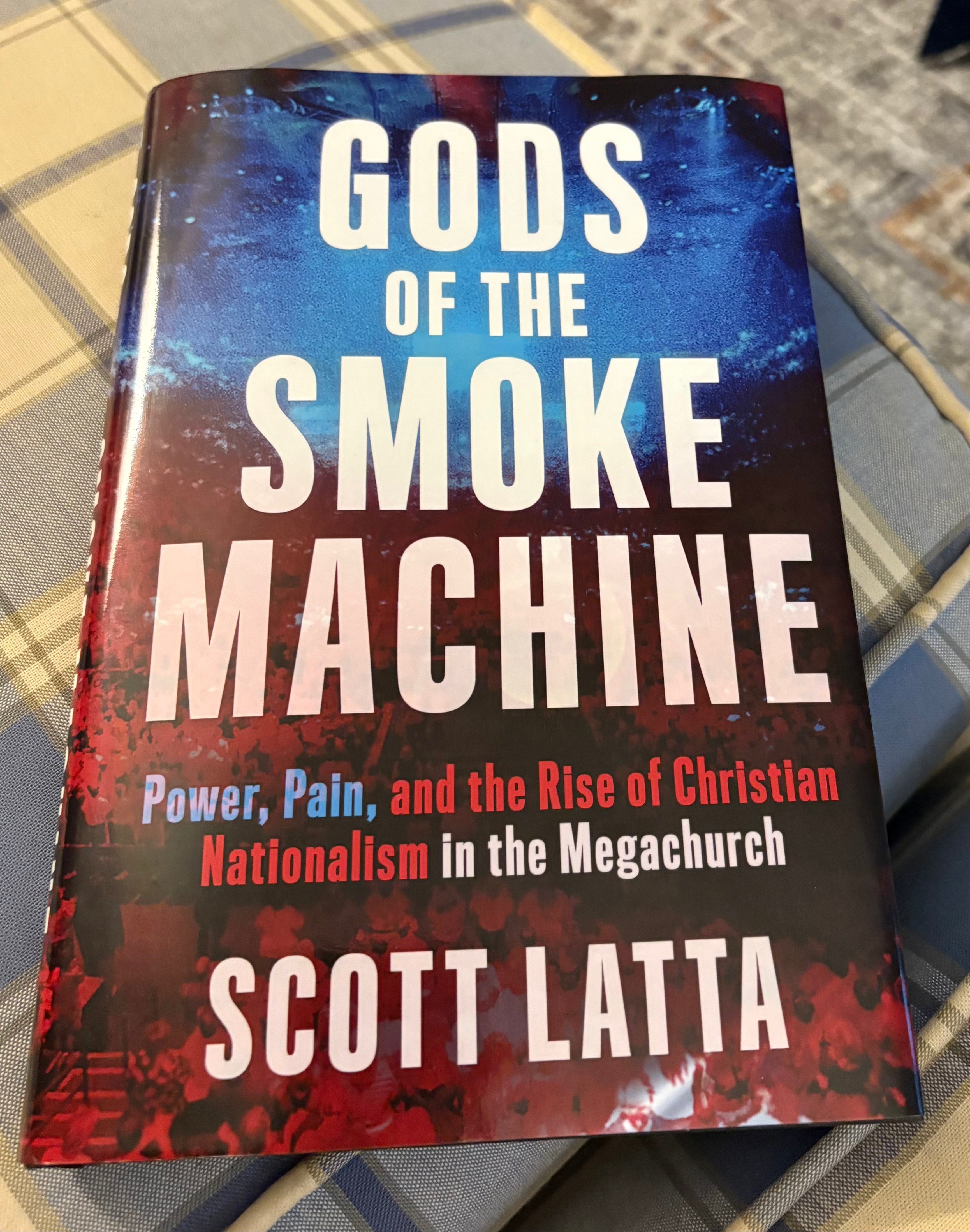
This particular podcast was an interview with the author of a new book entitled “Gods of the Smoke Machine: Power, Pain and the Rise of Christian Nationalism in the Megachurch” by Scott Latta. I found the conversation compelling so I ordered the book. What follows are my reflections after having finished reading it (I suppose that makes it a book review).

Okay, so the book was a page-turner for me. It is well-written. Latta’s writing style is quite engaging and easy to read, and I would recommend this book to pastors and church leaders who are on the front-lines of ministry in contemporary culture.

Hard Conversations

There are few topics more difficult for Christians to talk about than the failures of the church. I love the church. I’ve been formed by it, baptized in it, comforted and corrected by it. Yet, my own history and experience have taught me that love does not require blindness. Sometimes love requires truth-telling.

Latta attempts to shine light on a truth that many folks find difficult to talk about. Nevertheless, it is a conversation worth having. Reading the book caused me to ask the question: Are we worshiping God, or have we learned to worship the machinery built in His name?

Let me confess that Latta and I are not of the same “tribe.” He is one who is in the process of “deconstructing” his faith (or has completed the process–I’m not really sure after reading the book).

This is not a review of the somewhat new and novel idea of “deconstruction” of one’s faith, but if you’re unfamiliar with the term, you can Goggle it to learn more. Simply put, it is exactly what comes to your mind when you hear the phrase “deconstructing one’s faith.”

Though not of the same tribe, I found some value in reading the work. It does us good to get out of our echo chambers to hear other voices. They cause us to think and possibly find some common ground upon which we might build a relationship.

When Growth Becomes the Measure of Faithfulness

Latta reflects on the rise of the modern megachurch and the ways large congregations have learned to thrive even as church participation in America declines. He points out in the introduction that overall church attendance has fallen by about half over the past 25 years. Yet, while overall attendance has fallen, attendance in the megachurch (weekly attendance greater than 2,000 people) has increased by 10% between 2015 and 2020.

Yes, as Latta points out, the pie is getting smaller, but the megachurch’s piece has gotten larger.

Growth itself, of course, is not the problem. Scripture celebrates growth when it flows from faithfulness. But Latta raises a necessary concern: when numerical success, branding, and influence become the primary measures of God’s blessing, something essential is at risk of being lost.

From a pastoral perspective, this is not simply a critique of church size or style. It is a call to remember that the church is not a product to be managed but a body to be shepherded. Efficiency and excellence can serve the gospel—but they can never replace presence, humility, or accountability.

Listening to the Wounded

Perhaps the most sobering parts of the book are the voices of those who were hurt within church systems that should have protected them. Latta shares stories of people who experienced spiritual manipulation, silencing, and abuse, and who found that institutional loyalty often outweighed compassion, truth and accountability.

These stories deserve our prayerful attention. My pastor’s heart reminds me that the credibility of the church is not measured by attendance numbers or production quality, but by how we treat “the least of these”—especially when listening is inconvenient or costly. Repentance, not reputation management, is the way of Christ.

Of course, my more pragmatic (or cynical) self wants to say, “There are two sides to every story.” We only hear one side of the story in Latta’s book. In fairness, according to Latta, churches and pastors were given opportunity to comment, but most did not respond.

Faith, Power, and Allegiance

Latta also explores the uneasy relationship between some megachurches and political power, particularly the blending of Christian language with nationalist ideology. Viewed through my pastoral lens, my concern is not about political disagreement, but about ultimate allegiance. When loyalty to leaders, movements, or ideologies begins to eclipse allegiance to Christ, the church’s witness becomes distorted.

The church has always lived in tension with worldly power. The danger comes when that tension disappears—when the cross is replaced by the quest for influence, and when winning matters more than loving.

A Call to Self-Examination, Not Cynicism

While Gods of the Smoke Machine is clearly critical of the state of the American megachurch, I think Latta painted with a very broad brush. The focus of the book really is upon a very few megachurches and their pastors. He says very little about the majority of churches (there are approximately 1,800 megachurches in the U.S.) and pastors who are faithful to the Gospel and do their best to love one another.

Not to despair, though. The book became for me an invitation to self-examination. Not every church is a megachurch, and not every leader is compromised—but every Christian community must regularly ask hard questions about power, transparency, faithfulness and yes, accountability (there’s that word again).

This book challenges pastors, elders, and congregants alike to consider whether our structures reflect the character of Christ or simply the efficiencies of modern institutions. It urges us to remember that the Spirit of God is not manufactured by lighting cues, smoke machines or emotional crescendos, but is present where there is truth, repentance, and love (oh, and accountability).

Reading with Hope

Ultimately, Gods of the Smoke Machine is a book best read slowly, prayerfully, and with humility. It may stir grief, anger, or recognition. But it can also stir hope—hope that the church can still choose a better way, and that reform is possible when the people of God are willing to listen, repent, and return to the simplicity of the gospel.

For pastors, church leaders, and thoughtful Christians, this book offers an opportunity not to abandon the church, but to love it more faithfully—by seeking the health of Christ’s body rather than the success of its machinery.

There is a bit of the prophetic in the work. Unfortunately (or fortunately?), that prophetic word is coming from one outside the church (well, one who left the church). I don’t know if that makes him an outside insider or an inside outsider. Either way, it will do we leaders well to listen to that prophetic word and take it seriously.

Until next time, keep looking up…

Must Be Something in the Water…

Well, dang! It’s happened again…and in the Dallas, Texas area, too. What has happened again? Another prominent pastor has fallen from grace.

Pastor Steve Lawson, pastor (well, former pastor now) of Trinity Bible Church in Dallas, Texas was removed from his ministry by the elders of the church last week because of an “inappropriate relationship” with a woman who was not his wife. (Read more about the story here).

I’m not here to dump on Pastor Lawson. He’s got enough people doing that. I do want to say, though, there must be something in the water in the Dallas area that is affecting pastors. Only this past June, two very high profile pastors resigned or were removed from ministry in the Dallas area for the same issue facing Pastor Lawson. (I wrote about those two persons here).

I’ll say that Pastor Lawson (who is 73 years old!) is/was a passionate preacher. I’ve listened to a number of his sermons through the years, and have read a couple of his books (he’s written over 30). When he preached, he always preached with certainty and authority (that’s my kind of preaching). He may not have always been right, but he was never in doubt. He was, by all accounts, a holy man used mightily by God for His glory.

A Christian Reaction to Non-Christian Behavior

As one might expect, the ordeal has the Christian community scratching its collective head wondering what is going on with all these “holy” people. Are they living sham lives, false lives, hypocritical lives?

The non-Christian community is not asking the questions, they’re simply saying that all Christianity is a sham and that all Christians are hypocrites (they might be correct on the hypocrite part). Lawson just happens to be the latest example to their point.

As I have reflected over the past week on Lawson’s situation, I’ve found myself asking the same questions. The easier path would be to dismiss these fallen pastors as charlatans and move on, but in so doing we might overlook some truth and miss what God is doing in the midst of it all. So, where is the truth?

First, we need to clarify that we are ALL sinners saved by the amazing grace of God in Jesus Christ. Both preacher and parishioner are subject to sin because as the Apostle Peter reminds us “Your enemy the devil prowls around like a roaring lion looking for someone to devour” (1 Peter 5:8 NIV). The devil can devour the preacher as easily as the parishioner.

Second, these pastors were removed or stepped away from vocational ministry. Appropriately so, I might add. The sins to which they’ve either admitted or accused are of the disqualifying sort–at least until repentance is made and restoration practiced (that’s a whole other discussion).

Clergy should be held to a higher standard, but even acknowledging that fact, I am reminded of the words of Oswald Chambers: “The call of God has nothing to do with salvation and sanctification; it isn’t because you are saved and sanctified that you’ve been called to preach.” We are called to preach because God chose us to do so, and in so doing, placed a “divine compulsion” (the Apostle Paul’s words) within us.

Third, God uses both the holy and the unholy to minister to His people. This is where it gets sticky, but this is the point I want to make as I reflect on these events.

The Holy and The Unholy

I am reminded of Paul’s words to Timothy:

20 In a large house there are articles not only of gold and silver, but also of wood and clay; some are for special purposes and some for common use. 21 Those who cleanse themselves from the latter will be instruments for special purposes, made holy, useful to the Master and prepared to do any good work. (2 Timothy 2: 20 – 21 NIV)

Paul writes to Timothy to encourage him to rightly handle the Word of God. He even goes so far as to name two who have departed from the truth and brought confusion to the body of Christ. Yet, in his encouragement he admits that God’s house contains both holy and unholy vessels. Here’s the truth: God uses both!

Are the holy vessels more useful? Yes, obviously, but just because the holy vessels are MORE useful, doesn’t mean the Master does not utilize the unholy ones.

Please don’t hear me making excuses for these pastors and their failures. Their failures are their own and they must own them and deal with the consequences. What I am saying is don’t discount the good God has done through the ministry He entrusted to them–in spite of their failures. Stated another way: Don’t let the good God has done be negated by their unholy actions.

Nothing justifies their actions, but their actions don’t mean God wasn’t using them. So, why would God use unholy vessels? I can think of three reasons.

God and Unholy Vessels

The first reason is that God loves His people. He’s not using the person for the sake of the person. If He were, the person might begin to think that God owes him/her something because they’re “holy.” Or, the person might begin to think that God is okay with what he/she is doing…if it were all about the person. No, God is using the unholy for the sake of His people, and if another person’s life is touched in the course of that ministry, God has demonstrated His love for His people using an unholy vessel.

The second reason might be that God is storing up judgement/discipline for that “holy/unholy” person. Maybe God is giving that person the rope he/she is asking for, and surely, if you give a person enough rope he/she will hang themselves. Perhaps it is all about judgment/discipline towards His house. Is that not God using the unholy for His purpose?

The third reason is so that He can demonstrate the riches of His grace. God’s is an amazing and extravagant grace, and He gives it in ways we don’t always understand, nor do we always like (ask the older brother in the Story of the Prodigal Son).

If God used only holy people, it wouldn’t be long before all the holy people would be pointing to themselves thinking everything was happening because they are so holy. No, everything is happening because God is so gracious. It is always and forever about what God is doing, never ever about what we are doing.

So, I suppose we should let this be a warning to all of us (especially those of us in ministry). So, I heed the warning by seeking to live a holy life, by confronting the sin that is within me, and by crucifying the passions and lusts of the flesh on a daily basis…well, because holiness is such a daily endeavor. And I do it not for ministry success, but because I’m a disciple of Jesus Christ.

Yes, God uses holy vessels in a greater way than unholy ones, but God can, and sometimes does, use people who are undeserving. And, He does it whether I like it or not.

Until next time, keep looking up…

A Lot of “One Another-ing”…

Studying for a recent message, I was led to reflect on the number of times the New Testament talks about our relationship with “one another.” I was prompted by the Apostle Paul’s admonition to the church at Ephesus…

Therefore I, the prisoner of the Lord, urge you to walk in a manner worthy of the calling with which you have been called, with all humility and gentleness, with patience, bearing with one another in love

Ephesians 4: 1-2 (NASB)

So, here is what I found in my reflection:

Love one another.

Serve one another.

Accept one another.

Strengthen one another.

Help one another.

Encourage one another.

Care for one another.

Forgive one another.

Submit to one another.

Commit to one another.

Trust with one another.  

Be devoted to one another.

Be patient with one another.

Be interested in one another.

Be accountable to one another.

Confess to one another.

Live in harmony with one another.

Do not pass judgment on one another.

Do not slander one another.

Instruct one another.

Greet one another.

Admonish one another.

Spur one another on toward love and good deeds.

Meet with one another.

Agree with one another.

Be concerned for one another.

Be humbled to one another in love.

Be compassionate to one another.  

Do not anger one another.

Do not lie to one another.

Do not grumble to one another.

Give preference to one another.

Be at peace with one another.

Be of the same mind with one another.

Comfort one another.

Be kind to one another.

Live in peace with one another.

Carry one another’s burdens.

By my count, that’s 38 “one anothers” in the New Testament. There are probably more and if I took more time, I’d probably find them, but time is a precious commodity and the deadlines are pressing, so I invite you to add to my list if I missed any. I promise that you won’t offend me if you correct me. Please correct me. It’s called accountability, which is one of the “one anothers.”

My point is simply this: that’s a lot of “one another-ing!” One another-ing only happens in the context of the Body of Christ. It is what we’re called to as the church.

My reflection also raises the question: How are we doing with our one another-ing?

We’re (I’m) not doing it perfectly, but that’s okay. I’m not perfect. And, the church isn’t perfect. That’s why we (I) need grace. The church isn’t perfect because it is made up of imperfect people. How does the saying go? If you ever find a perfect church, don’t go! You’re sure to mess it up.

I do think, though, that all this one another-ing is not simply about going to church. It is about belonging to the church. The Church! You know? The Communion of Saints! Yes, that holy, catholic body that exists across time and space, and in all places where the name of Jesus Christ is exalted. Yes, that Church that is, at one and the same time, both global and local. This Church is meant to make a difference in the world, but it will only do so as we grow in our capacity to “one another” properly. We grow by the grace of God in Jesus Christ by the power of the Holy Spirt.

So, how’s your “one anothering” coming along?

Until next time, keep looking up…

The Pastor’s Heart or Prophet’s Voice…

I’m approaching a milestone birthday, and no, I’m not going to say which one, but as it approaches I must confess that I’ve struggled greatly over the past few years with finding a balance between a pastor’s heart and the prophetic voice that is part of a preacher’s calling. The older I’ve gotten, the more I hear the prophetic voice dominating my reactions to things I see and hear around me. I find myself often wanting to stand up and shout, “Repent, for the Kingdom of God is at hand!”

I often justify my reactions by the fact that one of my seminary professors many years ago said to me, “Lynn, you have the gift of prophetic utterance.” Then, he added, “That won’t often sit well with congregations you will serve. Find balance.” In recent years, I think I’ve lost that balance (if I ever had it).

I’ve actually probably never had balance. I’m going to admit that I’ve always tried to err on the side of the pastor’s heart. Nothing wrong with that, I suppose, until I acknowledge the reason I did: approval addiction. I wanted to be liked more than I wanted to be obedient. I wanted to be a “successful” pastor more than I wanted to be an obedient disciple. The older I get, the more I realize that I need to call my own self to repentance. The older I get, the more I realize how much grace I need…and how much grace I’ve been shown. Helps to strengthen the pastor’s heart, but if I’m not careful it can quench the prophet’s voice. Lord, I need balance.

I think the prophetic voice is more predominate these days because I’ve been separated from the body of Christ. No, I haven’t left the church. I’ve preached plenty of times in plenty of places, but Vanessa and I haven’t called a single congregation home for a long time. I don’t count the two and a half years we served a small congregation (wonderful congregation, wonderful folks, good friends). It was where we attended worship, but time and distance prevented us (me) from investing ourselves in the life of the congregation in ways that form deep connections that nurture the pastor’s heart. That’s totally on me, not the congregation.

I admit. I was running a new business and I was investing way more time and effort in that enterprise than I was in nurturing the congregation. For that, I owe them a sincere apology. They deserved better. It was during that time that I sensed my preaching moving toward the prophetic voice, and I lost a sense of the pastor’s heart. See, if you try real hard, you can justify anything, but just because something is justifiable doesn’t mean it is justified. Then again, maybe I’m just getting older. Maybe it’s just that I’m suffering from GOMS (grumpy old man syndrome), and I don’t feel the need to be liked as much.

Of course, it could be that I look around me and see our culture and the church coming off the rails. I mean really, who would have thought…even 10 minutes ago…that we’d be having a cultural conversation concerning sex change operations for children? FOR CHILDREN! (<<<<<that’s me shouting in my most prophetic sounding voice). Or, that Congress would be holding hearings on the matter and having trouble deciding if it is “gender-affirming care,” or “genital mutilation.”

The prophetic voice in me wants desperately to shout that the practice of sex change operations for CHILDREN is getting awfully close to the Old Testament practice of child sacrifice. The prophetic voice in me wants to shout Genesis–

So God created mankind in his own image,
    in the image of God he created them;
    male and female he created them.

Genesis 1: 27 (NIV)

Let’s start the debate there and see where it leads us. There are just some things in this world that are immutable. Maybe we need the prophet’s voice to remind us.

Then, I remember when the pastor’s heart was more real to me, and I consider the circumstances and issues that bring a child and his or her parents to such a decision and I want desperately to show compassion and empathy and grace. I want desperately to understand what brought them to this place so that I might in some way be in ministry to them, to lead them to the Truth in Jesus Christ. And, I realize that can never happen until there is a deep relationship that is formed between us. That relationship can only be formed in the context of community…the community that is found in the church.

I need a church home. We all do, really. Without a church home, I know the prophetic voice will increasingly dominate my calling and I’ll continue to see the pastor’s heart diminished…for the worse, I think. For those who aren’t pastors/preachers, without a church home you’ll likely grow more cynical and self-centered (but maybe not) as you get older. Just another sign that we all need grace…and balance.

So, Lord, I’m looking for balance…balance between the prophet’s voice and the pastor’s heart. If it’s true that I have both, I don’t want to lose either. May the Holy Spirit guide us all to the place of full obedience so that we might be perfectly balanced in the center of His will.

Until next time, keep looking up…