A Crown or a Cross?

What Palm Sunday Teaches Us About Shattered Expectations and True Faith

This Sunday is Palm Sunday—the day we remember the crowds waving palm branches and shouting “Hosanna!” as Jesus rode into Jerusalem. But here’s what haunts me every year: Less than a week later, many of those same voices were shouting “Crucify Him!”

How does a crowd go from crowning a King to demanding His death in just a few days? And what does that say about us when God doesn’t meet our expectations?

On Palm Sunday, we often focus only on the triumphal entry. This year, let’s do something different. We’ll look at Mark’s account of Jesus entering Jerusalem—and then jump straight to the trial before Pilate on Good Friday. In less than a week, the same city saw the crowd shift from “Hosanna!” to “Crucify Him!” They began the week expecting a crown. They ended it demanding a cross.

The Triumphal Entry (Mark 11:1-11)

As Jesus approached Jerusalem, riding on a young colt, the crowd erupted in praise straight from Scripture:

Hosanna! Blessed is he who comes in the name of the Lord! Blessed is the coming kingdom of our father David! Hosanna in the highest!” (Mark 11:9-10, quoting Psalm 118)

They spread their cloaks and leafy branches on the road, anointing Him as King in a festal procession. These weren’t outsiders. They were good, religious people who knew and loved the Word of God.

From “Hosanna” to “Crucify Him” (Mark 15:1-15)

Fast-forward to the trial before Pilate. The chief priests, elders, scribes, and the crowd—still religious people—now cried out, “Crucify Him!” They chose Barabbas, a rebel and murderer, over Jesus.

In just days, their cheers turned to condemnation. Why?

They knew the Scripture… but they did not understand the Word made flesh standing before them. They wanted a crown on their terms—a political deliverer who would overthrow Rome and restore Israel’s glory immediately. When Jesus refused to fit their expectations, their hearts turned.

The heartbreaking truth is that both crowds were driven by the same root issue: Jesus shattered their expectations.

The Same Struggle Today

If we’re honest, the same thing can happen to us. Many of us are “good, religious folks” who love the Bible and love Jesus. We pray for healing, deliverance from addiction, or for our children to come home—expecting the crown of quick answers and comfortable outcomes.

When God says “no,” or “not yet,” or when the cross of suffering comes instead of the comfort we wanted, our hearts can waver just like that first-century crowd.

Yet here is the wonder of the gospel: God’s “no” to our agenda is often His greater “yes” to a better, eternal life—resurrection life. He does not abandon us to our sin or our pain. He uses even the hardest things to redeem us.

The very thing we think will destroy us, the Lord uses to shape us.

Jesus Knows the Pain of “No”

Remember Jesus in the Garden of Gethsemane, praying, “Let this cup pass from me.” Even the Son of God asked for a different way, and heaven was silent. Not because the Father didn’t love Him, but because the cross was the only way to save us.

That temporary “no” from the Father became our eternal “yes.” Because Jesus went to the cross, the crown comes through the cross—one of the beautiful paradoxes of God’s Kingdom.

Our God is a big-picture God. As He declares in Isaiah 46:10, “I make known the end from the beginning, from ancient times what is still to come.” He sees the whole story. We see only the painful circumstances right in front of us. But He is already turning our “no” into resurrection victory.

What This Means on Monday Morning

When the medical scan comes back worse, when the phone call brings bad news, or when the prodigal still hasn’t come home—what then?

We have a daily choice: Will I demand the crown on my terms right now, or will I trust the King who leads through the cross?

Here are four practical steps when your expectations are shattered:

  1. Name the disappointment honestly to God. Jesus did this in Gethsemane—pour out your heart without pretense.
  2. Remember you are not abandoned. The same God who said “no” to His own Son is working something far greater than we can see.
  3. Choose to worship anyway. Sing “Hosanna” even when you don’t feel it. Sunday is coming.
  4. Cling to your baptism. Those waters marked you as belonging to the King whose crown came through the cross.

When you feel your heart beginning to waver like that ancient crowd, run back to the cross and whisper, “Lord, I don’t understand, but I trust You. You are still King of kings.”

We Are Barabbas

Nowhere is this clearer than at the trial before Pilate. The crowd was given a choice: Jesus or Barabbas. Barabbas was exactly what they wanted—a man of action promising quick deliverance. Jesus was what they (and we) needed—the innocent Son of God who would take their place.

They chose Barabbas. And Jesus took Barabbas’s place on the cross.

We are Barabbas. We are the guilty ones who deserve judgment, yet because of Jesus we go free. He took our place so that our temporary “no’s” could become God’s eternal “yes.”

We want a quick, revolutionary fix. Jesus offers sacrificial love. We want a crown on our terms right now. Jesus gives us the cross that leads to the crown of life.

The Crown That Comes Through the Cross

One day, the same Jesus will return riding a white horse. On His robe and on His thigh will be written: “King of kings and Lord of lords” (Revelation 19:16). The crown of thorns becomes the crown of glory. The cross was never the end—it was the path to His eternal reign.

The crowd had a choice: a crown or a cross. Which choice will we make?

Until next time, keep looking up…

Just One More Hour…

37 Then he returned to his disciples and found them sleeping. “Simon,” he said to Peter, “are you asleep? Couldn’t you keep watch for one hour? (John 14:37 NIV)

One hour can make all the difference in the world.

Just ask anyone on that first Sunday morning after daylight saving time. Our bodies don’t adjust. We feel it all day long—and somehow, we never quite get it back.

Researchers even have a name for it: social jetlag. When our internal clocks and our external schedules don’t line up, everything feels off. We’re not just tired—we’re out of sync.

And that’s not just a physical reality. It’s a spiritual one, too.

We all know what it’s like to be “asleep” when we should be alert—whether from exhaustion, distraction, or just the weight of life.

In Mark 14, Jesus and His disciples face their own “one hour” moment in the Garden of Gethsemane. What we see there is the difference one hour can make—and two very different responses to it.

A Moment They Slept Through

It had been a long week.

Celebration. Conflict. Teaching. Travel. Late nights and heavy conversations. By the time they arrived in the garden after the Passover meal, the disciples were worn out—physically and spiritually.

Jesus asked them to do one simple thing: stay awake and pray.

But they couldn’t do it.

When Jesus returned, He found them sleeping and asked,
“Couldn’t you watch for one hour?”

The cross was on His mind—and they slept right through it.

That’s what makes this moment so sobering. The disciples didn’t fail because they were rebellious. They failed because they were tired.

And if we’re honest, that’s where many of us live.

We don’t intend to drift. We don’t plan to miss what matters most. But life wears us down, and before we know it, we’ve grown spiritually inattentive.

A Moment Jesus Leaned Into

While the disciples slept, Jesus prayed.

“My soul is overwhelmed with sorrow to the point of death…
Abba, Father… take this cup from me. Yet not what I will, but what you will.”
(Mark 14: 35-36)

This is one of the most honest and human moments we see in the life of Jesus.

He is overwhelmed. Distressed. Under immense pressure.

And yet—He doesn’t run from it. He brings it to the Father.

That’s what sets Jesus apart in this moment. Under pressure, He doesn’t withdraw—He surrenders.

And in that surrender, we see something we desperately need to understand:

Pressure is never pointless.

The garden itself reflects that truth. Gethsemane means “oil press”—a place where olives are crushed so that what’s inside can be released.

In the same way, it was under the crushing weight of this moment that Jesus fully surrendered to the will of the Father—and set in motion what would lead to our redemption.

God did not waste that moment.

And He doesn’t waste ours either.

What This Means for Us

There’s hope here—real hope.

First, it’s not a sin to be overwhelmed.

We sometimes think faith means always being strong, always being happy, always having it together. But Jesus shows us otherwise. He was overwhelmed—and still faithful.

Second, it’s not wrong to pray for deliverance.

Jesus prayed, more than once, “Take this cup from me.” Honest prayer is not weak faith—it’s real faith.

But here’s the key:

Prayer is not about getting what we want from God. It’s about finding the strength to walk in what God wants for us.

God is playing the long game, even when we’re looking for the shortcut.

And sometimes, the center of His will is not the most comfortable place—but it is always the best place.

When Your Hour Comes

If you haven’t faced your “one hour” moment yet—a season of pressure, grief, or testing—you will.

The question is not if that moment comes. The question is how you’ll respond when it does.

Will you face it asleep… or surrendered?

The good news is this: even if you’ve missed moments before—even if you’ve slept through seasons you wish you could redo—Jesus doesn’t leave you there.

He meets you with grace.

He calls you forward again.

He invites you back to faithfulness.

We may never get that lost hour back from daylight saving time.

But the hours we’ve missed spiritually?

Those are met with grace.

I think I’ll take the grace!

Until next time, keep looking up…

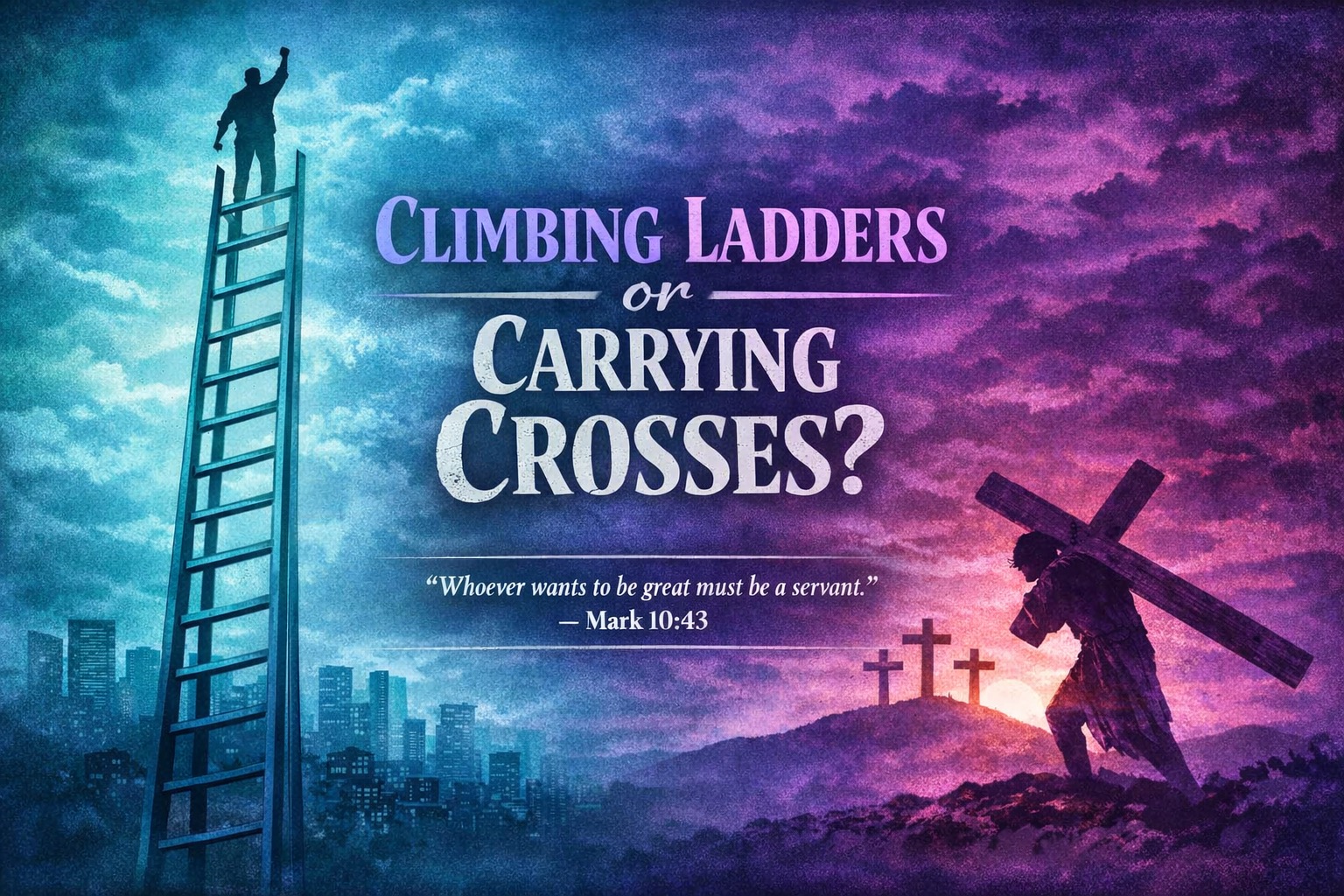
Climbing Ladders or Carrying Crosses…

Here’s what I’ve been wrestling with all week…Mark 10:35-45.

If James and John—the Sons of Thunder—showed up in our church today asking Jesus for the VIP thrones in His kingdom, what would we say?

We might high-five their ambition. “Guys, you’ve got vision! That’s the drive we need.” We’d probably hand them a leadership book and say, “Keep climbing—sacrifice a little now to go up later.” 

In business, politics, and even too many church circles, we celebrate the climbers. Success looks like ascending the ladder.

But Jesus doesn’t applaud them. Right after predicting His own suffering and death—for the third time—He responds, in essence: “You have no idea what you’re asking.”

This passage in Mark 10 turns my idea of leadership upside down. Here’s where I’ve landed this morning: Kingdom greatness doesn’t climb ladders. It descends—through service, sacrifice, and ultimately the cross.

The World’s Way

James and John approach Jesus: “Teacher, do for us whatever we ask… Grant us to sit, one at Your right hand and one at Your left, in Your glory.” Thrones. Honor. Prime seats.

These are the same disciples who once wanted to call down fire on a rejecting village (Luke 9:51-56). Ambitious? Yes. Evil? Not really—just blinded by the world’s definition of success. And the timing stings: this comes immediately after Jesus warns them again about His coming rejection, death, and resurrection.

Jesus doesn’t scold. He asks, “Are you able to drink the cup I drink, or be baptized with the baptism I’m baptized with?” The cup is suffering. The baptism is immersion in pain and death.

They boldly reply, “We are able.” Jesus affirms they will share in that suffering (James martyred, John exiled), but the seats aren’t His to grant.

The other disciples hear and get indignant—jealousy erupts. Sound familiar? We’ve all wrestled with “Who’s the greatest?” in our hearts, families, workplaces, or churches.

Jesus gathers them and contrasts the world’s model: “You know that those considered rulers of the Gentiles lord it over them… But it shall not be so among you. Whoever wishes to become great among you shall be your servant, and whoever wishes to be first shall be slave of all.

In the world, leaders climb ladders. In the Kingdom, leaders carry crosses.

It’s one thing to wash feet. It’s another to carry a cross.

We read good leadership books—even Christian ones. John Maxwell’s Law #18 says a leader must give up to go up. Helpful principle. But for Jesus, sacrifice isn’t one law among many—it’s the only law. “Going up” isn’t the goal. Going down is.

The Jesus Way

Jesus doesn’t just teach this. He embodies it:

For even the Son of Man came not to be served but to serve, and to give His life as a ransom for many.” (Mark 10:45)

The Son of Man—with all authority—didn’t come to be waited on. He came to serve. And the ultimate service? Laying down His life to ransom captives free. That’s the Suffering Servant of Isaiah 53.

Paul captures the full descent in Philippians 2:

Have the same mindset as Christ Jesus: Who, being in very nature God, did not consider equality with God something to be used to his own advantage; rather, he made himself nothing by taking the very nature of a servant… he humbled himself by becoming obedient to death— even death on a cross! (Philippians 2:5-8)

The cross doesn’t just save us. It shapes us—how we live, serve, and lead.

A Little Confession

This passage has confronted me hard during Lent. For years in ministry, I climbed the ecclesiastical ladder. I started wanting to help people (that’s why I left law enforcement for pastoring—more room for grace). But I brought worldly expectations: success meant bigger churches, bigger roles, maybe even bishop.

The Church encouraged it—leadership seminars, conferences, principles adapted from the world. I rose to District Superintendent, then a large church. I eyed the next rung.

And yes, jealousy too—just like the disciples. Seeing others promoted to “big” churches, I wondered, “Why not me? Why hasn’t God blessed me that way?”

Lent is for repentance. Jesus never tires of leading us home. By grace, He’s reshaping that ambition in me—not perfectly, but continually.

What About You?

Everything rises or falls on Mark 10:45. Jesus didn’t climb a ladder—He descended to the cross so we could be set free. That ransom wasn’t for our comfort or status; it was so we could become like Him: servants who lead by laying down our lives.

So here’s the question: Will you lay down the ladder you’ve been climbing? Maybe it’s ambition for recognition in your family, workplace, church role, or your own heart. Will you pick up your cross instead—not dramatically, but in daily choices: to serve rather than be served, listen rather than demand, give rather than grasp?

The same John who chased thrones later wrote: “This is how we know what love is: Jesus Christ laid down his life for us. And we ought to lay down our lives for our brothers and sisters” (1 John 3:16).

If God transformed him, He can transform us.

Here is the prayer I’ve been praying all week: “Lord, I lay down my ladder. I pick up my cross. Reshape me like You.”

Would you pray it with me? Share your thoughts in the comments—I’d love to hear and pray with you.

Until next time, keep looking up…

(If this stirred something, feel free to share it. Lent is a season for turning toward the cross together.)

Jesus is Enough…

We live in a world of plenty. I don’t think any of us living in the United States of America could legitimately argue otherwise, the frequent conversations centered around homelessness, poverty and food insecurity notwithstanding. Even the poorest among us are considered rich by the rest of the world’s standards. 

There are, however, signs around us that indicate even in this world of plenty, there is still something lacking, and that is truly sad. Those indicators are not tangible things like food, shelter, clothing and transportation. They’re much more intangible—things like identity, meaning, purpose and fulfillment. Dare I even say, “Salvation?” You know? All things that money can’t buy.

According to recent data from the National Alliance on Mental Illness and other sources, about 1 in 5 U.S. adults — over 60 million people — experience mental illness each year, with rising concerns around depression, anxiety, and suicide. This hits young people especially hard: Generation Z, despite unprecedented access to information via smartphones, reports some of the highest levels of mental health struggles among generations. We’ve experienced it in our own family, and it is heartbreaking.

Life is not a matter of having enough stuff. It’s a matter of having the right stuff. We can go through life achieving much success, status in our community, gaining financial security and all while being deeply sincere in our beliefs and our actions, and yet, we can still feel as though something is missing. That is a sad predicament, indeed!

A Rich Young Ruler

Lest I paint too grim a picture, though, let me remind us that there is nothing new under the sun. We’re not the first generation to wrestle with the nature of “stuff” and its impact on our lives. Remember that Jesus encountered a young man who came asking the deep question we’ve all asked at one time or another: “What must I do to inherit eternal life?” Mark’s record of the encounter begins this way:

As Jesus was starting out on his way to Jerusalem, a man came running up to him, knelt down, and asked, “Good Teacher, what must I do to inherit eternal life?” (Mark 10:17 NLT)

This encounter is recorded in the three “synoptic” Gospels—Mark, Luke and Matthew. When we put all three accounts together we begin to get a clear picture of the young man. Yes, Mark only says a “man,” but Matthew makes the distinction that he is “young,” and Luke even includes that he is a “ruler” of sorts, so this has become “the story of the rich young ruler.”

I find it interesting that he was young, and like the young people of our day, he was struggling with a deep existential question. I mention Mark’s account because there is one detail that Mark gives us that I believe we need to note if we’re to grasp the meaning of the entire encounter. I’ll “circle back” to that detail momentarily.

What do we know about this young man? Well, from Luke’s gospel (Luke 18:18-30), we know he was rich. We assume it from Mark and Matthew (Matthew 19:16-26) because it says he had “great wealth.” Great wealth? From that, it is safe to assume that he had some measure of success in his life, although I suppose he could have inherited his wealth. Even if he did inherit it, we know that most children from wealthy families do pretty well on their own. Whether he inherited his wealth or was a successful businessman, his success brought him a measure of status in his community because Luke tells us he was a “ruler.”

It’s unlikely that a Roman official would approach Jesus with a religious question, so the “rich young ruler” was probably a Jewish leader in the local synagogue or perhaps even a member of the Sanhedrin, the Jewish court that dealt with religious issues in Jesus’ day.

Something is Missing

Success? Check. Status? Check. I think we can also say he was sincere. According to Mark, the man runs to Jesus and bows before Him. This was not some Jewish religious leadership set up of Jesus. No, this is not how they operated. In Mark’s gospel, the Scribes, Pharisees and Sadducees just show up and start questioning Jesus (see Mark 2 and Mark 7).

Mark says the man both ran and knelt indicating he was sincerely seeking wisdom and an answer to his question. But, we also learn of his sincerity in his keeping of the law. Listen to the conversation again:

17 As Jesus was starting out on his way to Jerusalem, a man came running up to him, knelt down, and asked, “Good Teacher, what must I do to inherit eternal life?” (That’s a sincere question)

18 “Why do you call me good?” Jesus asked. “Only God is truly good. 19 But to answer your question, you know the commandments: ‘You must not murder. You must not commit adultery. You must not steal. You must not testify falsely. You must not cheat anyone. Honor your father and mother’.”

20 “Teacher,” the man replied, “I’ve obeyed all these commandments since I was young.”

The young man was a sincere seeker after truth. By every account, here was a man that had success, status in the community and financial security who was truly sincere in matters of faith. He was a good man seeking to do the right thing and live a good life.

And yet, something was missing. All of that was not enough. Let me say it another way: This man had achieved all he could hope to achieve. It was not enough. He was lacking in a world of plenty. I wonder if we don’t often find ourselves in the same position? Could it be that we, like him, have everything the world says should be enough…yet still walk away empty?

Personally, as a businessman, I know how easy it is to depend on the balance sheet and the P&L statement to define success and my achievement. I did the same thing when I was in full-time ministry.

Success is the measure of a man. Sincerity is a gauge for our goodness. Both are far from reality. The truth is we want to be achievers, not believers. We think we can achieve our salvation, and we do so through success and sincerity. None of our achievements merit salvation. Even the most sincere among us can be sincerely wrong.

A Little Love Goes a Long Way

I love Jesus’s response to him. Here’s that little detail Mark includes, which is so unlike Mark. Mark is a “just the facts” kind of guy. Mark’s inclusion of this detail signifies (I think) its importance. Verse 21 says, “Looking at the man, Jesus felt genuine love for him.”

Genuine love! Jesus responded to him with love. It is in love that Jesus corrects us all, and it is in love that Jesus invites us all. 1 John 3:16 says, “We know what real love is because Jesus gave up His life for us.”

Jesus wasn’t angry with the man. Jesus heard the man’s question and saw the man’s need, so He responds, “Here’s what you lack…go sell your stuff…give it to the poor…come, follow Me” (Lynn paraphrase).

Here’s the sad part: Mark tells us the man went away sad because he had great wealth. Yes, he had stuff. He had success. He had status. He had security. He even had sincerity. The one thing he lacked? Surrender! The man just couldn’t let go.

Jesus uses the man’s departure as a teaching moment for His disciples. Jesus says, “Hey guys. Do you know how hard it is for a rich person to make it into the Kingdom? It’s easier for a camel to go through the eye of a needle than it is for a rich person to enter the Kingdom” (another Lynn paraphrase).

Let’s set aside the “camel and eye of the needle” for now. Focus on that and we miss the point. That’s called majoring in the minors. The point Jesus is teaching his disciples is the difficulty of anyone entering the Kingdom of God.

And, the disciples get the point! “If that’s the case, who can be saved?” It’s the same question the man was asking. So, Jesus brings the point home in verse 27: “Humanly speaking, it is impossible. But not with God. Everything is possible with God.”

And, there it is. The key to eternal life…for the man in the encounter…for the disciples…and ultimately, for us, too. Everything is possible with God!

Surrendering the Good for the Best

That which is missing for us who live in a land of plenty is surrender. Surrender to the Lordship of Christ. We’re all good people. We’re generally successful folks. Most of us have a good measure of financial security and we have sincerely sought to be good people…to do the right thing for the right reason. But we wonder, “Am I saved?” “Will I make it to the Kingdom?” There’s something unsettled in our spirits and we can’t quite put our finger on it.

Success. Status. Security. Sincerity. Those are all good things. Not a bad thing in the bunch. They are, however, not enough. One thing we lack: surrender.

The man loved good things more than he loved Jesus. There is the sin in this encounter. No, it wasn’t a sin that would make us go, “Oh! No! How could he?” Sin is much more subtle than that. It slips up on us and catches us unaware…so much so that we think it isn’t even sin.

The man kept the law. He wanted to keep control, too. Control rarely feels like control to us. It feels like responsibility. Yet, it kept him from following Jesus. What a shame. Letting a good thing keep him from the best thing.

Our success and our sincerity are never enough for our salvation. Salvation never comes until we surrender to Jesus. Surrender all the things that hinder us from following Him. There is no salvation apart from surrender. Don’t misunderstand me. Salvation is not a transaction. We are not saved because we surrender perfectly — we are saved because we trust the One who surrendered Himself for us. 

We hold in our grasp many great and wonderful things…things we’ve worked hard for…things we’ve attained. They mean a lot to us. They are good and wonderful things. They are not the greatest thing, though, and in order to grasp the greatest thing, we have to let go of the good things.

Surrender is not dramatic first. It is directional. It is this: Lord, You get final say:

  • Over my money.
  • Over my schedule.
  • Over my reputation.
  • Over my ambitions.
  • Over my security.
  • Over my success.

We cannot save ourselves. Our success will not be enough. Our status will not be enough. Our security will not be enough. Our sincerity will not be enough. But what is impossible with us is possible with God. God has done for us what we could never do for ourselves. Fully. Finally. In Jesus Christ. Jesus is enough!

So, we do not achieve eternal life. We receive it. We trust Him.

The man walked away sad. We don’t have to walk away sad because Jesus is all the enough we’ll ever need.

Until next time, keep looking up…