I spend a lot of time looking through my windshield. To pass the time, I listen to a lot of podcasts (and I mean a lot!). I came across one recently entitled “The Roys Report” that peeked my interest, so I gave it a listen.
I came across The Roys Report months ago when I was following news of the fall of several prominent megachurch pastors. I won’t say I’ve been a regular listener of the podcast, but if one pops up that sounds interesting, I give it a listen.
This particular podcast was an interview with the author of a new book entitled “Gods of the Smoke Machine: Power, Pain and the Rise of Christian Nationalism in the Megachurch” by Scott Latta. I found the conversation compelling so I ordered the book. What follows are my reflections after having finished reading it (I suppose that makes it a book review).
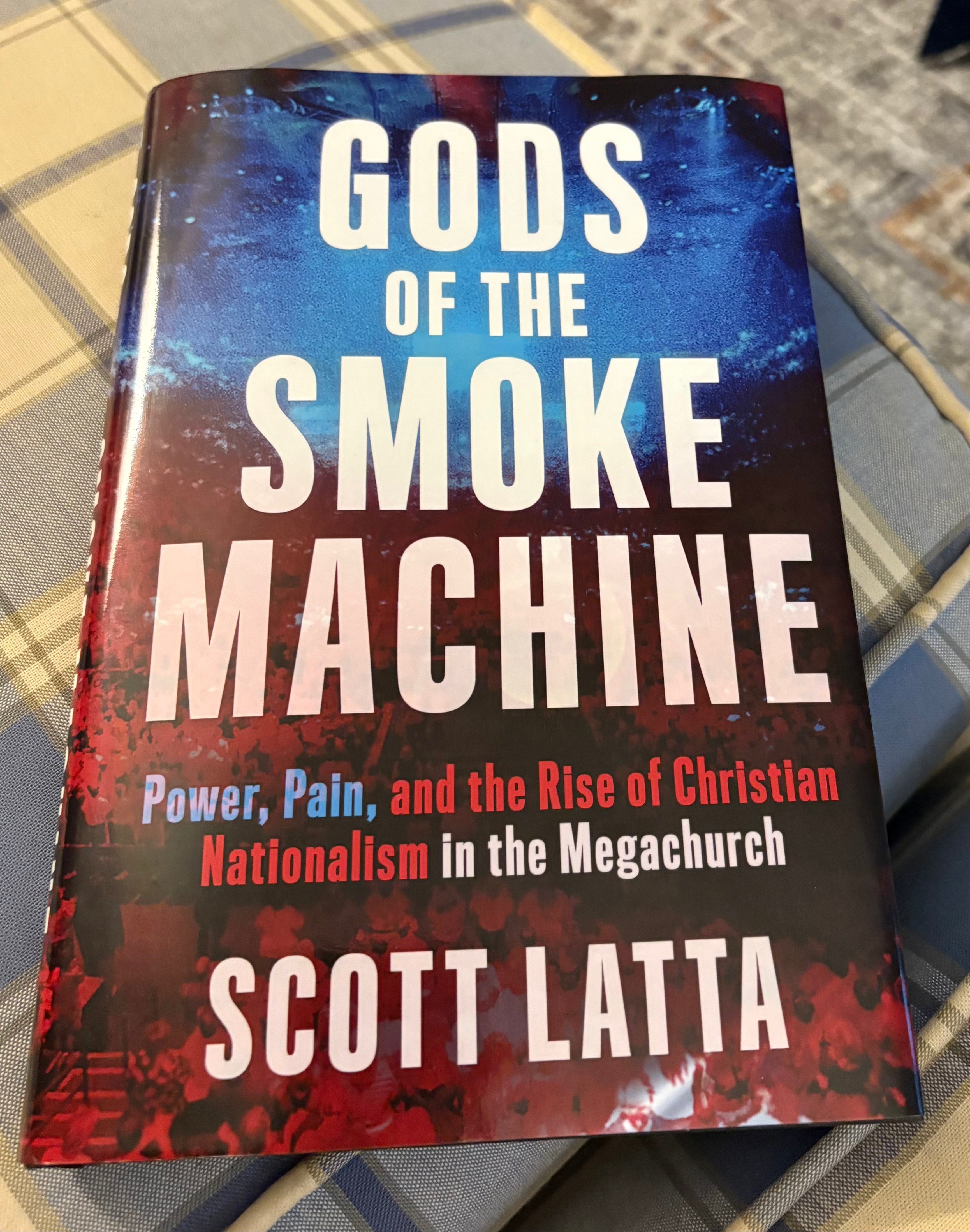
Okay, so the book was a page-turner for me. It is well-written. Latta’s writing style is quite engaging and easy to read, and I would recommend this book to pastors and church leaders who are on the front-lines of ministry in contemporary culture.
Hard Conversations
There are few topics more difficult for Christians to talk about than the failures of the church. I love the church. I’ve been formed by it, baptized in it, comforted and corrected by it. Yet, my own history and experience have taught me that love does not require blindness. Sometimes love requires truth-telling.
Latta attempts to shine light on a truth that many folks find difficult to talk about. Nevertheless, it is a conversation worth having. Reading the book caused me to ask the question: Are we worshiping God, or have we learned to worship the machinery built in His name?
Let me confess that Latta and I are not of the same “tribe.” He is one who is in the process of “deconstructing” his faith (or has completed the process–I’m not really sure after reading the book).
This is not a review of the somewhat new and novel idea of “deconstruction” of one’s faith, but if you’re unfamiliar with the term, you can Goggle it to learn more. Simply put, it is exactly what comes to your mind when you hear the phrase “deconstructing one’s faith.”
Though not of the same tribe, I found some value in reading the work. It does us good to get out of our echo chambers to hear other voices. They cause us to think and possibly find some common ground upon which we might build a relationship.
When Growth Becomes the Measure of Faithfulness
Latta reflects on the rise of the modern megachurch and the ways large congregations have learned to thrive even as church participation in America declines. He points out in the introduction that overall church attendance has fallen by about half over the past 25 years. Yet, while overall attendance has fallen, attendance in the megachurch (weekly attendance greater than 2,000 people) has increased by 10% between 2015 and 2020.
Yes, as Latta points out, the pie is getting smaller, but the megachurch’s piece has gotten larger.
Growth itself, of course, is not the problem. Scripture celebrates growth when it flows from faithfulness. But Latta raises a necessary concern: when numerical success, branding, and influence become the primary measures of God’s blessing, something essential is at risk of being lost.
From a pastoral perspective, this is not simply a critique of church size or style. It is a call to remember that the church is not a product to be managed but a body to be shepherded. Efficiency and excellence can serve the gospel—but they can never replace presence, humility, or accountability.
Listening to the Wounded
Perhaps the most sobering parts of the book are the voices of those who were hurt within church systems that should have protected them. Latta shares stories of people who experienced spiritual manipulation, silencing, and abuse, and who found that institutional loyalty often outweighed compassion, truth and accountability.
These stories deserve our prayerful attention. My pastor’s heart reminds me that the credibility of the church is not measured by attendance numbers or production quality, but by how we treat “the least of these”—especially when listening is inconvenient or costly. Repentance, not reputation management, is the way of Christ.
Of course, my more pragmatic (or cynical) self wants to say, “There are two sides to every story.” We only hear one side of the story in Latta’s book. In fairness, according to Latta, churches and pastors were given opportunity to comment, but most did not respond.
Faith, Power, and Allegiance
Latta also explores the uneasy relationship between some megachurches and political power, particularly the blending of Christian language with nationalist ideology. Viewed through my pastoral lens, my concern is not about political disagreement, but about ultimate allegiance. When loyalty to leaders, movements, or ideologies begins to eclipse allegiance to Christ, the church’s witness becomes distorted.
The church has always lived in tension with worldly power. The danger comes when that tension disappears—when the cross is replaced by the quest for influence, and when winning matters more than loving.
A Call to Self-Examination, Not Cynicism
While Gods of the Smoke Machine is clearly critical of the state of the American megachurch, I think Latta painted with a very broad brush. The focus of the book really is upon a very few megachurches and their pastors. He says very little about the majority of churches (there are approximately 1,800 megachurches in the U.S.) and pastors who are faithful to the Gospel and do their best to love one another.
Not to despair, though. The book became for me an invitation to self-examination. Not every church is a megachurch, and not every leader is compromised—but every Christian community must regularly ask hard questions about power, transparency, faithfulness and yes, accountability (there’s that word again).
This book challenges pastors, elders, and congregants alike to consider whether our structures reflect the character of Christ or simply the efficiencies of modern institutions. It urges us to remember that the Spirit of God is not manufactured by lighting cues, smoke machines or emotional crescendos, but is present where there is truth, repentance, and love (oh, and accountability).
Reading with Hope
Ultimately, Gods of the Smoke Machine is a book best read slowly, prayerfully, and with humility. It may stir grief, anger, or recognition. But it can also stir hope—hope that the church can still choose a better way, and that reform is possible when the people of God are willing to listen, repent, and return to the simplicity of the gospel.
For pastors, church leaders, and thoughtful Christians, this book offers an opportunity not to abandon the church, but to love it more faithfully—by seeking the health of Christ’s body rather than the success of its machinery.
There is a bit of the prophetic in the work. Unfortunately (or fortunately?), that prophetic word is coming from one outside the church (well, one who left the church). I don’t know if that makes him an outside insider or an inside outsider. Either way, it will do we leaders well to listen to that prophetic word and take it seriously.
Until next time, keep looking up…


 Not the Perfect Pastor