Failure Doesn’t Have to be Final…

The church where I pastor (Haughton Methodist Church) is reading the Bible through in a year. I made the commitment to the congregation that if they would read the Bible through in a year, then I would preach from one of the passages they read over the previous week. So far, except for one week, I’ve kept that commitment. The weekly readings have become my lectionary for the year.

This week, we read Matthew’s account (Matthew 26: 69-75) of Peter’s denials of Jesus. I love the Apostle Peter. One reason I do is because Peter’s journey through life (and faith) so greatly reflects my own. Peter’s is a life that experienced many transformations, and I believe there is something for all of us to learn, even in Peter’s (seeming) failure. I think Peter’s life reminds us that transformation is an on-going thing. It’s never a one-time event. That’s kind of what the whole “sanctifying” grace idea is about.

Sanctifying Grace

Let me focus on sanctifying grace here just a moment because I believe I see it at work in Peter’s life in these moments. In John Wesley’s understanding, God’s grace is real (primarily) in three distinct ways—prevenient grace, justifying grace and sanctifying grace.

Let me try to illustrate: I went to the heart doctor this week. Whoopee! The price of getting old, I suppose. The doctor informed me that I did, in fact, have a heart problem. Prevenient grace is like going to the heart doctor and finding out there is something wrong with your heart. There is a dawning awareness that something has to change…that transformation is needed.

Justifying grace is that moment when we come to embrace the reality that something is wrong with our heart, and that we’ll embrace the prescription offered by the doctor. A better analogy would be discovering you need a heart transplant (prevenient grace), and actually submitting to the surgery necessary to get a new heart (justifying grace), but hey, I don’t need a heart transplant so…

Sanctifying grace is learning how to live with your new heart condition. The diet has to change. The exercise routine has to change. There may even be a few medications involved (there is!). If we’re going to honor the gift we’ve been given, we have to stop doing the things we did before and start doing new, healthier things.

What does any of that have to do with Peter? I’m glad you asked.

Peter’s Tale

Peter’s life was filled with transformative moments. He walked on water (Matthew 14). That is a transformative moment. Yet, Peter had such small faith that he couldn’t sustain it.

Another transformative moment came when Jesus changed Peter’s name and called him “the Rock” (sorry, Dwayne Johnson), yet almost immediately after, Jesus rebukes him and calls him satan (Matthew 16: 21 – 23). Talk about whiplash!

Still another transformative moment for Peter came on Mount Herman when he witnessed Jesus transfigured, and Peter wanted to build three shrines for Moses, Elijah and Jesus (Matthew 17: 1 – 13).

Perhaps the most transformative experience of Peter’s life was his denial of Jesus. It’s interesting that the most transformative event is also considered Peter’s greatest failure.

Peter, who was ready to die for Christ, had a change of heart (a transformation?) when confronted by a young lady around a campfire.

His world had been turned upside-down when Christ was arrested…and yes, this same Peter who would deny Jesus three times was the same Peter, who at the time of Jesus’ arrest, cut off the ear of one of the Roman guards. Brash, daring, adventuresome…yet, humbled under a colossal failure.

God would, however, use Peter’s colossal failure to transform him into a disciple who would change the world. There is hope for me yet! Failure doesn’t have to define us. Failure doesn’t have to be final!

Let me share three brief lessons I learn as I survey Peter’s failure.

Temptation

First, temptation gets us all sooner or later. Peter, who walked on water, saw Jesus transfigured and even had his mother-in-law healed from her sick bed (wonder what he thought about that?) gave in to the temptation he faced.

Call it fear, call it peer pressure, call it whatever you’d like to call it–he was tempted and he succumbed. What’s worse, Jesus had warned him that it was going to happen. Peter, in his brashness, said, “Never, Lord!”

Never say never. Temptation will get even the best of us. Temptation will get us when we least expect it in the most subtle ways.

What a stark contrast between this Peter, cowering before a servant girl in a courtyard, and the Peter who would grab the sword and cut off a soldier’s ear.

It’s a good reminder that battlefields (spiritual ones) are everywhere, even in the most mundane places. There are battlefields even in the quiet, routine moments of life.

Lying

A second lesson I learn is lying gets easier with time. Peter denies Jesus not once, or twice, but three times, and with each denial he takes one step further away from the Truth.

Lie #1–“I don’t know what you’re talking about.”

Lie #2–“I don’t know the man!”

Lie #3–“Dad-gum it, people (I didn’t want to use the language Peter probably used), I told you I don’t know that man!”

This is a moral failure in the worst sort of way. Seriously, lying to protect your own skin? How low can you go? Wait! Don’t ask. You might get the chance to find out. Friends, the truth matters. It always matters.

From Failure to Faith

One final lesson I learn (perhaps the most important one) is that faith comes after failure. Look it up in Merriam-Webster. Faith comes after failure (cute, huh?).

Peter heard the rooster crow and he was immediately reminded of Jesus’ previous warning. Matthew tells us that Peter wept bitterly. Peter could have chosen to wallow in this shame and his failure would continue to define him for subsequent generations, but we know that is not what happened.

Peter’s journey defines for us our response to our own failures. This moment of bitter weeping is significant. It marks the beginning of Peter’s repentance. Regret is a painful emotion, but it can also be a catalyst for transformation. When we are confronted with our own failures, we have two choices: we can either sink into despair or allow our brokenness to drive us back to God.

In Peter’s tears, we see a heart that is broken but not hardened. Unlike Judas, who also experienced regret but fell into hopelessness (Matthew 27: 1 – 10), Peter’s sorrow leads him toward restoration.

Restoration

Remorse, repentance, restoration. That’s God’s plan for our failures (moral or otherwise). All of it is a gift of God’s sanctifying grace. I’m reminded of the words to the old hymn of the Church “Grace Greater Than Our Sin:”

Grace, grace, God’s grace; grace that will pardon and cleanse within. Grace, grace, God’s grace; grace that is greater than all our sin.

Peter, this Peter, who failed so greatly would go on to become the great leader of the early church, and would eventually give his life for the cause of Christ. His failure did not define him. Neither should ours.

Step Into Your Calling

One final point I would make…and it gets sticky here…our failures do not disqualify us from God’s service. Many would argue that point, depending on the particular failure, but I would say, either we believe in grace, or we don’t. We either believe in forgiveness, or we don’t. We either believe in restoration, or we don’t (ask the Prodigal Son).

Yes, one can be restored to ministry, but remorse and repentance are requisite. Peter wasn’t restored immediately. In Mark’s gospel, Jesus was intentional in alerting Peter of His resurrection. Jesus told the women at the tomb, “Go tell the disciples AND PETER…(Mark 16).

And, in John’s gospel, we find Jesus coming to Peter and the other disciples after His resurrection to fully restore Peter (John 21: 15 – 19) to leadership among the disciples.

This is a hard one to swallow, for sure, and it needs its own blog to unpack, but the reality is that Christian discipleship is hard work. It’s ugly work. It is, however, necessary work. And, there is no greater work that needs to be done.

This is a hurting world full of hurting people, both inside and outside the Church. This hurting world needs the message of grace in Jesus Christ. This hurting world and these hurting people need the message that failure doesn’t have to be final…now…or ever!

Until next time, keep looking up…

Ode to a Grease Fire…

One never really knows how quickly life can change. One minute you’re at a grandson’s baseball game, the next minute the fire department is at your house fighting fires! Well, almost…

So, here’s the story on the fire at our home last Thursday evening. Vanessa, Lincoln and I finished dinner (beef tips and rice–yummy!), cleaned up the kitchen and headed out the door to watch Ryder play baseball. Two and a half hours later we return to a smoke-filled home.

Vanessa walked in and discovered the back burner on the stove on high. Unfortunately, there was a pan of fish grease sitting on that particular burner. The grease got hot, flared and caused the fire that will basically gut the downstairs portion of our home.

First, I take full responsibility for the fire. It is my fault that the grease was still sitting on the stove. I fried fish the Friday before and the grease was still sitting on the stove. Now, I have my defense. It was fresh grease. I couldn’t pour it back in its container because I didn’t empty the container. I couldn’t pour it down the sink and I wasn’t going to waste it by pouring it in the woods (I’ve only used it once, for heaven’s sake), so on the stove it sat.

Vanessa has tried desperately to claim responsibility. She wiped the stove after supper that evening, she says, and surely she must have inadvertently turned the knob as she wiped the stove. She has never done that before, but she believes there really is no other explanation. After all, we didn’t use that burner in preparing supper, so there’s no reason it should have ever been on.

Well, after putting on my fire investigator hat, I think I’ve come up with another explanation. It was Abby. It was all Abby. Abby is our five-year old black lab mix.

We left Abby at home like we always do. What else we did, though, was leave a roll (a garlic knot, actually) on the pan, on the stove, on top of the pan of grease. Abby has been known to snitch a snack off the kitchen counter if no one is watching and obviously, no one was watching. I surmise that Abby was attempting to snitch the roll (it really was out of her reach) and turned the burner knob with her paw.

No offense to Abby (she was doing what dogs do), but it’s the only thing that makes sense to me. Not to say that there couldn’t have been a first time for Vanessa to turn a knob while cleaning the stove, but it never happened before, and besides, there’s a bright red light that lights on the stove whenever a burner is on. She would have seen that…I think.

It really doesn’t matter how it happened. It happened and now I write this blog from a borrowed home because the cleaning company representative thought it not a good idea for us to stay in the upstairs portion of our home. So, we join the ranks of those who have been displaced due to fire or flood, and let me tell you, it is dad-gum inconvenient!

I have a new appreciation for those who have been through similar circumstances, whether due to fire or flood. At first, there is a great sense of helplessness. You think about a lifetime of memories that you hope can be salvaged. The initial moments of the crisis are well, overwhelming. You want to sit down for a moment, but then you realize you can’t because there is soot all over everything, so you lean against a cabinet. Then, you realize you just ruined your shirt because there is soot there, too.

My empathy level (and sympathy level) for others has gone way up over the last two days.

Let me say without equivocation that we are blessed beyond measure and eternally grateful that no one was hurt (not even Abby), and we are blessed and eternally grateful that the house wasn’t a complete loss. Somehow, the fire burned itself out quickly or it would have been so much worse.

The cleaning company has already been in and surveyed the damage and the insurance adjuster is scheduled for Monday at noon. The mess will be cleaned up soon and the rebuild will begin soon after. We’ll be back home in no time…we hope.

I am also grateful and blessed that our son, Adam, is working with us now in the shop, and he’s been a trooper to keep the doors open while I’ve been otherwise occupied. It’s been a incredible blessing to have him on board, and doubly so over the last few days.

We’re also grateful for insurance companies and cleaning companies. It’s never fun paying all those premiums. We complain the whole time we do it, but initial conversations with the insurance company (thanks to our daughter Kelsey) indicate we are well covered. We know we’ll never be made whole, but we’ll be fine, and for that we are grateful.

I really don’t know what will happen going forward, but one lesson I’ve learned is this: never, ever leave a pan of grease sitting on the stove. As soon as it cools, do something…anything…with the used grease. Sounds to me like the perfect excuse to finally buy that fish cooker I’ve been wanting. Not only will it store my grease, but I can cook outside and not stink up the house. Smart reasoning, if you ask me!

I’ve also been reminded what an amazing wife I married. She hasn’t stopped going since this happened. There has been no grass growing under her feet in moving this family ahead. I’m like, “Sit down and take a breath,” and she’s like, “There’s too much to do!” Vanessa Malone kills it!

So, there you have it. It’s a bump in the road of life…a little bump compared to what some others I know are going through…but a bump nonetheless. I’m reminded how little our bump is by what’s happening in our community this weekend. It’s the Minden St. Jude Auction. I think Vanessa is more upset that she’s missing the auction than she is about the fire.

The auction reminds me that there are many people battling cancer and fighting for their lives. Theirs is a life and death battle. Ours? A minor inconvenience. Perspective matters. Our prayers are with all those in that battle.

Until next time, keep looking up…
Preaching in the Storefront, Part 2: Five Drawbacks to Storefront Church…

I wrote last week concerning the advantages of preaching in a storefront church (read it here). I figured I should also share some of the limitations that come with having a storefront church. These limitations affect both our congregation and the community.

Space Limitations

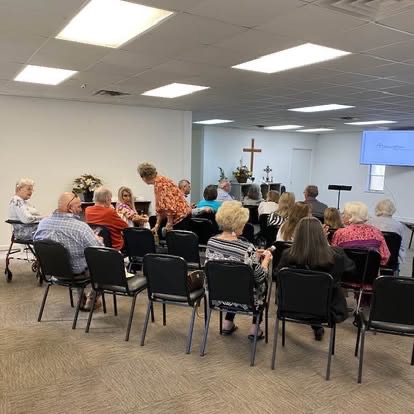
Our storefront church faces significant constraints due to limited physical space. Unlike traditional church buildings, which are purpose-built to accommodate a large congregation, classrooms, offices, and multipurpose spaces, our space (though originally a church) was fitted for commercial use.

Our space lacks the architectural features needed for worship, such as high ceilings, sanctuaries, and designated areas for fellowship. We’re going to struggle to figure out how to hold events in our space, or to expand to Sunday school or small group ministry. And, potluck…well, we’ll just have to see about that.

Additionally, our storefront has a relatively small seating capacity. Yes, there is a wall we can take out, but even then, limited space can lead to overcrowding, discomfort, and an inability to host special events, such as weddings, funerals, or community outreach programs.

One other thing to note, the lack of auxiliary spaces like nurseries, kitchens, and meeting rooms may hinder the church’s ability to offer vital services, such as childcare, Bible studies, and community meals.

Perception and Identity

The perception of a church operating in a storefront can also pose challenges. Traditional church buildings convey a sense of permanence, sanctity, and history, which can attract members and foster community respect.

In contrast, a storefront church can struggle to establish the same sense of legitimacy and stability. Passersby may view it as a temporary or informal operation rather than a dedicated place of worship.

This perception issue can extend to potential members, who might associate the storefront location with financial instability or a lack of resources. For some, the absence of traditional symbols such as steeples, stained glass windows, and pews may detract from the spiritual atmosphere they expect in a church setting. Over time, these perceptions can impact the church’s ability to grow and sustain itself.

Acoustics and Ambiance

Storefronts are not designed with worship services in mind, and this often leads to challenges with acoustics and ambiance. Traditional church buildings are constructed to enhance sound quality, ensuring that sermons, music, and prayers resonate effectively within the space. Storefronts, on the other hand, often have flat ceilings, hard floors, and minimal soundproofing, which can result in poor acoustics and echoing.

Luckily, the acoustics are not very bad in our storefront. I preach without a microphone every Sunday (not a hard thing to do when our average attendance is 30, but if we grow, I’ll probably have to rethink it). More people absorb more sound. Without a microphone, I might become muffled. Heck, they might think I’m muffled now, but they haven’t said so if that’s the case.

The lack of ambiance in a storefront can also hinder the spiritual experience. Traditional church buildings often feature architectural elements like vaulted ceilings, intricate woodwork, and natural lighting, all of which contribute to a sense of reverence and awe. I’ll confess that our team has done a fantastic job of creating a worshipful ambiance in our space, but many storefronts can feel sterile or utilitarian, which can make it difficult for congregants to feel spiritually connected or inspired.

Zoning Issues

Operating a church in a storefront can also lead to zoning and legal challenges. Many municipalities have specific zoning regulations that restrict or limit the use of commercial spaces for religious purposes. I haven’t found that to be the case with Bossier Parish, but if you’re thinking about a storefront church in another community, it’s best to check zoning early in the planning process.

Churches may be required to apply for special permits or variances, which can be time-consuming and costly. Additionally, these regulations often limit the types of activities that can take place within the space, further constraining the church’s ability to serve its congregation and community.

Parking is another common issue associated with storefront churches, and it certainly it with ours. We’ve got four spaces in front of the church and have to utilize a parking lot for a strip center next door. Spots fill up fast when we have a large (40 people) crowd for church. Any growth we experience will ultimately be impacted by limited parking.

Financial Limitations

Storefront churches are a cost-effective alternative to traditional buildings, as I mentioned in my previous blog. That notwithstanding, they can also present significant financial challenges in the long term.

Leasing or purchasing a storefront space is initially more affordable, but the costs associated with retrofitting the space for worship can be substantial. Churches may need to invest in sound systems, seating, lighting, and signage to make the space functional and welcoming.

Additionally, rent will go up at some point, which can strain the church’s budget. Unless your landlord is a member of the congregation and has mercy on it, rent will increase. If rents become unaffordable or the property owner decides not to renew the lease, the congregation may be forced to relocate, disrupting their operations and sense of community.

Deep Roots

Traditional church buildings often serve as landmarks and gathering places, hosting events, providing shelter, and offering a range of social services. Storefronts, by contrast, may not have the space or facilities needed to support such activities. This can restrict the church’s ability to act as a hub for community life and outreach.

Moreover, the transient nature of storefront operations can make it difficult for a church to establish deep roots in the community. If the congregation frequently moves or struggles to maintain a visible presence, it may struggle to build trust and foster long-term relationships with local residents and organizations.

Conclusion

This much I know: For every advantage a storefront may offer a congregation, there is an equal disadvantage. The task of the pastor and the congregation is to weigh the advantages and disadvantages appropriately, pray and then follow the leading of the Holy Spirit.

I’m uncertain how the storefront will impact our congregation yet. We haven’t been in the space long enough to know. I know God has put us here for now, so we’ll seek to be faithful to the call we hear going forward.

But still, if you’re in the Bossier Parish, Caddo Parish or Webster Parish area, please come join us. Perhaps you’ll help us figure it out.

Until next time, keep looking up…