Must Be Something in the Water…

Well, dang! It’s happened again…and in the Dallas, Texas area, too. What has happened again? Another prominent pastor has fallen from grace.

Pastor Steve Lawson, pastor (well, former pastor now) of Trinity Bible Church in Dallas, Texas was removed from his ministry by the elders of the church last week because of an “inappropriate relationship” with a woman who was not his wife. (Read more about the story here).

I’m not here to dump on Pastor Lawson. He’s got enough people doing that. I do want to say, though, there must be something in the water in the Dallas area that is affecting pastors. Only this past June, two very high profile pastors resigned or were removed from ministry in the Dallas area for the same issue facing Pastor Lawson. (I wrote about those two persons here).

I’ll say that Pastor Lawson (who is 73 years old!) is/was a passionate preacher. I’ve listened to a number of his sermons through the years, and have read a couple of his books (he’s written over 30). When he preached, he always preached with certainty and authority (that’s my kind of preaching). He may not have always been right, but he was never in doubt. He was, by all accounts, a holy man used mightily by God for His glory.

A Christian Reaction to Non-Christian Behavior

As one might expect, the ordeal has the Christian community scratching its collective head wondering what is going on with all these “holy” people. Are they living sham lives, false lives, hypocritical lives?

The non-Christian community is not asking the questions, they’re simply saying that all Christianity is a sham and that all Christians are hypocrites (they might be correct on the hypocrite part). Lawson just happens to be the latest example to their point.

As I have reflected over the past week on Lawson’s situation, I’ve found myself asking the same questions. The easier path would be to dismiss these fallen pastors as charlatans and move on, but in so doing we might overlook some truth and miss what God is doing in the midst of it all. So, where is the truth?

First, we need to clarify that we are ALL sinners saved by the amazing grace of God in Jesus Christ. Both preacher and parishioner are subject to sin because as the Apostle Peter reminds us “Your enemy the devil prowls around like a roaring lion looking for someone to devour” (1 Peter 5:8 NIV). The devil can devour the preacher as easily as the parishioner.

Second, these pastors were removed or stepped away from vocational ministry. Appropriately so, I might add. The sins to which they’ve either admitted or accused are of the disqualifying sort–at least until repentance is made and restoration practiced (that’s a whole other discussion).

Clergy should be held to a higher standard, but even acknowledging that fact, I am reminded of the words of Oswald Chambers: “The call of God has nothing to do with salvation and sanctification; it isn’t because you are saved and sanctified that you’ve been called to preach.” We are called to preach because God chose us to do so, and in so doing, placed a “divine compulsion” (the Apostle Paul’s words) within us.

Third, God uses both the holy and the unholy to minister to His people. This is where it gets sticky, but this is the point I want to make as I reflect on these events.

The Holy and The Unholy

I am reminded of Paul’s words to Timothy:

20 In a large house there are articles not only of gold and silver, but also of wood and clay; some are for special purposes and some for common use. 21 Those who cleanse themselves from the latter will be instruments for special purposes, made holy, useful to the Master and prepared to do any good work. (2 Timothy 2: 20 – 21 NIV)

Paul writes to Timothy to encourage him to rightly handle the Word of God. He even goes so far as to name two who have departed from the truth and brought confusion to the body of Christ. Yet, in his encouragement he admits that God’s house contains both holy and unholy vessels. Here’s the truth: God uses both!

Are the holy vessels more useful? Yes, obviously, but just because the holy vessels are MORE useful, doesn’t mean the Master does not utilize the unholy ones.

Please don’t hear me making excuses for these pastors and their failures. Their failures are their own and they must own them and deal with the consequences. What I am saying is don’t discount the good God has done through the ministry He entrusted to them–in spite of their failures. Stated another way: Don’t let the good God has done be negated by their unholy actions.

Nothing justifies their actions, but their actions don’t mean God wasn’t using them. So, why would God use unholy vessels? I can think of three reasons.

God and Unholy Vessels

The first reason is that God loves His people. He’s not using the person for the sake of the person. If He were, the person might begin to think that God owes him/her something because they’re “holy.” Or, the person might begin to think that God is okay with what he/she is doing…if it were all about the person. No, God is using the unholy for the sake of His people, and if another person’s life is touched in the course of that ministry, God has demonstrated His love for His people using an unholy vessel.

The second reason might be that God is storing up judgement/discipline for that “holy/unholy” person. Maybe God is giving that person the rope he/she is asking for, and surely, if you give a person enough rope he/she will hang themselves. Perhaps it is all about judgment/discipline towards His house. Is that not God using the unholy for His purpose?

The third reason is so that He can demonstrate the riches of His grace. God’s is an amazing and extravagant grace, and He gives it in ways we don’t always understand, nor do we always like (ask the older brother in the Story of the Prodigal Son).

If God used only holy people, it wouldn’t be long before all the holy people would be pointing to themselves thinking everything was happening because they are so holy. No, everything is happening because God is so gracious. It is always and forever about what God is doing, never ever about what we are doing.

So, I suppose we should let this be a warning to all of us (especially those of us in ministry). So, I heed the warning by seeking to live a holy life, by confronting the sin that is within me, and by crucifying the passions and lusts of the flesh on a daily basis…well, because holiness is such a daily endeavor. And I do it not for ministry success, but because I’m a disciple of Jesus Christ.

Yes, God uses holy vessels in a greater way than unholy ones, but God can, and sometimes does, use people who are undeserving. And, He does it whether I like it or not.

Until next time, keep looking up…

A Little R & R…

Broken Bow Getaway

I write this morning from beautiful Broken Bow, Oklahoma. Vanessa and I took a few days (very few) for some rest and recreation. It is our first journey to Broken Bow. It has been a very nice and relaxing time away, and it was much needed.

We really wanted to go to the beach…the beach (any beach) is our go-to spot for reconnecting with each other and to get away from it all, but unfortunately, there aren’t any beaches close enough to make it feasible for a three-day trip (three days is all we have). Broken Bow is only three hours or so from the house, so that left more time for doing nothing than spending a day driving to the beach…so, here we are.

It’s been enjoyable. It’s been relaxing. Both what we needed. We’ve eaten too much trying local restaurants (Grateful Head Pizza, Mountain Fork Brewery, Beaver’s Bend Restaurant, Buffalo Grill). We’ve napped both days. We’ve seen new sights. We’ve taken a boat ride on pristine Broken Bow Lake. We’ve soaked in a hot tub. We took a ride through Beavers Bend State Park. Dipped our toes in the river. Watched fishermen fishing for trout in the stream. I even slept in one morning of our trip.

We’ve scoped out a lot of territory for a return trip with the grandchildren. They’d probably enjoy it more than we have. There’s ATV riding and hiking and swimming and paddle boarding and fishing…all great outdoor activities. I could see us renting a pontoon boat for a day on Broken Bow Lake tubing and fishing and cooking. I’d love to get a guide and take the grandsons fly fishing. Vanessa says she and the granddaughter want to learn to fly fish, too. Maybe my son could bring a couple of his Cushman carts and we could do some ATV riding along the trails in the Ouachita National Forest. So much to do. So little time.

We needed some time away. The only “time away” Vanessa and I have had in 2024 was to the EMC Journey session in Copperas Cove, TX in May. That was a refreshing time away, for sure, but it was a “working” conference, so does it really count as vacation? No, I don’t think so.

That’s the way it is when you own your own business. What’s the old saying? “The eye of the master fattens the calf.” No one watches your business like you do. I now know why Bill Malone spent so much time at Malone’s Grocery and Hardware in Chatham, LA.

A New Journey

We also needed some time away because next Sunday, September 29th, Vanessa and I begin a new journey as pastor at Haughton Methodist Church. Their’s has been a challenging journey out of The United Methodist Church. They have been without a pastor for some time now and after much prayer and consideration, we feel called to serve them in this capacity.

The congregation has been meeting for a little over a year in the Holiday Inn in Bossier City (part of their challenging journey), but will soon be moving into their new home at 966 Highway 80 in Haughton, LA on October 6th. I look forward to being a part of this transition, and I’m excited about all the possibilities that exist to grow the Kingdom of God in the Haughton area.

Hey? If you’re in the area, we meet for coffee and fellowship at 10 a.m., with worship following at 10:30 a.m. Plan on joining us September 29th at the Holiday Inn on Highway 80 in Bossier City and on October 6th at our new home. We’d love to see you!

I’ll be serving as a bi-vocational pastor for as long as they’ll have me. I’ll be selling oil during the week and pastoring on the weekend. We’ll see how that works out. We gave it a try at Lakeview Methodist Church for a few months, but the day job made it difficult to commit to the congregation the time it needed to grow the congregation. My prayer is the same thing won’t happen this time with the Haughton congregation.

Right now, we’re at a staffing level with the business that I absolutely don’t have to be there ALL the time. Join me in prayer that it stays that way and that I can eventually be more than just a Sunday preacher in Haughton.

Anyhow…it’s time to get up, start packing up and make the drive back home and to the real world. Monday is coming and there is oil to sell, cars to service and the Gospel to preach. Next week, by God’s grace, I’ll be doing all three–rested and ready to do so!

Until next time, keep looking up…

Not Nearly Enough…

A friend asked me a question this week. It was a simple question asked in sincerity, but it challenged me in a way I haven’t been challenged since I left full-time ministry.

What was the question? “How common in your career did you see pastors and leaders teaching entire sanctification?”

I had to think real hard the last time I heard a sermon on entire sanctification. Honestly, I couldn’t remember one. Honestly, I had to check my sermon file to see if I had ever preached one. Luckily, I found ONE sermon in my file. Entire sanctification is obviously something that was never high on my list of priorities to preach and teach.

Well, if it was impossible for me to remember if I had preached a sermon on entire sanctification, it was impossible to remember hearing one. I could only answer my friend with, “In The United Methodist Church, rarely!”

Perhaps that is what is wrong with The United Methodist Church (or any other Wesleyan denomination). The doctrine of entire sanctification lies at the heart of Wesleyan theology, and yet we (meaning me) rarely heard it preached (or preached it) from a Wesleyan pulpit.

Sure, we mentioned it (or heard it mentioned) in passing, but we never dug deeply into it or spent too much time on it. Let’s face it. When we pastors and laity went to Annual Conference, we didn’t get deep dives into Wesleyan theology. We got motivational speeches and rah-rah talks about best practices in ministry that we could take back to our congregations.

Same thing when we attended leadership conferences. Seriously, how many preachers (and laity) would ever sign up for a conference entitled “Sanctification Summit?” Nah! Not many. Instead, we’d rather flock to conferences with names like “Refuel,” or “The Global Leadership Summit,” or “Disciple Making Summit,” or the “Orange Conference” (what do oranges have to do with ministry?). After all, we want to grow our churches. I mean, isn’t that the point?

Entire Sanctification

Unless you’re a pastor in the Wesleyan tradition, you’re probably asking yourself, “What does he mean by entire sanctification?” I’m glad you asked.

Rev. John Wesley

Sanctification is a $3 theological word that means “holiness.” Well, if we don’t like the word sanctification, we probably like the word holiness even less. Me? Holy? Never! Yet, holiness is at the heart of John Wesley‘s theology, and we Wesleyans ought to be teaching it! Maybe that’s the key to our church growth? Maybe holiness is what will make the church stand out from the culture?

For most folks, holiness is reserved for monks, missionaries, mystics and martyrs, not everyday Mark and Mary. Nothing could be further from the truth. It was Chuck Colson who said, “Holiness is the everyday business of every Christian. It evidences itself in the decisions we make and things we do, hour by hour, day by day.”

Colson is correct, and his statement echoes the words of the Apostle Paul written to the Church at Thessolinica two thousand years ago. God’s will for our lives is holiness. Paul says so right there in chapter 4, verse 3: God wants you to be holy, so you should keep clear of all sexual sin. The NIV translates it this way: It is God’s will that you should be sanctified: that you should avoid sexual immorality. The KJV says it this way: For this is the will of God, even your sanctification.

Avoiding Holiness

One reason we shy away from holiness as a way of life is because of the “holier-than-thou” crowd. Actually, “holier-than-thou” is not really holiness at all. In Jesus’ day, the “holier-than-thou” crowd turned out to be the Pharisees—arrogant, prideful and self-righteous. Certainly not the traits Jesus would applaud and want his disciples to emulate. Rather, it was the Pharisees for whom Jesus reserved his most scathing condemnations.     

Another reason we might shy away from the word holiness is the word’s close association with the “holiness” movements of the late-19th century, and the Pentecostal and charismatic movements of the mid-to-late 20th century (which actually had their genesis in the Wesleyan tradition).

The extremes of those movements gave too many people in the church permission to separate themselves from holiness. Use whatever excuse we may to lay claim to our own unholiness, it doesn’t change the fact that God’s will for our lives is for us to be holy.

Perhaps a third reason we shy away from the teaching of holiness (entire sanctification) is because we confuse it with “perfection.” We think we have to be perfect, and after all, no one is perfect (boy! don’t I know that to be true?). How can I teach what I am not? How can I be what is impossible to be? Well, let’s go back to Wesley…

The Heart of John Wesley’s Theology

John Wesley helps us understand better in his A Plain Account of Christian Perfection. Holiness is not sinless perfection. Unconscious sin will always remain. No matter what level of holiness we attain, there will always be more room to grow. This fact helps us live in humility. It’s like Jesus would tell the Pharisees, “Take the log out of your own eye before you complain about the speck in your neighbor’s.” Knowing we have further room to grow keeps us from the holier-than-thou attitude.

Wesley would further say that holiness (or perfection) does not mean freedom from errors or mistakes. We’ll always have inaccurate perceptions, deal with deceptive apperances, have clouded memories and distorted opinions based on faulty information. It does not mean the sin nature has been eradicated. The seed of the sin nature still exists, and abiding outside of God’s grace leads to the sin nature conquering us.

And, Lord help us, holiness is not about freedom from temptations. As a matter of fact, Satan’s attacks will likely increase because he thinks he’s losing control.     

Well, if holiness is not that, what is it? For Wesley, as for the Apostle Paul, it is a heart full of love—love for God and love for neighbor. According to Paul, if we love God and love our neighbor, it changes our conduct. As our love for others increases, God establishes our hearts blameless in holiness. Our holiness is reflected in the way we treat others.

Waiting for Sanctification

Wesley, in his sermon The Scripture Way of Salvation would say it thusly:

“It is thus that we wait for entire sanctification; for a full salvation from all our sins, –from pride, self-will, anger, unbelief; or, as the Apostle expresses it, ‘”‘go unto perfection.'”‘ But what is perfection The word has various senses: here it means perfect love. It is love excluding sin; love filling the heart, taking up the whole capacity of the soul. It is love ‘”‘rejoicing evermore, praying without ceasing, in everything giving thanks’.”

“…we wait for entire sanctification…”

We wait. Sanctification is not an overnight thing. Sanctification is growing in grace. Sanctification is a moment-by-moment, day-by-day decision on our part. Yes, it is done through the power of the Holy Spirit, by the surrender of our will to His, but surrender is done daily by our choice–that’s called “free will.”

Attaining and Maintaining

Don’t think you can attain holiness (entire sanctification)? Oh, I think you underestimate the power of grace. Also, how uncouth would it be for the Lord to ask something of us that He knew we couldn’t achieve?

John Wesley said it this way: “Christ died to deliver sinners from not only the guilt but also the power of sin.” Our salvation (which is God’s will for our lives) would be an incomplete salvation unless it delivered us from sin’s power as well as sin’s penalty. God never intended the cross to address only the “judicial” matters of our sin. God equally intended the cross to reshape those who believe toward the holiness to which He calls us.

Salvation is the simplest thing to attain, but it is the hardest thing to maintain. It is in the maintaining that we reach what Wesley termed “entire sanctification, for a full salvation from our sins…” Salvation is attained through the simple act of believing. Salvation is maintained through the difficult act of obedience. Believing and obeying both demand surrender.

Full salvation is a long time coming, but salvation is attained and maintained as a child. As a child trusts to attain and as a child obeys to maintain, but maintaining is so much harder than attaining.

So, how often have we taught entire sanctification? Not nearly often enough. How often should we teach entire sanctification? Well, if we’re truly Wesleyan, a whole lot more often than we have.

Well, that just what I think, but I’m not the perfect pastor, which is probably why I haven’t preached and taught full salvation more often. Maybe by His grace, I’ll do better.

Until next time, keep looking up…

Grace and the Government…

I just can’t seem to get politics off my mind (I can’t imagine why!). Perhaps writing about it will help to clear the many cobwebs that appear to be clouding my judgement these days. If I were exercising good judgment, I’d stay as far away from politics as I can, but I’m not exercising good judgment, so…

I am thinking primarily of the Apostle Paul’s instructions to the Roman Church in Romans 13. It gives me no small amount of heartburn to read his words, especially as I contemplate the future of this nation called the United States of America. Our choices for leadership aren’t stellar, but choose we must. Here is Paul’s counsel to the early church:

Let everyone be subject to the governing authorities, for there is no authority except that which God has established. The authorities that exist have been established by God.Consequently, whoever rebels against the authority is rebelling against what God has instituted,and those who do so will bring judgment on themselves. For rulers hold no terror for those who do right, but for those who do wrong. Do you want to be free from fear of the one in authority? Then do what is right and you will be commended. For the one in authority is God’s servant for your good. But if you do wrong, be afraid, for rulers do not bear the sword for no reason. They are God’s servants, agents of wrath to bring punishment on the wrongdoer. Therefore, it is necessary to submit to the authorities, not only because of possible punishment but also as a matter of conscience.

This is also why you pay taxes, for the authorities are God’s servants, who give their full time to governing. Give to everyone what you owe them: If you owe taxes, pay taxes; if revenue, then revenue; if respect, then respect; if honor, then honor.

Romans 13: 1 – 7 (NIV)

I read Paul’s words and I think, “Yeah, right! I’m not submitting to that!” There is so much our government does that I don’t agree with…that seems down-right un-Christian. Why would I submit to that?

Pres. Ronald Reagan

I’m also reminded of President Ronald Reagan (the first President I had the pleasure of voting for, by the way–I also want to see the new movie). President Reagan once quipped, “I think you all know that I’ve always felt the nine most terrifying words in the English language are ‘I’m from the government and I’m here to help’.” His cynicism reflects my own.

The Roman Example

How can I read Paul’s words in light of my cynicism? First, I have to take off my American glasses. I think about government and my mind focuses (quite naturally) upon our federal government, our state government, or our local community governmental structures. The Apostle Paul didn’t have any of these in mind when he penned his counsel to the Roman church. Paul was living in a vastly different culture than our own, yet even then he could council disciples that the government was there to help.

Paul was living in a world dominated by the Roman Empire, and his council was somewhat shocking to the Christians living in Rome. The Roman Empire was one of the most evil and cruel empires to ever rule a larger part of the world.

The emperor at that time was Nero. He took pleasure in killing Christians. In fact, historians say that he burned many Christians as torches to light up his garden parties. Yet, in spite of its cruelty, immorality, and persecution of Christians, Paul said to submit to the government in Rome.

His instruction to submit is front and center in this passage. In his instruction to submit, Paul gives us insight into God’s vision and role of government, and his words still speak to those of us who seek to be faithful disciples of Jesus Christ.

God and the Government

Paul can’t help but remind the Roman Christians that God is the one who establishes governments. Three times Paul states that God has established all government authority. A quick reflection of biblical history confirms the fact.

When God wanted to take his people out of Egypt he broke the will of Pharaoh with ten plagues. In God’s dealings with his people he used the governments of the world to bring blessing or punishment as needed. God used the Assyrians to destroy Israel. God used Nebuchadnezzar to take his people into captivity in Babylon as punishment for their disobedience. There they repented and returned to the Lord. Then God brought in Cyrus, king of the Medes and Persians, to set his people free and place them back in the Promised Land. The Old Testament indicates that the Lord blessed all people through Cyrus.

In the New Testament, God continues pulling the strings of kings and governments. God’s timing is always right! Luke’s gospel (Luke 2) tells us “At that time the Roman emperor Augustus…” God’s Son was to enter the world just as the emperor issued a decree that a census should be taken of the entire Roman world. It was a time when the world had the best roads, an efficient postal service, safe travel, and some semblance of law and order. Paul’s appeal was based on the ultimate idea of the sovereign nature of God, and if we believe nothing else, don’t we believe ultimately, God is in control?

But, I ask myself, what about the evil governments? Is God responsible for the power of the communists who tried to stamp out the gospel? What about Adolf Hitler? Or, how about those immoral, corrupt, and crooked politicians that are found in our own government? Is God responsible for their power?

The Power of Sin

Here I see the power of sin at work in God’s creation. The fact that any leader, as sinful humans, take authority and abuse it is not God’s fault. The problem (it seems to me) with a theocracy is not with God, but with those who represent God when they begin to think they ARE God. This holds, too, for our own government. We must be careful that those in our own government don’t assume that they have taken God’s place.

Government is not God. Government is a tool given that God uses for His purposes. When Jesus was on trial before Pontius Pilate he corrected Pilate’s false understanding of government authority. Remember that Pilate said, “Don’t you realize I have power either to free you or to crucify you?

Jesus responded, “You would have no power over me if it were not given to you from above” (John 19:11).

Sin is a powerful thing, and the same sin that touches the depth of our hearts can touch the depth of even the best human government. One of the biggest hurdles for us to cross in order to have the attitude that Paul described in these verses from Romans chapter 13 is to see the governing authorities as being established by God. When the Holy Spirit works that conviction in us, then we will want to submit to the governing authorities. A glance at history, and a look at God’s Word, will convince us that God establishes all authority.

I think Benjamin Franklin would agree. Franklin said, “I’ve lived, sir, a long time, and the longer I live, the more convincing proofs I see of this truth—that God governs in the affairs of men. If a sparrow cannot fall to the ground without His notice, is it probable that an empire can rise without His aid? We have been assured, sir, in the sacred writings, that ‘except the Lord build the house they labor in vain who build it.’ I firmly believe this, and I also believe that without His concurring aid, we shall succeed in this political building no better than the builders of Babel.”

The Purpose of Government

God’s establishing government is not without purpose, and Paul discloses at least two tasks of government. First, he indicates that government’s responsibility is to order society. Think about what the government does for us. We have state and federal highways. It is the government that provides libraries, schools, and universities.

Those in authority provide law and order through police departments and the justice system. We have fire protection. We have freedom to worship and practice our religion. The government ensures free trade and fair business practices. Those in authority maintain an army to protect our borders from invasion.

William Barclay says it this way: “To the state ordinary people owe a wide range of services which individually they could not enjoy. It would be impossible for every man to have his own water, light, sewage, transport system. These things are obtainable only when men agree to live together. And it would be quite wrong for a man to enjoy everything the state provides and to refuse all responsibility to it. That is one compelling reason why the Christian is bound in honour to be a good citizen and to take his part in all the duties of citizenship.”

Government (or should I say good government?) is nothing more than a body of people who have covenanted together to maintain certain relationships between each other by the observance of certain laws. Without these laws and the mutual agreement to observe them, evil and selfishness would win the day. Each of us owe our security to the government, and are therefore under a responsibility to it. 

As Paul notes, part of that ordering of society is the idea of the government’s responsibility to execute justice. Justice is a delicate issue. It always raises the question of whose justice are we talking about.

Justice is often about perspective, I suppose. The government was greatly used, I believe, by God through the 1960’s and the civil rights movement. There were many injustices that were corrected through government action. Thanks be to God!

And, the 1860’s, too. Again, in the U.S., and prior in England, government was a tool of God used to abolish the institution of slavery. In all those instances, there were those who debated, argued and fought and even died for justice sake. As we reflect back on those times in history, dare any of us say that justice did not prevail? The church’s voice was integral in all of those struggles. No matter the political climate, we must never let the voice of the church be silenced in the fight for justice.

The struggle for justice continues even today, as well it ought. Survey the twenty-four hour news cycle and we can hear the cries of those who plead for justice. The church must hear their cries, and must be ready to respond in the name of justice.

I remind us all, though, that what the people of God seek is righteousness…that is how justice is defined. Just because something can be justified does not make it right. God seeks righteousness, from his people and in his creation. Justice and justification are not necessarily the same thing. 

Some have suggested that Paul was writing these words concerning justice and aiming them at the Jewish people. You might recall the Jewish people were quite the rebellious bunch in the first century near east. Insurrections were not uncommon, especially in Galilee.

The Zealots give us an example (among which one of Jesus’ own disciples is numbered). The Zealots were convinced that there was no king for the Jews but God; and that no tribute must be paid to anyone except to God. They were not content with simple passive resistance. Their aim was to make any civil government impossible. They were known as the dagger-bearers. They were nationalists who employed terrorist methods that were not only directed towards the Roman government, but they also wrecked the houses and burned the crops and assassinated the families of their own fellow-Jews who paid tribute to the Roman government. Paul is saying, “No way! That’s not the action of a disciple.” It was Paul’s way of saying, “You reap what you sow.”

The Need for Grace

What is true for nations is also true for individuals. We think little of violating the speed limit until we are the one stopped for speeding. H. L. Menken said, “Injustice is relatively easy to bear; what stings is justice.”

It is here that I see the power of sin in my life. It is here that I see my need for grace. The source of all grace is our God, who ultimately showed us grace through His Son, Jesus Christ on the cross. Even there, it was the Roman government used as God’s instrument to get us to grace, as atrocious as it was, for, you see, grace is a messy thing. We try to sanitize it, in our lives, in our culture and even in our churches, but no matter, grace is messy (see the Parable of the Prodigal Son). But, the Good News is God’s got a handle on all of it.

So, what are we to do? Paul says submit. Our submission is not really to the government, though. Rather, our submission is to the sovereignty of God.

God has got this thing…at least that’s what I keep reminding myself. The election will come. Someone will win it. I’ll like it or I won’t. Either way, my prayer is that I will be found faithful, and I’ll look for grace…even in the government. Maybe you will, too.

Until next time, keep looking up…

Is Jesus Worth It?

I’m not the perfect pastor. I’m not the perfect pastor because I’m not a perfect person. Among the many foibles I possess is not know when to keep my mouth shut…well, let me clarify that. I know when I should keep my mouth shut. The foible is in actually keeping my mouth shut.

I should probably clarify that further. My tendency is to keep my mouth shut when I should speak up and to open my mouth when I shouldn’t speak up. I’m uncertain as to which I’m doing this morning, but here goes anyway…well, because I’m not the perfect pastor.

Faith and Politics…again!

Those who know me know (and I’ve confessed) that I am a bit of a political junkie. Naturally, the election season has my interest peaked. Because I’ve also been a pastor (and probably will be again someday), I’m always looking at the intersection of faith and politics. It always raises the question, “How does our faith inform our politics?”

Some people might proffer the question, “Should our faith inform our politics?” I say if our faith doesn’t inform our politics, it’s probably not much of a faith.

So, how is faith informing politics this election cycle? Well, I’m glad you asked!

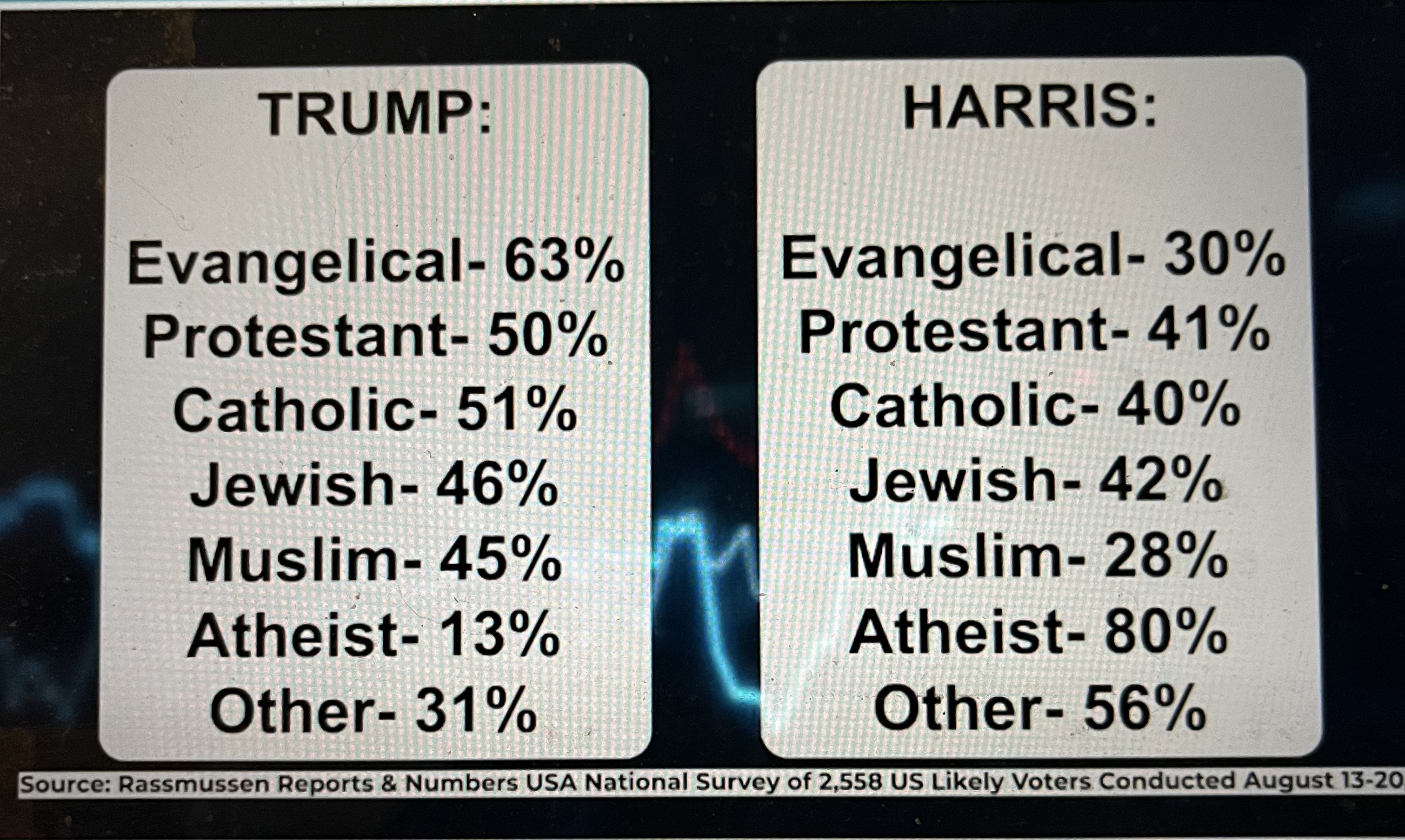
I came across this interesting survey from Rasmussen Reports last week. Rasmussen is an independent polling organization that polls daily through each election cycle. It is independent in the sense that it is neither left nor right leaning, and it does its best to “weight” its polls so that their polls aren’t skewed one way or the other. It is also independent in that they neither depend upon outside money, nor do they receive outside money to conduct polling. Seems to me that is how it should be.

Here’s what their polling found, and what I find interesting in the intersection of faith and politics: people of faith (all faith backgrounds) are generally voting for Donald Trump. Here’s the breakdown Rasmussen reported:

This poll is getting little attention in the media. The only reason I found it is because I was looking for it. Though it is getting little attention, I find it quite revealing in showing there really is a clash of cultures in this election and that clash is between the religious and the non-religious.

Every major faith group (except “other”) is voting in the majority for Donald Trump, and the only group even close to the margin of error is the Jewish faith. “Other” would include Hindu, Buddhist, et. al., and I only assume they were lumped together because the sample size of each was too small to be reliable.

While people of “other” faith backgrounds support Harris, the overwhelming majority of atheists support her. I’m sorry, but that just gives me pause as one who identifies as an evangelical believer in Jesus Christ.

It’s not that I believe Kamala Harris to be a non-religious person. According to Biography.com, she grew up in a black baptist church, has attended Hindu temples (as a result of her Indian heritage) and married a Jewish man. Now, that’s what I call an intersection of faith and politics!

Atheism in the Public Square

When I consider that the “atheists” could be the deciding factor in the most consequential election of our lifetime, I am concerned about the direction of our nation. Every national poll shows this election to be a toss-up (see here and here for two of the most recent). The atheist vote could very well make the difference.

Why do so many atheists support the Democratic Party? From what I’ve been able to discern, it comes down to two things: abortion rights and Christian nationalism. I’d post a few links here on abortion rights and Christian nationalism but you can do a simple Google search and find all the links you need. You’ll be reading for days.

Let me just get this out of the way: I am staunchly pro-life, and that is pro-life in the sense that life begins at conception and that every avenue must be pursued to protect that life. I am also a pragmatist (and not a Christian nationalist) and I believe that the Supreme Court of the United States got it right when they returned the abortion debate to the individual states. That is just one place where my faith informs my politics, and yes, I know it sets up its own clash of cultures. But, I’m just an old white guy, so what do I know?

A “Christian” Nation?

No, I’m not a Christian nationalist (as the term is most commonly defined–it’s a relatively new term, by the way). I do not believe that the United States must be a “Christian” nation, but I do believe that the United States of America was formed (and its underlying foundational documents designed) by people who were Christian, or whose philosophical/ideological perspective were rooted in the Judeo-Christian worldview.

The values and morals that shaped this nation are the values and morals that have their foundation in Scripture. The further we move away from those values as a nation, the more endangered the American experiment becomes…and the more godless the culture becomes. We are far down that road now. I’m wondering if there is a U-turn in our future? I’m wondering if this election cycle will tell us?

Not that Donald Trump is a bastion of Christian morality. His moral failures have been documented copiously, and you can do your own Google search on that, too. Honestly, I believe we are left with the two choices we have for President of the United States BECAUSE we have become unmoored from the Judeo-Christian values upon which this nation was founded.

I also believe the election of Donald Trump won’t provide the U-turn the nation needs to preserve our nation. It might slow it down a little, but it won’t turn it around. The U-turn that matters will happen in the Church through the power of the Holy Spirit. It will take a spiritual revival on the level of the first and second Great Awakenings. It will take prayer and preparation that can only begin in the faith communities of our nation.

The Ripkens

I won’t say who I’ll be voting for in this election. I’ll only say I won’t be voting with the atheists. You can if you want, but don’t come crying to me when we become a completely godless nation. Of course, becoming a completely godless nation might not be such a bad thing. Ask Nik and Ruth Ripken, they can tell you.

The Ripkens were missionaries to Malawi and Somalia, and it was while they were in Somalia that they lost one of their three sons. Their loss forced the Ripken’s to reconsider their calling, and after some reflective time, they were assured they were called to be missionaries, although the focus of their ministry shifted.

They felt called to go into the regions of the world where Christians were persecuted greatest to discover ways they could be in ministry to them. Nik Ripken began by traveling to Russia, China and Central Asia to interview members of the persecuted church.

What he discovered was not that we needed to do anything to help the persecuted church, but that it was his faith that was resurrected by the faithful witness of those Christians. They heard stories of pastors imprisoned and emaciated, yet still clung to their hope in Christ. They heard stories of fathers separated from their families because they smuggled bibles in for others to discover Christ.

In China, he was able to meet with about 150 house church pastors to hear their stories. He said no one really knew what they would find in China. In 1948, when communism came to China, the church was outlawed. At the time, there were between 400,000 and 700,000 Christians.

No one really knew if the church had survived after all these years. Yet, today there are over 10 million Christians in a nation that is openly hostile to their faith. The church flourished in conditions it should not have. The 150 pastors, after telling their stories to Ripken began to ask, “Has Christ made it to the rest of the world?”

What the Ripken’s discovered was that where the church was persecuted the greatest was the very place where faith has thrived the greatest. History has taught the same lesson. The burning question Ripken had for all he interviewed was, “Is Christ worth it?” Is Christ worth the suffering, the imprisonment, the loss of family and even death? As one interviewee said, “Oh, Christ is worth it!”

The lesson for me as I live in this culture that is shifting around me is to ask myself, “Is Jesus worth it?” When all cultural accommodation for the Christian faith ends, will Jesus be worth it? Will Jesus be worth my family? Will Jesus be worth my job? Will Jesus be worth my life?

I pray that I can say, “Oh, Christ is worth it!” My fear is I won’t have the courage.

Until next time, keep looking up…